
H View
  • Home
  • About
  • Blogs
  • Categories
    • AI
    • Tech
    • Lifestyle
    • Business
      • Money
    • Sports
  • Reviews
  • Contact
Connect With Us
H View
  • Home
  • About
  • Blogs
  • Categories
    • AI
    • Tech
    • Lifestyle
    • Business
      • Money
    • Sports
  • Reviews
  • Contact
Connect
Health

The Symphony of Energy: The Human Story Behind the Vitamin B Complex

☆☆☆☆☆No reader ratings yet
By RajeshUpdated July 16, 20264 min read18 views

We often go through life searching for a sudden spark to pull us out of exhaustion. We reach for double-shot espressos, energy drinks, and quick sugar fixes, treating our lack of vitality like an empty fuel tank that just needs a cheap refill. But our bodies don’t run on brute force. True human energy is a beautiful, intricate symphony, and its master conductors are the family of B vitamins.

The Vitamin B Complex is not a single element, but a close-knit family of eight distinct, water-soluble nutrients. They are the quiet mechanics of our cellular world, constantly turning the food we eat into stable mental clarity, steady physical endurance, and emotional resilience. Because they are water-soluble, our bodies cannot store them for long—they ask us to return to the earth daily for a fresh supply. When they are missing, the music slows down, and our health begins to fray.

At H View, our “Vision Before Mission” philosophy challenges us to look past clinical charts. Understanding the B-complex family isn’t about memorizing scientific jargon; it is about recognizing the physical whispers of our bodies and realizing how deeply our daily wellness relies on whole, unrefined food.

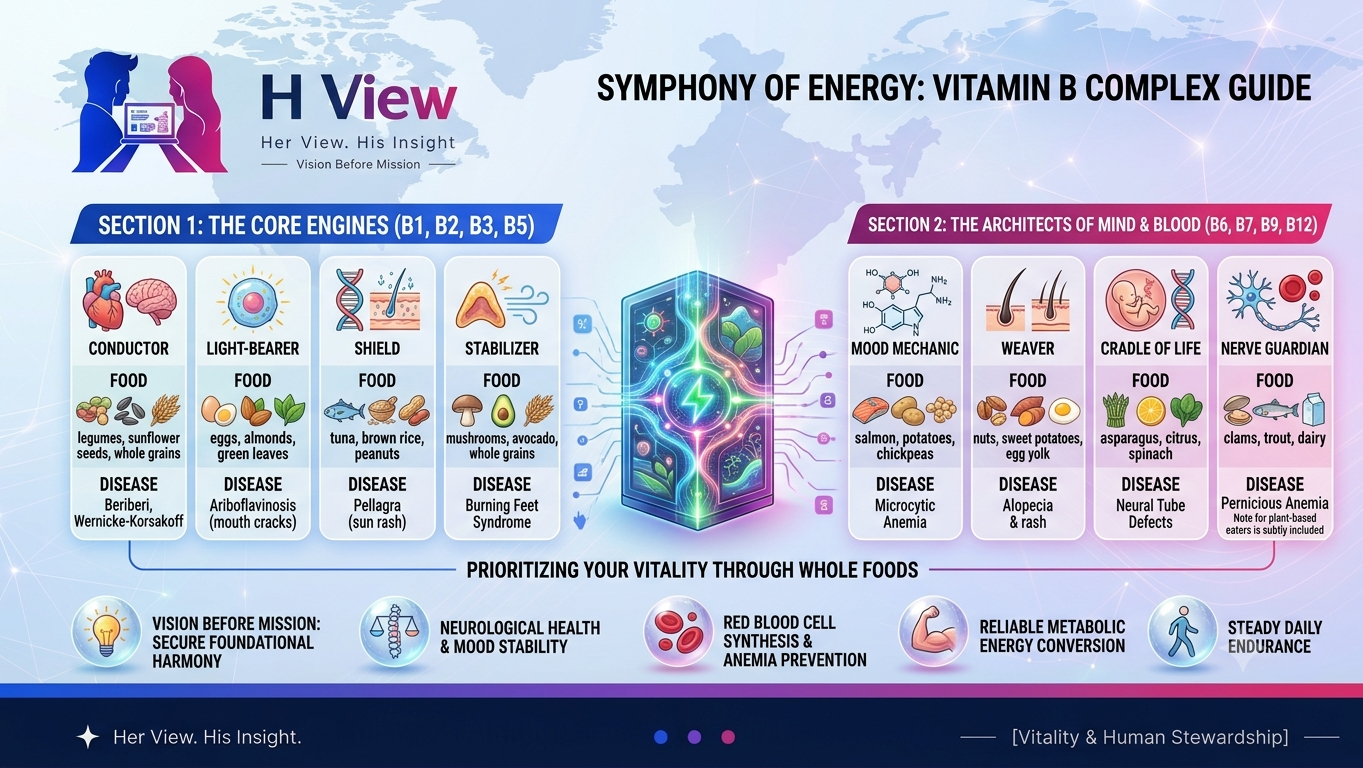
1. The Core Engines: B1, B2, B3, and B5

These four vitamins work at the very root of your metabolism, unlocking energy from your daily meals and protecting your structural baseline.

  • Vitamin B1 (Thiamine) – The Conductor: It helps transform carbohydrates into fuel for your brain and heart.
    • Deficiency & Disease: Without it, cells starve for energy. A severe shortage leads to Beriberi, characterized by profound muscle weakness, nerve damage, or heart failure. It can also cause Wernicke-Korsakoff syndrome, a severe neurological condition often linked to poor nutrient absorption.
    • Human Food Sources: Whole grains, pork, sunflower seeds, legumes, and enriched yeast.
  • Vitamin B2 (Riboflavin) – The Light-Bearer: Vital for cellular respiration and breaking down fats.
    • Deficiency & Disease: A lack of B2 causes Ariboflavinosis, which manifests as painful cracks at the corners of the mouth (cheilosis), a swollen, bright red tongue, and hypersensitivity to light.
    • Human Food Sources: Dairy products, eggs, lean meats, almonds, and green leafy vegetables.
  • Vitamin B3 (Niacin) – The Cellular Shield: Essential for DNA repair and maintaining healthy skin and nerves.
    • Deficiency & Disease: A prolonged shortage causes Pellagra, traditionally known by the “Four Ds”: Dermatitis (severe, sun-sensitive skin rash), Diarrhea, Dementia, and, if ignored, Death.
    • Human Food Sources: Chicken, beef, tuna, peanuts, and brown rice.
  • Vitamin B5 (Pantothenic Acid) – The Stabilizer: Found in almost all living cells, it manufactures stress hormones and neurotransmitters.
    • Deficiency & Disease: While rare, a deficiency causes a distinct, painful sensation known as “burning feet syndrome,” alongside extreme fatigue and irritability.
    • Human Food Sources: Avocados, mushrooms, whole grains, broccoli, and eggs.

2. The Architects of Mind and Blood: B6, B7, B9, and B12

These elements manage our internal equilibrium, from the chemical messengers that govern our moods to the creation of the very blood that gives us life.

  • Vitamin B6 (Pyridoxine) – The Mood Mechanic: Crucial for producing serotonin and dopamine, the molecules of joy and calm.
    • Deficiency & Disease: Shortages can trigger unexplained depression, confusion, weakened immunity, and microcytic anemia.
    • Human Food Sources: Chickpeas, bananas, salmon, potatoes, and poultry.
  • Vitamin B7 (Biotin) – The Weaver: Essential for the metabolism of fatty acids, famously supporting our outer layers.
    • Deficiency & Disease: Shortages lead to brittle hair, hair loss (alopecia), and a distinctive scaly red rash around the eyes, nose, and mouth.
    • Human Food Sources: Egg yolks, nuts, seeds, sweet potatoes, and liver.
  • Vitamin B9 (Folate) – The Cradle of Life: The master architect of DNA synthesis and new cell growth.
    • Deficiency & Disease: A lack of folate causes megaloblastic anemia. Crucially, a shortage during pregnancy can lead to devastating neural tube defects (like spina bifida) in developing infants.
    • Human Food Sources: Dark leafy greens (spinach, kale), asparagus, Brussels sprouts, and citrus fruits.
  • Vitamin B12 (Cobalamin) – The Nerve Guardian: Works hand-in-hand with B9 to form red blood cells and maintain the protective myelin sheath around our nerves.
    • Deficiency & Disease: Because it is primarily found in animal products, plant-based eaters must be mindful. A deficiency causes Pernicious Anemia and progressive, sometimes irreversible neurological damage, starting as a tingling numbness in the hands and feet.
    • Human Food Sources: Clams, beef, trout, eggs, dairy, and fortified nutritional yeast.

Conclusion: Gaining Clarity in a Fast-Paced World

When we suffer from brain fog, unexplained mood shifts, or chronic fatigue, our bodies aren’t failing us—they are communicating with us. Sourcing your B-complex vitamins from fresh, diverse, whole foods is a gentle declaration that you value your long-term health over immediate, artificial stimulants.

By cultivating a clear vision of how these eight elements sustain us, we can transform our relationship with food. Eating mindfully isn’t about rigid diet culture; it is a daily, compassionate act of giving your body the foundational harmony it needs to live beautifully.

8.3/10
Cellular Energy ArchitectureH View Score
Design8.5
Performance9.6
Value9.0
Experience9.2

Pros

  • Directly unlocks natural cellular energy from daily food intake
  • Essential for neurological health, neurotransmitter balance, and mood stability
  • Crucial for red blood cell synthesis, preventing debilitating anemias
  • Water-soluble profile minimizes the risk of toxic buildup in body tissues

Cons

  • Cannot be stored long-term, demanding consistent daily intake through fresh food
  • Highly vulnerable to being destroyed or lost during intensive cooking and food processing
  • Strict plant-based diets require deliberate supplementation to avoid serious B12 deficiencies

An Indispensable Blueprint for Vitality

Written by

Rajesh

Rajesh is an H View contributor covering science, energy, architecture, sustainability, and practical knowledge topics. His articles focus on explaining complex ideas in a simple way, connecting real-world examples with useful insights for readers who want to understand how systems, design, and innovation shape everyday life.

Topics coveredH ViewHealthReviewsTechAudioGadgetsWordpress
View all posts by author

Submit Your View

Share your real experience and help other readers decide better.

🔒 Your review may be published after moderation.

Reader Reviews

No community views yet. Be the first to share yours.
8.0Excellent

H View Score

A quick view of our final rating for this review.

✉

Stay Updated with H View

Get the latest reviews and insights straight to your inbox.

🔒 No spam. Unsubscribe anytime.

Trending Reviews

The Art of Saying “NO”: Reclaiming Your Time, Energy, and PeaceAugust 20, 2026Keyword Research for Beginners: How to Find What People Actually Search on GoogleAugust 20, 2026What Does “Savings” Actually Mean? Cash, Bank Balance, FD, RD, Gold, Insurance and Investments ExplainedAugust 20, 2026Companies Replaced Workers With AI. Why Are Some Hiring People Back?August 20, 2026Nothing X App Explained: 12 Settings Every Nothing and CMF Earbud Owner Should KnowAugust 20, 2026Am I in a Toxic Relationship? 10 Signs You Shouldn’t IgnoreAugust 20, 2026How to Get Your Website Mentioned in ChatGPT, Gemini and Google AI SearchAugust 19, 2026Why the Middle Class Is Spending More and Saving LessAugust 19, 2026

Related Blogs

H View

The Art of Saying “NO”: Reclaiming Your Time, Energy, and Peace

We are raised in a world that praises the word “yes.” From an early age,…

Rajesh August 20, 2026
Digital Marketing

Keyword Research for Beginners: How to Find What People Actually Search on Google

Publishing an article does not automatically mean people will find it. You may spend hours…

Harika August 20, 2026
Money

What Does “Savings” Actually Mean? Cash, Bank Balance, FD, RD, Gold, Insurance and Investments Explained

Ask ten people how much they have saved and you may get ten completely different…

Harika August 20, 2026
AI

Companies Replaced Workers With AI. Why Are Some Hiring People Back?

For the past few years, the AI story in the workplace has been told in…

Satya Hemanth August 20, 2026
H View

Honest reviews. Smart ratings. Real insights.

Explore

HomeReviewsBlog

Company

AboutAdvertiseContact

Support

Privacy PolicyTerms & ConditionsDisclaimerEditorial Policy

Subscribe to H View

Get the latest updates and exclusive content straight to your inbox.

🔒 No spam. Unsubscribe anytime.
© 2026 H View. All rights reserved.
HomeReviewsBlogContact