
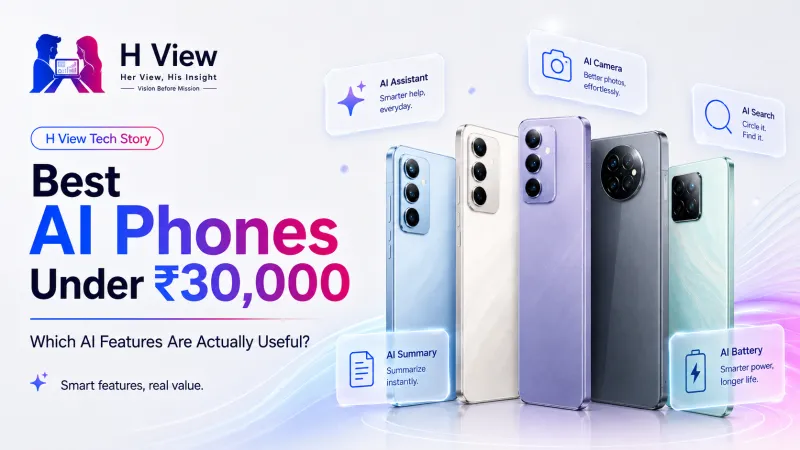
Best AI Phones Under ₹30,000 in India: Which AI Features Are Actually Useful?
A year or two ago, artificial intelligence was something smartphone brands used mainly to justify flagship prices. Expensive phones were the first to receive generative photo editing, live transcription, smart summaries, contextual assistants and tools that could understand what
A year or two ago, artificial intelligence was something smartphone brands used mainly to justify flagship prices. Expensive phones were the first to receive generative photo editing, live transcription, smart summaries, contextual assistants and tools that could understand what was happening on the screen. In 2026, that separation is disappearing quickly.
Phones under ₹30,000 now offer Google Gemini integration, Circle to Search, AI photo editing, object removal, image expansion, call and notification summaries, contextual memory and even assistants designed to suggest what you should do next. The problem is that almost every manufacturer now puts the letters “AI” somewhere on the product page, even when the actual feature is little more than a filter or cloud-based image editor.
That makes choosing an AI phone under ₹30,000 more complicated than comparing processors or battery capacities. A phone with ten AI-branded functions is not automatically more useful than one with four well-integrated tools. Many features also depend on an internet connection because the processing happens in the cloud rather than directly on the phone.
For H View, the more useful question is therefore not “Which phone has the most AI?” It is which affordable phone uses AI in ways that can genuinely save time, improve photographs or simplify everyday tasks?
What Should Count as a Useful AI Phone in 2026?
Before ranking models, it helps to separate practical AI from branding.
A genuinely useful AI feature should reduce the amount of work the user needs to do. Circle to Search is useful because you can identify something on screen without opening a separate browser and typing a description. Object removal is useful when it fixes an otherwise good photograph. A notification summary can be useful because it saves you from reading twenty messages individually.
By contrast, a camera mode called “AI Colour Boost” is not enough by itself to make a phone an AI-centric device.
There is also an important difference between on-device AI and cloud AI. Many phones in this price range rely on Google Gemini or remote servers for advanced processing. That is not necessarily bad; cloud processing can provide powerful features on less expensive hardware. However, it means some functions need internet access and may involve sending relevant information to a cloud service for processing.
With that in mind, these are the strongest options currently available below or very close to ₹30,000.
1. Motorola Edge 70 — Best Overall AI Experience Under ₹30,000
If AI functionality is the main reason you are shopping in this category, the Motorola Edge 70 currently makes one of the strongest arguments.
The phone is priced at around ₹29,999 for 8GB RAM and 256GB storage and uses Qualcomm's Snapdragon 7 Gen 4 platform. It combines that hardware with Motorola's increasingly ambitious Moto AI suite.
Where Motorola stands out is that its AI tools extend beyond photography. Catch Me Up 2.0 can help summarise missed information, while Pay Attention 2.0 is aimed at capturing and organising important details. Remember This + Recall allows users to save information they may need later, and Next Move is designed to suggest relevant actions based on what is currently happening on the phone.
That is much closer to the kind of AI integration that can improve daily usage.
For example, imagine returning to your phone after an hour-long meeting with multiple unread messages. A useful AI system should help identify what matters rather than force you to process every notification manually. Likewise, being able to save something important and retrieve it later through natural language is far more practical than another AI-generated wallpaper.
Motorola also applies AI to photography through features such as AI Action Shot, photo enhancement and video optimisation. The hardware itself is strong, with a 6.7-inch 1.5K AMOLED display, 120Hz refresh rate, dual 50MP rear cameras and a 50MP front camera.
The main reason we place it first is not that every Moto AI feature is revolutionary. It is that Motorola currently offers one of the broadest combinations of productivity AI + camera AI + respectable mid-range hardware at this price.
H View pick: Best AI-focused all-rounder.
 Also readNothing OS 5.0 Open Beta Is Live: New Features, Eligible Phones and Should You Install It?→
2. OnePlus Nord CE 6 — Best for AI Plus Battery Life
The OnePlus Nord CE 6 is another strong option, particularly for people who want useful AI tools without sacrificing battery endurance.
Its 8GB/128GB variant starts at ₹29,999, and the phone combines Snapdragon 7s Gen 4 performance with an enormous 8,000mAh battery and 80W charging. It also includes a 6.78-inch 1.5K AMOLED display running at up to 144Hz.
OnePlus builds its AI experience around OxygenOS 16 and Google Gemini while adding its own image and productivity tools. Gemini gives users access to conversational assistance, while OnePlus's editing features can remove unwanted objects, improve compositions and enhance photographs.
This is a more conventional AI package than Motorola's, but it may appeal to more users because the features are easy to understand.
Imagine taking a holiday photo where a stranger walks through the background. AI object removal can fix the image without requiring Photoshop. If you are reading something complicated, Gemini can help explain it. These are not futuristic experiences, but they are practical.
The Nord CE 6 also has another advantage that has nothing to do with AI: battery life. Its 8,000mAh cell means someone using AI tools, navigation, mobile data and the camera heavily throughout the day has a much larger energy reserve than many rivals.
The main compromise is camera versatility. Gadgets 360's review notes the lack of an ultrawide camera and says gaming performance could be stronger.
H View pick: Best combination of AI features and exceptional battery endurance.
3. Redmi Note 17 5G — Best for Google's AI Ecosystem
The Redmi Note 17 5G is one of the more straightforward choices for someone who mainly wants Google's AI features rather than a heavily customised manufacturer assistant.
The 6GB/128GB model starts at ₹27,999, while the 8GB version moves slightly over the ₹30,000 limit at ₹30,999. It runs HyperOS 3 and supports Google Gemini Live and Circle to Search, alongside Xiaomi's own image tools such as AI Erase, AI Sky and AI Image Expansion.
Circle to Search remains particularly useful because it reduces friction. If you see a pair of shoes, landmark, product or unfamiliar object in an app, you can search for it directly from the current screen rather than saving a screenshot and opening another application.
Gemini Live is more conversational. You can discuss what you are looking at or ask follow-up questions rather than using the traditional one-question, one-answer assistant model.
The Note 17 also gives buyers an 8,000mAh battery, 120Hz AMOLED display and Snapdragon 4 Gen 4 chipset. Battery endurance is therefore one of its strongest non-AI advantages.
There are compromises. Gadgets 360 notes occasional interface stutters, weak GPU performance and a significant amount of preinstalled software.
That makes the Note 17 a better choice for ordinary productivity and media consumption than demanding gaming.
H View pick: Best for Gemini, Circle to Search and Google's familiar AI tools.
4. Poco M8 Power — Best AI Value Under ₹28,000
If you like the Redmi Note 17 idea but want to spend less, Poco M8 Power deserves attention.
The phone starts at ₹24,999 for 6GB/128GB, while the 8GB version costs around ₹27,999. It uses the same Snapdragon 4 Gen 4 platform and 8,000mAh battery capacity, while HyperOS 3 brings access to Gemini and Circle to Search.
Poco also includes AI-focused imaging tools such as AI Reflection Removal and AI Erase, which can be surprisingly useful when editing casual photographs.
Reflection removal is a good example of AI solving a real smartphone problem. Anyone who has photographed something through a shop window, train window or glass display knows how distracting reflections can be. If the software can reduce those distractions convincingly, that is more useful than dozens of decorative AI filters.
The Poco's main appeal is value. You are receiving many of the same Google AI features offered on considerably more expensive phones while staying comfortably below ₹30,000.
It is not the phone we would choose if sophisticated AI productivity is the priority. Motorola remains more interesting there. But if you mainly want Gemini, Circle to Search and practical photo editing at the lowest price, Poco makes a strong case.
H View pick: Best affordable AI phone for value-conscious buyers.
5. Realme 16x 5G — Best for Simple AI Photo Editing
The Realme 16x 5G approaches AI more narrowly.
Its strongest tools are focused on photography. Realme includes AI Edit Genie, object removal, image enhancement and resolution-improvement tools alongside its 50MP camera.
The idea behind AI Edit Genie is to make image editing easier for people who do not want to navigate complicated controls. Instead of understanding every editing parameter, the user can make simpler requests and allow the software to perform the adjustment.
For social-media users, that may be enough.
The phone also includes a 7,000mAh battery, 144Hz display and MediaTek Dimensity 6300 processor. Pricing starts at ₹25,999, with higher-storage configurations moving close to or slightly above ₹30,000.
Where it falls behind Motorola and OnePlus is the overall AI ecosystem. Most of its standout functionality remains camera-oriented rather than deeply integrated into productivity and information management.
That does not necessarily make it a bad AI phone. It simply means buyers should understand what kind of AI they are paying for.
H View pick: Best for users primarily interested in AI-assisted photo editing.
What About Samsung, Vivo and Other Phones Under ₹30,000?
There are several other phones worth considering, but the AI story becomes more complicated because pricing changes frequently.
Current price trackers list models such as Samsung Galaxy F70 Pro 5G, Vivo T5x, Vivo T4 Pro, Realme P4 Power and Samsung Galaxy A35 5G below ₹30,000 depending on variant and retailer.
That is why shoppers should pay attention to actual selling prices rather than only launch prices.
A device originally launched above ₹30,000 can become one of the strongest deals in this category during Flipkart, Amazon or offline promotions. Conversely, memory-cost increases have already pushed some smartphone prices higher during 2026.
For this article, we have prioritised phones whose AI positioning and current sub-₹30,000 variants are clear enough to recommend without relying on temporary bank offers.
Which AI Features Are Actually Worth Using?
After comparing these phones, a pattern becomes clear. The most useful AI features are not necessarily the most impressive demonstrations.
Circle to Search is useful because it removes steps from searching. AI object removal and image expansion help save photographs that would otherwise need more complicated editing. Notification and conversation summaries can reduce information overload. Features such as Motorola's Remember This and Recall become valuable if they reliably help users retrieve information later.
Gemini can also be useful, but simply having Gemini installed should not be treated as a major hardware advantage. Google's assistant is available across many Android phones.
This is one reason we would be careful with the phrase “AI phone.”
If two devices provide the same cloud-based Gemini experience, then battery life, cameras, display quality and software support should still influence the buying decision more heavily.
Do You Need an Expensive Processor for AI?
Not necessarily, because a lot of AI processing in this segment happens in the cloud.
That is how manufacturers can offer powerful generative features without putting a flagship chipset inside every device. The phone sends the relevant request or data to a remote service, the AI processes it and returns the result.
The downside is dependence on connectivity. Some features may work more slowly on poor networks or may not work offline at all.
More capable processors still matter for on-device AI, camera processing and responsiveness, which is one reason the Motorola Edge 70 and OnePlus Nord CE 6 feel more future-ready than lower-cost options based on entry-level chipsets.
For buyers planning to keep a phone for three or four years, we would still prioritise a capable processor rather than buying purely for an impressive AI feature list.
 Also readNothing OS 4.1 Explained: New Features, Eligible Phones and Should You Update?→
Her View
AI becomes useful on a phone when I stop thinking about it as AI.
If I can remove someone from the background of a photograph in seconds, find a product without leaving the app I am using or catch up on a group of missed notifications without reading every message individually, the feature has done its job. I do not need a glowing AI logo appearing every time it happens.
That is why I prefer phones where AI sits quietly inside normal tasks. Motorola currently does this particularly well with productivity features, while Google's Circle to Search remains one of the easiest AI tools for anyone to understand.
I would still choose the phone based on the complete experience. A useful AI editor cannot compensate for poor battery life, an uncomfortable display or weak long-term software support.
His Insight
The sub-₹30,000 market demonstrates why AI is rapidly becoming less useful as a premium differentiator.
Gemini, smart photo editing and contextual search are already appearing on affordable devices. Over the next few years, many of today's “AI features” will probably become normal Android functionality rather than something manufacturers can charge extra for.
The important differentiation will shift toward how deeply AI understands the user's context and how much can happen privately on the device.
Motorola's broader Moto AI approach is interesting for that reason. OnePlus offers a better overall hardware balance, while Redmi and Poco make Google's AI ecosystem accessible for less money.
The winner is therefore not the phone advertising the most AI. It is the phone where those tools fit naturally into an already strong device.
H View Verdict
If AI is your main priority below ₹30,000, Motorola Edge 70 is our strongest overall choice because Moto AI goes beyond photography into information management and everyday productivity. At ₹29,999 with 8GB RAM and 256GB storage, it also provides strong hardware around those features.
The OnePlus Nord CE 6 is the better choice for someone who wants a balanced phone with AI tools and outstanding battery capacity. Its 8,000mAh battery, 80W charging and solid OxygenOS experience make it particularly appealing to heavy users.
The Redmi Note 17 5G is our recommendation for buyers who mainly want Gemini and Circle to Search, while Poco M8 Power offers much of the same AI functionality at a lower starting price. Realme 16x makes the most sense for someone whose interest in AI is primarily about easier photo editing.
The larger lesson is that buyers should stop treating the word AI as a specification.
Ask what the feature actually does, whether it requires the internet, whether you will use it repeatedly and whether the rest of the phone is good enough without it.
In 2026, almost every smartphone can claim to be intelligent. The best AI phone is the one that quietly saves you time without making you think about the technology behind it.
Frequently Asked Questions
For the broadest combination of productivity and camera AI, we currently prefer the Motorola Edge 70. It includes Moto AI features such as Catch Me Up 2.0, Pay Attention 2.0, Remember This + Recall and Next Move, alongside AI-assisted photography tools.
The OnePlus Nord CE 6 and Redmi Note 17 5G both offer 8,000mAh batteries. Poco M8 Power also has an 8,000mAh battery and starts at a lower price.
Redmi Note 17 5G and Poco M8 Power support Google's Circle to Search through their current HyperOS software, alongside access to Gemini.
Not always. Many generative AI features in this price segment are cloud-based and require an internet connection. Some simpler camera and system functions may run locally depending on the phone and feature.
Yes, if the AI tools solve problems you actually have. Features such as object removal, contextual search, summaries and information recall can be genuinely useful. However, AI should not be prioritised above basics such as performance, battery life, cameras and software support.
Yes. OxygenOS 16 includes Google Gemini and OnePlus's own AI-assisted photography and productivity tools. Its 8,000mAh battery and 80W charging also make it one of the better balanced devices in the category.
They serve somewhat different purposes. Gemini is Google's general-purpose AI assistant, while Moto AI adds Motorola-specific features such as Catch Me Up, Remember This and Next Move. Motorola users can therefore benefit from both broader Google AI and device-specific functionality.
H View stories follow our editorial policy. Spotted an error? Tell us and we will correct it.
Rate this article
One tap is enough. No comment needed.
Was this article helpful?
Your answer goes straight to our editors.










Comments0
No comments yet. Start the conversation.