
AI Agents vs Chatbots: What Is the Difference for Everyday Users?
A chatbot answers you. An AI agent goes and does something for you. Here is the difference in plain words, with everyday examples and the risks worth knowing.
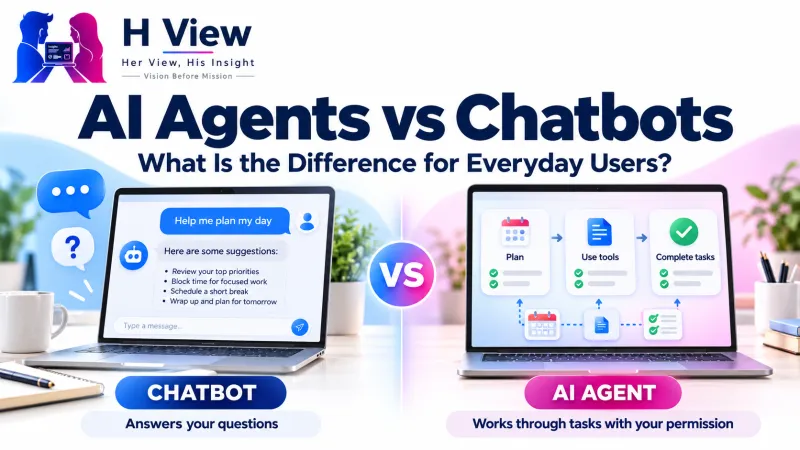
The simplest difference in AI agents vs chatbots is this: a chatbot answers your questions, while an AI agent takes actions to complete a task for you. A chatbot tells you how to book a train ticket. An agent can open the site, compare options and book it, often asking you to confirm before paying.
The word "agent" is suddenly everywhere: in phone launches, office software and startup pitches. Some of it is genuine, and some of it is a chatbot with a new label. If you are not a technical person, you do not need to understand how agents are built. You just need to know what they can do, what they cannot, and when to stay in control.
What is a chatbot?
A chatbot is a program you talk to. You type or speak, and it replies. Older chatbots followed fixed scripts, like the ones on a bank website that only understand "balance" or "block card". Modern AI chatbots such as ChatGPT, Gemini or Claude use large language models, so they can understand normal language, write, summarise and explain. But in their basic form, they stay inside the conversation. They give you information, and you do the work.
What is an AI agent?
An AI agent is an AI system that can plan and carry out steps towards a goal, using tools such as a web browser, your email, a calendar or company software. Google Cloud describes AI agents as software systems that use AI to pursue goals and complete tasks on behalf of users (Google Cloud). Anthropic, which makes Claude, distinguishes between fixed "workflows" and agents that "dynamically direct their own processes and tool usage" (Anthropic).
Chatbot vs agent at a glance
Chatbot
- Answers questions and writes text
- Works inside the chat window
- You take the action yourself
- Low risk if it gets something wrong
AI agent
- Plans steps and uses tools
- Can browse, fill forms, send emails or update records
- Takes the action for you, often with approval
- Mistakes can have real consequences
 Also readDraftVoice AI Review: A Voice-First Productivity Tool for Everyday Work→
What does an AI agent actually do, step by step?
How an agent handles a task
What are some everyday examples?
| Task | Chatbot | Agent |
|---|---|---|
| Planning a trip to Goa | Suggests an itinerary | Checks flight and hotel options and builds a shortlist with prices |
| Managing your inbox | Drafts a reply you paste | Sorts emails, drafts replies and schedules meetings for your approval |
| Small business orders | Explains how to track orders | Answers customer messages on WhatsApp, checks stock and updates the order sheet |
| Job search | Improves your resume text | Finds matching openings and fills application forms for you to review |
The business examples are where agents are already common. Clinics, coaching centres and shops use AI assistants on WhatsApp that can answer questions, book appointments and update records. If you are curious how such systems are designed in practice, the WhatsApp AI healthcare CRM case study on Harika Behara's portfolio walks through a real example.
What are the risks of using AI agents?
- Approve every payment or booking yourself before it goes through
- Give agents access only to the accounts they truly need
- Be careful with agents reading emails or web pages, which can contain misleading instructions
- Check the result, especially dates, amounts and names
- Know how to switch the agent off or revoke its access
The core risk is simple: when a chatbot is wrong, you read a bad answer. When an agent is wrong, it may send the wrong email or book the wrong date. Our piece on AI and your privacy covers what happens to the data you share.
Her View
For busy parents, caregivers and small business owners, agents could genuinely give back time, from sorting school emails to handling routine customer questions. But convenience should never mean handing over control blindly. A good rule at home: let the agent prepare, and let a human decide.
 Also readAI Skills Are Becoming a Hiring Requirement: Is Knowing ChatGPT Enough?→
His Insight
Many products called "agents" today are chatbots with a few tools attached. That is not a bad thing, but it helps to test them on small, low-risk tasks first. Measure how often they finish a task correctly without help. If you have to fix every second result, it is still a drafting assistant, whatever the label says.
H View Verdict
Chatbots talk; agents act. Use chatbots freely for learning and drafting, and use agents for repetitive tasks where you can review the result before it matters. The more an agent can spend, send or delete, the more closely you should supervise it.
Frequently Asked Questions
What is the difference between an AI agent and a chatbot?
A chatbot responds to your questions in a conversation. An AI agent can plan steps and use tools such as websites, email or apps to complete a task for you.
Is ChatGPT a chatbot or an agent?
In its basic form it is a chatbot. Many AI assistants, including ChatGPT, Gemini and Claude, now offer agent-like features that can browse or act in apps, usually with your approval.
Are AI agents safe to use?
They can be, if you limit their access, approve important actions such as payments, and check their work. Avoid giving them more permissions than a task needs.
Can small businesses use AI agents?
Yes. Common uses include answering customer messages, booking appointments and updating order or customer records, with a person reviewing exceptions.
H View stories follow our editorial policy. Spotted an error? Tell us and we will correct it.
Rate this article
One tap is enough. No comment needed.
Was this article helpful?
Your answer goes straight to our editors.











Comments0
No comments yet. Start the conversation.