

Best Digital Marketing Tools in 2026: What Marketers Actually Need and What They Can Skip
Open LinkedIn for a few minutes and you will probably come across a colourful graphic…
 Harika October 6, 2026
  By HarikaUpdated July 17, 202610 min read117 views
When Carl Pei announced a technology company called Nothing, the name naturally created curiosity.
It sounded unusual, risky and almost impossible to search for online. More importantly, the company was entering an industry already controlled by some of the world’s most powerful brands. Apple had built a tightly connected ecosystem, Samsung offered devices across nearly every price range, and Chinese manufacturers were competing aggressively through specifications and pricing.
A new consumer-technology company had little room for error.
Yet Nothing did not try to look like an established corporation from its first day. It used mystery, community conversations, unconventional marketing and a clear visual identity to make people curious before it had even released a product.
What started with a pair of transparent wireless earbuds gradually developed into smartphones, headphones, software, artificial-intelligence features and the more affordable CMF product family.
Nothing is still a young company, and its long-term success is not guaranteed. However, its journey already demonstrates how a smaller challenger can become recognisable without copying the brands it hopes to compete against.
Nothing was founded in London in 2020 by Carl Pei, who had previously helped establish OnePlus. The company was publicly introduced in early 2021 with an ambition to make technology feel exciting again and eventually reduce the barriers between people and their devices.
The name “Nothing” reflected a larger idea. Technology should ideally become so natural and seamless that it stops feeling like an obstacle.
That ambition was much broader than producing another pair of earbuds or another Android phone. However, a new company could not build an entire ecosystem immediately. It needed a first product that was relatively accessible, visually memorable and capable of introducing the brand without carrying the enormous risk of launching a smartphone first.
Wireless earbuds became that starting point.
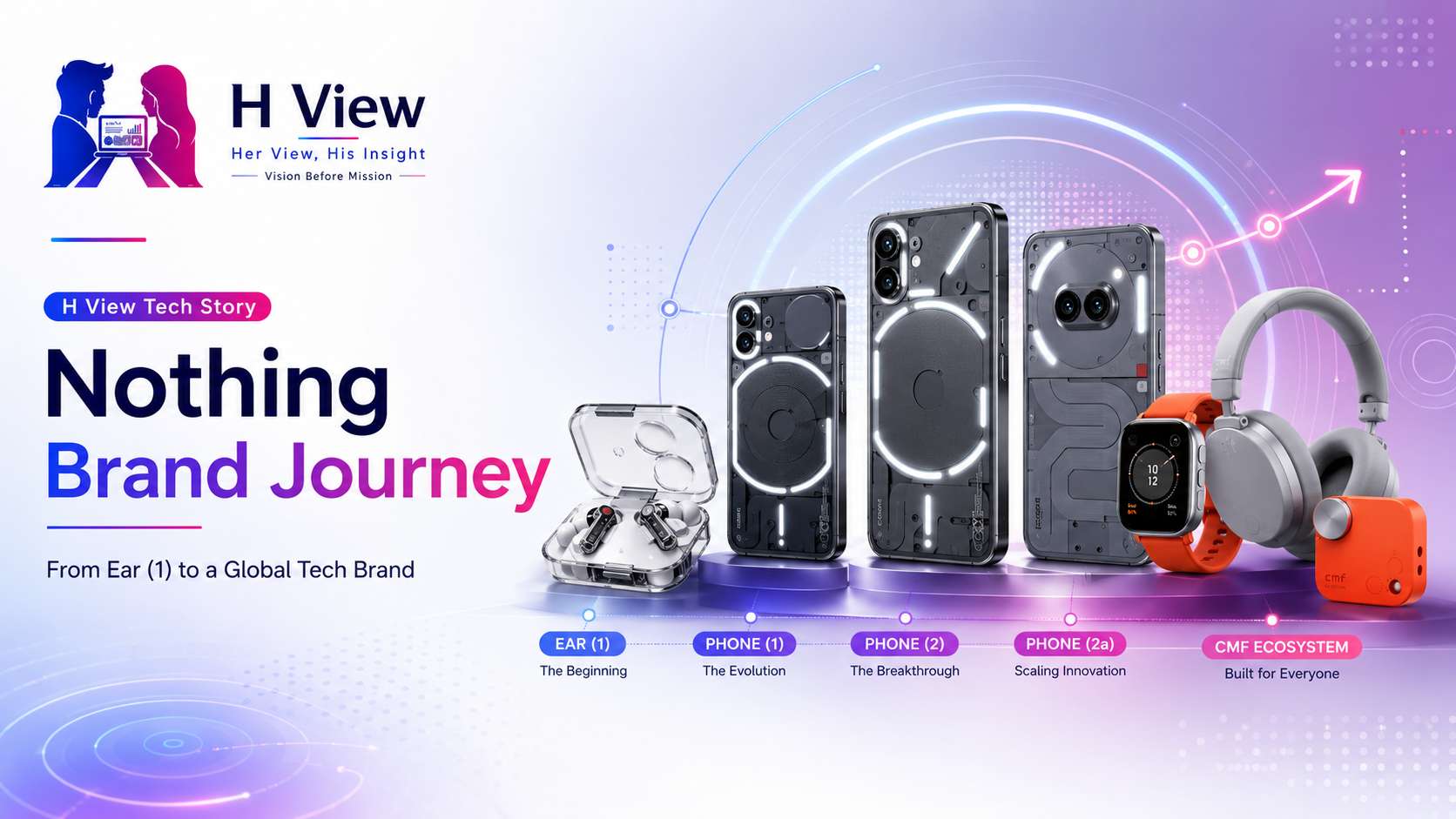
Nothing launched Ear (1) in 2021 as its first commercial product. The transparent charging case and partially transparent earbuds gave customers their first clear look at the company’s design direction.
Wireless earbuds were already everywhere. Apple’s AirPods had popularised the category, and numerous brands were competing through active noise cancellation, battery life and lower prices.
Nothing therefore needed more than respectable specifications.
Ear (1) succeeded in making people notice the design. The product exposed carefully arranged internal-looking elements and used contrasting details to distinguish the left and right earbuds. Even the case felt like part of the experience rather than simple packaging for the earbuds.
The transparent appearance later became central to Nothing’s broader brand identity.
Ear (1) was not perfect, but it proved something important: people were willing to pay attention to a new technology company when its products felt visually different.
That attention gave Nothing the confidence and recognition required for a far more difficult challenge.
Nothing announced Phone (1) in 2022 and officially introduced it later that year. It was the company’s first smartphone and only its second major product category.
Launching a smartphone is significantly more complicated than releasing earbuds. A phone requires dependable hardware, cameras, software, network compatibility, updates, customer support and an extensive supply chain.
Nothing again used design as its strongest differentiator.
Phone (1) featured a transparent-inspired rear panel and the first major version of the Glyph Interface. Hundreds of LEDs formed recognisable lighting patterns for notifications, calls, charging and camera use. Contemporary reviews highlighted the Glyph system as the phone’s defining characteristic, even while questioning whether it might become a novelty over time.
The phone did not attempt to defeat the most expensive flagships through raw power. Instead, it offered a distinctive mid-range experience built around design, wireless charging, a clean Android interface and a sense of personality.
This was the moment Nothing changed from an interesting audio start-up into a serious smartphone company.
Phone (1) also established several ideas that would continue across later devices:
Those elements helped Nothing create something many smartphone manufacturers still struggle to achieve: instant recognition.
A memorable phone design may persuade someone to pick up a device, but software determines whether that person enjoys using it every day.
Nothing OS gradually became one of the company’s most important assets.
The interface retained much of Android’s flexibility while adding Nothing’s typography, widgets, monochrome icons and visual language. Instead of heavily modifying every part of Android, Nothing attempted to create a cleaner experience that still felt familiar.
This balance was important. A young brand could not afford to release unstable or overly experimental software merely to appear different.
As later phones arrived, Nothing OS became more polished and closely connected to the hardware identity. The company also began incorporating Essential AI tools and search experiences into newer devices, demonstrating that its ambition had expanded beyond appearance alone. Current Nothing products combine the brand’s software styling with AI-supported organisation and search features.
Whether these tools become genuinely useful will depend on continued development. Nevertheless, they show how Nothing is trying to build its future around both design and interaction.
First-generation products often receive attention because they are new. The second generation reveals whether a company can improve its ideas rather than repeat them.
Phone (2), introduced in 2023, moved Nothing towards a more premium position. It offered stronger performance, a refined Glyph system and a more developed version of Nothing OS.
The product showed that Phone (1) was not intended to be a one-time design experiment.
Nothing began treating Glyph as a platform that could evolve through software. More segmented lighting allowed timers, progress indicators and selected application integrations to communicate information without requiring users to look directly at the display.
Not every buyer found these features essential. That remains one of Nothing’s continuing challenges: turning its most recognisable idea into something consistently useful.
However, Phone (2) helped establish continuity. Nothing now had a phone family rather than a single attention-grabbing device.
Nothing’s next important move was not simply creating a more powerful phone. It was making its design philosophy available at a more affordable price.
Phone (2a), launched in 2024, adapted Nothing’s visual identity for the competitive mid-range smartphone market. It used a redesigned rear layout, a simplified Glyph system and specifications intended to appeal to value-conscious buyers.
This was strategically important, especially in markets such as India.
A challenger brand cannot grow by selling only aspirational products. It needs devices that introduce more people to the ecosystem. Phone (2a) helped Nothing reach buyers who liked the company’s identity but could not justify higher pricing.
It also demonstrated that Nothing’s design language could change without becoming unrecognisable.
In 2023, Nothing introduced CMF by Nothing, a more affordable product line focused on colour, materials, functionality and accessible design.
CMF initially concentrated on products such as earbuds, watches and chargers before expanding into smartphones and headphones.
The sub-brand allowed Nothing to target lower price categories without making every Nothing-branded product compete primarily on cost. It also created room for a more colourful and playful visual identity.
CMF Phone 1 became particularly important because it brought customisable construction and removable rear panels into an affordable smartphone. Later products expanded the family across phones, watches, earbuds and over-ear headphones. The current CMF catalogue includes CMF Phone 2 Pro, Watch 3 Pro, Buds 2 models and CMF Headphone Pro.
CMF is not merely Nothing with a lower price tag. It has gradually developed its own personality:
For Indian buyers, CMF may become as important as Nothing itself because it allows a larger audience to enter the ecosystem.
Nothing began with wireless earbuds, but its portfolio now covers smartphones, in-ear audio, over-ear headphones, watches, software and AI-supported features.
Phone (3) represented another major step by positioning itself as Nothing’s first full flagship smartphone. It introduced a redesigned Glyph Interface, Essential Search and a four-camera system built around 50 MP sensors.
By 2026, Nothing had also expanded its phone range through newer mid-range devices such as Phone (4a) and Phone (4a) Pro. These products continued the company’s focus on expressive design while adding improved cameras and Essential AI tools.
This broader catalogue suggests that Nothing no longer wants to be viewed only as “the transparent phone company.”
It is attempting to build a complete consumer-technology brand with products at different prices and for different types of users.
Nothing has consistently treated community participation as part of its identity.
Its community platform allows users to discuss products, suggest features, submit concepts and participate in selected review or design initiatives. The company has also experimented with community-created product editions and review programmes.
This approach has practical benefits.
A young company cannot always compete with the marketing budgets of the largest technology corporations. An active community can generate discussion, feedback, creative concepts and authentic product coverage.
It also gives smaller creators an opportunity to become visible through the quality of their work rather than follower count alone.
However, community involvement must remain meaningful. Asking users for ideas is valuable only when the company clearly shows how feedback influences products and software.
For H View, this is one of the most interesting parts of Nothing’s growth. It creates room for independent writers, reviewers and users to contribute to the conversation while still evaluating the company critically.
A strong brand story should not hide mistakes.
Nothing has faced criticism over software issues, camera consistency, customer service, product availability and whether some features provide enough practical value.
The company also experimented with a messaging service that was withdrawn quickly after serious security concerns emerged. The incident demonstrated the risks of moving rapidly into services that require extremely high levels of trust and technical protection.
Nothing must also manage a difficult balance as it grows.
Its early appeal came partly from feeling like a rebellious alternative. As the company becomes larger and enters premium price categories, customers will judge it by the same standards applied to established manufacturers.
Distinctive design can create interest, but it cannot excuse:
The company’s future will depend on whether its operations mature as successfully as its branding.
Nothing’s journey is impressive because the company entered an overcrowded market and still created a recognisable identity within a relatively short period.
Ear (1) introduced transparency.
Phone (1) introduced Glyph and Nothing OS.
Phone (2) refined the original concept.
Phone (2a) broadened the audience.
CMF brought the design philosophy into more affordable categories.
Phone (3) and the newer product generations showed the company’s ambition to compete across a wider part of the technology market.
Nothing now promotes a simple mission: making technology feel fun again.
That message resonates because many modern devices have become technically excellent but emotionally predictable.
Nothing was founded in 2020 by Carl Pei, who previously co-founded OnePlus.
Ear (1), a pair of transparent wireless earbuds launched in 2021, was Nothing’s first commercial product.
Nothing introduced Phone (1) in 2022. It brought the company’s transparent design language, Nothing OS and Glyph Interface into the smartphone market.
Yes. CMF is Nothing’s more affordable product brand, focused on accessible design, colour and practical functionality.
Nothing phones are recognised for their transparent-inspired designs, Glyph lighting, dot-matrix visual language and clean Nothing OS interface.
Nothing now operates across multiple price segments. Nothing-branded devices generally occupy mid-range and premium categories, while CMF focuses more strongly on affordability.
Harika is the co-founder of H View and covers AI, technology, gadgets, digital tools, online platforms, and modern internet trends. Her articles focus on simplifying complex topics with practical explanations, balanced opinions, and reader-first insights.
Share your real experience and help other readers decide better.
No community views yet. Be the first to share yours.
Open LinkedIn for a few minutes and you will probably come across a colourful graphic…
Harika October 6, 2026 
When an employee resigns, many organisations move quickly into replacement mode. The manager informs HR,…
Harika October 6, 2026 
For many corporate employees, the workday begins long before they actually start working. They wake…
Harika October 5, 2026 
Many projects begin with an assumption that sounds reasonable on paper: the client will explain…
Harika October 1, 2026