
Claude Can Now Remember You: Is This the Feature That Finally Makes It Feel Like a Real Assistant?
One of the biggest frustrations with AI assistants has always been repetition. You explain how you work, describe your project, tell the assistant your preferred writing style, mention the people involved, clarify what you do not want, and finally get a useful result. Then you op
One of the biggest frustrations with AI assistants has always been repetition. You explain how you work, describe your project, tell the assistant your preferred writing style, mention the people involved, clarify what you do not want, and finally get a useful result. Then you open a new chat and have to explain half of it again.
That is the exact problem Claude’s updated memory system is trying to solve.
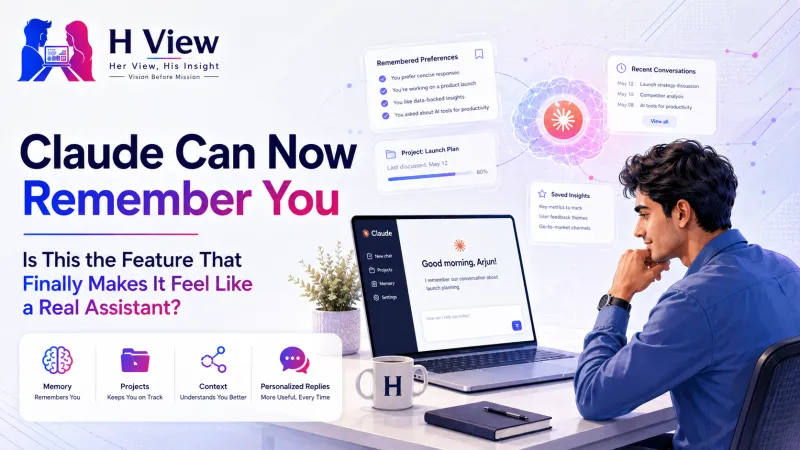
Anthropic has expanded Claude’s memory significantly in 2026. Claude can now retain useful context from conversations, organise what it remembers into editable topics, keep separate memory for different projects, and carry relevant context across normal chat and Claude Cowork in the cloud. Memory is now on by default for Free, Pro and Max users, while Team and Enterprise organisations keep it off by default unless an administrator enables it.
The change sounds small when described as “Claude remembers things about you,” but the practical effect could be much bigger. An assistant that remembers your working style is fundamentally different from one that treats every conversation like a first meeting.
The more interesting question, then, is not whether Claude has memory.
It is whether memory finally makes Claude feel less like a chatbot and more like an assistant that actually knows how you work.
What Claude Memory Actually Means
Claude’s memory is not simply a giant transcript of every conversation you have ever had.
Anthropic’s updated system stores useful information as individual topics that Claude can read and update while you work. Instead of waiting until a conversation ends and producing one large summary, Claude can save specific pieces of context as they become relevant. If a project deadline moves, for example, the new information can be available in a later conversation without requiring you to explain the change again.
You can also directly tell Claude to remember something.
That means a user might say that they prefer concise client emails, use React for frontend work, follow a particular coding convention, or are managing a specific project. Claude can retain those details and use them later when the context is relevant.
The important difference is continuity.
A normal AI conversation is useful because the model understands the messages inside that chat. Memory extends that understanding beyond the chat itself.
For someone who uses Claude once every few weeks, this may feel like a convenience feature. For someone using it daily for work, the difference can become much more meaningful.
The Real Benefit Is Not Remembering Facts About You
The obvious way to think about memory is personal information: your name, job, preferred tone or favourite tools.
That is useful, but it is not necessarily where memory becomes most powerful.
The real advantage is remembering how work is done.
Imagine using Claude regularly to prepare business documents. Without memory, you may repeatedly explain that your reports should begin with the decision required, avoid excessive bullet points, use plain language, and separate confirmed facts from recommendations.
With memory, those preferences can become part of Claude’s working understanding.
A developer may no longer need to repeatedly explain that a project uses pnpm instead of npm, that tests should accompany every significant change, or that a particular architectural pattern should not be modified without discussion.
A marketing professional might have Claude remember the audience, tone and positioning of a brand. A manager could have it remember the format expected in weekly updates.
Those are small pieces of context individually.
Together, they begin to resemble the knowledge a good colleague accumulates after working with someone for several months.
 Also readClaude Is Helping Build the Next Claude. Are We Entering the Era of Self-Improving AI?→
Claude Now Lets You See What It Remembers
One of the most important parts of Anthropic’s approach is that memory is not supposed to operate as an invisible profile that users cannot inspect.
The updated system exposes memories under Settings > Memory, organised into individual topics. Users can review, edit or delete those entries rather than simply trusting Claude to remember the right things indefinitely. Anthropic expanded those controls on August 25, 2026, alongside memory support for Cowork.
This matters because an AI assistant can easily remember something that was once correct but later becomes outdated.
Suppose Claude remembers that you are managing Project A. Six months later, you have moved to Project B. If that old information continues influencing responses, memory can become a source of confusion rather than convenience.
Editable memory gives the user a way to correct that.
It also creates an important psychological difference. People may be more comfortable allowing an assistant to remember information when they can clearly see what has been stored and remove it themselves.
Memory is much more useful when it remains under user control.
Projects Get Their Own Memory Too
This may be one of the most useful parts of Claude’s implementation for professional users.
Claude gives individual projects their own memory space and project summary. That means context from one project does not necessarily have to bleed into another.
Consider someone managing two clients.
Client A prefers detailed reports, formal language and weekly status updates. Client B wants short messages, direct recommendations and only monthly reporting.
If an AI assistant used one undifferentiated memory for everything, those preferences could conflict.
Separate project memory solves much of that problem.
The assistant can understand that one project has its own people, terminology, deadlines and communication style without automatically applying those assumptions everywhere else.
That begins to make Claude feel less like one chatbot with a single personality and more like a workspace that understands different contexts.
For people using AI seriously across several projects, that separation may matter more than many flashy model upgrades.
Memory Now Follows You Into Claude Cowork
Anthropic has also connected memory across normal Claude chat and Claude Cowork, provided Cowork is running in the cloud.
This means context learned during conversations can be available when Claude carries out a task in Cowork, and information that emerges from Cowork can become available in later chats.
Imagine asking Claude in chat to help plan a client update. Later, you ask Cowork to draft and organise the actual deliverable. If Claude already knows who the manager is, what tone they prefer and what the current project priorities are, the second task begins with far more context.
This is the point where memory starts moving beyond convenience.
A chatbot normally waits for you to tell it what matters.
An assistant begins with an understanding of the environment before you give the next instruction.
That is a much more ambitious product direction.
Claude Can Even Import Memory From Other AI Assistants
Anthropic has also introduced an experimental feature that allows users to transfer memory between Claude and other AI services.
The idea is straightforward: if someone has spent months teaching another assistant about their preferences and workflows, switching to Claude should not necessarily mean starting from zero. Claude can import that context, while users can also export Claude’s memory for backup or migration elsewhere.
This is more important than it first appears.
Until now, one of the hidden forms of AI platform lock-in has been context. The longer you use an assistant, the more it learns about how you work. Moving to another tool means losing that accumulated understanding.
Portable memory begins to challenge that.
Anthropic currently describes memory importing as experimental, so it should not be treated as perfectly reliable. But the direction is interesting: personal AI context may eventually become something users expect to carry between products rather than surrender to one platform.
If that happens, memory itself could become as important as model intelligence.
What Claude Chooses Not to Remember Matters Too
An assistant remembering everything would not necessarily be desirable.
Anthropic’s updated memory system avoids storing certain sensitive categories by default, including subjects such as health, race, ethnicity, religious beliefs, politics and gender identity. Users who genuinely want Claude to remember those areas can explicitly enable Include sensitive topics in memory.
That default is sensible.
People may discuss highly personal subjects with an AI in one context without wanting that information influencing unrelated conversations months later.
There is a major difference between remembering, “I prefer shorter emails,” and remembering sensitive personal details simply because they appeared once in a conversation.
Anthropic’s approach recognises that memory is not automatically valuable just because information can be stored.
Good memory requires selective forgetting too.
Incognito Chat Becomes Much More Important Once Memory Exists
Claude now offers incognito chats for situations where you do not want a conversation saved into history or used for memory.
Incognito chats are available across Free, Pro, Max, Team and Enterprise plans. They do not use Claude’s existing memory and do not add information from that conversation to memory afterward.
This feature becomes particularly useful once people begin relying on persistent context.
Imagine Claude knows your normal professional preferences, but you want to explore a hypothetical scenario, discuss a confidential issue, or test an unusual writing style without affecting future behaviour. Incognito gives you a clean session.
That distinction mirrors something people already understand in browsers.
Most of the time, continuity is convenient.
Sometimes you want a temporary space that leaves no lasting behavioural context.
The more powerful memory becomes, the more valuable that choice becomes too.
Memory Is Not the Same as Instructions
Claude already offers other personalization tools, and it is worth understanding the difference.
Anthropic supports account-wide instructions, project instructions and styles. Those features tell Claude explicitly how you want it to behave. Memory, by contrast, can develop from the things Claude learns while working with you.
Think of the distinction this way.
An instruction might say, “Always write client emails in a concise and professional tone.”
Memory might learn that a particular manager prefers the summary at the top, that one client dislikes technical jargon, or that your current project has moved into a testing phase.
Instructions are rules you set.
Memory is context accumulated through work.
Using both together can make Claude considerably more consistent than relying on either one alone.
 Also readAnthropic May Launch a New Claude Model—So Why Is the AI Race Speeding Up Again?→
But Memory Can Also Make Wrong Answers More Convincing
There is a less obvious downside.
When an AI remembers context, users may trust it more.
That trust can become dangerous if the remembered information is outdated, misunderstood or simply wrong.
Suppose Claude incorrectly remembers that a project deadline is September 10 when it actually moved to September 5. Future planning based on that memory may sound highly personalised and confident while being built on the wrong assumption.
The answer may feel better because Claude remembers the project.
It may still be wrong.
This is why users should periodically review memory rather than treating it as permanent truth.
A useful assistant is not one that remembers everything forever.
It is one whose memory can be corrected as easily as a human colleague can be updated.
Does Memory Finally Make Claude Feel Like a Real Assistant?
It gets much closer.
The defining difference between an assistant and a tool is often continuity.
A calculator does not need to know who you are. A search engine does not need to remember how you prefer reports written. But a good human assistant gradually learns what matters, remembers the people involved, understands priorities and stops asking the same questions repeatedly.
Claude’s new memory system begins to reproduce some of that experience.
It can remember professional context, communication preferences, ongoing work and technical habits. It can separate different projects, carry memory into cloud-based Cowork tasks and allow users to inspect or delete what it knows.
That does not make Claude a human assistant.
It still lacks human understanding in many important ways, and memory does not eliminate hallucinations or poor judgement.
But it changes the nature of the interaction.
The conversation starts less often from zero.
That alone can make the relationship with the product feel fundamentally different.
Her View
Memory makes AI much more comfortable to use because repeatedly explaining yourself is one of the fastest ways for an assistant to stop feeling helpful. If I have already explained how I prefer an article written or how a project is organised, I do not want to rebuild that context every morning.
At the same time, I would only want that convenience if I can see and control what has been stored. The fact that Claude now exposes memory topics and allows them to be edited or removed is therefore as important as the memory feature itself.
The best version of personalised AI should feel familiar without becoming intrusive. It should remember what makes the work easier while allowing the user to decide where that familiarity stops.
His Insight
From a product perspective, memory may eventually become one of the biggest competitive advantages in AI.
Model intelligence is improving quickly across several companies. If multiple assistants become capable enough for most everyday tasks, the differentiator may increasingly be context: which assistant understands your projects, tools, preferences and working history well enough to reduce friction.
Anthropic’s decision to support project-specific memory and even experimental memory import is therefore strategically important. It suggests that Claude is being designed not simply as somewhere you ask questions, but as a persistent work environment.
That may prove more valuable to long-term users than another incremental benchmark improvement.
Frequently Asked Questions
Yes. When memory is enabled, Claude can retain useful context from previous conversations and use it in future chats. Claude can also search past chats on supported paid plans.
Yes. Memory is currently on by default for Free, Pro and Max users. Team and Enterprise organisations have different defaults and administrator controls.
Yes. The updated memory experience displays remembered information as individual topics under Settings > Memory, where you can edit or delete entries.
Claude does not store sensitive areas such as health, beliefs and similar personal topics by default. Users can explicitly enable sensitive-topic memory if they want those areas remembered.
Yes. Claude allows you to pause memory or reset it. Pausing keeps existing memory but stops using or adding to it, while resetting permanently deletes stored memories and starts fresh.
An incognito chat is a temporary conversation that does not use Claude’s existing memory and does not contribute new information to memory. It is useful when you want a clean or more private session.
Yes. Anthropic currently offers an experimental memory import feature for supported plans, and Claude memory can also be exported for backup or migration to another service.
Yes, when Claude Cowork runs in the cloud, the same memory can be shared between Cowork and normal chat. Locally running Cowork sessions do not currently use that shared memory.
H View stories follow our editorial policy. Spotted an error? Tell us and we will correct it.
Rate this article
One tap is enough. No comment needed.
Was this article helpful?
Your answer goes straight to our editors.








Comments0
No comments yet. Start the conversation.