

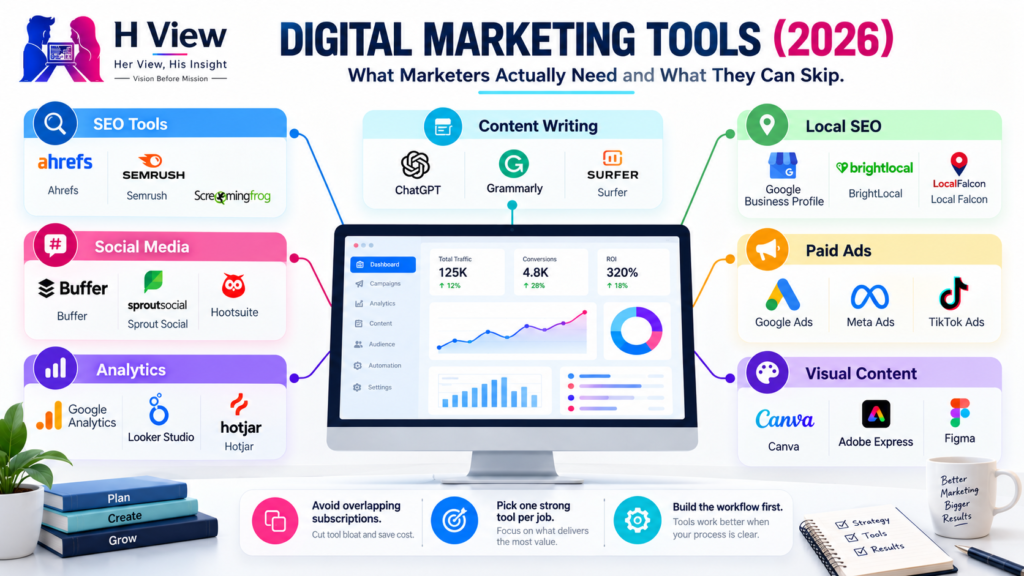
Best Digital Marketing Tools in 2026: What Marketers Actually Need and What They Can Skip
Open LinkedIn for a few minutes and you will probably come across a colourful graphic…
 Harika October 6, 2026
  By HarikaUpdated July 18, 202618 min read31 views
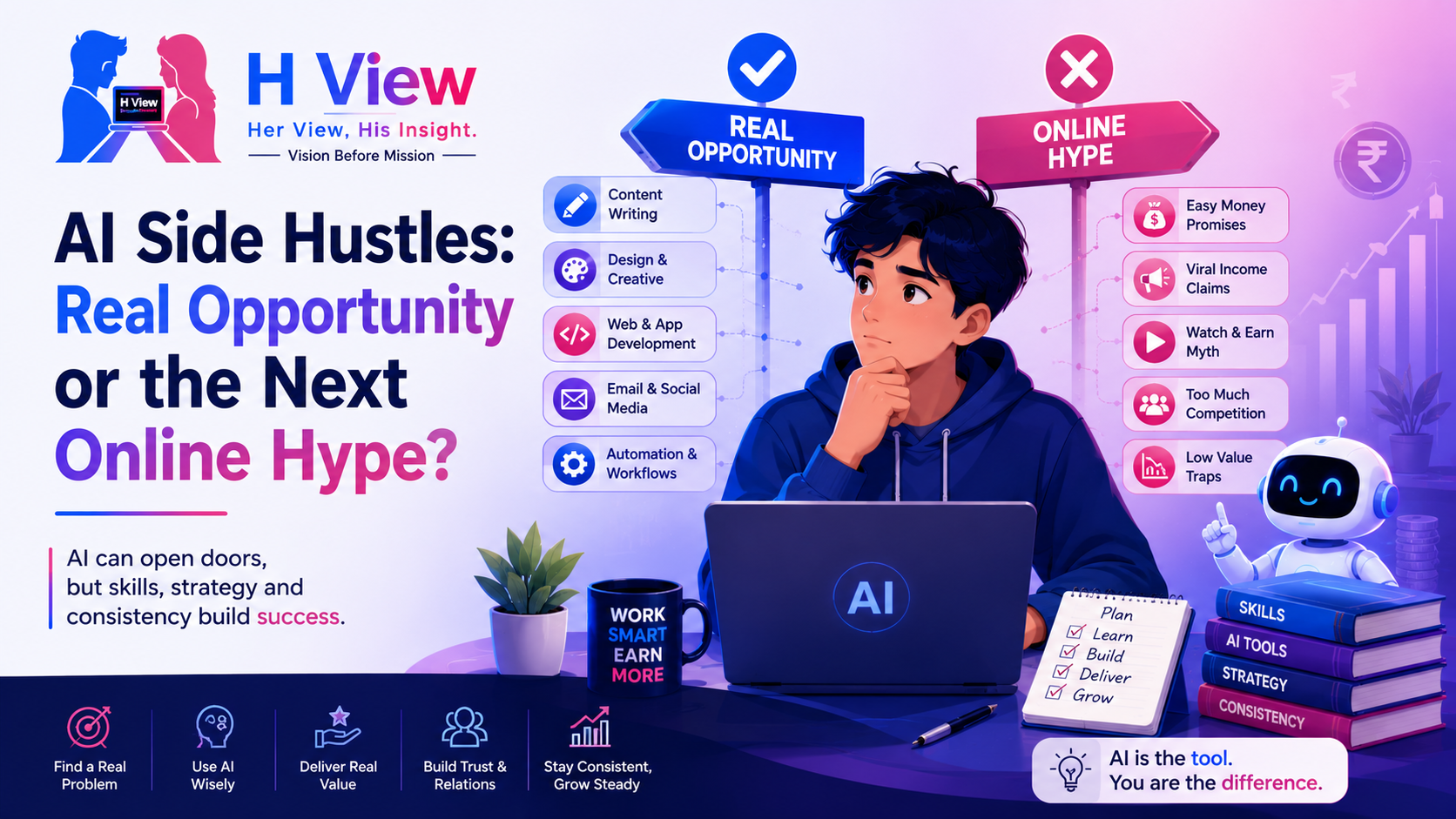
Artificial intelligence has created a new wave of online income promises.
Social media is filled with videos showing people using AI to write articles, create logos, build websites, generate videos, automate businesses, and launch digital products within hours. Some creators claim that anyone can start earning with little experience, no team, and almost no investment.
For students, employees, freelancers, and small business owners, this sounds exciting.
A side hustle that once required months of learning may now appear possible with a few prompts and the right AI tool. Someone can create social-media posts, prepare product descriptions, design presentations, edit videos, or build a simple website much faster than before.
But there is an important question behind all this excitement:
Are AI side hustles a genuine income opportunity, or are they becoming the next online hype sold through unrealistic success stories?
The truth lies somewhere in between.
AI can create real opportunities. It can reduce the time, cost, and technical difficulty involved in starting a service or small online business. But it does not automatically create customers, trust, quality, or long-term income.
AI may make it easier to begin. It does not make success effortless.
The idea of a side hustle is not new.
People have always looked for ways to earn beyond their main salary through freelancing, tutoring, reselling, consulting, design, writing, and part-time business.
AI has made these options feel more accessible.
A person with basic writing skills can use AI to prepare a stronger first draft. A designer can generate initial concepts quickly. A developer can create code structures faster. A small business owner can automate repetitive communication.
The appeal is especially strong because AI side hustles often appear to require:
These advantages are real.
The problem begins when people confuse lower entry barriers with guaranteed income.
From one perspective, AI is one of the most empowering tools available to beginners.
A person may have ideas but lack professional writing skills. Someone may understand business but struggle with design. Another person may know how to solve a customer problem but not know how to build a website or create marketing materials.
AI can help bridge these gaps.
It allows individuals to test ideas without hiring a large team. A freelancer can create samples more quickly. A small agency can handle more work. A student can build a portfolio while learning.
AI can support side hustles such as:
These opportunities can be useful for people who are willing to learn, practise, and provide a real service.
AI can reduce the time needed to produce the first version of the work. This gives beginners more space to focus on customer needs, communication, and improvement.
The same technology that helps one person start also helps thousands of others enter the same market.
When everyone can generate blog posts, captions, logos, presentations, and videos quickly, these services become easier to offer—and harder to differentiate.
A client may receive dozens of similar proposals. Many freelancers may use the same tools, prompts, and templates. The market becomes crowded with work that looks polished but feels generic.
This creates downward pressure on pricing.
A person may expect to earn well from AI-assisted content writing, only to discover that clients are receiving very low-cost offers from multiple freelancers. A designer may create images faster, but still struggle to convince customers that the work has unique value.
AI reduces production difficulty, but it also reduces the value of average output.
The side hustle becomes profitable only when the person adds something AI alone cannot provide:
Without these, the service becomes easy to replace.
One of the biggest misunderstandings is treating AI itself as the business.
Saying “I use AI” is not a complete offer.
Customers do not usually pay because someone knows how to open an AI tool. They pay because a problem is solved.
A restaurant owner may pay for better social-media content. A local shop may pay for product listings. A startup may need customer-support workflows. A student may need tutoring. A company may need a professional presentation.
AI helps deliver the service, but the service must still have a clear outcome.
Instead of offering “AI content creation,” a stronger offer may be:
The clearer the problem, the easier it is for a customer to understand the value.
AI side hustles often look simple from the outside.
A beginner watches a tutorial, subscribes to a tool, creates a few samples, and expects customers to arrive.
But several important steps are missing.
They may not know:
The tool is rarely the most difficult part.
Getting the first customer, understanding their expectations, delivering on time, and earning repeat business are usually much harder.
This is why many people spend money on courses and subscriptions but never recover the cost.
They learn how to generate output, but not how to build a business.
AI side hustles are more practical when they are connected to an existing skill or a real market need.
Writers can use AI for research organisation, outlines, editing, and idea generation. However, they must still provide original insights, fact-checking, tone, and brand understanding.
Small businesses often need captions, calendars, post ideas, and basic creative support. AI can reduce production time, but the freelancer must understand the audience and local market.
AI can help create product descriptions, FAQs, category content, and basic website copy. Knowledge of WordPress, ecommerce, SEO, and customer experience increases the value.
Job seekers may need stronger resumes, LinkedIn profiles, cover letters, and interview preparation. AI can assist, but personalisation and honest representation are essential.
People with technical knowledge can help businesses automate repetitive tasks such as lead capture, follow-ups, document handling, and reporting.
Tutors can use AI to create quizzes, examples, study plans, and explanations. The tutor still needs subject knowledge and teaching ability.
AI can generate initial concepts, but strong design still requires layout, hierarchy, branding, and visual judgment.
The strongest side hustles usually combine AI with a useful human skill.
Many AI side-hustle videos promote digital products, automated channels, ebooks, prompt packs, faceless videos, or AI-generated websites as passive income.
Some of these models can work. But they are rarely passive in the beginning.
A digital product still requires:
An AI-generated ebook will not sell simply because it exists. A faceless video channel still needs a clear niche, strong storytelling, consistency, and audience understanding.
The promise of passive income often hides the active work required to build attention and demand.
AI can accelerate production. It cannot guarantee that anyone will care about the result.
A simple approach is better than trying five ideas at once.
Choose something you already understand or are willing to learn properly.
Focus on local businesses, students, ecommerce sellers, professionals, coaches, or another clear group.
The offer should be specific and easy to explain.
Let AI speed up research, drafting, organisation, and repetitive work. Do not make the tool the entire value proposition.
Quality samples help customers understand what you can deliver.
Ask potential customers what they struggle with. Do not build the entire service based only on online assumptions.
Customers pay for the result, reliability, and time saved—not the number of AI tools used.
Use feedback to strengthen the service, workflow, communication, and pricing.
Be cautious when an opportunity depends on claims such as:
Real businesses usually involve uncertainty, learning, customer acquisition, and repeated effort.
The more effortless the promise sounds, the more carefully it should be examined.
Her View: AI lowers barriers and helps more people turn skills, ideas, and knowledge into income. It allows students, employees, and small business owners to start services with less investment and greater speed.
His Insight: AI also creates crowded markets, generic output, unrealistic expectations, and low-value competition. Without real skills, customer understanding, and consistent effort, the side hustle may never become sustainable.
Both views are valid.
AI side hustles are not fake, but neither are they automatic.
The tool creates leverage. The person still needs to create value.
AI can help people start earning in new ways, but it should not be treated as a money-printing machine.
The most realistic opportunity is not to ask, “How can I earn using AI?”
A better question is:
“Which real problem can I solve better, faster, or more affordably with the help of AI?”
That shift changes everything.
People who chase tools may keep switching from one trend to another. People who build skills, understand customers, and use AI responsibly have a better chance of creating sustainable income.
AI side hustles are real opportunities when they are built on usefulness, trust, and quality.
They become hype when they are sold as effortless income without skill, patience, or responsibility.
Social media is filled with videos showing people using AI to write articles, create logos, build websites, generate videos, automate businesses, and launch digital products within hours. Some creators claim that anyone can start earning with little experience, no team, and almost no investment.
For students, employees, freelancers, and small business owners, this sounds exciting.
A side hustle that once required months of learning may now appear possible with a few prompts and the right AI tool. Someone can create social-media posts, prepare product descriptions, design presentations, edit videos, or build a simple website much faster than before.
But there is an important question behind all this excitement:
Are AI side hustles a genuine income opportunity, or are they becoming the next online hype sold through unrealistic success stories?
The truth lies somewhere in between.
AI can create real opportunities. It can reduce the time, cost, and technical difficulty involved in starting a service or small online business. But it does not automatically create customers, trust, quality, or long-term income.
AI may make it easier to begin. It does not make success effortless.
The idea of a side hustle is not new.
People have always looked for ways to earn beyond their main salary through freelancing, tutoring, reselling, consulting, design, writing, and part-time business.
AI has made these options feel more accessible.
A person with basic writing skills can use AI to prepare a stronger first draft. A designer can generate initial concepts quickly. A developer can create code structures faster. A small business owner can automate repetitive communication.
The appeal is especially strong because AI side hustles often appear to require:
These advantages are real.
The problem begins when people confuse lower entry barriers with guaranteed income.
From one perspective, AI is one of the most empowering tools available to beginners.
A person may have ideas but lack professional writing skills. Someone may understand business but struggle with design. Another person may know how to solve a customer problem but not know how to build a website or create marketing materials.
AI can help bridge these gaps.
It allows individuals to test ideas without hiring a large team. A freelancer can create samples more quickly. A small agency can handle more work. A student can build a portfolio while learning.
AI can support side hustles such as:
These opportunities can be useful for people who are willing to learn, practise, and provide a real service.
AI can reduce the time needed to produce the first version of the work. This gives beginners more space to focus on customer needs, communication, and improvement.
The same technology that helps one person start also helps thousands of others enter the same market.
When everyone can generate blog posts, captions, logos, presentations, and videos quickly, these services become easier to offer—and harder to differentiate.
A client may receive dozens of similar proposals. Many freelancers may use the same tools, prompts, and templates. The market becomes crowded with work that looks polished but feels generic.
This creates downward pressure on pricing.
A person may expect to earn well from AI-assisted content writing, only to discover that clients are receiving very low-cost offers from multiple freelancers. A designer may create images faster, but still struggle to convince customers that the work has unique value.
AI reduces production difficulty, but it also reduces the value of average output.
The side hustle becomes profitable only when the person adds something AI alone cannot provide:
Without these, the service becomes easy to replace.
One of the biggest misunderstandings is treating AI itself as the business.
Saying “I use AI” is not a complete offer.
Customers do not usually pay because someone knows how to open an AI tool. They pay because a problem is solved.
A restaurant owner may pay for better social-media content. A local shop may pay for product listings. A startup may need customer-support workflows. A student may need tutoring. A company may need a professional presentation.
AI helps deliver the service, but the service must still have a clear outcome.
Instead of offering “AI content creation,” a stronger offer may be:
The clearer the problem, the easier it is for a customer to understand the value.
AI side hustles often look simple from the outside.
A beginner watches a tutorial, subscribes to a tool, creates a few samples, and expects customers to arrive.
But several important steps are missing.
They may not know:
The tool is rarely the most difficult part.
Getting the first customer, understanding their expectations, delivering on time, and earning repeat business are usually much harder.
This is why many people spend money on courses and subscriptions but never recover the cost.
They learn how to generate output, but not how to build a business.
AI side hustles are more practical when they are connected to an existing skill or a real market need.
Writers can use AI for research organisation, outlines, editing, and idea generation. However, they must still provide original insights, fact-checking, tone, and brand understanding.
Small businesses often need captions, calendars, post ideas, and basic creative support. AI can reduce production time, but the freelancer must understand the audience and local market.
AI can help create product descriptions, FAQs, category content, and basic website copy. Knowledge of WordPress, ecommerce, SEO, and customer experience increases the value.
Job seekers may need stronger resumes, LinkedIn profiles, cover letters, and interview preparation. AI can assist, but personalisation and honest representation are essential.
People with technical knowledge can help businesses automate repetitive tasks such as lead capture, follow-ups, document handling, and reporting.
Tutors can use AI to create quizzes, examples, study plans, and explanations. The tutor still needs subject knowledge and teaching ability.
AI can generate initial concepts, but strong design still requires layout, hierarchy, branding, and visual judgment.
The strongest side hustles usually combine AI with a useful human skill.
Many AI side-hustle videos promote digital products, automated channels, ebooks, prompt packs, faceless videos, or AI-generated websites as passive income.
Some of these models can work. But they are rarely passive in the beginning.
A digital product still requires:
An AI-generated ebook will not sell simply because it exists. A faceless video channel still needs a clear niche, strong storytelling, consistency, and audience understanding.
The promise of passive income often hides the active work required to build attention and demand.
AI can accelerate production. It cannot guarantee that anyone will care about the result.
A simple approach is better than trying five ideas at once.
Choose something you already understand or are willing to learn properly.
Focus on local businesses, students, ecommerce sellers, professionals, coaches, or another clear group.
The offer should be specific and easy to explain.
Let AI speed up research, drafting, organisation, and repetitive work. Do not make the tool the entire value proposition.
Quality samples help customers understand what you can deliver.
Ask potential customers what they struggle with. Do not build the entire service based only on online assumptions.
Customers pay for the result, reliability, and time saved—not the number of AI tools used.
Use feedback to strengthen the service, workflow, communication, and pricing.
Be cautious when an opportunity depends on claims such as:
Real businesses usually involve uncertainty, learning, customer acquisition, and repeated effort.
The more effortless the promise sounds, the more carefully it should be examined.
Her View: AI lowers barriers and helps more people turn skills, ideas, and knowledge into income. It allows students, employees, and small business owners to start services with less investment and greater speed.
His Insight: AI also creates crowded markets, generic output, unrealistic expectations, and low-value competition. Without real skills, customer understanding, and consistent effort, the side hustle may never become sustainable.
Both views are valid.
AI side hustles are not fake, but neither are they automatic.
The tool creates leverage. The person still needs to create value.
AI can help people start earning in new ways, but it should not be treated as a money-printing machine.
The most realistic opportunity is not to ask, “How can I earn using AI?”
A better question is:
“Which real problem can I solve better, faster, or more affordably with the help of AI?”
That shift changes everything.
People who chase tools may keep switching from one trend to another. People who build skills, understand customers, and use AI responsibly have a better chance of creating sustainable income.
AI side hustles are real opportunities when they are built on usefulness, trust, and quality.
They become hype when they are sold as effortless income without skill, patience, or responsibility.
Yes, but beginners still need to develop a useful skill, identify customers, create strong samples, and deliver reliable work. AI reduces effort but does not guarantee income.
The best option depends on existing skills. Content support, social-media assistance, resume services, presentation design, tutoring, and basic website content are common starting points.
Many can be started with low investment, but there may still be costs for subscriptions, internet, software, marketing, payment platforms, and training.
It can be used as part of a service, but the output should be reviewed, fact-checked, personalised, and improved. Client policies and disclosure requirements should also be respected.
Most require active work, especially in the beginning. Digital products and automated systems may later reduce effort, but they still require setup, promotion, support, and updates.
There is no fixed timeline. It depends on the skill, service, pricing, market demand, portfolio, and ability to find customers.
The biggest mistake is focusing only on the AI tool instead of the customer problem. Clients pay for useful results, not for prompts or tool access.The biggest mistake is focusing only on the AI tool instead of the customer problem. Clients pay for useful results, not for prompts or tool access.
AI may replace low-value, generic work, but freelancers who provide strategy, customization, expertise, communication, and accountability can remain valuable.
Harika is the co-founder of H View and covers AI, technology, gadgets, digital tools, online platforms, and modern internet trends. Her articles focus on simplifying complex topics with practical explanations, balanced opinions, and reader-first insights.
Share your real experience and help other readers decide better.
No community views yet. Be the first to share yours.
Open LinkedIn for a few minutes and you will probably come across a colourful graphic…
Harika October 6, 2026 
When an employee resigns, many organisations move quickly into replacement mode. The manager informs HR,…
Harika October 6, 2026 
For many corporate employees, the workday begins long before they actually start working. They wake…
Harika October 5, 2026 
Many projects begin with an assumption that sounds reasonable on paper: the client will explain…
Harika October 1, 2026