

Best Digital Marketing Tools in 2026: What Marketers Actually Need and What They Can Skip
Open LinkedIn for a few minutes and you will probably come across a colourful graphic…
 Harika October 6, 2026
  By HarikaUpdated September 20, 202610 min read40 views
For regular ChatGPT users, model announcements can sometimes feel more complicated than useful. A new name appears in the model picker, benchmark charts begin circulating online, and suddenly everyone is discussing whether the latest version is smarter than the one that worked perfectly well yesterday. Most people, however, are not choosing an AI model because it scored a few points higher on a technical evaluation. They want to know whether it gives better answers, wastes less time, handles difficult work more reliably and feels noticeably different in everyday use.
That makes the latest GPT-5.6 changes more interesting than a routine model release.
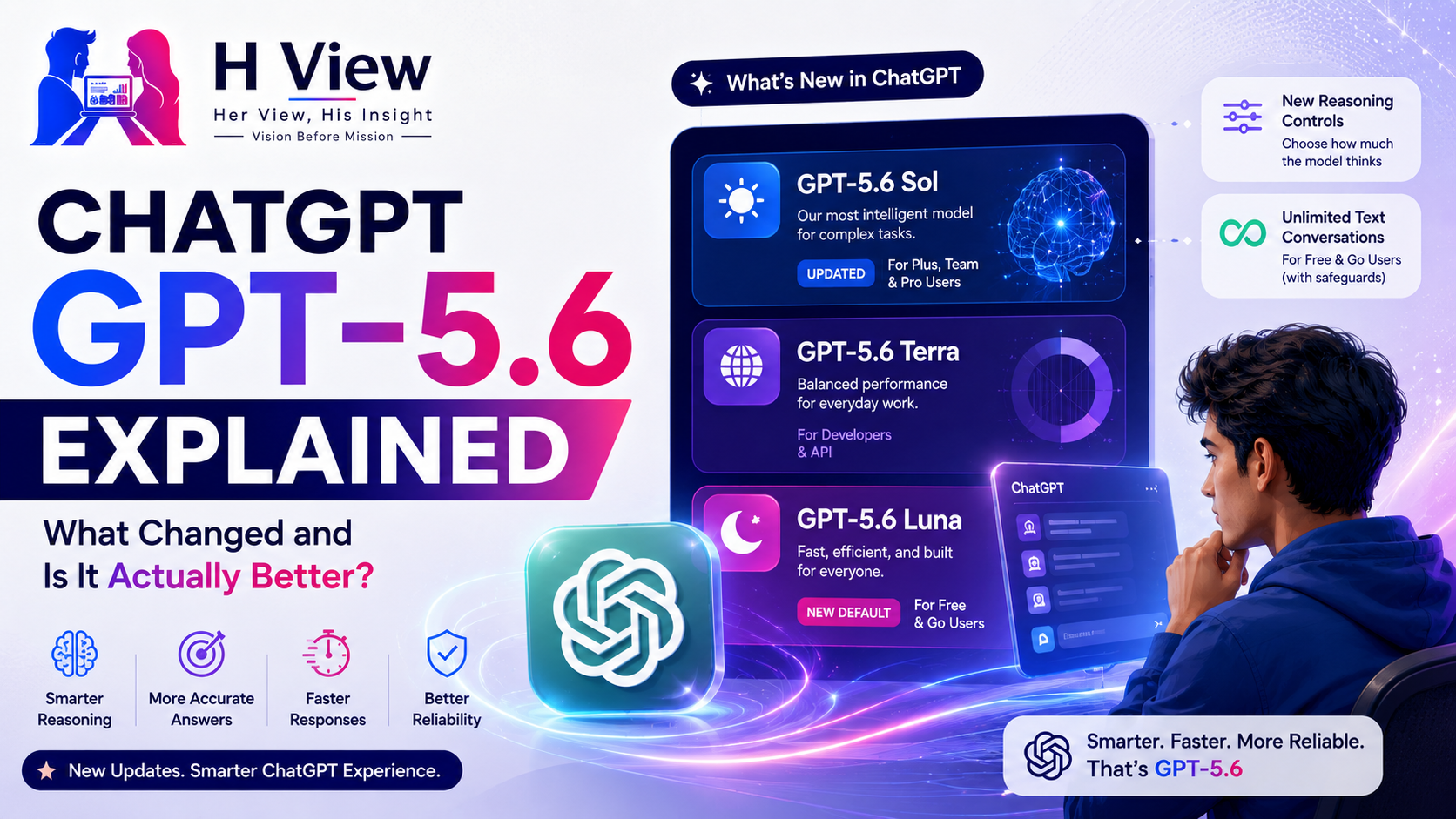
OpenAI originally launched the GPT-5.6 family in July 2026, with Sol positioned as its flagship model, Terra as a more balanced option and Luna as the fastest, lowest-cost member of the family. The company has now gone further by changing how GPT-5.6 appears inside ChatGPT itself. Paid users are receiving an updated version of GPT-5.6 Sol with new reasoning controls, while GPT-5.6 Luna is becoming the default experience for Free and Go users.
So the useful question is not simply whether GPT-5.6 has better benchmarks.
It is whether ChatGPT has become meaningfully better for the person actually sitting in front of it.
The first thing worth clearing up is the name itself. GPT-5.6 is a family rather than a single model. Sol, Terra and Luna have been designed for somewhat different levels of work, which helps explain why two ChatGPT users can now have different GPT-5.6 experiences.
GPT-5.6 Sol is intended for demanding work involving areas such as coding, research, knowledge work, science, design and computer use. OpenAI also offers GPT-5.6 Sol Pro for particularly difficult and longer-running tasks. Terra sits between the flagship and lightweight models, while Luna is designed around speed and lower computational cost.
For somebody using ChatGPT to rewrite a short email, the distinction may barely matter. But imagine a developer asking the system to inspect a large codebase, identify an intermittent error, modify several files and validate the result. Or consider someone supplying several reports and asking ChatGPT to reconcile the information before creating a business presentation. Those are the situations where stronger reasoning and better handling of long workflows begin to matter.
The interesting part of the August update is that OpenAI is trying to make these differences less visible to ordinary users. Instead of expecting everyone to understand model architecture, ChatGPT increasingly decides how much reasoning a request deserves.
One of the clearest changes is the way GPT-5.6 Sol handles answers.
OpenAI says the updated model has been tuned to be more direct, use tighter formatting and avoid unnecessary detail when a question does not require it. For more complicated work, it can expand its response while keeping the central recommendation easier to follow. The company also says it has worked on factual reliability, particularly for answers that depend on dates, numbers, rules, sources or assumptions.
That may sound like a small refinement, but anyone who uses AI frequently knows how irritating the opposite behaviour can become. Ask a simple question such as whether a particular setting exists in an application, and an assistant may give several paragraphs of background before reaching the answer. On the other hand, give it a complicated business problem and the response may sometimes appear confident without examining enough of the underlying assumptions.
A more useful AI assistant needs to understand the difference.
There is also a new reasoning slider for eligible paid users. Rather than thinking of ChatGPT as simply “fast” or “smart,” users can choose how much reasoning effort GPT-5.6 Sol should apply. Medium, High and, on some plans, Extra High reasoning levels are available, while GPT-5.6 Sol Pro sits above those for more demanding workflows.
In practical terms, you probably do not need the deepest reasoning setting to correct grammar in a WhatsApp message. But if you are comparing three business proposals, analysing a difficult spreadsheet or debugging a production issue, allowing the model more time to reason can be worthwhile.
Perhaps the more significant change for the wider audience is happening on the free tier.
OpenAI says GPT-5.6 Luna is becoming the default model for Free and Go users. These users are also moving toward unlimited everyday text conversations, subject to abuse-prevention safeguards, while separate limits continue to apply to features such as files, images, voice and data analysis. A new Think option lets Free and Go users ask Luna to spend more effort on harder questions.
It is important not to misunderstand what this means. Free users are not suddenly receiving unrestricted access to GPT-5.6 Sol. OpenAI’s current plan documentation specifically states that Free and Go users receive Luna rather than Sol.
For many people, though, that distinction may be less important than it sounds.
A college student asking for help understanding a difficult concept, a job seeker improving a résumé or a small business owner drafting customer communication may care much more about responsiveness and useful answers than about owning access to the flagship model.
That is where Luna could have a bigger impact than the model hierarchy suggests. Making a capable model available for far more everyday conversations can change how people actually use ChatGPT.
Probably not in every conversation, and that is not necessarily a criticism.
The best improvements to an everyday tool often become visible through fewer frustrations rather than spectacular demonstrations.
Imagine asking ChatGPT to compare two laptops you are considering. A genuinely improved experience is not one that produces the longest comparison. It is one that understands that battery life matters more to you than gaming performance, distinguishes the current selling price from an advertised maximum discount, notices when one specification has changed between variants and tells you which machine actually fits your situation.
The same principle applies at work. If you upload meeting notes and ask for a client update, you do not need a model to demonstrate how intelligent it is. You need it to understand which decisions were confirmed, which issues remain unresolved and which details should not be presented as facts.
OpenAI says GPT-5.6 has been improved for professional knowledge work and for producing documents, spreadsheets and presentations with greater accuracy and stronger adherence to reference formats. Its launch material also describes better performance across long-running workflows, tool use and computer interaction.
Those capabilities become valuable only when they reduce the amount of checking and correction the user has to do afterward.
A model being more reliable does not make it infallible.
This distinction becomes particularly important because stronger AI can create more convincing mistakes. A weak answer often looks uncertain. A sophisticated answer can be beautifully structured, cite information, produce a polished table and still misunderstand a critical assumption.
Consider someone using ChatGPT to calculate whether a new business subscription will save money over twelve months. If the AI assumes the quoted price includes GST when it does not, the reasoning built on top of that figure can still be wrong even if every later calculation is perfect.
The same applies to research, legal documents, medical information, financial decisions and current events. Better reasoning should reduce the burden of verification; it should not remove verification entirely.
For H View, that is one of the most important parts of the GPT-5.6 story. The conversation around AI models often focuses on whether they are becoming intelligent enough to replace work. Everyday users have a more immediate problem: learning which parts of the work they can confidently delegate and which parts still deserve human judgement.
The improvement I would value most is not a benchmark number. It is whether ChatGPT becomes easier to live with.
An AI assistant that constantly overexplains simple questions can quickly feel exhausting, particularly when you are using it several times during a working day. At the same time, a tool that gives a quick answer when you genuinely need careful reasoning can be equally frustrating. The attempt to let ChatGPT adjust between those situations feels more meaningful than simply making every response longer or more technical.
The free-tier changes matter here too. Many people first experience ChatGPT casually before deciding whether it deserves a place in their studies, work or daily routine. Giving those users a faster and more capable default model could make AI feel less like something reserved for technical users and more like an ordinary productivity tool.
From a practical perspective, GPT-5.6 looks less like a race to make one giant model and more like an effort to allocate intelligence efficiently.
Sol can handle the demanding work, while Luna can cover a much larger volume of everyday tasks without requiring the same computational cost. Terra occupies the middle ground for products such as Work, Codex and API applications. OpenAI has also reduced the price of Terra and Luna since the GPT-5.6 family launched, reinforcing the idea that efficiency is becoming as important as raw capability.
That has consequences beyond ChatGPT subscriptions. Developers building AI products need to decide when an expensive flagship model is genuinely necessary and when a smaller model can deliver almost the same practical result. The same thinking applies to individual users. There is little value in selecting the maximum reasoning setting for every task simply because it is available.
Good AI usage is increasingly going to involve matching the amount of intelligence to the problem.
GPT-5.6 does look like a meaningful upgrade, but probably not for the reason implied by most model-launch headlines.
The important change is not that ChatGPT suddenly knows everything or that one benchmark says Sol is stronger than an older model. The more useful development is that ChatGPT is becoming better at deciding how much effort a task deserves while OpenAI is making a different part of the GPT-5.6 family available to a much wider free audience.
Paid users working with research, coding, complex documents or longer workflows have the strongest reason to care about Sol and its reasoning controls. Free users may notice the upgrade differently: quicker everyday conversations, broader text access and the ability to ask Luna to think harder when necessary.
For most people, the right test is therefore remarkably simple. Do not ask whether GPT-5.6 is the smartest model on a chart.
Ask whether it helps you reach a reliable result with fewer corrections, fewer unnecessary words and less time spent fighting the tool.
If it does, that is an upgrade people will actually notice.
GPT-5.6 is OpenAI’s current model family consisting of Sol, Terra and Luna. Sol is the flagship model intended for demanding reasoning and professional work, Terra balances capability with speed and cost, and Luna is the fastest and lowest-cost member of the family.
Free and Go users are receiving GPT-5.6 Luna as their default model rather than GPT-5.6 Sol. They can also use the Think option for harder questions, which continues to run on Luna.
Yes. OpenAI currently lists Medium and High GPT-5.6 Sol reasoning for Plus users. Higher tiers receive additional reasoning options, with GPT-5.6 Sol Pro available on qualifying plans.
The reasoning control lets eligible users choose how much computational effort GPT-5.6 Sol should devote to an answer. Higher reasoning levels are intended for difficult tasks where additional analysis may improve the result, while simpler questions can be handled more quickly.
OpenAI says the updated GPT-5.6 Sol in ChatGPT has been tuned to make fewer factual mistakes, particularly where answers rely on dates, numbers, sources, rules and assumptions. That is an improvement target rather than a guarantee that every answer will be correct, so important information should still be verified.
Harika is the co-founder of H View and covers AI, technology, gadgets, digital tools, online platforms, and modern internet trends. Her articles focus on simplifying complex topics with practical explanations, balanced opinions, and reader-first insights.
Share your real experience and help other readers decide better.
No community views yet. Be the first to share yours.

Open LinkedIn for a few minutes and you will probably come across a colourful graphic…
Harika October 6, 2026 
When an employee resigns, many organisations move quickly into replacement mode. The manager informs HR,…
Harika October 6, 2026 
For many corporate employees, the workday begins long before they actually start working. They wake…
Harika October 5, 2026 
Many projects begin with an assumption that sounds reasonable on paper: the client will explain…
Harika October 1, 2026