

Best Digital Marketing Tools in 2026: What Marketers Actually Need and What They Can Skip
Open LinkedIn for a few minutes and you will probably come across a colourful graphic…
 Harika October 6, 2026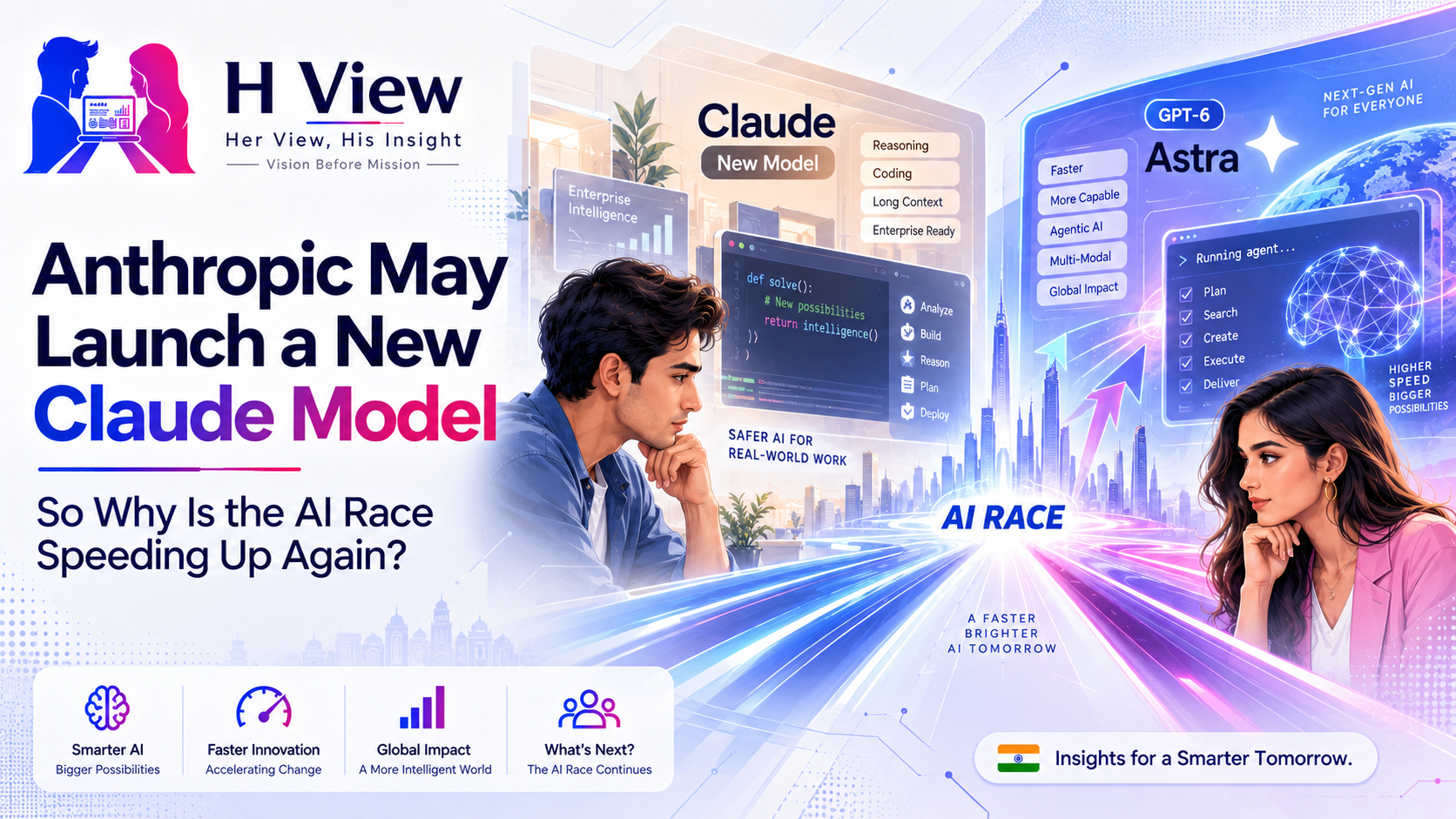
 By Satya HemanthUpdated September 21, 202614 min read30 views
Only a few days ago, one of the most influential figures in artificial intelligence was arguing that the industry might need to slow down. Anthropic CEO Dario Amodei has been warning that frontier AI capabilities are developing so quickly that safety systems, monitoring, and governance may struggle to keep pace. Yet Anthropic is now reportedly considering another advanced Claude model as competition with OpenAI intensifies, creating one of the most revealing contradictions in the AI industry today.
The situation is not as simple as saying Anthropic has changed its mind. A company can genuinely believe that the entire industry should move more cautiously while also knowing that slowing down by itself could cost customers, developers, enterprise contracts, and technical leadership. That tension has become more visible after OpenAI’s GPT-6 Astra gained early enterprise traction and placed fresh pressure on Claude in precisely the professional market where Anthropic has built much of its recent momentum.
This makes the story much more interesting than another routine “new Claude model is coming” update. It gives us a real-world example of the problem facing every major AI laboratory in 2026: how do you argue for responsible progress when your competitors have strong incentives to keep accelerating?
OpenAI introduced GPT-6 Astra as a model aimed heavily at professional work, computer use, coding, research, and longer multi-step workflows. That positioning brings Astra directly into areas where Anthropic has been trying to make Claude especially valuable, including enterprise knowledge work, coding agents, and professional AI assistance.
Claude is no longer competing only for people who want to ask a chatbot questions. Anthropic has spent considerable effort turning it into a platform for developers, researchers, businesses, and employees who want AI integrated into serious workflows. That makes enterprise adoption particularly important because business customers tend to generate repeat usage, longer contracts, and substantial API spending rather than simply opening an AI assistant occasionally.
Reuters reported on September 19 that GPT-6 Astra had recently accounted for approximately 13% of spending in one enterprise-AI tracking dataset, compared with around 8% for Claude Fable. Those numbers do not represent total global AI market share and should not be interpreted that way, but they help explain why Anthropic may be unwilling to give OpenAI months of uncontested momentum.
If Astra continues gaining adoption among the exact businesses Anthropic wants to serve, delaying Claude’s next capability jump becomes more than a technical choice. It becomes a commercial decision with consequences for revenue, customer loyalty, developer adoption, and Anthropic’s longer-term position in the AI market.
Anthropic’s position on AI safety has become one of its strongest differentiators. Amodei has repeatedly argued that frontier models could become powerful enough to create serious cybersecurity, autonomy, and control risks if capability continues advancing faster than safeguards. His recent calls for coordinated pacing were therefore not framed as opposition to AI development, but as an argument that companies need enough time to understand and control what they are building.
The difficulty appears when that principle meets competition. If Anthropic delays its next model while OpenAI continues improving Astra, Google advances Gemini, Meta builds its own systems, and lower-cost competitors continue emerging, Anthropic carries the commercial cost of caution while the wider industry keeps moving. From a safety perspective, slowing may look responsible; from a business perspective, slowing alone can look dangerous.
That distinction is crucial because it explains why the current situation is not necessarily hypocrisy. Anthropic can sincerely believe that all frontier labs should slow down together while also believing that Anthropic cannot afford to become the only major lab doing so. The contradiction comes from the structure of the market rather than simply from one company’s messaging.
The easiest way to understand the current AI race is to imagine several runners who all agree that the track has become dangerous. Every runner might benefit if everyone reduced speed together, but nobody wants to slow down first while the others continue sprinting. The result is that everyone may keep accelerating even though several participants privately believe the pace is becoming unsafe.
That is increasingly what frontier AI development looks like. OpenAI, Anthropic, Google, Meta, xAI, Chinese AI companies, open-model developers, cloud providers, chipmakers, and governments all have different incentives, but few want to be seen as falling behind.
| Scenario | Possible advantage | Main problem |
|---|---|---|
| Every major lab accelerates | Rapid innovation and faster capability gains | Safety, monitoring, and governance may struggle to keep up |
| One company slows alone | More time for testing and safeguards | Competitors may capture customers, talent, and market share |
| Major labs slow together | Safety work gets time to catch up | Coordination is difficult and may raise legal or geopolitical issues |
| Governments impose common standards | Creates more consistent rules | Regulations may differ by country and move slower than technology |
| Companies focus on efficiency instead of raw scale | Lower costs and potentially more reliable deployment | Rivals may still pursue bigger capability jumps |
Anthropic’s reported consideration of another model illustrates this problem unusually clearly. The company does not necessarily need to abandon its safety concerns to release a new model. It does, however, have to operate inside a market where those concerns do not remove competitive pressure.
Another development makes the race even more complicated: Claude is increasingly participating in Anthropic’s own AI research and development.
Reuters reported on September 17 that Claude now “leads” roughly 26% of Anthropic’s internal AI R&D work, compared with about 1% in March. Anthropic also reported that more than 90% of its research activity in August involved some form of collaboration between human researchers and AI systems.
This does not mean Claude independently designs and releases its own successor. Human researchers still review and supervise the work, and responsibility remains with Anthropic’s teams. What it does mean is that AI is increasingly becoming part of the machinery used to create better AI.
That development could shorten model-development cycles considerably. If stronger Claude models help researchers analyse experiments, write code, investigate failures, test ideas, and accelerate engineering work, then every improvement in the model can potentially make the next improvement easier to produce. Competitors pursuing similar AI-assisted research may create the same effect inside their own organisations.
For users, this sounds like rapid innovation. For safety researchers, it raises a harder question: what happens when the technology being governed is also helping accelerate the process that produces the next generation?
Anthropic’s competitive choices are also becoming more financially significant because the company is reportedly preparing for a possible public listing. Reuters says a potential IPO could come after the 2026 U.S. midterm elections, although the plans remain subject to change and should not be treated as confirmed.
The same reporting says Anthropic had reached an annualised revenue run rate of more than $65 billion by July 2026, compared with about $40 billion for OpenAI according to figures cited by Reuters. These are extraordinary numbers for companies operating in a market that only a few years ago was still being treated as experimental.
Becoming a public company would not force Anthropic to abandon safety work, but it would add another audience to satisfy: shareholders. Investors will care about revenue growth, margins, model costs, enterprise retention, and whether Anthropic can maintain its competitive position against OpenAI, Google, and increasingly capable lower-cost alternatives.
That can make long-term safety decisions harder. Spending months on evaluations and safeguards can be strategically important, but a lost enterprise customer shows up much more clearly in financial reporting than a disaster that was prevented because a model was released more carefully.
One reason the AI race feels faster is that the products themselves are changing.
The early generative AI competition was relatively easy for ordinary users to understand. People compared ChatGPT, Claude, and Gemini by asking the same questions, giving them the same writing task, or testing which one generated better code. Model competition happened mostly inside the conversation window.
That is no longer enough to describe the market. Frontier AI systems are increasingly being judged on whether they can operate tools, analyse large collections of information, work across software environments, complete coding tasks, conduct research, and continue through multi-step workflows without needing constant instructions.
This is particularly important for Anthropic because professional use has become one of Claude’s strongest identities. If OpenAI can convince enterprises that Astra handles longer autonomous workflows better, the competitive challenge is much larger than losing a few consumer chatbot comparisons.
Anthropic therefore has strong reasons to keep improving Claude even while arguing that the broader race needs stronger guardrails.
The biggest threat to Claude may eventually come from neither OpenAI nor Google.
Businesses are becoming more sophisticated about AI costs, and many are discovering that the most powerful model is unnecessary for every task. A company may use a frontier model for difficult reasoning while routing summarisation, classification, document extraction, or routine customer requests to a smaller and much cheaper model.
This creates a different kind of competition. Anthropic has to prove not only that Claude can perform difficult tasks, but that the added intelligence is worth paying for.
Reuters’ latest report notes that investors are paying increasing attention to competition from cheaper and open-source AI models. If those systems become “good enough” for large volumes of enterprise work, frontier providers may face pressure from both directions: stronger premium competitors above them and cheaper alternatives below them.
That is why simply releasing the most powerful model possible may no longer guarantee market leadership. Cost, latency, reliability, security, integrations, developer experience, and predictability are becoming just as important.
Not necessarily, and this distinction matters if we want to understand the story fairly.
Calling for slower frontier development is different from promising never to release another model. Anthropic could argue that the real objective is to make capability growth conditional on stronger evaluations, monitoring, safeguards, and deployment controls rather than freezing development completely.
A new Claude model could therefore arrive with tighter restrictions around dangerous capabilities, stronger misuse monitoring, more extensive red-team testing, or different access levels depending on what the system can do. The important question would not merely be whether the model is stronger, but whether the safeguards have advanced alongside the capability.
This is also where outside scrutiny becomes important. AI companies evaluating their own systems will always face a conflict between commercial excitement and safety concerns. Independent evaluations, shared standards, transparent reporting, and clearer regulatory expectations could help determine whether claims of “responsible acceleration” mean something measurable rather than becoming another marketing phrase.
For ordinary Claude users, another potential release can create the feeling that whatever model they just learned is already outdated. That anxiety is understandable because the industry constantly presents the newest release as a major leap forward, even when many everyday users would notice only modest differences in normal work.
The more useful approach is to stop treating every new model as an automatic upgrade requirement. A writer who already gets excellent results from Claude may gain very little from switching immediately. A developer might care much more if the new model materially improves repository understanding, autonomous coding, or debugging. An enterprise will want to know whether stronger capability justifies the additional cost and operational risk.
For H View, that should become our standard when reviewing AI releases. We should not ask only whether the benchmark number increased. We should ask what real problem became easier to solve, whether reliability improved, what changed in everyday use, and whether the user actually gains enough value to care.
That kind of evaluation becomes more important as model cycles shorten because otherwise users are pushed into a permanent upgrade loop where the newest AI always appears necessary simply because it is new.
There is something uncomfortable about hearing AI companies warn that development may be moving too quickly while watching the same companies prepare increasingly capable systems. At first glance, it can look inconsistent, but the commercial pressure behind that behaviour makes the situation more understandable. These companies are competing for customers, talent, investor confidence, and technological leadership at the same time that they are trying to define responsible boundaries for technology whose limits remain uncertain.
For users, the important lesson is not to confuse speed with progress. A new model matters when it becomes more dependable, easier to control, more useful for real work, or safer to trust with meaningful responsibilities. If the only improvement is that a benchmark score rises while users face greater cost, uncertainty, or complexity, the upgrade may be less important than the launch presentation suggests.
That is why the next Claude model, whenever it arrives, should be judged on what it improves in practice rather than on whether Anthropic can say it has answered Astra.
From an engineering and business perspective, Anthropic’s dilemma shows why voluntary restraint is unlikely to solve the AI safety problem by itself. Competitive markets reward capability improvements quickly, while the benefits of safety work are often invisible because success means that a failure never happened.
A company may spend enormous resources proving that a model is safe enough to deploy, yet customers mainly notice whether a competitor is faster, cheaper, or more capable. That creates a structural incentive to keep pushing capability while treating safety as something that must somehow keep pace in parallel.
If policymakers and industry leaders genuinely want frontier AI development to become more cautious, they may eventually need stronger shared standards, independent evaluations, or international agreements that reduce the disadvantage of being the company that slows down first. Without that coordination, even organisations that sincerely believe the race is moving too quickly may feel compelled to continue running.
Anthropic’s situation is therefore not merely a company story. It is a demonstration of why governing frontier AI is so difficult when safety concerns and competitive incentives point in opposite directions.
Whether Anthropic releases another Claude model next week, next month, or later is not the most important part of this story. What matters is what the possibility tells us about the AI industry in 2026.
Anthropic has become one of the most vocal companies warning that frontier AI could advance faster than society’s ability to monitor and control it. At the same time, GPT-6 Astra is gaining enterprise attention, AI-assisted research is shortening development cycles, cheaper alternatives are becoming more competitive, and Anthropic itself may be moving toward the public markets. Every one of those forces pushes the company toward faster innovation rather than slower development.
That is the contradiction at the centre of the modern AI race. Companies may agree that safety deserves more time, but very few want to discover that they were the only organisation that gave competitors that time.
If Anthropic does release another Claude model soon, the most useful comparison will therefore not be whether it beats Astra on a leaderboard. The more important test will be whether Anthropic can show that the new system became more capable without making the very safety problems it has been warning about significantly harder to manage.
That would be a more meaningful achievement than winning another benchmark.
No. Reuters reported on September 19, 2026 that Anthropic is considering another advanced model release, but the company has not publicly confirmed a final model name or launch date. Until Anthropic makes an official announcement, it is more accurate to describe the release as being under consideration rather than confirmed.
Competitive pressure appears to be an important factor. OpenAI’s GPT-6 Astra has gained early enterprise traction, while Anthropic also faces competition from Google and increasingly capable lower-cost or open alternatives. A faster Claude release could help the company defend its position in enterprise AI and professional workflows.
Yes. Anthropic leadership has argued for more coordinated pacing of frontier AI development because safety and monitoring may not be advancing as quickly as model capability. That position is not necessarily the same as saying Anthropic should permanently stop developing new models; the proposal is primarily about industry-wide coordination rather than unilateral withdrawal from competition.
There is no single reliable measure that can establish one model as universally better. Different models perform differently across coding, reasoning, writing, computer use, cost, latency, and enterprise workflows. Reuters reported stronger Astra spending in one enterprise dataset, but that represents adoption within that particular dataset rather than proof that Astra is superior at every task.
Yes, although humans remain in control of the process. Anthropic reported that Claude now leads around 26% of its internal AI R&D work, with more than 90% of August research activity involving human-AI collaboration in some form. That suggests AI is becoming an important development tool inside the organisations creating the next generation of AI systems.
Not automatically. Users should look at whether the new model improves the tasks they actually perform, whether pricing changes, and whether reliability or speed is materially better. A model upgrade that makes autonomous coding significantly stronger may matter greatly to a developer but have little practical impact for someone mainly using Claude to edit documents or brainstorm ideas.
Satya Hemanth is the founder of H View and writes on careers, sports, leadership, digital trends, and practical decision-making. His articles focus on clear explanations, real-world examples, and useful insights for students, young professionals, and everyday readers.
Share your real experience and help other readers decide better.
No community views yet. Be the first to share yours.
Open LinkedIn for a few minutes and you will probably come across a colourful graphic…
Harika October 6, 2026 
When an employee resigns, many organisations move quickly into replacement mode. The manager informs HR,…
Harika October 6, 2026 
For many corporate employees, the workday begins long before they actually start working. They wake…
Harika October 5, 2026 
Many projects begin with an assumption that sounds reasonable on paper: the client will explain…
Harika October 1, 2026