
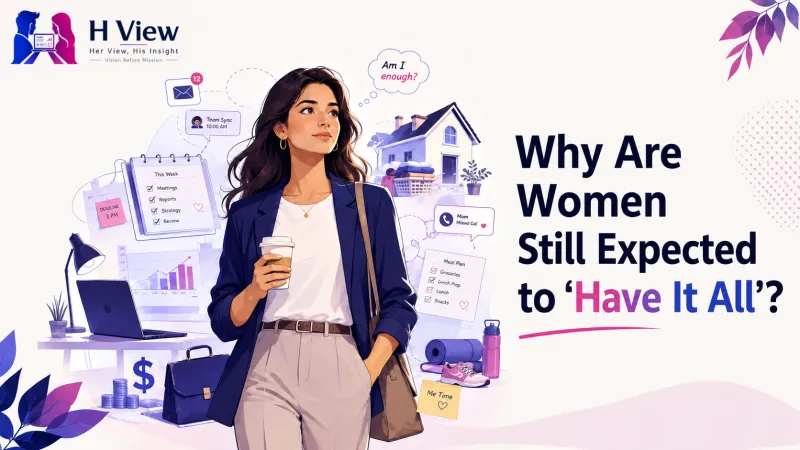
Why Are Women Still Expected to “Have It All”?
There is a strange contradiction in the way modern women are often spoken about. They are encouraged to study, build careers, earn their own money, travel, become confident, stay healthy, maintain friendships, marry the right person, raise well-adjusted children, support ageing p
There is a strange contradiction in the way modern women are often spoken about. They are encouraged to study, build careers, earn their own money, travel, become confident, stay healthy, maintain friendships, marry the right person, raise well-adjusted children, support ageing parents, keep a comfortable home, look good, and somehow remain emotionally available through all of it.
None of those things is wrong on its own. The problem appears when they are bundled together and presented as the minimum standard for a successful life.
A woman can have a good job and still feel guilty that she is not spending enough time with her family. She can stay home with young children and wonder whether she has damaged her career. She can be financially independent and still be judged for not marrying. She can marry and be asked when she will have children. Once she has one child, the next question may be when the second one is coming.
It can begin to feel as though there is no point at which she is simply allowed to say, “This is enough for me.”
“Having It All” Once Sounded Like Freedom
The idea of women “having it all” originally carried an empowering message. Women should not have to choose between education and marriage, or between a career and family, simply because society had already decided what their role should be.
That change mattered. Greater access to education, employment, money, travel, property, and professional opportunities gave women choices that many previous generations did not have.
But somewhere along the way, possibility became expectation.
Instead of saying a woman can build a career and a family if she wants both, the message began to sound more like she should succeed at both. Independence was added to the traditional list of responsibilities rather than replacing any of them.
The result is a generation of women with more opportunities than before, but also an enormous number of things they can potentially feel they are failing at.
Career Success Comes With Its Own Set of Expectations
A working woman is expected to be ambitious, reliable, productive, and constantly developing professionally. She may be told to negotiate better, ask for promotions, build a network, invest in new skills, take leadership opportunities, and make sure she does not fall behind.
Those are reasonable ambitions for someone who wants them. Yet work does not happen in a separate universe from the rest of life.
A woman can spend all day handling meetings, deadlines, customers, presentations, and difficult decisions, then return home to another set of responsibilities. If she appears tired, the advice often becomes another task: organise better, exercise more, sleep earlier, meditate, plan meals, reduce screen time.
At some point, even the advice for managing exhaustion can become exhausting.
The problem is not always that women need better productivity systems. Sometimes there are simply too many expectations competing for the same twenty-four hours.
 Also readWhy Are Working Daughters-in-Law Still Expected to Behave Like Full-Time Homemakers?→
Home Still Does Not Manage Itself
Women entering the workforce did not automatically cause household responsibilities to disappear.
In many homes, responsibilities are much more equally shared than they were a generation ago. Yet even in relatively modern households, women can still become the default planners. They remember appointments, organise school requirements, think about meals, notice what needs replacing, keep track of family events, arrange gifts, maintain social relationships, and remember things before they become problems.
This is different from completing one particular chore. It is the ongoing responsibility of noticing.
A partner may genuinely contribute at home while still asking, “What should I do?” The question sounds helpful, but it leaves one person responsible for seeing the whole picture and assigning pieces of it.
When that happens alongside full-time employment, the working day does not really end. It simply changes location.
Motherhood Comes With an Impossible Standard
The pressure becomes even more intense once children enter the picture.
Modern mothers are encouraged to be emotionally available, informed about nutrition, involved in education, attentive to development, patient during difficult behaviour, careful about screen time, supportive of hobbies, and present for meaningful family experiences.
At the same time, they are told not to lose themselves.
Keep your career moving. Exercise. Spend time with your partner. Maintain friendships. Take care of your mental health. Invest for the future. Do not become “only a mother.”
It is difficult to miss the contradiction.
A woman who devotes herself heavily to parenting may be told she needs an identity outside motherhood. A woman who returns quickly to an ambitious career can be asked whether she is giving enough time to her children.
The standard moves depending on what she chooses.
Appearance Has Somehow Remained Part of the Job
Even competence and exhaustion do not seem to excuse women from expectations around appearance.
There is pressure to age well, dress appropriately, remain fit, take care of skin and hair, and appear polished without seeming overly concerned with appearance. After pregnancy, women may encounter messages about “getting their body back,” as though the body temporarily belonged somewhere else.
Social media has made this pressure harder to escape because people are constantly exposed to women who appear to be doing everything beautifully.
The successful professional is also exercising at 6 a.m. The mother of two has a spotless home. Someone is preparing nutritious meals while running a business. Another person has time for skincare, travel, date nights, meditation, and an immaculate wardrobe.
What the viewer rarely sees is the support structure, money, childcare, flexible schedules, domestic help, editing, or simple chaos outside the frame.
Comparison happens between a person's full life and someone else's selected moments.
Even Rest Can Become Another Form of Achievement
The modern woman is now also expected to be good at resting.
Self-care has become its own industry, complete with morning routines, journaling, wellness plans, fitness goals, digital detoxes, retreats, and carefully designed methods of relaxation.
Some of these practices are genuinely helpful. The strange part is how easily rest itself becomes another task to perform correctly.
If a woman spends Sunday doing nothing, she may feel guilty because there are things she could be finishing. If she spends Sunday catching up, she reaches Monday without feeling restored.
Rest works poorly when it has to compete with a long mental list of unfinished responsibilities.
Sometimes what a tired woman needs is not another wellness routine. She needs fewer things to be responsible for.
Single Women Face a Different Version of the Same Pressure
Women who are unmarried or do not have children are not automatically free from the “have it all” expectation.
In fact, their achievements may sometimes be treated as temporary substitutes for the thing society assumes they eventually should want.
She can have a career, savings, a home, close friendships, travel experiences, and a life she genuinely enjoys, yet conversations may still return to marriage. Success does not always stop people from asking when she plans to “settle down.”
The implication can be subtle but powerful: everything else is impressive, but something essential is still missing.
This makes it difficult for women to define success on their own terms. A woman who genuinely does not want every traditional milestone may spend years defending a life she is perfectly happy living.
Women Also Put Pressure on Themselves
Not every expectation comes directly from men, families, workplaces, or social media. Some of it has already been absorbed.
A woman may have grown up believing that being capable means never needing help. She may want to be excellent at work, a thoughtful daughter, a supportive partner, a reliable friend, and an organised person because those things genuinely matter to her.
The pressure can therefore continue even when nobody is actively demanding it.
She may feel uncomfortable delegating because someone else will do the task differently. She may say yes because disappointing people feels worse than overloading herself. She may continue functioning long after she is exhausted because she has built an identity around being the person who manages.
Learning to do less can therefore feel surprisingly difficult.
It requires accepting that something may remain unfinished, someone may be disappointed, or another person may complete a task imperfectly.
Maybe Equality Should Include the Freedom to Choose Less
Real freedom is not having the opportunity to do everything. It is being allowed to decide which things matter.
One woman may genuinely want an intense career and no children. Another may want marriage, children, and a slower professional life. Someone else may want both career and motherhood but without chasing the highest possible level of achievement in either. Another woman may change her mind several times.
None of these choices represents failure.
A more useful idea of equality would give women access to opportunities without requiring them to accept every opportunity simultaneously. It would also recognise that prioritising one area of life means giving something else less attention for a while.
That is not poor balance. It is how human beings work.
 Also readWhy Are Working Women So Exhausted Even When They’re Doing Everything “Right”?→
Her View
The exhausting part of “having it all” is not that women have too many opportunities; it is that we sometimes treat every opportunity as another responsibility. A woman should be able to want a demanding career without being told she has neglected family, or want a quieter life without being told she lacked ambition. She should be allowed to love motherhood without losing her identity and to enjoy independence without having to explain why marriage has not happened yet. Freedom becomes meaningful only when women can choose what a good life looks like instead of simply receiving a newer, longer checklist.
His Insight
Men have an important role in changing this expectation because equality cannot exist only at the level of encouraging women to work. It also has to appear in ordinary life: sharing planning, childcare, household responsibility, elder care, and the emotional work that keeps families functioning. Telling a woman she can achieve anything means very little if she is then expected to achieve everything while everybody around her continues living much as before. A fairer partnership is not about “helping” an overwhelmed woman do her responsibilities. It is recognising which responsibilities were never meant to belong to her alone.
Perhaps Women Do Not Need to Have It All
Maybe the phrase itself has reached the end of its usefulness.
Nobody really has everything at once. Every life contains trade-offs. The person building a demanding business may have less free time. Someone prioritising young children may temporarily slow their career. A person who values independence may choose not to marry simply because an acceptable option appears.
The healthier goal is not to collect every possible achievement.
It is to build a life that feels worthwhile from the inside.
Women fought for the right to have more choices. The next stage may be recognising that having choices also includes the right to decline some of them.
A woman should not need a perfect career, perfect family, perfect home, perfect body, active social life, healthy savings account, peaceful mind, and beautifully organised calendar to prove that she used her opportunities well.
Sometimes success is choosing what matters, accepting what does not fit, and finally becoming comfortable with a life that looks complete to you even if someone else thinks something is missing.
Frequently Asked Questions
Because modern expectations have expanded faster than older expectations have disappeared. Women are encouraged to build careers, become financially independent, maintain relationships, raise children, manage homes, stay healthy, and remain emotionally available, often all at the same time.
It usually refers to the idea that women should successfully combine career, family, relationships, financial stability, health, appearance, friendships, and personal fulfilment. The problem is not having choices; it is the pressure to succeed in every area simultaneously.
Many women feel pulled between conflicting standards. If they focus on work, they may worry about family. If they prioritise family, they may worry about career progress. This constant switching between expectations can create guilt even when they are objectively doing well.
The mental load includes planning, remembering, organising, and anticipating what needs to be done at home or for family. Even when chores are shared, women may still carry much of the invisible responsibility for making sure everything happens.
Mothers are often expected to be deeply involved in their children’s lives while also maintaining careers, relationships, health, and personal identity. This creates an unrealistic standard where they are expected to give full attention to several demanding roles at once.
Yes. Social media often shows polished snapshots of women who appear successful, fit, organised, happy, well-dressed, productive, and present for their families. What is usually missing is the support, money, flexibility, help, editing, and chaos behind those images.
No. Choosing fewer priorities can be a healthy and intentional decision. A woman may decide to slow her career, delay marriage, remain single, have fewer children, or protect more personal time. Those choices do not mean she lacked ambition.
A healthier approach is to decide what matters most in a particular stage of life and accept that not everything can receive equal attention at once. Success can mean building a life that feels sustainable and meaningful rather than one that looks complete from the outside.
H View stories follow our editorial policy. Spotted an error? Tell us and we will correct it.
Rate this article
One tap is enough. No comment needed.
Was this article helpful?
Your answer goes straight to our editors.









Comments0
No comments yet. Start the conversation.