

H View
  • Home
  • About
  • Blogs
  • Categories
    • AI
    • Tech
    • Lifestyle
    • Business
      • Money
    • Sports
  • Reviews
  • Contact
Connect With Us
H View
  • Home
  • About
  • Blogs
  • Categories
    • AI
    • Tech
    • Lifestyle
    • Business
      • Money
    • Sports
  • Reviews
  • Contact
Connect
Lifestyle

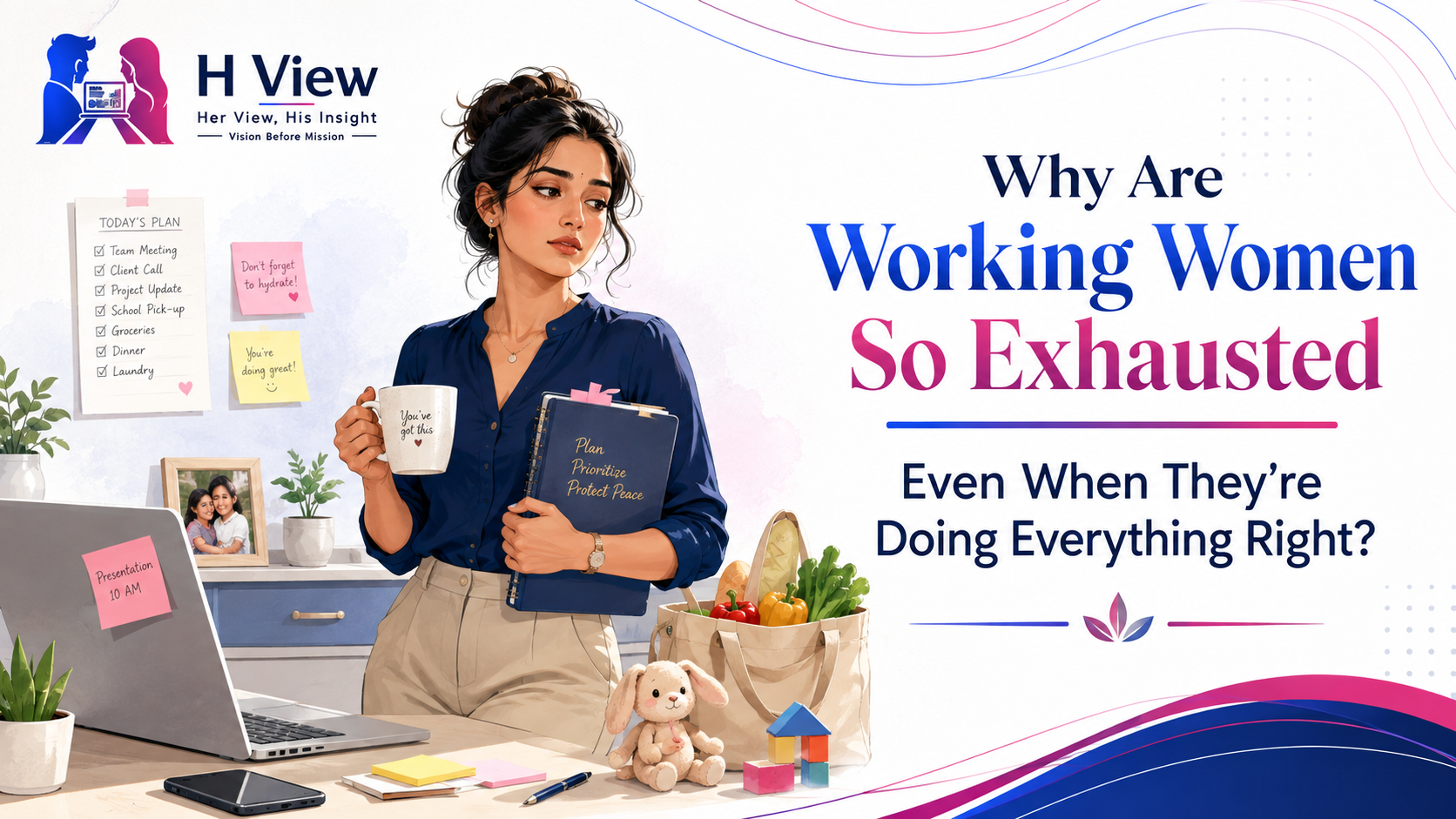
Why Are Working Women So Exhausted Even When They’re Doing Everything “Right”?

☆☆☆☆☆No reader ratings yet
By AnnapurnaUpdated August 27, 202611 min read2 views

She studied, built a career, earns her own money, manages her responsibilities, takes care of the people around her, and tries to make time for herself. From the outside, it looks like she is doing exactly what a modern woman is supposed to do. Yet by the end of most days, she is exhausted.

This exhaustion is not always caused by one terrible job, one difficult family member, or one obvious crisis. Often, it comes from carrying too many normal responsibilities at the same time. A woman may finish an eight-hour workday and immediately begin another shift of cooking, planning, cleaning, organising, remembering appointments, checking on children or parents, responding to messages, and preparing for tomorrow.

The uncomfortable truth is that women gained access to careers, income, and independence, but many of the older expectations placed on them did not disappear. Instead, the new responsibilities were added on top of the old ones.

That is why a woman can be successful, financially independent, loved by her family, and still feel completely drained.

Having a Career Did Not Remove the Work at Home

For many working women, paid employment is only one part of the day.

A woman may attend meetings, manage clients, solve problems, meet deadlines, and commute home after a demanding day. Once she reaches home, however, the expectation that she will notice what needs to be done may still remain.

Dinner needs planning. Groceries are running out. A school form needs signing. Someone has a medical appointment next week. Clothes need washing. A relative needs to be called. The house is becoming untidy. A birthday is coming up.

Individually, none of these tasks seems enormous. Together, they create a second workload that often has no clear starting or finishing time.

The problem is not simply that women do household work. It is that many are simultaneously expected to perform like employees who have no responsibilities at home and family members who have no demanding careers outside it.

Trying to satisfy both expectations every day is exhausting.

The Mental Load Is Harder to See Than Physical Work

One of the most tiring parts of modern life is not always doing tasks. It is remembering that the tasks exist.

Someone has to notice that toothpaste is almost finished, remember when school fees are due, schedule the dentist appointment, plan what the family will eat, check whether there is enough food for tomorrow, and keep track of what everyone needs.

This is often called the mental load.

Two people may share physical chores while one person still carries most of the planning. A partner might happily buy groceries when asked, but someone else had to notice what was missing, prepare the list, and remember that shopping needed to happen.

That invisible coordination consumes attention throughout the day. A woman can be sitting in a professional meeting while part of her mind is remembering that she needs to order a school uniform before Friday.

The work continues even when nobody can see her doing it.

Women Are Expected to Perform Well Everywhere

Modern women often face contradictory expectations.

At work, they are expected to be ambitious, productive, confident, available, and focused. At home, they may be expected to be patient, caring, organised, emotionally present, and available in an entirely different way.

If they invest heavily in their career, someone may question whether they are neglecting family. If they prioritise family for a period, they may worry that their career is falling behind.

Even personal appearance can become another responsibility. There is pressure to exercise, eat well, look presentable, maintain friendships, attend events, stay informed, and somehow also sleep properly.

The result is a life where almost every area has its own performance standard.

A woman may therefore finish a day having completed dozens of things and still go to bed thinking about what she failed to do.

Rest Can Start Feeling Like Something That Must Be Earned

Many exhausted women struggle to rest without guilt.

Sitting quietly for an hour can feel uncomfortable when there is laundry nearby, unanswered work messages, something to prepare for tomorrow, or a family responsibility that could be handled in advance.

Even weekends can become catch-up days.

Saturday may be used for cleaning, shopping, appointments, social obligations, and all the personal tasks that could not fit into the working week. Sunday becomes preparation for Monday. By the time the new week begins, there was technically time away from work but very little genuine recovery.

This is one reason simple advice such as “take more time for yourself” can feel unrealistic.

Rest is difficult when the underlying workload remains unchanged.

Being Financially Independent Does Not Automatically Mean Being Free

Earning money can dramatically increase a woman’s choices, but financial independence does not automatically remove every traditional expectation.

A woman may contribute equally or even earn more than her partner while still being treated as the default person responsible for managing the household.

This can create a frustrating imbalance. She may feel proud of her independence while simultaneously wondering why she is responsible for both career performance and most domestic organisation.

The phrase “he helps me at home” unintentionally reveals the problem. If two adults share a home, one partner should not always be considered the owner of the responsibility while the other receives credit for helping.

Shared life requires shared ownership.

That does not mean every task has to be divided exactly in half. Different couples can organise responsibilities differently. What matters is whether both people genuinely carry responsibility rather than one person managing everything and delegating pieces of it.

Motherhood Can Add Another Entire Layer

For working mothers, exhaustion can become even more intense.

Children require more than feeding, transport, and school fees. There are routines, illnesses, homework, emotional needs, school communication, activities, friendships, birthdays, clothes, meals, and countless decisions.

Even in households where fathers are actively involved, mothers may still find themselves treated as the default parent. Schools call them first. Family members ask them where something is. Children themselves may automatically go to their mother for certain needs.

That constant availability can make it difficult to mentally leave family responsibilities even while working.

A mother can therefore spend her workday worrying that she is not giving enough attention at home and her evening worrying that she is falling behind professionally.

There is very little space where she feels she is doing enough.

Women Are Often Carrying Emotional Work Too

Families do not only need practical organisation. They require emotional maintenance.

Someone remembers that a parent is feeling lonely, notices that a child has been unusually quiet, smooths over tension between relatives, checks whether a partner had a difficult day, and remembers important events.

Women are often expected to notice these emotional details.

This can be rewarding because caring for people creates meaningful relationships. But emotional responsibility becomes draining when one person is expected to constantly monitor everyone else’s wellbeing while their own exhaustion remains unnoticed.

The woman who asks everyone, “Are you okay?” may quietly wonder why nobody asks her the same question with enough patience to hear the real answer.

Success Can Sometimes Increase the Pressure

There is another strange problem: the more capable a woman appears, the more responsibility people may give her.

At work, reliable employees are often rewarded with more tasks. At home, organised family members become the person everyone depends on.

Competence creates trust, but it can also create overload.

A woman who rarely complains may eventually become the person who handles everything because everyone assumes she can.

The exhaustion may therefore remain hidden for years. She continues functioning, meeting deadlines, attending events, and managing responsibilities, so other people assume she is fine.

Burnout does not always look like complete collapse. Sometimes it looks like functioning successfully while feeling permanently tired.

“Self-Care” Cannot Fix an Unequal Workload

The modern solution to exhaustion is often self-care.

Take a bath. Go for a walk. Have a spa day. Meditate. Wake up earlier for yoga. Book a weekend away.

These things can be enjoyable and helpful, but they cannot solve a life where the basic distribution of responsibility is unsustainable.

A woman does not necessarily need a better skincare routine. She may need fewer responsibilities.

She may need a partner who notices what needs doing without being told. She may need family members to stop assuming she is automatically available. She may need clearer boundaries at work or permission to let some things remain imperfect.

Self-care works best when it supports a manageable life. It becomes frustrating when it is offered as the solution to structural exhaustion.

Why Asking for Help Can Feel So Difficult

Many women know they are overwhelmed but still struggle to ask for help.

Part of this comes from habit. If you have spent years being the responsible person, handing over responsibility can feel uncomfortable.

There can also be fear of judgement. A woman may worry that asking for help makes her a poor employee, wife, daughter, or mother.

Sometimes it feels easier to do something herself than explain exactly how it needs to be done.

But this creates a cycle. The more one person handles, the less everyone else learns to handle. Eventually, her competence becomes the reason she is expected to continue carrying everything.

Breaking that cycle often requires accepting that other people may do tasks differently and that “different” does not always mean wrong.

Younger Women Are Beginning to Question the “Have It All” Promise

For years, women were encouraged to believe they could have everything: career success, financial independence, marriage, motherhood, a beautiful home, strong friendships, fitness, travel, and personal fulfilment.

The message sounded empowering.

The missing sentence was that nobody can give 100 percent to every area of life at exactly the same time.

Younger women are increasingly questioning whether success should mean maximising every part of life simultaneously. Some are choosing flexible careers, delaying marriage, reconsidering motherhood, living independently, or becoming more protective of their personal time.

These choices are sometimes criticised as a lack of ambition or commitment.

They may actually represent something much simpler: women recognising that a good life should also contain enough energy to enjoy it.

Her View

The modern working woman does not necessarily need to become more efficient. Many women are already extraordinarily efficient, which is exactly why so much keeps being placed on them. The deeper change is learning that being capable does not create an obligation to handle everything. A career, family, relationship, and personal life can all matter without one woman becoming the invisible manager responsible for keeping every part functioning. Rest should not be treated as a reward received only after everybody else’s needs have been satisfied.

His Insight

Men who genuinely want equal partnerships need to look beyond whether they occasionally help with household tasks. The more important question is who carries responsibility for noticing, planning, remembering, and following through. Equality becomes meaningful when both people feel ownership of the life they share rather than one person acting as the manager and the other waiting for instructions. Sharing that invisible responsibility can reduce exhaustion far more than occasional grand gestures because it changes everyday life.

Maybe She Is Not Failing. Maybe She Is Carrying Too Much.

Working women are often told to manage time better, become more organised, learn to say no, exercise, sleep earlier, and practise self-care.

Some of that advice can help.

But there is another possibility worth considering. Maybe the woman who feels exhausted is not doing life badly. Maybe she is simply doing too much of it.

Being educated, employed, financially independent, caring, organised, and responsible should not require permanent exhaustion.

The goal of women’s independence was never supposed to be proving that women could handle a full career while continuing to carry every old expectation as well.

Real progress should not simply give women more opportunities to work.

It should also give them more freedom to decide what work, responsibility, ambition, family, and rest should actually look like in their own lives.

Frequently Asked Questions

Why are working women so exhausted all the time?

Working women may feel exhausted because paid work is often combined with household responsibilities, emotional care, family planning, childcare, and the invisible mental load of remembering what needs to be done. The issue is not always poor time management; sometimes the total workload is simply too high.

What is the mental load for working women?

The mental load is the invisible work of planning, remembering, organising, and anticipating family needs. It can include managing appointments, groceries, school tasks, bills, meals, family events, and household routines even when someone else helps with the physical work.

Why doesn’t financial independence always reduce women’s stress?

Financial independence creates more freedom and choice, but it does not automatically remove traditional expectations at home. A woman may contribute equally to household income while still carrying more domestic and emotional responsibility.

Why do working mothers feel especially burnt out?

Working mothers often manage both professional responsibilities and the demands of parenting, including school communication, routines, health, emotional support, activities, and household planning. This can create the feeling of never fully switching off from one role before starting another.

Can self-care solve burnout for working women?

Self-care can help with recovery, but it cannot solve a fundamentally unequal or overloaded life. Rest, exercise, hobbies, and time alone are useful, but lasting improvement may require clearer boundaries, shared responsibilities, and a more realistic workload.

Why do women feel guilty when they rest?

Many women are used to being responsible for other people’s needs, so resting can feel unproductive or selfish. Social expectations around being a good employee, partner, mother, or daughter can make it difficult to stop without feeling that something is being neglected.

How can partners reduce the mental load on working women?

The biggest change is to share ownership rather than simply wait to be told what to do. Both partners can take responsibility for planning, remembering, organising, and completing tasks so that one person is not acting as the household manager.

Is feeling constantly tired a sign of burnout?

Persistent exhaustion can be one sign of burnout, especially when it is combined with reduced motivation, irritability, feeling emotionally drained, or struggling to recover even after rest. Ongoing or severe symptoms may also have other causes, so professional medical or mental-health advice can be appropriate if fatigue is persistent or concerning.

Written by

Annapurna

Annapurna is an H View contributor covering relationships, family, lifestyle, entrepreneurship, and everyday decision-making. Her articles focus on emotional clarity, practical understanding, and human-centered perspectives that help readers think better about personal and professional situations.

Topics coveredBusinessH ViewLifestyleRelationships
View all posts by author

Submit Your View

Share your real experience and help other readers decide better.

🔒 Your review may be published after moderation.

Reader Reviews

No community views yet. Be the first to share yours.

8.0Excellent

H View Score

A quick view of our final rating for this review.

✉

Stay Updated with H View

Get the latest reviews and insights straight to your inbox.

🔒 No spam. Unsubscribe anytime.

Trending Reviews

Best AI for Coding in 2026: ChatGPT, Claude, Gemini or Something Else?August 27, 2026Raksha Bandhan 2026: Why Rakhi Is on August 28—and How the Meaning of Sibling Protection Is ChangingAugust 27, 2026One More Attempt—or Time to Move On? The Career Risk of Endless Government Exam PreparationAugust 27, 2026Samsung Galaxy S26 FE Explained: Is the Fan Edition Still Worth Buying in 2026?August 27, 2026Eid-e-Milad 2026: Why It Is Observed and What the Day Means Beyond a HolidayAugust 26, 2026Onam 2026: Why Kerala Still Welcomes King Mahabali—and What the Festival Really MeansAugust 26, 2026Why Are Core Engineering Students Moving Away From Their Own Fields?August 26, 2026Realme P4s 5G With 8,000mAh Battery: Are Big-Battery Phones Becoming the New Normal?August 26, 2026

Related Blogs

AI

Best AI for Coding in 2026: ChatGPT, Claude, Gemini or Something Else?

A few years ago, asking for the best AI for coding usually meant asking which…

Harika August 27, 2026
Culture

Raksha Bandhan 2026: Why Rakhi Is on August 28—and How the Meaning of Sibling Protection Is Changing

Every year, Raksha Bandhan arrives with a familiar picture: a sister tying a rakhi around…

Harika August 27, 2026
Careers

One More Attempt—or Time to Move On? The Career Risk of Endless Government Exam Preparation

There is a particular kind of career uncertainty that many government-job aspirants understand very well.…

Satya Hemanth August 27, 2026
Gadgets

Samsung Galaxy S26 FE Explained: Is the Fan Edition Still Worth Buying in 2026?

Samsung’s Fan Edition phones have always occupied an unusual place in the Galaxy lineup. They…

Harika August 27, 2026
H View

Honest reviews. Smart ratings. Real insights.

Explore

HomeReviewsBlog

Company

AboutAdvertiseContact

Support

Privacy PolicyTerms & ConditionsDisclaimerEditorial Policy

Subscribe to H View

Get the latest updates and exclusive content straight to your inbox.

🔒 No spam. Unsubscribe anytime.
© 2026 H View. All rights reserved.
HomeReviewsBlogContact