

Best Digital Marketing Tools in 2026: What Marketers Actually Need and What They Can Skip
Open LinkedIn for a few minutes and you will probably come across a colourful graphic…
 Harika October 6, 2026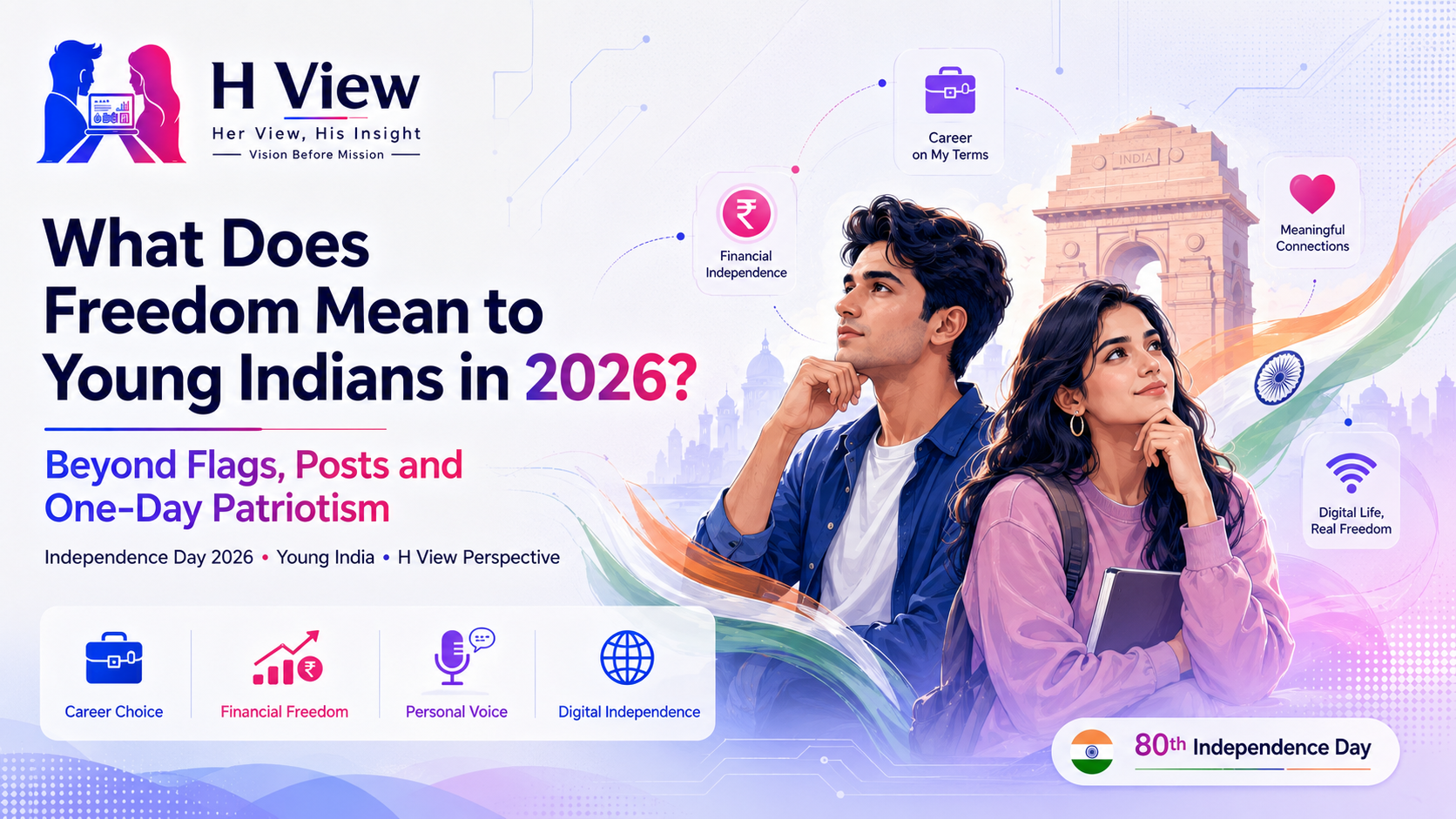
 By AnnapurnaUpdated August 14, 202610 min read42 views
Every August 15, India turns visibly patriotic. Flags appear on balconies and bikes, offices organise celebrations, schools prepare cultural programmes, brands change their colours to saffron, white and green, and social media fills with messages about freedom. For one day, the idea of independence feels everywhere.
But for a young Indian in 2026, freedom is no longer understood only through the story of what happened in 1947.
That history still matters deeply. India’s independence ended British colonial rule and gave the country the right to govern itself. Yet almost eight decades later, a generation that did not experience foreign rule is asking a different set of questions. What does independence mean when you are free as a citizen but still feel trapped by financial pressure, career uncertainty, family expectations, social comparison or the constant need for approval?
That does not reduce the meaning of Independence Day. In many ways, it makes the occasion more personal.
For young Indians today, freedom is increasingly about what happens after political independence has already been achieved: whether an individual can build a life with enough confidence, stability and choice to actually feel independent.
The freedom India celebrates on August 15 was enormous in scale. It was the freedom of a nation to decide its own future after colonial rule. That achievement cannot be compared casually with everyday frustrations such as having a difficult job or disagreeing with parents.
At the same time, national freedom naturally creates another expectation over time: citizens should be able to use that freedom to build meaningful individual lives.
A young person born in 2002, for example, has grown up in an India very different from the country their grandparents knew. They have access to smartphones, digital payments, online education, international entertainment, remote work, global career options and information that earlier generations might have struggled to find.
Yet greater access does not automatically produce greater freedom.
Someone may have hundreds of career options on the internet but feel unable to choose one because they are expected to become an engineer. A woman may earn her own salary but still feel that major decisions about marriage, travel or where she lives require the approval of several relatives. A young man may technically be free to leave an unhealthy job but continue working there because a monthly EMI gives him no financial breathing room.
Freedom looks different when seen from inside everyday life.
Previous generations often associated a stable job with success because stability itself was difficult to achieve. Government jobs, engineering, medicine and a small group of conventional professions became desirable partly because they provided security.
Young Indians today have been exposed to a much larger world of work.
A student may want to become a designer, filmmaker, game developer, digital marketer, entrepreneur, fitness coach, data analyst or content creator. Some may want to work remotely for an overseas company instead of joining a traditional office. Others may want to build a business rather than prepare for another competitive examination.
The options have expanded, but the freedom to choose them can still be complicated.
Imagine a student who finishes engineering and realises during the final year that coding does not interest him. He becomes interested in marketing and spends six months building practical skills. The actual career change may be manageable. Explaining to everyone why an engineering graduate is “leaving engineering” can feel harder.
This is where career freedom becomes more than the availability of jobs. It becomes the freedom to define success differently.
H View has discussed similar questions in our career coverage because many young people are not simply struggling to find employment. They are also trying to understand whether the path they were told to follow is still the path that makes sense for them.
Money does not guarantee happiness, but a lack of financial independence can quietly reduce choice.
A person who cannot support themselves independently may have much less freedom to move cities, leave an unhealthy workplace, pursue a different career or say no to decisions being made on their behalf.
This is particularly visible in the years immediately after graduation.
A 24-year-old earning ₹25,000 per month may technically have a job but still depend on family for housing. Another person earning ₹60,000 may appear more independent but could be paying a large education loan, supporting parents and carrying credit-card debt. Income alone does not tell us how much freedom someone actually has.
Financial independence is therefore less about looking wealthy and more about creating room to make decisions.
It might mean having six months of expenses saved so that losing a job does not become an immediate crisis. It may mean avoiding a car loan simply because colleagues are buying cars. For someone else, it could mean being able to contribute to their parents while still saving for their own future.
There is a quiet form of freedom in not having every decision dictated by the next salary date.
This may be one of the more uncomfortable parts of the conversation.
Indian society has changed dramatically, but comparison remains deeply embedded in everyday life. Earlier, the comparison might have happened between cousins or neighbours. Today, social media gives people thousands of additional lives to compare themselves with.
Someone opens Instagram and sees a former classmate travelling in Europe. Another friend has bought an apartment. Someone else has announced a promotion. A college senior is apparently running a successful startup. By the time the phone is put down, an ordinary life can suddenly feel inadequate.
The strange part is that many of those people may be experiencing exactly the same pressure.
Independence from comparison does not mean refusing ambition. It means being able to separate what you genuinely want from what you have been trained to display.
A person who is happy living in a rented apartment may still feel pressure to buy a home because home ownership is considered proof of success. Someone who does not want children may face questions about when they will “settle down.” A couple may spend beyond their budget on a wedding because a modest celebration might be interpreted as something having gone wrong.
These decisions are legally free.
Emotionally, they may not feel free at all.
Freedom inside relationships is often misunderstood as the ability to do whatever you want.
Healthy personal freedom is almost the opposite. It involves being able to remain yourself while also respecting the people you have chosen to build a life with.
Young Indians today are negotiating relationships in ways that previous generations did not always openly discuss. Inter-caste and interfaith relationships, choosing whether to marry, delaying marriage, living independently after marriage and deciding how much involvement extended families should have can all create tension between individual choice and collective expectations.
There is no easy formula here.
Families can provide extraordinary emotional and practical support. At the same time, care can sometimes become control without anybody intending it to. Parents may believe they are protecting their child while the child experiences the same behaviour as pressure.
The difficult part is learning to distinguish advice from authority.
Real independence does not require rejecting family. It requires reaching a point where affection and respect do not prevent adults from taking responsibility for their own decisions.
Young Indians have more access to information than any generation before them, but there is an irony hidden inside that access.
A smartphone gives us enormous freedom while also becoming one of the easiest ways to lose control of our attention.
We choose when to open Instagram, yet may check it dozens of times without consciously deciding to. We can learn almost any subject online, but an hour intended for research can disappear into short videos. AI can save time by drafting, summarising and analysing information, while dependence on AI can slowly reduce the amount of thinking we do ourselves.
Modern digital freedom may therefore involve something surprisingly simple: the ability to decide where your attention goes.
The person who can put their phone away for two hours and concentrate on one difficult task may now possess a form of independence that is becoming increasingly rare.
Technology should increase our options. When it begins deciding our habits for us, the relationship becomes more complicated.
For many young women, freedom is often experienced through small everyday decisions rather than dramatic acts of rebellion. Being able to travel alone, choose what to study, continue working after marriage, decide when or whether to have children, manage personal money and have opinions that are not automatically treated as disrespectful can matter enormously.
At the same time, independence should not be confused with having to prove that you need nobody. There is nothing less independent about accepting help, valuing family or choosing a traditional life if that is genuinely what you want. The more meaningful freedom is being able to make those choices without feeling that your worth depends on satisfying everyone else.
Young men face a different but equally real set of expectations. Financial success is still strongly connected to how men are judged, and many are taught to carry pressure quietly. A man may dislike his career, struggle financially or feel uncertain about marriage, yet believe that admitting any of those things makes him look weak or irresponsible.
Independence for men should also include the freedom to redefine responsibility. Providing for a family matters, but responsibility should not require destroying your health, remaining in work you cannot sustain or measuring your entire identity through income. A more mature form of independence is knowing what obligations are genuinely yours and what expectations you have simply inherited.
Independence Day should always remain connected to the people who fought for India’s political freedom. Without that freedom, many of the personal choices we debate today would exist in an entirely different context.
But remembering history does not require freezing the meaning of freedom in 1947.
For young Indians in 2026, independence has become an ongoing question about how national freedom translates into everyday life. Can you choose work that suits you? Can you manage your money without constantly performing success? Can you respect your family without surrendering every major decision? Can you use technology without allowing it to consume your attention? Can you build relationships where love does not require losing your identity?
These are not replacements for the meaning of August 15. They are some of the ways that meaning continues.
Perhaps the most useful way to celebrate independence is not only to ask how free our country is.
It is also to ask what we are doing with the freedom we already have.
India celebrates Independence Day on August 15 because the country became independent from British colonial rule on 15 August 1947. The day marks the transfer of power and the beginning of India governing itself as an independent nation.
Yes. The official Independence Day archive identifies 2025 as India’s 79th Independence Day, making August 15, 2026 the 80th Independence Day.
For many young people, freedom extends beyond political rights into practical areas such as choosing a career, achieving financial independence, making relationship decisions, managing social expectations and maintaining control over digital habits.
No. Someone can earn a good income and still have very little financial flexibility because of debt or high expenses. Financial independence is better understood as having enough control over money to make important life decisions without immediate financial fear.
Not necessarily. Personal freedom can coexist with strong family relationships. The important difference is whether advice and cultural expectations help inform a decision or completely remove an adult’s ability to make that decision for themselves.
Beyond celebrations, Independence Day can be an opportunity to understand India’s history, appreciate the freedom inherited from earlier generations and think seriously about how responsibly we use that freedom in our own lives.
Annapurna is an H View contributor covering relationships, family, lifestyle, entrepreneurship, and everyday decision-making. Her articles focus on emotional clarity, practical understanding, and human-centered perspectives that help readers think better about personal and professional situations.
Share your real experience and help other readers decide better.
No community views yet. Be the first to share yours.

Open LinkedIn for a few minutes and you will probably come across a colourful graphic…
Harika October 6, 2026 
When an employee resigns, many organisations move quickly into replacement mode. The manager informs HR,…
Harika October 6, 2026 
For many corporate employees, the workday begins long before they actually start working. They wake…
Harika October 5, 2026 
Many projects begin with an assumption that sounds reasonable on paper: the client will explain…
Harika October 1, 2026