
Plaud One AI Earbuds Explained: Are Earbuds Becoming Personal AI Assistants?
Wireless earbuds have spent the last few years competing on predictable features. Better active noise cancellation, longer battery life, spatial audio, improved microphones and higher-quality Bluetooth codecs have dominated most launches. Plaud One takes a very different route. I
Wireless earbuds have spent the last few years competing on predictable features. Better active noise cancellation, longer battery life, spatial audio, improved microphones and higher-quality Bluetooth codecs have dominated most launches. Plaud One takes a very different route. Instead of asking whether earbuds can sound a little better, Plaud is asking whether the device already sitting in your ears can become a personal AI assistant that remembers conversations and acts on what was discussed.
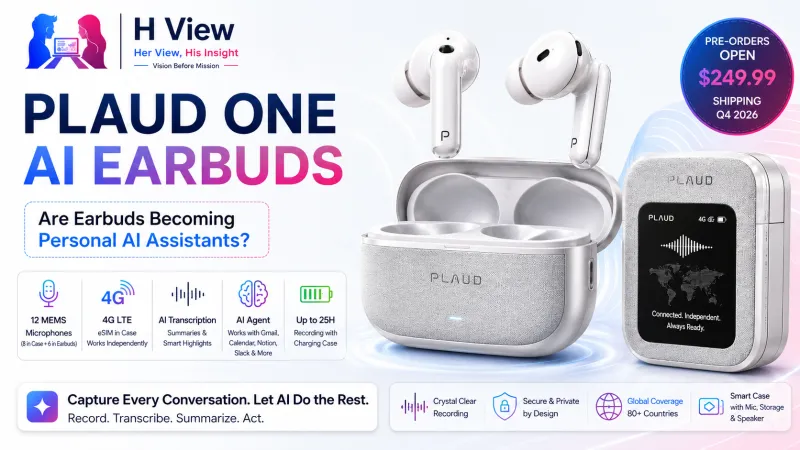
Unveiled in late August 2026 as the Plaud One Explorer Edition, the new earbuds can record phone calls and conversations, transcribe them, produce summaries and feed that context into Plaud’s AI system. The charging case is unusually important too: it includes its own microphones, storage and 4G connectivity through an eSIM, allowing it to work as a standalone recorder without relying constantly on a nearby smartphone or Wi-Fi network.
Plaud is opening pre-orders in selected markets at $249.99, with shipping expected during the fourth quarter of 2026. The product is being presented as an Explorer Edition rather than a mass-market AirPods rival, which is an important distinction. Plaud appears to be testing whether professionals actually want AI note-taking embedded into something as familiar and socially normal as earbuds.
The idea is fascinating, but it also raises an uncomfortable question: do we really want our earbuds listening to enough of our working day to become useful?
Plaud One Is More AI Recorder Than Ordinary Earbud
The easiest mistake would be to judge Plaud One only against AirPods, Galaxy Buds or Nothing Ear.
It is certainly a pair of wireless earbuds. Plaud has equipped it with 12mm drivers and active noise cancellation, so users can listen to music, take calls and use it like a conventional audio product. The bigger purpose, however, is conversation capture. Each earbud contains three microphones, while the charging case contains another four microphones designed for recording meetings and discussions from further away.
That changes how the product should be understood. Conventional earbuds are primarily audio-output devices that happen to include microphones. Plaud One is almost the opposite: it is an AI recording and productivity device that happens to use the form of wireless earbuds.
Plaud already has experience in this category. Its earlier products, including Note and NotePin devices, were designed around recording conversations and turning them into structured notes. The company says more than 2.5 million people now use its hardware or software, suggesting AI note-taking has moved well beyond a tiny experimental niche.
Plaud One takes that existing idea and places it into a device people may already be comfortable wearing for several hours each day.
The Charging Case Is Actually One of the Most Interesting Parts
Normally, an earbud charging case has one job: keep the earbuds charged.
Plaud has turned its case into an independent AI recorder. It includes four microphones, built-in storage, a speaker and cellular connectivity. The microphones are designed to capture voices from up to around five metres away, which means the case can be placed on a conference table while the user leaves the earbuds in their ears or even removes them entirely.
The built-in eSIM is what makes this especially unusual. Because the case has its own 4G LTE connection, Plaud says recordings can be uploaded and processed without depending on the owner’s smartphone or local Wi-Fi. Some reports say the cellular service is intended to work across more than 80 countries.
Imagine attending an hour-long client meeting. Instead of placing a phone face-up in the middle of the table, you could put the Plaud case down and allow it to capture the discussion. When the meeting ends, the recording can move into Plaud Intelligence for transcription and summarisation.
This is the kind of design decision that makes Plaud One more interesting than simply putting an AI button on normal earbuds.
 Also readAI Knows What You Want Before You Search—Is Convenience Becoming Manipulation?→
Recording Is Only the First Step
AI transcription itself is no longer particularly unusual. Zoom, Teams, Google Meet, Otter, Fathom and several other tools can already turn conversations into text and produce summaries.
Plaud’s bigger ambition is to use those conversations as working context.
Its Plaud Agent is designed to connect with services including Gmail, Google Calendar, Notion and Slack. After a conversation is transcribed, the AI can potentially use what was discussed to draft follow-up emails, prepare documents, produce reports or create other work outputs.
Consider a salesperson leaving a customer meeting. A conventional recorder gives them an audio file. A transcription service gives them a written record. Plaud’s intended workflow goes further: recognise that the customer asked for a revised proposal, prepare a summary of the discussion and potentially draft the follow-up email before the salesperson reaches the next meeting.
A consultant could spend an entire day in workshops and ask Plaud to turn the discussions into a structured findings document. An executive could ask what was last discussed with a particular client instead of searching through notebooks, email threads and old recordings. Plaud specifically uses these kinds of professional workflows to explain what it believes agentic AI can eventually do.
That is a much stronger proposition than “AI earbuds that summarise meetings.”
Context Across Multiple Conversations Could Be the Real Breakthrough
The most interesting part of Plaud’s strategy may not be individual meeting summaries at all.
The company wants Plaud Intelligence to preserve enough context across conversations that the AI can understand how projects and relationships develop over time. A meeting from Monday may become useful context for another conversation several weeks later.
This is where AI wearables could eventually become genuinely useful. Human work rarely happens inside isolated conversations. Someone promises something during a call, another decision happens in Slack, and a deadline changes during a later meeting. People are expected to remember how those pieces connect.
An AI system that can organise those fragments could reduce a surprisingly large amount of administrative work.
The difficulty is that useful memory requires access to information, and access creates privacy questions. Plaud One becomes more valuable as it understands more of your conversations, but that same characteristic makes transparency around recording, storage and permissions extremely important.
Battery Life Shows the Difference Between Listening and Recording
Plaud One is not designed around the extreme battery-life numbers often advertised by ordinary earbuds.
Plaud says the earbuds can record approximately six hours of in-person meetings or around three hours of calls on a charge. Combined with the charging case, reports indicate users can get around 25 hours of conversation recording, although figures vary depending on the particular recording mode being discussed.
That sounds modest beside conventional earbuds promising 30, 40 or even 50 hours of music playback, but continuous recording is a different workload. Multiple microphones are active, speech needs to be captured clearly, and recordings eventually need to be uploaded for processing.
For the intended audience, six hours of meeting capture may be more meaningful than 12 hours of Spotify playback. Someone spending an entire workday moving between conversations can repeatedly return the earbuds to the case between meetings.
The product therefore needs to be judged according to the job it is trying to do rather than by the traditional TWS specification checklist.
There Is Also a Subscription Cost After Buying the Hardware
The $249.99 price is not necessarily the full cost of using Plaud One.
According to current launch information, buyers receive 300 minutes of transcription each month, after which additional subscription plans are required. Plans reportedly begin around $8.33 per month when paid annually. Plaud One Explorer Edition buyers also receive approximately $200 in credits intended for upcoming Plaud Intelligence agent features.
This is important because AI hardware increasingly comes with two prices: the price of the physical device and the price of the intelligence running behind it.
Someone attending one or two important meetings a month may remain inside the included allowance. A consultant recording several hours of conversations every day will exceed 300 minutes quickly.
That means the buying decision should not be based only on whether $249.99 seems reasonable for premium earbuds. Potential buyers need to decide whether the recurring AI service is valuable enough to become another subscription.
Plaud One Is Not Coming to India Yet — At Least Not Officially
Plaud itself has just started expanding more seriously into India. Earlier in August, the company launched the Plaud Note Pro at ₹20,990 and NotePin S at ₹19,990, making them available through channels including Amazon, Blinkit and offline retailers.
Plaud One is different. The Explorer Edition pre-order is currently limited to selected international markets, and the sources reviewed for this article do not confirm official Indian availability or an Indian price.
That distinction matters because simply converting $249.99 into rupees would not tell us what Plaud One would actually cost here. Taxes, distribution costs, cellular connectivity arrangements and local subscription pricing could all affect an eventual Indian launch.
Given that Plaud has now formally entered India with other products, an eventual Plaud One launch would not be surprising. It simply should not be treated as confirmed until the company announces it.
Would You Really Replace AirPods or Galaxy Buds With These?
This may be Plaud One’s biggest challenge.
People are extremely attached to their existing earbuds. AirPods integrate deeply with Apple products. Galaxy Buds work closely with Samsung devices. Pixel Buds fit naturally into Google’s ecosystem, while Nothing and CMF increasingly offer strong software integration through Nothing X.
Plaud is asking buyers to consider another priority: productivity.
Someone whose main requirement is excellent music quality may have little reason to switch. Plaud is not positioning One as the ultimate audiophile earbud. Its competitive advantage is recording, transcription and AI workflow automation.
For a lawyer, consultant, journalist, sales executive, founder or manager who spends several hours a day in meetings, that equation changes. The ability to automatically capture and structure conversations could save considerably more time than a slight improvement in sound quality.
For someone who attends two meetings a month, it could be an expensive solution to a problem that a phone app already handles reasonably well.
The Privacy Question Cannot Be Treated as a Footnote
Plaud One also highlights one of the biggest issues facing AI wearables.
Recording a meeting is very different from listening to music. Other people are involved.
Consent laws and workplace policies differ between countries and jurisdictions. Even when recording is legally permitted, people may reasonably expect to know when a conversation is being captured and potentially processed by an AI service.
Earbuds create an additional social challenge because they do not obviously look like recording equipment. A phone placed on the table with a recording interface visible communicates what is happening. Someone wearing ordinary-looking earbuds does not.
For Plaud One to succeed beyond early adopters, the company will need to make recording status, consent practices, privacy controls and data handling extremely clear.
The strongest AI wearable is not the one that can secretly hear the most. It is the one people can trust enough to use openly.
 Also readChatGPT GPT-5.6 Explained: What Changed and Is It Actually Better?→
Are AI Earbuds Becoming a New Gadget Category?
Plaud is not alone in exploring this idea.
TechCrunch notes that companies including Viaim and Anker have already experimented with note-taking earbuds, while numerous AI recording devices now exist as pendants, pins, cards, wristbands and dedicated recorders.
Earbuds may have one fundamental advantage over many of those products: people already wear them.
The AI hardware industry has repeatedly struggled with new form factors. Asking someone to wear an unfamiliar pendant or pin every day creates behavioural friction. Earbuds already have a reason to be present during calls, commuting and work.
That could make them a more natural home for AI assistants than yet another dedicated wearable.
The interesting future is not necessarily an earbud constantly recording everything around you. A more realistic direction may be an earbud that can capture a conversation when asked, understand what matters and then perform a small number of useful actions without requiring the phone to come out of your pocket.
Plaud One is one of the clearest attempts at that future so far.
Her View
The part of Plaud One I find most useful is not the idea of recording every conversation. I would actually be uncomfortable with that becoming normal. What interests me is the ability to remove the repetitive work that comes after an important discussion.
Meetings often end with several small responsibilities: send someone a document, schedule another discussion, remember a deadline, update notes and make sure everyone understood the same decision. Those tasks are easy individually but surprisingly tiring when repeated across a full week.
If Plaud can reliably capture an agreed action and prepare the follow-up without losing the human context, I can see professionals saving a meaningful amount of time. The system becomes much less appealing, however, if using it means constantly thinking about recording permissions or paying for more AI minutes than expected.
For me, Plaud One is exciting as a focused work tool, not as something that should listen to everyday life continuously.
His Insight
Plaud One also illustrates where the AI hardware market is becoming more realistic.
Early AI gadgets often tried to replace the smartphone. That was an enormous promise and usually a bad starting point. Plaud is doing something narrower: take a device people already understand and make one work process substantially easier.
That gives the product a better chance of finding a real audience.
The challenge is that Plaud is competing against software as much as hardware. A good pair of existing earbuds combined with Fathom, Granola, Otter or another note-taking tool may already solve enough of the problem for many people. Plaud therefore has to prove that the dedicated microphones, standalone 4G case and deeper conversational context create a workflow that is meaningfully better than simply running an app.
If they do, the $249.99 price can make sense for professionals. If they do not, Plaud One risks becoming an expensive recorder attached to competent earbuds.
H View Verdict
Plaud One is one of the more interesting gadget launches of 2026 because it does not simply add “AI” to a familiar product and leave the experience unchanged. The earbuds, standalone recording case, eSIM connectivity and Plaud Agent are designed around a specific idea: capture the conversations where work happens, understand what was agreed and turn that information into useful actions.
That concept could be genuinely valuable for people who spend large parts of their working day in meetings, calls and interviews. For them, the most valuable feature may not be transcription at all; it may be avoiding the hour spent later converting those conversations into emails, notes and action items.
The limitations are equally clear. Plaud One costs $249.99 before ongoing AI subscriptions, the Explorer Edition is limited to selected markets, India availability has not been confirmed, and the privacy implications of wearable recording require much more than a small disclaimer.
Final H View Take: Plaud One should not be thought of as a better AirPods alternative for everyone. It is better understood as an AI productivity recorder disguised as a familiar pair of earbuds. If Plaud’s agent features work as promised, this could be an early glimpse of how personal AI assistants actually become useful—not by replacing our phones, but by quietly taking care of the work that begins after a conversation ends.
Frequently Asked Questions
Plaud One Explorer Edition is a pair of wireless earbuds designed around AI note-taking and productivity. The earbuds can record conversations and calls, while Plaud Intelligence can transcribe, summarise and use that information to help generate follow-up work.
The Explorer Edition is priced at $249.99 in the US, with equivalent launch pricing of £229 and €249.90 in selected European markets. Pre-orders opened on 27 August 2026, with shipments expected during Q4 2026.
Its charging case includes an eSIM and 4G LTE connectivity, allowing recordings and AI interactions to work without depending continuously on a nearby phone or Wi-Fi connection.
Yes. The earbuds contain multiple microphones, while the charging case has four microphones designed for capturing in-person conversations from up to approximately five metres away under supported conditions.
Plaud says its AI agent can integrate with services including Gmail, Google Calendar, Notion and Slack. The intended workflows include drafting follow-up emails and generating documents or other outputs from captured conversations. Some advanced agent functions are still part of Plaud’s developing intelligence platform.
Buyers receive a monthly transcription allowance, currently reported at 300 minutes. Users needing more transcription can purchase plans starting at about $8.33 per month when paid annually, and future agentic functions will also use Plaud credits.
Official Indian availability for Plaud One has not been confirmed in the sources reviewed for this article. Plaud has, however, recently launched other AI recording devices in India, including Note Pro and NotePin S.
H View stories follow our editorial policy. Spotted an error? Tell us and we will correct it.
Rate this article
One tap is enough. No comment needed.
Was this article helpful?
Your answer goes straight to our editors.










Comments0
No comments yet. Start the conversation.