

Best Digital Marketing Tools in 2026: What Marketers Actually Need and What They Can Skip
Open LinkedIn for a few minutes and you will probably come across a colourful graphic…
 Harika October 6, 2026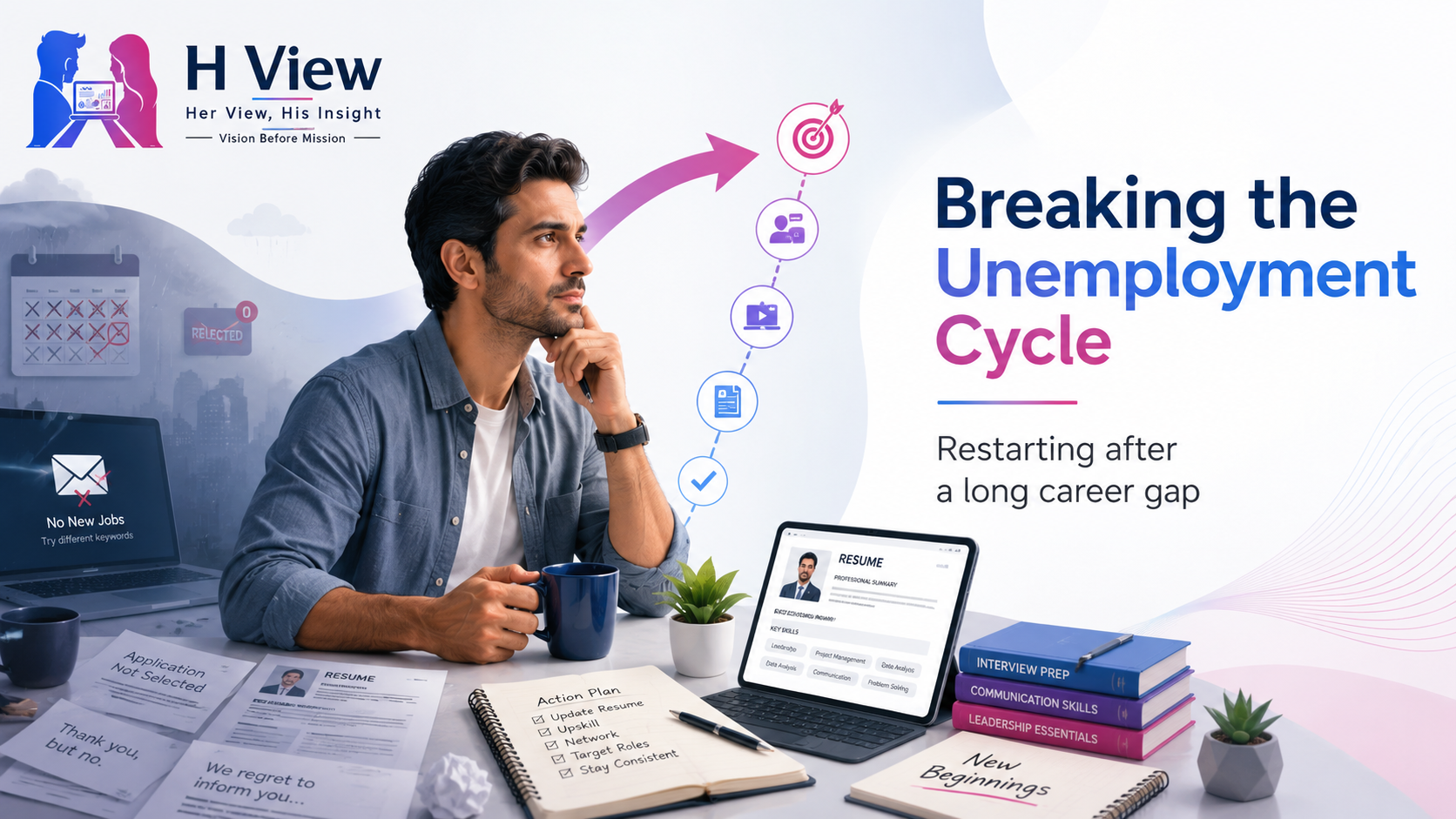
 By Satya HemanthUpdated September 20, 202613 min read38 views
Being unemployed for a few weeks can feel temporary. A few months later, the same situation starts to feel heavier. After a year or more, the problem is no longer only that you do not have a job. The gap itself begins to influence how employers read your profile, how confidently you apply, how current your skills remain, and how willing you are to take risks.
That is why long-term unemployment can become a loop rather than a simple waiting period.
The pattern is often painfully familiar. A person loses a job or leaves one for family, health, study, relocation or personal reasons. The next role does not arrive quickly. The gap grows. Recruiters begin asking what happened during the break. The candidate becomes more self-conscious, applies more randomly, accepts fewer interviews because confidence has dropped, and sometimes keeps waiting for a role similar to the one they had years ago. The longer this continues, the harder re-entry feels.
This is not a rare problem. Recent discussion around India’s labour market has drawn attention to millions of young people who are neither working, studying nor in formal training, while career-gap guidance from major job platforms has become a significant topic in 2026. (timesofindia.indiatimes.com) At the same time, returnship programmes are actively being offered by employers such as Cognizant for experienced professionals who have taken career breaks, which shows that re-entry is difficult but far from impossible. (careers.cognizant.com)
The important question is not whether a long gap permanently ends a career. It does not. The more useful question is how to stop allowing the gap to grow without adding any new evidence that you are ready to work again.
Recruiters usually do not reject a gap simply because empty months exist on a timeline. Their real concern is uncertainty.
If you last worked eight years ago, the recruiter may wonder whether the tools you used are still relevant, whether you can adjust to a modern workplace, whether your salary expectations match your current market value, and whether you can immediately handle the responsibilities of the role. In technology, finance, marketing, HR and operations, workflows can change significantly over several years.
That does not mean your earlier experience becomes worthless. Someone who managed clients, solved operational problems or worked inside a professional team still has valuable knowledge that a fresher may not have.
The problem is that old experience and current readiness are not the same thing.
This is why the re-entry question slowly changes. After six months, the employer may mainly want to understand why you left. After several years, the employer also wants proof of what you can do now.
Research from Ashoka University examining career interruptions found a significant callback penalty for career-break profiles in its study of female applicants, with larger effects in roles where employers placed greater value on recent experience. That research focused on specific profiles and should not be treated as a universal number for every candidate, but it demonstrates something important: employers can place real weight on recency. (papers.ssrn.com)
Imagine someone who worked for two years in software support, left the role, and then spent the next six years trying different things without returning to formal employment.
If those six years included freelance work, updated certifications, practical projects, family business responsibility or continuous learning, the story is very different from six years in which the candidate completely disconnected from the field.
Both resumes still show a break from full-time employment.
But only one candidate has recent evidence.
This is why the worst strategy during unemployment is to treat every day as a waiting room. If the plan becomes, “I will start learning again once I get a job,” the candidate is asking the employer to take the entire risk.
A better approach is to create something current before the job arrives.
That may be a project, a certification with practical output, contract work, freelance work, volunteering, consulting for a small business, or even a documented case study relevant to the target role. The activity does not need to be glamorous. It simply needs to show that the candidate is active now, not frozen at the point where the old career stopped.
Long-term unemployment often changes how people search.
At first, a candidate applies only to roles similar to their previous job. After repeated rejection, the search widens. Soon the same resume is being sent to customer support, operations, HR, administration, testing, sales, analytics and project coordination roles.
It feels productive because the application count rises.
But the profile becomes harder to position.
A recruiter hiring for operations may see an outdated technical resume. A recruiter hiring for support may see skills that do not match the vacancy. The candidate then receives fewer callbacks, becomes more anxious and increases application volume even further.
The solution is not necessarily to apply less. It is to target more clearly.
Someone returning after a long gap should usually choose one primary re-entry direction and one realistic adjacent option. The resume should explain the earlier experience in a way that supports that direction, while recent learning or projects should demonstrate current relevance.
A person with old banking-operations experience might target operations, compliance support or customer-process roles rather than applying to every corporate vacancy. Someone with previous software experience may return through testing, support, implementation or junior development depending on what skills they have refreshed.
The search becomes easier when the employer can understand the career story quickly.
This distinction matters emotionally and professionally.
People with long gaps sometimes begin describing themselves as though they are freshers again. That is usually inaccurate.
If you worked for three years before a career break, you still worked for three years. You learned how managers communicate, how deadlines behave in the real world, how customers respond, and how teams handle mistakes. Those experiences do not vanish because time passed.
At the same time, you cannot necessarily demand the exact market position you would have reached if those eight years had been continuous employment.
That is the uncomfortable middle ground.
You are not a fresher.
You may also not be immediately competitive with someone who has ten continuous years of recent experience.
The healthiest restart strategy accepts both facts.
This may mean returning at a lower level than you originally expected, accepting a temporary salary reset, or entering through a contract role. That can feel emotionally difficult, especially if former colleagues are now managers or earning much more.
But a temporary step backward can sometimes create forward momentum faster than another two years of waiting for the perfect role.
Consider someone who worked as an operations executive eight years ago and earned ₹35,000 per month before leaving the workforce.
They return to the market expecting at least ₹60,000 because eight years have passed and salaries have increased. On paper, that expectation feels reasonable.
But employers are comparing them with candidates who have spent those eight years continuously managing current tools, processes and teams.
A company may offer ₹30,000–₹40,000 for a re-entry role.
The candidate rejects it because the salary feels like going backwards.
Another year passes.
Now the gap is nine years.
The decision becomes even harder.
This does not mean everyone should accept any low offer. Employers can exploit vulnerable job seekers, and poor-quality roles with no learning value may not help.
The more useful question is whether the role can rebuild recent experience, current references and market credibility.
Sometimes the value of the first role after a long gap is not the first month’s salary. It is what that role makes possible twelve months later.
Trying to make a long career break invisible usually creates more problems.
Recruiters can see missing dates. Background checks may expose invented employment. Fake experience certificates can create much larger problems than the original gap.
Indeed India’s current guidance recommends acknowledging employment gaps and being prepared to explain them clearly rather than avoiding the subject. (in.indeed.com) Naukri’s 2026 guidance similarly treats career breaks as something candidates should explain professionally rather than conceal. (naukri.com)
The explanation does not need to become a life story.
A clear line is usually stronger than defensive paragraphs.
For example, someone who took time away for family responsibilities can state that fact briefly and then shift attention to current readiness. Someone who prepared for government examinations can mention the preparation period honestly and explain that they have now chosen to return to the private sector.
The recruiter ultimately wants to know two things: why the gap occurred, and why the candidate is ready now.
The second answer matters more.
Long-gap candidates often react by joining too many courses.
Someone with previous IT experience may suddenly learn Python, Java, cloud, cybersecurity, data science and AI because they feel they need to compensate for the gap.
This can waste months.
Start with the target role instead.
Look at 20 or 30 current vacancies and identify what has changed since you last worked. If your old role still exists but now requires a new CRM, analytics tool or cloud platform, learn that gap specifically.
Your old knowledge is the foundation. Current learning should update it.
The question is not, “How do I become a completely new person?”
It is, “What evidence will make my previous experience useful again?”
That mindset makes re-entry much less overwhelming.
One important development is the growth of structured return-to-work programmes.
Cognizant, for example, currently advertises a returnship programme for professionals with at least three years of prior experience and a career break of twelve months or more. Its programme is specifically designed to bring experienced professionals back into work through current technical roles. (careers.cognizant.com)
These programmes are useful because they recognise the real problem: experienced people with gaps do not always need to start their careers from zero. They may need a structured period to refresh context and prove current capability.
Contract roles can work similarly.
Many candidates avoid contracts because they believe only permanent employment counts as a real career restart. That can be too rigid. A six- or twelve-month contract with genuine responsibilities can create recent work history, new references and updated skills.
The important distinction is between a legitimate role with real work and a fake consultancy promising fabricated experience.
One rebuilds credibility.
The other can destroy it.
The most painful part of a long career gap is often not technical.
It is psychological.
After enough rejection, people start editing themselves before employers even have a chance to reject them. They avoid applying to strong companies because they assume the gap will disqualify them. They become uncomfortable when someone asks what they do for work. Interviews feel less like professional conversations and more like interrogations about the missing years.
That loss of confidence can make the candidate appear less capable than they actually are.
A person who once managed difficult customers or handled serious responsibilities may struggle to explain a simple project because they are focused entirely on whether the interviewer is judging the gap.
Re-entry requires rebuilding the professional identity as much as the resume.
That happens through action. Completing a real project, attending interviews, doing contract work and speaking with professionals in the industry gradually gives the person recent experiences to talk about.
The gap stops becoming the only story.
Recruiters are making risk decisions.
When they see someone with an eight-year gap, their concern is usually not moral judgement. They want to know whether the person can perform now, whether the skills are current and whether the transition back into full-time work will succeed.
Telling them, “Give me one chance and I will prove myself,” places all the uncertainty on the employer.
Showing them a current project, updated certification, freelance assignment or recent returnship changes the conversation.
The candidate is demonstrating that the restart has already begun.
This is also why waiting for a company to rescue your career is a weak strategy. The most convincing re-entry candidate is someone who has already created momentum before the offer letter arrives.
Long-term unemployment feels enormous when you think about fixing everything at once.
A shorter timeline makes the problem more manageable.
During the first month, choose the role you are genuinely targeting and study the current market. Rewrite the resume around that role, update LinkedIn, and identify exactly which skills are outdated.
During the second month, build recent evidence. Complete one relevant practical project, assignment, certification or freelance activity. Start reconnecting with former colleagues and industry contacts without immediately asking everyone for a job.
During the third month, begin a focused application cycle. Apply to roles that genuinely match, including smaller companies, contract positions and returnship opportunities. Track which applications produce responses and change the strategy based on evidence.
The objective of those ninety days is not necessarily to guarantee employment.
It is to stop the career gap from remaining empty.
That alone changes the re-entry story.
The longer someone remains unemployed, the harder returning can become. That is real. Recent skills matter, recruiter confidence matters, and long gaps can create more questions than short ones.
But difficulty is not the same as impossibility.
An eight-year career gap does not erase the person who worked before it. What matters is whether that older experience can be connected convincingly to what the market needs today.
The biggest mistake is waiting for a job before restarting the career.
Restart first.
Choose a direction. Refresh the specific skills required for it. Build recent evidence. Explain the gap honestly. Consider contract roles, returnships and smaller companies instead of waiting only for the ideal permanent job and previous salary level.
Once recent experience appears on the resume again, the problem changes. The candidate is no longer only “someone with an eight-year gap.”
They become someone who had a gap and has already returned.
That distinction can be the beginning of the next career rather than the end of the previous one.
Yes, although re-entry may require updated skills, recent evidence of work and flexibility around the first role. Structured returnships, contract positions, projects and targeted applications can all help rebuild recent experience.
No. Long gaps should be explained briefly and honestly. Trying to invent employment or use fake experience can create serious background-verification problems.
Not necessarily. Your previous experience still counts, but you may need to consider junior, returnship or transitional roles depending on how current your skills are and how long you have been away.
Sometimes a temporary salary reset can make sense if the role provides genuine experience, current skills and a path to future growth. It should still be evaluated carefully for fairness and career value.
Start with current job descriptions for your target role. Identify the specific tools and requirements that changed during your gap rather than collecting unrelated certificates.
Yes. Some employers run returnship or re-entry programs. Cognizant currently advertises a program for professionals with prior experience and a career break of at least twelve months. Eligibility varies by program and should always be verified on the employer’s official careers page. (careers.cognizant.com)
Satya Hemanth is the founder of H View and writes on careers, sports, leadership, digital trends, and practical decision-making. His articles focus on clear explanations, real-world examples, and useful insights for students, young professionals, and everyday readers.
Share your real experience and help other readers decide better.
No community views yet. Be the first to share yours.
Open LinkedIn for a few minutes and you will probably come across a colourful graphic…
Harika October 6, 2026 
When an employee resigns, many organisations move quickly into replacement mode. The manager informs HR,…
Harika October 6, 2026 
For many corporate employees, the workday begins long before they actually start working. They wake…
Harika October 5, 2026 
Many projects begin with an assumption that sounds reasonable on paper: the client will explain…
Harika October 1, 2026