

Smartphones Launching in India in August 2026: Confirmed Models, Expected Prices and Who Should Wait
August 2026 is shaping up to be an important month for Indian smartphone buyers. Google…
 Harika August 3, 2026
  By HarikaUpdated September 20, 20269 min read44 views
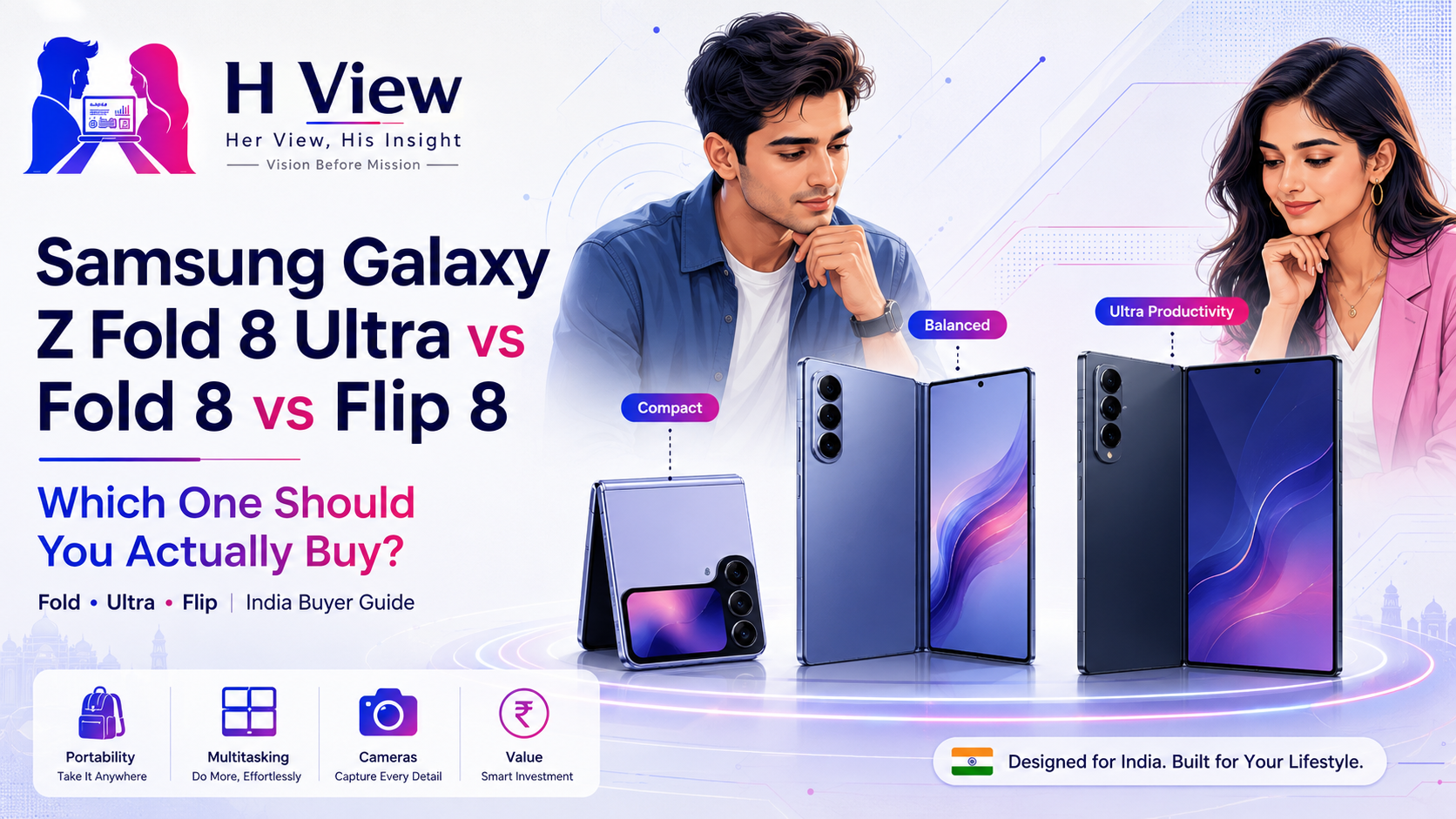
Samsung’s 2026 foldable lineup is no longer a single expensive Fold accompanied by a smaller Flip. This year, Indian buyers have three clearly different choices: the Galaxy Z Flip 8, the newly positioned Galaxy Z Fold 8, and the top-end Galaxy Z Fold 8 Ultra.
The prices make the decision serious.
The Galaxy Z Flip 8 starts at ₹1,24,999, the Galaxy Z Fold 8 at ₹1,79,999, and the Galaxy Z Fold 8 Ultra at ₹1,99,999. Samsung says the three devices together received more than 271,000 Indian pre-orders within 72 hours, with 45% coming from Tier-2 cities and smaller markets.
Foldables are clearly attracting interest. But popularity does not automatically mean a foldable is the right purchase.
At these prices, the real question is:
What can a foldable give you that a conventional premium smartphone cannot?
| Model | RAM / Storage | Official Price |
|---|---|---|
| Galaxy Z Flip 8 | 12GB + 256GB | ₹1,24,999 |
| Galaxy Z Flip 8 | 12GB + 512GB | ₹1,44,999 |
| Galaxy Z Fold 8 | 12GB + 256GB | ₹1,79,999 |
| Galaxy Z Fold 8 | 12GB + 512GB | ₹1,99,999 |
| Galaxy Z Fold 8 | 16GB + 1TB | ₹2,39,999 |
| Galaxy Z Fold 8 Ultra | 12GB + 256GB | ₹1,99,999 |
| Galaxy Z Fold 8 Ultra | 12GB + 512GB | ₹2,19,999 |
| Galaxy Z Fold 8 Ultra | 16GB + 1TB | ₹2,59,999 |
These are Samsung’s official Indian launch prices.
That immediately creates an interesting problem: the 256GB Fold 8 Ultra costs only ₹20,000 more than the standard Fold 8, while the 512GB Fold 8 costs the same ₹1,99,999 as the 256GB Ultra.
So storage requirements can completely change which device represents better value.
The Galaxy Z Flip 8 is the easiest of the three to understand.
It behaves much more like a conventional smartphone when opened, but folds into a smaller body for carrying around.
Samsung says it weighs 180g and measures just 6.1mm when unfolded, making it the company’s lightest and slimmest Flip yet. The redesigned FlexWindow allows users to see notifications, personalised Now Brief updates and use Gemini features without opening the phone.
Its main camera is a 50MP unit supported by Samsung’s ProVisual Engine, while Flex Mode enables hands-free photos and videos from different angles.
What you are paying for here is primarily form factor and convenience, rather than a tablet-like productivity experience.
That makes the Flip 8 arguably the easiest foldable to recommend to someone who simply wants a more interesting everyday smartphone.
The Galaxy Z Fold 8 is particularly interesting because Samsung has repositioned it.
Samsung describes the Fold 8 Ultra as the direct successor to what previous buyers knew as the traditional Galaxy Z Fold, while the regular Fold 8 is a redesigned form factor focused more on content consumption and portability.
It weighs only 201g, making it Samsung’s lightest Galaxy Z Fold yet.
The device uses a 10:16 cover-screen ratio when folded and a 4:3 inner display when opened. Samsung says that combination is intended to make social media and everyday interactions comfortable on the outside while providing more room for movies, games, reading and multitasking inside.
It also includes:
Samsung has also introduced Flex Titanium in the foldable display structure, which it says is designed to improve durability and reduce the visibility of the crease over time.
At ₹1,79,999, the Fold 8 is still extremely expensive.
And unlike the Ultra, Samsung says the regular Fold 8 does not support the S Pen.
The bigger issue is price positioning.
Spend ₹20,000 more and the Fold 8 Ultra provides a larger display, a significantly more ambitious camera system and a larger battery.
That means the standard Fold 8 makes the most sense for buyers who specifically value its lighter 201g body and more compact form.
If maximum productivity is the reason you are buying a Fold, the Ultra is harder to ignore.
Samsung describes the Galaxy Z Fold 8 Ultra as its most advanced productivity-focused foldable.
Its main display measures 8 inches, while the device is only 4.1mm thick when unfolded and weighs 215g.
The Ultra also receives the strongest camera hardware of the lineup:
Performance comes from the Snapdragon 8 Elite Gen 5 for Galaxy, paired with a 5,000mAh battery and 45W charging.
This is the model designed for people who genuinely intend to use the unfolded screen for work.
The Ultra makes more sense for:
Running email, documents, communication tools and reference material side by side can genuinely benefit from a larger screen.
The combination of the larger display, 200MP camera and more advanced video options gives creators more flexibility than the standard Fold.
If you regularly move between spreadsheets, messaging, browser tabs, documents and AI tools, the unfolded display can reduce the need to constantly switch apps.
A foldable can occasionally replace carrying a separate small tablet for reading, entertainment and light productivity.
But this does not automatically make it a laptop replacement.
Long documents, serious spreadsheet work, development, professional video editing and many business applications remain substantially more comfortable on a laptop.
| Feature | Flip 8 | Fold 8 | Fold 8 Ultra |
|---|---|---|---|
| Starting price | ₹1,24,999 | ₹1,79,999 | ₹1,99,999 |
| Main idea | Compact foldable | Lightweight big-screen foldable | Maximum productivity |
| Weight | 180g | 201g | 215g |
| Battery | 4,300mAh | 4,800mAh | 5,000mAh |
| Main camera | 50MP | 50MP | 200MP |
| Best for | Everyday premium users | Media and portability | Work and creators |
| Maximum storage | 512GB | 1TB | 1TB |
Samsung’s published specifications establish a clear hierarchy: Flip 8 prioritises compactness, Fold 8 balances weight and large-screen content consumption, while Fold 8 Ultra adds more screen, camera hardware and productivity capability.
This remains one of the most important questions with any foldable.
Samsung has continued strengthening the hinge and inner display. The Fold 8 uses an Armor FlexHinge, Armor Aluminum, Gorilla Glass and the new Flex Titanium display structure.
However, a foldable still contains more mechanically complex components than a conventional slab phone.
You have:
That does not mean the phones are fragile, but it does mean someone spending ₹1.8–2.6 lakh should think seriously about accidental-damage coverage.
Samsung offers a two-year Samsung Care+ protection option for the new Fold lineup, while its Galaxy Forever programme combines accidental-damage protection with an upgrade or return option and an assured buyback value of up to 55%, subject to its terms.
They are considerably closer.
The Fold 8 weighing only 201g is particularly important because older book-style foldables often felt noticeably heavier than conventional phones. Samsung has also improved brightness, hinge engineering and display construction.
But maturity and value are different questions.
A foldable may now be practical enough to use every day while still being unnecessary for most buyers.
For someone using WhatsApp, Instagram, YouTube, calls, banking and photography, a conventional premium smartphone can accomplish the same tasks for substantially less money.
Foldables justify themselves when the folding screen changes how you actually use the device.
Choose a foldable when you regularly think:
“I wish my phone had more screen space.”
Do not choose one merely because:
“It looks futuristic.”
At ₹1.25 lakh to ₹2.6 lakh, novelty is an expensive reason to upgrade.
Conventional flagship phones still offer advantages such as:
The foldable needs to solve a specific problem for you.
You want the foldable experience primarily for compactness, design, selfies and everyday usage.
H View pick: Best foldable for most first-time foldable buyers.
You want a larger display but care strongly about keeping weight under control.
Its 201g weight is unusually impressive for a book-style foldable.
H View pick: Best balance between portability and large-screen experience.
You will genuinely use the large screen for productivity, content creation, multitasking and advanced photography.
The ₹20,000 difference between the base Fold 8 and base Ultra makes the Ultra particularly compelling for serious Fold buyers.
H View pick: Best overall Samsung foldable if budget is not the primary concern.
Skip this generation if:
A conventional flagship will make more financial sense for many buyers.
Foldable phones finally feel less like technology demonstrations and more like products people can realistically use every day.
But the appeal should come from convenience.
The Flip 8 is compelling because it becomes smaller. The Fold models are compelling because they become larger.
If neither transformation improves the way you use your phone, there is little reason to pay the foldable premium.
The most interesting device here may actually be the Fold 8 rather than the Ultra.
Reducing a book-style foldable to 201g addresses one of the category’s biggest practical problems. But Samsung’s pricing creates internal competition: buyers spending ₹1.8 lakh may reasonably decide that another ₹20,000 for the Ultra provides significantly more hardware.
That makes the Fold 8 a specialised choice rather than the automatic default.
Best for most foldable buyers: Galaxy Z Flip 8
Best for portability plus a large screen: Galaxy Z Fold 8
Best for productivity and creators: Galaxy Z Fold 8 Ultra
Best value for most smartphone buyers: Stay with a conventional flagship.
The Fold 8 Ultra is the most capable device of the three, but capability does not automatically create value.
At nearly ₹2 lakh, buy it because you already know how the folding display will improve your daily work—not because you hope to discover a reason after purchasing it.
The Galaxy Z Fold 8 starts at ₹1,79,999 for 12GB RAM and 256GB storage.
The Fold 8 Ultra starts at ₹1,99,999 and reaches ₹2,59,999 for the 16GB RAM and 1TB version.
Samsung has priced the 256GB Galaxy Z Flip 8 at ₹1,24,999 and the 512GB version at ₹1,44,999.
The Fold 8 Ultra has the more advanced system, including a 200MP primary camera, 50MP ultrawide and 3x optical telephoto camera.
For buyers prioritising productivity and photography, the larger display, 200MP camera, telephoto lens and 5,000mAh battery make the ₹20,000 jump relatively easy to justify. For users prioritising low weight and portability, the standard Fold 8 may make more sense.
No. Samsung states that the Galaxy Z Fold 8 does not support S Pen.
Harika is the co-founder of H View and covers AI, technology, gadgets, digital tools, online platforms, and modern internet trends. Her articles focus on simplifying complex topics with practical explanations, balanced opinions, and reader-first insights.
Share your real experience and help other readers decide better.
No community views yet. Be the first to share yours.
August 2026 is shaping up to be an important month for Indian smartphone buyers. Google…
Harika August 3, 2026