
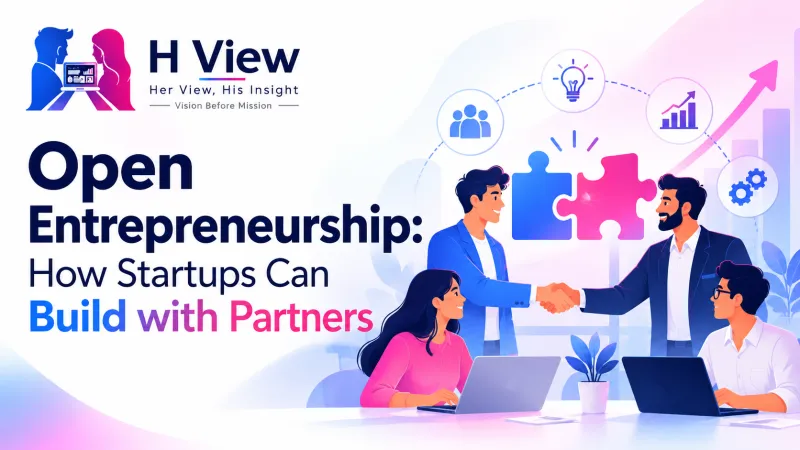
Open Entrepreneurship: How Startups Can Build with Partners
What open entrepreneurship means, how founders can work with customers and partners, and a practical pilot plan that protects ownership, data and trust.
Open entrepreneurship means building a venture with useful knowledge and capabilities from beyond the founder’s own organisation—such as customers, suppliers, research institutions, other startups or community groups. The goal is to solve a real problem faster or better through collaboration, while being deliberate about what information, ownership and risk each partner shares.
What does open entrepreneurship mean for a founder?
The phrase is used in different ways, and it does not describe one legal structure or a promise to give away intellectual property. In practice, it describes an entrepreneurial approach that crosses organisational boundaries. A founder may learn from prospective customers, test a product with a partner, license technology, co-develop a service, or connect a small venture to a larger distribution network.
It is related to open innovation: ideas and knowledge can flow into and out of a firm, instead of every solution being created and commercialised entirely in-house. For an early-stage business, openness can help fill gaps in expertise, equipment, reach or credibility. It can also expose a founder to costly delays, conflicting incentives or misuse of confidential information. The useful question is not “Should we be open?” but “Which boundary should we open, with whom, and for what outcome?”
How can a small business collaborate without losing control?
- Start with one customer problem. Write down who experiences it, what they do today and what would count as improvement. Do not begin with a partnership announcement or a technology looking for a market.
- List the missing capability. It might be product testing, packaging, software, a specialist skill, distribution or access to a user group. Be specific enough to choose a partner for the gap.
- Choose a partner whose incentives fit. A customer can give candid feedback; a supplier can improve production; a university lab may help validate a technical idea; another small firm may bring a complementary service. Check references, decision speed, conflicts of interest and ability to deliver.
- Design a limited pilot. Define the result, duration, responsibilities, cost, data access, decision rights and what happens if the test stops. A 30-day prototype or a small batch is easier to learn from than an open-ended commitment.
- Put boundaries in writing. Record who owns existing work, who owns new work, what can be shared, how customer information is protected, how either side can exit and whether either party can reuse the learning. Seek qualified legal advice before signing complex IP, investment or exclusivity terms.
- Review evidence, then decide. Compare the pilot with the starting point: quality, customer response, time, cost and reliability. Continue only if the collaboration creates value that justifies its coordination and risk.
 Also readBusiness Money or Household Money? A Simple System for Women-Led Small Businesses to Keep Them Separate→
What could open entrepreneurship look like in India?
Imagine a small food producer trying to make a shelf-stable product for local retailers. The founder can ask buyers which pack sizes move, work with a food technologist on safe shelf-life testing, and discuss delivery with a regional distributor. Each partner contributes different knowledge. The producer still needs clear quality controls, accurate labels, a fair commercial agreement and careful handling of customer or supplier data. Collaboration can shorten learning; it does not replace compliance or product responsibility.
The same pattern can help a craft collective, a women-led enterprise, a software startup or a neighbourhood service business. Start with the smallest exchange that can test an assumption. Share only the information needed for that test, and do not promise a partner access to customers, data or ownership that the business cannot safely provide.
When is an open approach useful—and when is it not?
It is useful when a venture has a clear gap, a capable partner, a measurable shared outcome and a manageable way to protect sensitive knowledge. It is less useful when the product’s core advantage depends on a secret that cannot be protected, when partners disagree about who serves the customer, or when coordination costs exceed the value of the extra capability.
Research offers a reason to be selective rather than starry-eyed. A 2023 study examined 405 innovative startups in the United Kingdom across 2002–2016, representing 4,401 firm-year observations. It found that open-innovation effects vary with the type and location of external partner. That is a case for choosing collaborations carefully, not a guarantee that openness will improve every startup’s results.
 Also readWhy Women Running Home Businesses Undercharge—and How to Price Your Work Properly→
Open entrepreneurship: frequently asked questions
Is open entrepreneurship the same as open-source business?
No. Open-source licensing is one possible model for sharing software or other work under defined terms. Open entrepreneurship is broader: it can include customer co-design, supplier partnerships, research collaboration, licensing or shared routes to market without making the whole product open source.
Does a startup need to share its idea publicly?
No. A founder can collaborate selectively, disclose only what a partner needs, and use written confidentiality and ownership terms where appropriate. Some conversations can happen without revealing the core method or sensitive customer information.
What is a safe first step?
Run a small pilot around one assumption, with a short timeline and written responsibilities. Agree on what success means and what information may be used after the pilot ends.
Further reading
H View stories follow our editorial policy. Spotted an error? Tell us and we will correct it.
Rate this article
One tap is enough. No comment needed.
Was this article helpful?
Your answer goes straight to our editors.




Comments0
No comments yet. Start the conversation.