Stop Replacing Employees Who Leave. Start Fixing Why They Wanted to Leave
When an employee resigns, many organisations move quickly into replacement mode. The manager informs HR,…
 Harika October 6, 2026
  By HarikaUpdated October 6, 202616 min read3 views
Open LinkedIn for a few minutes and you will probably come across a colourful graphic promising the “perfect digital marketing stack.” One section recommends multiple SEO platforms, another lists several social-media schedulers, and the next adds analytics tools, email platforms, AI writers, design applications, local SEO software and advertising dashboards. By the time you reach the bottom of the graphic, digital marketing can start to look less like a profession built around understanding customers and more like an expensive collection of subscriptions.
That is where many lists of digital marketing tools become less useful than they first appear. They are usually very good at showing what exists, but they rarely explain which tools solve genuinely different problems, which ones overlap heavily and which ones a smaller business can safely ignore. A freelancer managing three clients, a blogger building organic traffic, a local restaurant depending on Google Maps and a national e-commerce brand all need very different technology stacks, so copying the same list rarely makes sense.
The situation has become even more complicated in 2026 because artificial intelligence is now being added almost everywhere. SEO platforms are tracking AI visibility, social-media tools are adding AI-assisted publishing, content platforms are generating and optimizing copy, analytics products are becoming more predictive, and design tools increasingly include planning, collaboration and direct publishing. The result is greater capability, but it also creates far more overlap, which means choosing tools intelligently has become a strategy decision rather than a software-shopping exercise.
A few years ago, the boundaries between marketing tools were easier to understand. An SEO platform focused on keywords and backlinks, a social-media scheduler published posts, an email platform sent newsletters and a design tool created graphics. In 2026, many of those boundaries have blurred because the leading products are trying to own larger portions of the marketer’s workflow.
Semrush, for example, now presents its offering as more than traditional keyword research. Its current feature set includes competitor research, content tools, local search capabilities and AI visibility tracking across services such as ChatGPT, Gemini, Claude, Perplexity and Google AI Overviews. (semrush.com) Ahrefs has moved in a similar direction, describing itself as a platform for visibility across search, AI and the broader web, with tools for keywords, backlinks, technical audits and brand visibility in AI systems. (help.ahrefs.com)
The same overlap is happening outside SEO. Canva can now handle not only design but also content planning and direct scheduling to major social platforms, while its business offering combines creation, collaboration, content calendars and performance insights. (canva.com) This convergence is convenient, but it also means marketers need to ask whether a second or third tool is genuinely adding a capability they do not already have.
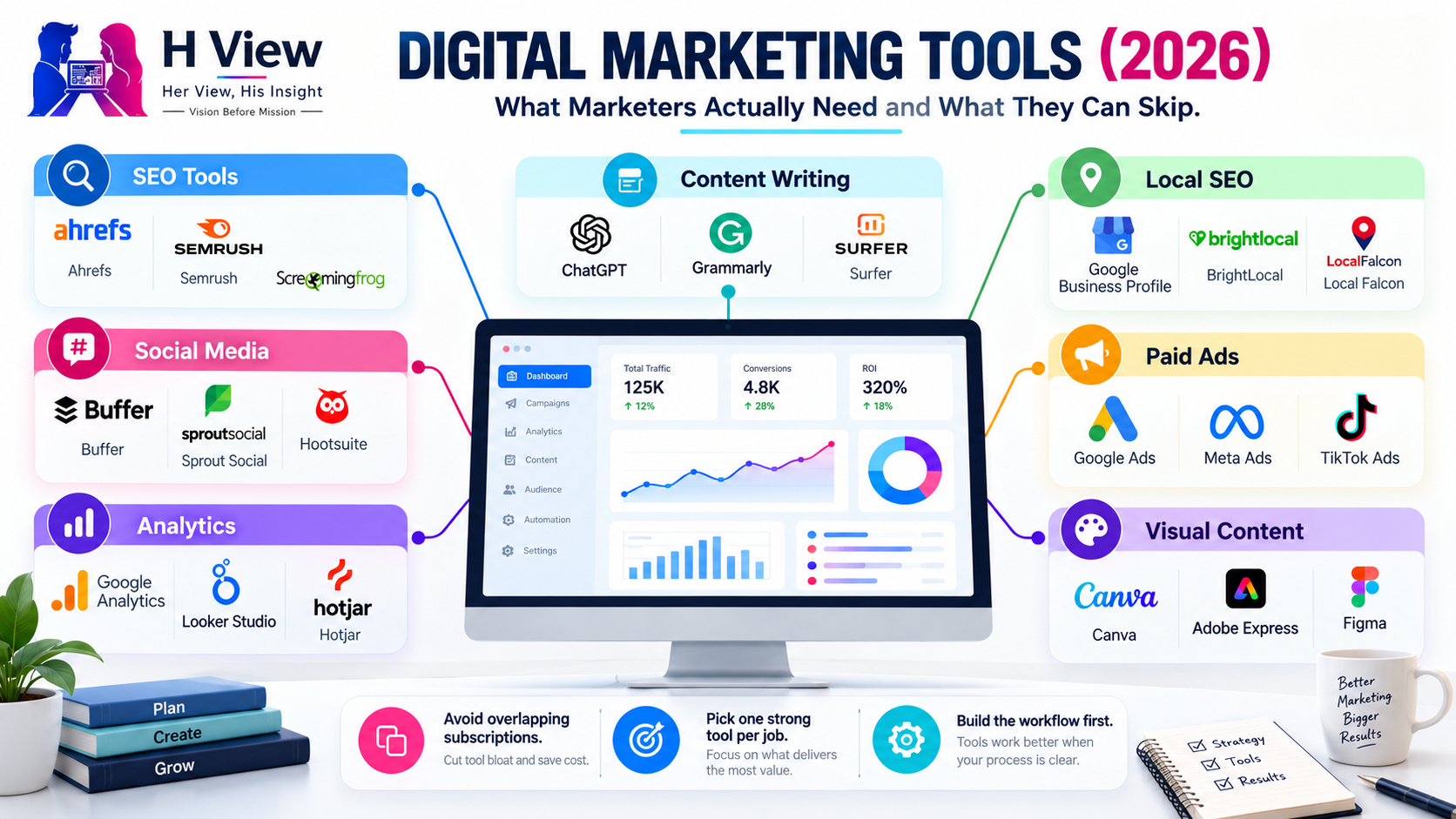
The most useful way to look at digital marketing software is not by asking which tools are popular, but by asking which problem needs to be solved. A business normally needs capabilities across search, content, social media, paid acquisition, analytics, email and visual creation, but it does not need three tools in every category. The table below shows a practical way to think about the current landscape without assuming that every platform must be purchased.
| Marketing Need | Popular Tools in 2026 | What They Are Best Used For |
|---|---|---|
| SEO & Search Research | Ahrefs, Semrush, Screaming Frog | Keywords, competitors, backlinks, technical audits and AI-search visibility |
| Content & Writing | ChatGPT, Grammarly, Surfer, Semrush Content Toolkit | Research, drafting, editing, optimization and repurposing |
| Social Media | Buffer, Sprout Social, Hootsuite | Scheduling, engagement, publishing and reporting |
| Local SEO | Google Business Profile, BrightLocal, Local Falcon | Maps visibility, listings, reviews and local rank tracking |
| Paid Advertising | Google Ads, Meta Ads, TikTok Ads | Paid search, social acquisition, remarketing and conversion campaigns |
| Analytics | Google Analytics, Looker Studio, Hotjar | Traffic measurement, reporting, dashboards and behavioural analysis |
| Email Marketing | Brevo, Mailchimp, ActiveCampaign | Campaigns, newsletters, automation and segmentation |
| Visual Content | Canva, Adobe Express, Figma | Social graphics, campaign assets, presentations and collaborative design |
A small business could realistically operate with one strong tool from only a few of these categories, especially if organic search, social media and email are its main channels. A larger marketing team may justify a much broader stack because multiple people need collaboration, approval workflows, reporting and advanced research. The important point is that the tool stack should follow the business model rather than the latest infographic.
SEO is one of the easiest places to overspend because several premium platforms appear to offer similar features. Ahrefs and Semrush both cover keyword research, competitor analysis and broader organic-search research, while Screaming Frog is commonly used as a technical crawler for diagnosing page-level issues. These products overlap, but they do not necessarily solve the same problem in the same way.
Ahrefs remains particularly useful when backlink analysis, competitor pages, keyword research and technical investigation are central to the workflow. Its current SEO Toolbar can show on-page structure, redirects, HTTP headers, broken outgoing links, Web Vitals, SERP positions and keyword ideas directly while browsing, while paid users can also access metrics such as search volume, keyword difficulty and page-level SEO data. (help.ahrefs.com) Its broader product now also includes Brand Radar for monitoring brand visibility across AI platforms, demonstrating how traditional SEO tools are adapting to AI-powered discovery. (ahrefs.com)
Semrush takes a broader marketing-suite approach. Its current platform combines keyword research, competitor analysis, local search tools, content creation and AI visibility tracking, making it attractive to marketers who want several functions inside one ecosystem. (semrush.com) Its AI visibility tools are specifically designed to track brand mentions and recommendations across AI platforms and Google AI Overviews, showing how the definition of “search visibility” is expanding beyond traditional ranking positions. (semrush.com)
Screaming Frog, on the other hand, becomes especially useful when the question is technical rather than competitive. If you need to crawl a website, identify redirect chains, inspect duplicate metadata, find broken links or audit page-level implementation, a crawler provides a different kind of value from a keyword-research platform. For a small site, however, Google Search Console, free browser tools and one paid SEO platform may already provide enough information, so purchasing everything at once is rarely necessary.
Content marketing has changed dramatically because generative AI has reduced the time required to research, organize and draft material. ChatGPT can assist with idea generation, topic research, outlining and rewriting, while Grammarly helps with language clarity and tone, and optimization platforms can provide additional search-focused recommendations. Semrush itself now offers a content toolkit that can generate articles, optimize existing content and repurpose published material into emails and social posts. (semrush.com)
The availability of these tools does not automatically improve the quality of what gets published. In fact, the opposite can happen when businesses begin producing more content simply because production has become easier. A hundred generic articles generated quickly can create more maintenance work, weaker brand identity and less value than ten genuinely useful articles built around real audience problems.
The strongest use of AI in content marketing is therefore assistance rather than surrendering the entire editorial process. AI can help discover questions, organize research, compare angles and accelerate a first draft, but a human editor still needs to verify facts, remove repetition, add experience, strengthen examples and make sure the article actually deserves to exist. The tool should make the process more efficient without turning every article into the same predictable structure.
Social-media management becomes difficult once a business operates across several platforms because publishing, responding, planning and reporting all compete for attention. This is where tools such as Buffer, Sprout Social and Hootsuite become useful, but the right choice depends heavily on the size of the team and how complicated the workflow really is. A solo creator mainly scheduling posts does not need the same feature set as a customer-care team handling thousands of messages.
Buffer remains attractive for simpler scheduling and publishing workflows, while its analytics experience is evolving. Buffer has announced that its older Analyze product will retire on October 7, 2026, with analytics moving into its newer Insights experience, which supports a broader set of social platforms. (support.buffer.com) That change is a useful reminder that social-media software evolves quickly, so an article written even a year ago may already describe a product differently from how it works today.
For larger teams, a more comprehensive social-management platform may make sense because analytics, engagement, approvals and collaboration can be as important as scheduling. The smartest decision is to begin with the actual workflow: how many accounts are being managed, how many people need access, whether approval processes matter and how much reporting is required. Paying for an enterprise-level system simply because it is well known can create unnecessary cost without improving the marketing itself.
Canva is a good example of how marketing software categories are starting to merge. Many people still think of it primarily as a tool for creating social posts, presentations and graphics, but Canva’s current Content Planner can also schedule designs directly to supported social platforms and help teams coordinate publishing. (canva.com)
Its business offering goes further by combining creation, planning, scheduling, collaboration and performance insights inside one environment. (canva.com) For a small marketing team that already creates most of its visuals in Canva, that overlap may reduce the need for a separate scheduling application, especially if the social workflow is relatively simple.
Figma remains more appropriate when design work requires detailed interface collaboration, prototypes and structured product-design systems rather than routine social content. Adobe Express occupies another space between quick content creation and branded publishing workflows. The important lesson is that the best visual-content tool should be selected based on the type of work being produced, not because every marketer is expected to subscribe to all three.
A business serving customers in a specific location has different search priorities from a national blog or an international software company. For a local clinic, restaurant, consultant or service provider, appearing prominently in Google Maps and maintaining accurate business information may produce more direct value than chasing broad informational keywords.
Google Business Profile therefore becomes one of the most important tools in a local-marketing stack, even though it is not a traditional SEO suite. Third-party services such as BrightLocal and Local Falcon can add reporting, local-rank tracking and competitive visibility analysis, but the foundation remains an accurate and actively maintained business presence.
The mistake is assuming that buying a large SEO platform automatically solves local visibility. Local search depends heavily on business relevance, location, profile quality, reviews and other factors that are different from normal content SEO. A local business should therefore spend first on the areas that directly affect customer discovery rather than automatically copying the toolkit of a global content website.
Paid advertising is another area where marketers can spread their budget across too many channels. Google Ads, Meta Ads and TikTok Ads are all powerful, but they reach people in different contexts and should not automatically receive equal investment.
Google Search advertising is particularly valuable when the customer already has clear intent. Someone searching for a specific service, product or solution is actively expressing what they want, which makes search advertising useful for high-intent acquisition. Social advertising can be stronger when the objective is discovery, awareness, retargeting or visually driven demand generation.
A small business should therefore begin with the platform closest to its customer journey. If people normally search for the service when they need it, Google Ads may deserve priority, while a visually driven consumer brand may gain more from Meta or TikTok. The platform is only useful when the audience, offer, tracking and economics all make sense together.
Marketing teams often accumulate dashboards faster than they accumulate insights. Google Analytics, Looker Studio, Hotjar and the reporting tools built into advertising and social platforms can generate enormous amounts of information, but more data does not automatically produce better decisions.
The most useful analytics stack answers practical questions. Where are visitors coming from, which pages attract qualified traffic, which campaigns produce conversions, where do users abandon the journey, and which content actually contributes to business outcomes? If a dashboard cannot help answer one of those questions, it may be adding noise rather than clarity.
Looker Studio becomes useful when information from several sources needs to be presented inside a common reporting environment, while behavioural tools such as Hotjar can help teams understand how visitors interact with pages. For smaller sites, however, Google Analytics, Search Console and platform-level conversion data may already provide enough visibility to make good decisions.
Email remains one of the few marketing channels where a business can build a direct relationship with an audience rather than depending entirely on search engines or social algorithms. Platforms such as Brevo, Mailchimp and ActiveCampaign make it easier to manage newsletters, segmentation, automated sequences and customer journeys, but their value depends on how sophisticated the communication actually needs to be.
A small publication may only need a clean newsletter, basic segmentation and a welcome sequence. An e-commerce or SaaS business may need far more advanced automation based on behaviour, purchases, product usage and lead stages. Paying for a complex automation platform before the business has enough subscribers or useful customer data often means purchasing capability that remains unused.
The better approach is to start with the customer journey and then choose the software. If the business only needs to send useful updates once a week, a simple platform is sufficient. When the lifecycle becomes more complex, automation becomes worth paying for because it solves an actual operational problem.
There is no perfect number, but most small teams need far fewer tools than marketing graphics imply. A practical starting stack could consist of one analytics platform, Search Console, one primary SEO or research tool when needed, one content or AI assistant, one visual-design tool, one social scheduler if multiple channels are active, and one email platform.
For many businesses, that may mean only five to seven core products rather than twenty subscriptions. Several tools can also be added only when a specific need appears, rather than being purchased before the workflow exists. The goal is to build a system where every tool has a clear role and where replacing it would create a noticeable operational gap.
Before adding another subscription, ask whether the tool does one of three things: saves meaningful time, provides information you cannot get elsewhere, or directly improves revenue or customer experience. If it does none of those things, it may be interesting software without being necessary software.
New marketers often assume professional digital marketing requires expensive software immediately. In reality, several of the most valuable tools are free or have genuinely useful free functionality, especially during the early stages of a website or small business.
Google Search Console provides first-party data about search queries, indexing and organic visibility. Google Analytics can help measure website behaviour, Google Business Profile supports local discovery, and tools such as the Ahrefs SEO Toolbar include free on-page, redirect and link-inspection functions. (ahrefs.com) Canva also provides free design capabilities, although more advanced planning and scheduling features depend on its paid tiers. (canva.com)
A paid platform becomes useful when it removes a real limitation, not when a marketer feels that a professional setup must look expensive. Starting lean also teaches you which metrics and workflows you actually use before you commit to larger subscriptions.
The most sophisticated marketing platform cannot compensate for an unclear audience, a weak offer or content that does not solve a meaningful problem. Tools accelerate a strategy, but they cannot create the strategy on their own.
A business that does not understand its customer can easily use Semrush to research the wrong keywords, ChatGPT to create the wrong articles, Canva to design the wrong posts and Meta Ads to pay for the wrong audience. The software may perform exactly as intended while the overall marketing still fails because the direction was wrong from the beginning.
The correct order is to understand the customer, decide which channels matter, define the outcome that needs to be measured and then choose the minimum set of tools needed to execute that plan. That sequence usually produces a much healthier marketing stack than buying software first and trying to invent a use case later.
Digital marketers are under constant pressure to keep up with tools because every week seems to bring another platform, AI assistant or productivity feature. That creates a fear that using fewer tools somehow means falling behind, even when the existing workflow is already doing the job effectively.
A simpler stack can actually create better work because the team spends less time switching dashboards, learning interfaces and moving data between products. When the software becomes almost invisible and the focus returns to understanding customers, publishing useful content and measuring real outcomes, the marketing process becomes easier to manage.
The best tool is therefore not necessarily the one with the longest feature list. It is the one that removes a real difficulty from the marketer’s day without creating three new ones.
The digital-marketing software industry benefits when marketers believe they need a different tool for every task. The marketer benefits when several important tasks can be completed reliably with a smaller number of systems.
That does not mean premium tools are unnecessary, because good software can dramatically improve research, automation, reporting and execution. It means every subscription should justify itself through better decisions, saved time, stronger output or measurable business impact.
The most mature marketing stack is not the biggest one. It is the one where every tool has a clear reason to stay.
There is no single perfect digital-marketing toolkit for 2026 because there is no single type of marketer. A blogger, a local business, a performance-marketing agency and an enterprise brand will naturally choose different products, even when they work in the same broad category.
The smartest approach is to start with the channels that actually matter to your audience and then choose one strong tool for each important job. Add another platform only when the existing setup can no longer provide the data, efficiency or capability you genuinely need.
Digital marketing success will not come from collecting Ahrefs, Semrush, Buffer, Sprout Social, Canva, Mailchimp, Hotjar and every new AI tool into one dashboard. It will come from understanding what the audience needs, selecting the right channel and using technology to make that work faster, clearer and more measurable.
The most useful categories include SEO research, analytics, content creation, social-media management, email marketing, paid advertising and visual-content tools. The specific platforms depend on the business, but Search Console, analytics software and a reliable content workflow are useful foundations for many marketers.
Most small businesses and bloggers do not need both immediately because the platforms overlap significantly in keyword research, competitor analysis and SEO research. Using one primary platform is often enough until there is a specific feature or workflow that justifies paying for the second.
ChatGPT can assist with research, planning, analysis and drafting, but it should not replace human editorial judgement. Strong content still requires verification, original context, good examples, audience understanding and a distinctive voice.
Canva can now create, plan and schedule content for supported social platforms, making it sufficient for many small teams that primarily need design and publishing functionality. More complex organizations may still need dedicated social-management software for advanced engagement, approvals, listening and reporting. (canva.com)
Beginners can start with Google Search Console, Google Analytics, Google Business Profile, free design tools and selected free SEO utilities. Paid software becomes more useful when larger datasets, competitor research, automation or team collaboration becomes necessary.
There is no fixed number, but a small team can often operate efficiently with five to seven core tools covering analytics, search, content, visual creation, social media and email. The exact number matters less than whether each tool has a clear and non-duplicated purpose.
AI is being integrated into traditional platforms rather than simply replacing them. SEO, social, design, email and analytics software increasingly include AI-powered functions, which is one reason marketers should review overlapping capabilities before adding new subscriptions.
Harika is the co-founder of H View and covers AI, technology, gadgets, digital tools, online platforms, and modern internet trends. Her articles focus on simplifying complex topics with practical explanations, balanced opinions, and reader-first insights.
Share your real experience and help other readers decide better.
No community views yet. Be the first to share yours.

When an employee resigns, many organisations move quickly into replacement mode. The manager informs HR,…
Harika October 6, 2026 
For many corporate employees, the workday begins long before they actually start working. They wake…
Harika October 5, 2026 
Many projects begin with an assumption that sounds reasonable on paper: the client will explain…
Harika October 1, 2026 
Many companies proudly talk about new hires, growing teams, expanding departments, and increasing headcount. On…
Harika September 30, 2026