

Best Digital Marketing Tools in 2026: What Marketers Actually Need and What They Can Skip
Open LinkedIn for a few minutes and you will probably come across a colourful graphic…
 Harika October 6, 2026
  By HarikaUpdated August 20, 202616 min read47 views
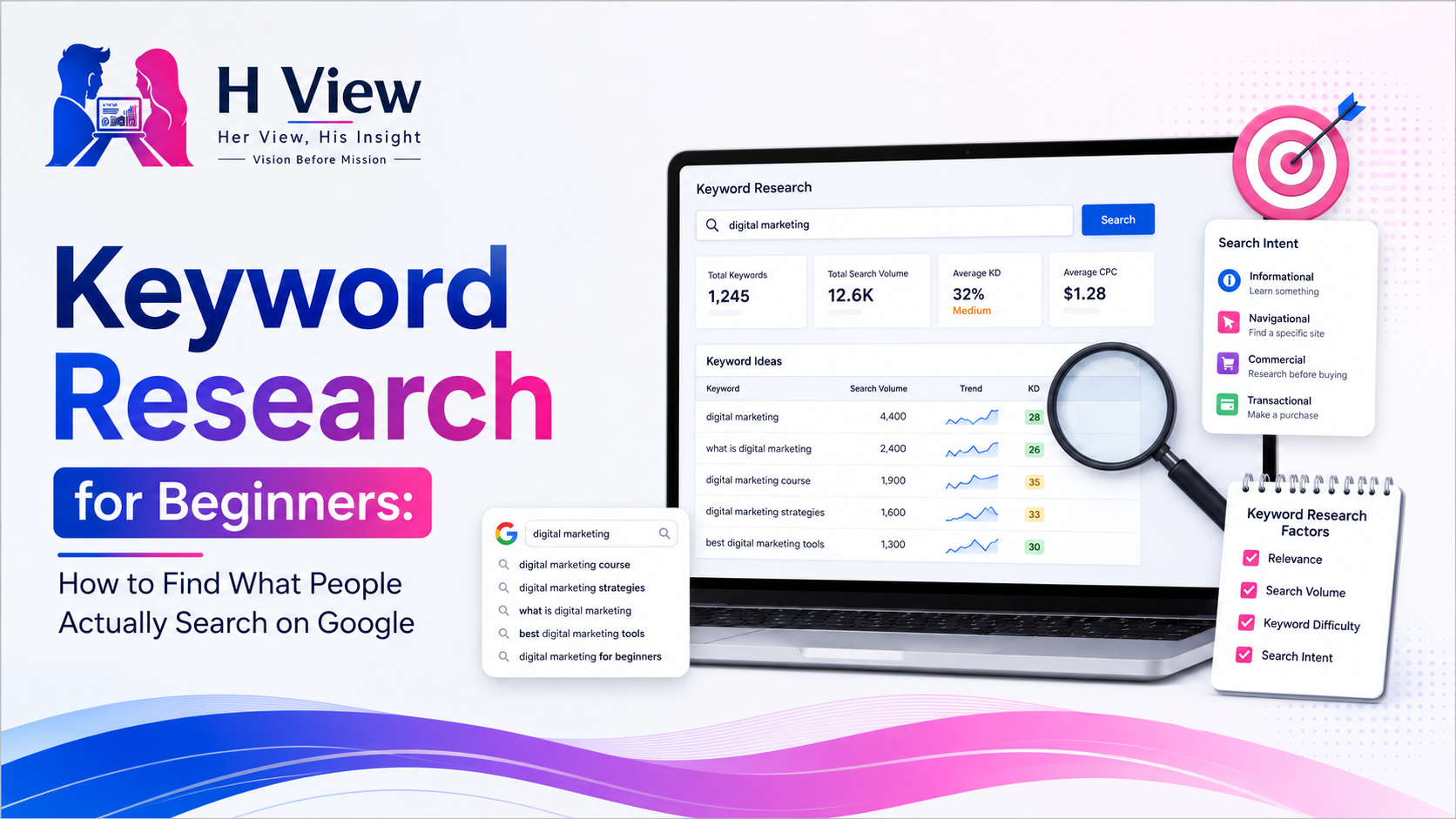
Publishing an article does not automatically mean people will find it. You may spend hours writing something useful, design a good featured image, optimize the page and still see almost no search traffic. In many cases, the problem begins before the article is written: the topic was chosen without understanding what people are actually searching for.
That is where keyword research becomes useful.
Keyword research is often presented as a technical SEO exercise involving search-volume graphs, keyword difficulty scores, CPC values and large spreadsheets. Those numbers can be useful, but they are not the real purpose of keyword research. The real purpose is to understand what people want to know, how they describe that need in search and whether your website can realistically provide a useful answer.
A good keyword is therefore not simply a phrase with a large search volume. It is a search query that connects three things: real demand, clear user intent and a topic your website is capable of covering well.
Keyword research is the process of finding and evaluating the words and phrases people type into search engines when they are looking for information, products, services or solutions.
Consider the topic of digital marketing. One person might search for “digital marketing,” while another searches for “how to learn digital marketing from home,” and someone else may type “best digital marketing course in India for beginners.” All three searches are connected to the same broad subject, but the intention behind them is different.
The first search is very broad and could mean almost anything. The second suggests that the person wants to learn. The third suggests that the person may already be comparing courses and could be close to making a purchase.
Understanding those differences is what separates useful keyword research from simply collecting phrases.
It helps to stop thinking of keywords as SEO terminology and start thinking of them as human questions.
A person who searches for “SEO” may simply want to understand what SEO means. Someone searching for “best free SEO tools” is probably looking for recommendations without wanting to spend money yet. A user searching for “Semrush vs Ahrefs” is clearly comparing two products, while someone searching “Semrush pricing India” may already be considering a purchase and wants to know whether the cost makes sense.
The wording changes because the person’s position in the decision-making process changes.
This is why keyword research should begin with understanding the person behind the search. Before asking how many people search for a phrase, ask what they are likely trying to achieve and what kind of page they would expect to find.
Search volume is one of the first metrics people look at when doing keyword research. It estimates how often a particular term is searched during a specific period, usually monthly.
Naturally, large numbers look attractive. If one keyword appears to receive 100,000 searches a month while another gets 2,000, the larger keyword can feel like the obvious choice. But high search volume does not automatically mean high opportunity.
Imagine a new website trying to target the keyword “marketing.” That term may receive enormous search demand, but the intent is incredibly broad. Someone could be looking for a marketing degree, a job, a definition, a marketing company, advertising ideas or a complete strategy.
Now compare that with “how to do keyword research for a new blog.” The search volume may be much lower, but the intention is far clearer. If your article answers that exact problem thoroughly, you have a stronger chance of satisfying the reader.
For a newer website, a smaller but highly relevant keyword is often more useful than a massive keyword dominated by established authority sites.
Keyword difficulty is a metric used by SEO tools to estimate how difficult it may be to rank organically for a keyword. It can help with planning, but beginners often treat it as though it were an official Google score.
It is not.
Different SEO tools calculate difficulty using their own formulas, backlink databases and assumptions. That means the same keyword can receive noticeably different difficulty scores depending on the platform you use.
A better approach is to treat difficulty as an initial warning and then manually inspect the search results. Look at the websites currently ranking, the quality of their content, how well they answer the query and whether the results appear dominated by large established brands.
When reviewing a keyword, ask yourself:
A manual search often reveals opportunities that a single difficulty percentage cannot.
Long-tail keywords are more specific search queries with narrower intent. They often have lower individual search volumes than broad keywords, but they can be extremely useful because the user’s need is clearer.
Take WordPress as an example. “WordPress” is an enormous topic. “WordPress SEO” is more specific, while “WordPress SEO for beginners” narrows the audience further. “WordPress SEO checklist for a new blog” gives us an even clearer idea of what the searcher expects.
The important point is that long-tail does not simply mean “a keyword containing many words.” The value comes from specificity.
A focused query makes it easier to create a page that directly solves a problem. It can also make competition more realistic for a smaller or developing website.
One of the biggest beginner mistakes is opening a keyword tool with no clear content strategy. The tool returns hundreds or thousands of suggestions, and suddenly every phrase looks like a possible article.
A better approach is to begin with the main subject areas your website genuinely covers.
For a Digital Marketing category, those broad topics might include:
These are not necessarily article titles. They are starting points.
Once you choose a broad topic such as SEO, think about the problems people commonly face. They may want to know how Google ranking works, why a page is not indexed, how to choose keywords, what backlinks are or how to use Search Console.
Those real questions are much closer to strong content opportunities.
The keyword tool should help refine your strategy, not create the strategy from nothing.
You can begin keyword research without paying for an SEO platform.
Google Search itself contains useful clues.
Start typing a topic and observe autocomplete suggestions. These suggestions can reveal common ways people phrase related searches. Then search the term and examine what Google is actually showing.
The types of pages in the results matter. If almost every result is a product page, the search may have commercial intent. If the results are mostly tutorials and educational guides, Google is likely interpreting the query as informational.
You should also look at related searches and common follow-up questions. These can help identify useful supporting sections or separate article opportunities.
The goal is not to blindly copy every Google suggestion. The goal is to understand what people appear to expect when they type the query.
Google Keyword Planner can help discover related keyword ideas and estimate search demand. It can be especially useful when you want to compare broad topics, explore variations or understand approximate demand in a specific location.
However, Keyword Planner is primarily an advertising tool.
That distinction matters because metrics such as advertiser competition and bid estimates are related to Google Ads. They should not automatically be interpreted as organic SEO difficulty.
When evaluating ideas from Keyword Planner, focus on the overall picture. A keyword should make sense for your audience, match your website and represent a topic you can cover properly.
Useful factors to consider include:
No single metric should make the decision by itself.
Keyword research becomes much more valuable once your website starts appearing in Google Search.
Google Search Console shows actual queries that trigger impressions for your pages. This means that instead of relying only on estimated demand from keyword tools, you can see how Google is already connecting your website with real searches.
Imagine you publish an article called “What Is SEO?” and later discover impressions for phrases such as “how SEO works,” “SEO for beginners,” “types of SEO” and “is SEO still useful.”
You may never have explicitly optimized for every one of those phrases.
That data tells you something important: Google understands that your page is related to those searches.
You can then use that information to improve the existing article, strengthen certain sections or identify new topics worth covering in separate articles.
Search Console is therefore more than a reporting tool. It becomes part of the content-planning process.
Keyword tools often produce many phrases that look different but essentially represent the same search intent.
For example:
A beginner may look at this list and think it requires five separate articles.
Usually, it does not.
If those searches all reflect essentially the same user need, one strong article can cover them naturally. Creating multiple pages around very small variations can make the website repetitive and may cause several pages to compete with one another.
Instead, group keywords by topic and intent.
A single comprehensive guide to keyword research can naturally include variations such as “how to find keywords,” “SEO keyword research” and “keyword research for beginners.”
Separate articles become useful only when the intent changes meaningfully. “Best free keyword research tools” is a different need because the reader wants recommendations. “How to use Google Keyword Planner” is also more specific and may deserve a dedicated tutorial.
Many SEO plugins encourage you to select a focus keyword and then measure how often it appears.
That can be useful as a reminder, but it can also make writing unnatural.
Suppose your focus keyword is “keyword research for beginners.” A normal article about the subject will naturally include related phrases such as search queries, SEO keywords, keyword ideas, search volume and search intent.
You do not need to repeat the exact phrase in every second paragraph.
If you force the same wording repeatedly just to satisfy an SEO score, the article becomes less readable.
The better approach is to use the main keyword in important places such as the title, introduction and relevant headings while allowing the rest of the article to use natural language.
A good article should feel as though it was written to explain a subject, not to satisfy a keyword counter.
Search intent can broadly be grouped into four useful categories.
The person wants to learn something. Searches such as “what is SEO,” “how does Google Search work” or “how to start a blog” usually fit here.
These searches work well for tutorials, explainers and educational content.
The user already knows where they want to go. Searches such as “Google Search Console login” or “YouTube Studio” are typically navigational.
Trying to rank ahead of the official destination usually has little value.
The searcher is researching before making a decision. Examples include “Yoast vs Rank Math,” “best WordPress hosting” or “Google Ads vs Facebook Ads.”
Comparison articles and detailed reviews often suit this intent.
The person appears ready to take an action. Searches such as “buy WordPress hosting,” “hire SEO agency” or “digital marketing course price” suggest stronger commercial intent.
These keywords can be valuable because the person may be closer to converting.
Understanding the intent helps you decide what kind of page to create.
Search volume tells you how much estimated demand exists. It does not tell you how valuable those visitors are to your website.
Imagine one article could attract 50,000 visitors but has almost nothing to do with your main business. Another article might attract only 2,000 visitors but reaches exactly the people most likely to subscribe, request a quote or buy something.
The second article may have much more value.
A local roofing company, for example, does not need millions of visitors interested in architecture. It needs enough people in the right location who genuinely need roofing services.
This is why keyword research should consider strategic relevance alongside traffic potential.
A strong website rarely becomes authoritative because it publishes unrelated articles around random keywords.
Related content works better when it supports a larger topic.
For example, an SEO cluster might include:
Each article answers a different question, but together they create much deeper coverage of SEO.
This approach also makes internal linking more natural. Someone reading about keyword research may want to understand on-page SEO next, while a reader facing an indexing issue may need Search Console guidance.
That creates a connected content experience instead of isolated blog posts.
New bloggers are often told to target only low-competition keywords.
That advice is incomplete.
A keyword may have low competition because hardly anybody searches for it. Another may appear easy because SEO tools have limited data. Some may be so obscure that ranking first produces almost no meaningful traffic.
A better keyword opportunity sits somewhere between real demand, clear intent, relevance and realistic competition.
Low difficulty can be useful, but it should not become the main goal.
Sometimes keyword tools show a search volume of zero.
That does not always mean nobody searches for the phrase.
Keyword tools rely on estimates and historical datasets, so very specific queries may not have enough recorded data to receive a meaningful volume estimate.
If a question repeatedly appears in customer conversations, comments, forums or Search Console, it may still deserve an article.
This is especially true for emerging topics. New products, software problems, AI features and recent updates may create demand before keyword databases fully reflect it.
Real audience problems should sometimes carry more weight than incomplete historical data.
Looking at ranking competitors is useful because it shows what Google currently considers relevant.
But the objective should not be to copy their structure.
If every top-ranking article explains the same five tools and repeats the same generic advice, publishing another version does not add much value.
Instead, ask what the existing results are missing.
Maybe they do not explain which keyword metrics beginners can safely ignore. Perhaps they require expensive tools. Maybe their examples focus only on the US market, or they do not show how Search Console can improve keyword research after publishing.
That missing perspective can become your advantage.
Competitor research should reveal where you can be more useful, not teach you how to reproduce what already exists.
You do not need a huge spreadsheet to get started. A simple process is enough:
This process is simple enough for beginners but strong enough to form the basis of a long-term SEO strategy.
Keyword research can become unnecessarily intimidating when every decision is reduced to numbers. One topic shows 500 searches, so it is immediately rejected. Another shows 50,000, so everyone wants to publish it even when the website has no realistic chance of competing.
Sometimes the better article begins with a smaller question that real people repeatedly ask. If you know that your audience genuinely struggles with a problem, there is value in answering it clearly even when the keyword tool does not make the opportunity look impressive.
Data should support judgement, not replace it.
The biggest keyword is rarely the smartest starting point for a smaller website. Broad topics such as “SEO,” “digital marketing” or “artificial intelligence” may have enormous search demand, but they are also surrounded by established publishers with years of authority and content behind them.
A developing website can compete more intelligently by becoming specific. Solve narrower problems, connect those articles into meaningful clusters and gradually build depth around the larger subject.
Keyword research is therefore not about discovering a secret phrase that guarantees traffic. It is about identifying where search demand and your ability to provide something useful overlap.
A good keyword has several qualities at the same time. People genuinely search for it, the intent is understandable, the topic fits your website and the competition is realistic enough to justify the effort.
Sometimes that keyword may receive tens of thousands of searches.
Sometimes it may receive only a few hundred.
The number alone cannot tell you whether the article is worth creating.
The strongest strategy combines search data with audience understanding, competitor analysis and real performance information from your own website.
That is what keyword research should help you do.
It is not about forcing keywords into an article after it has already been written. It is about discovering which questions are worth answering before you begin writing at all.
Keyword research is the process of discovering and evaluating the words and phrases people use in search engines. It helps website owners understand search demand, user intent and potential content opportunities.
Search volume is an estimate of how frequently a keyword is searched during a specific period. It is useful for comparing demand, but it should not be the only factor used when choosing a topic.
Keyword difficulty is an estimate provided by SEO tools of how challenging it may be to rank organically for a particular search. Different platforms calculate it differently, so the actual search results should always be reviewed as well.
Long-tail keywords are more specific search queries with clearer intent. They often have lower individual search volume than broad terms but can be useful because the searcher’s need is easier to understand.
Yes. Google Search, Google Keyword Planner, Google Trends and Google Search Console can all provide useful keyword information. Paid SEO tools can make research easier and provide additional competitive data, but they are not mandatory for beginners.
There is no fixed number. One article should primarily satisfy one clear search intent while naturally covering closely related phrases and subtopics.
Neither automatically. The better choice depends on relevance, search intent, competition and the value of the visitor to your website. A smaller keyword with strong intent can sometimes be far more useful than a broad high-volume term.
Harika is the co-founder of H View and covers AI, technology, gadgets, digital tools, online platforms, and modern internet trends. Her articles focus on simplifying complex topics with practical explanations, balanced opinions, and reader-first insights.
Share your real experience and help other readers decide better.
No community views yet. Be the first to share yours.
Open LinkedIn for a few minutes and you will probably come across a colourful graphic…
Harika October 6, 2026 
When an employee resigns, many organisations move quickly into replacement mode. The manager informs HR,…
Harika October 6, 2026 
For many corporate employees, the workday begins long before they actually start working. They wake…
Harika October 5, 2026 
Many projects begin with an assumption that sounds reasonable on paper: the client will explain…
Harika October 1, 2026