

Entry-Level Job—but Experience Required? The Fresher Trap Nobody Is Fixing
A fresher opens a job portal and finds an attractive vacancy. The title says Entry-Level,…
 Satya Hemanth August 9, 2026
  By Satya HemanthUpdated September 20, 20266 min read79 views
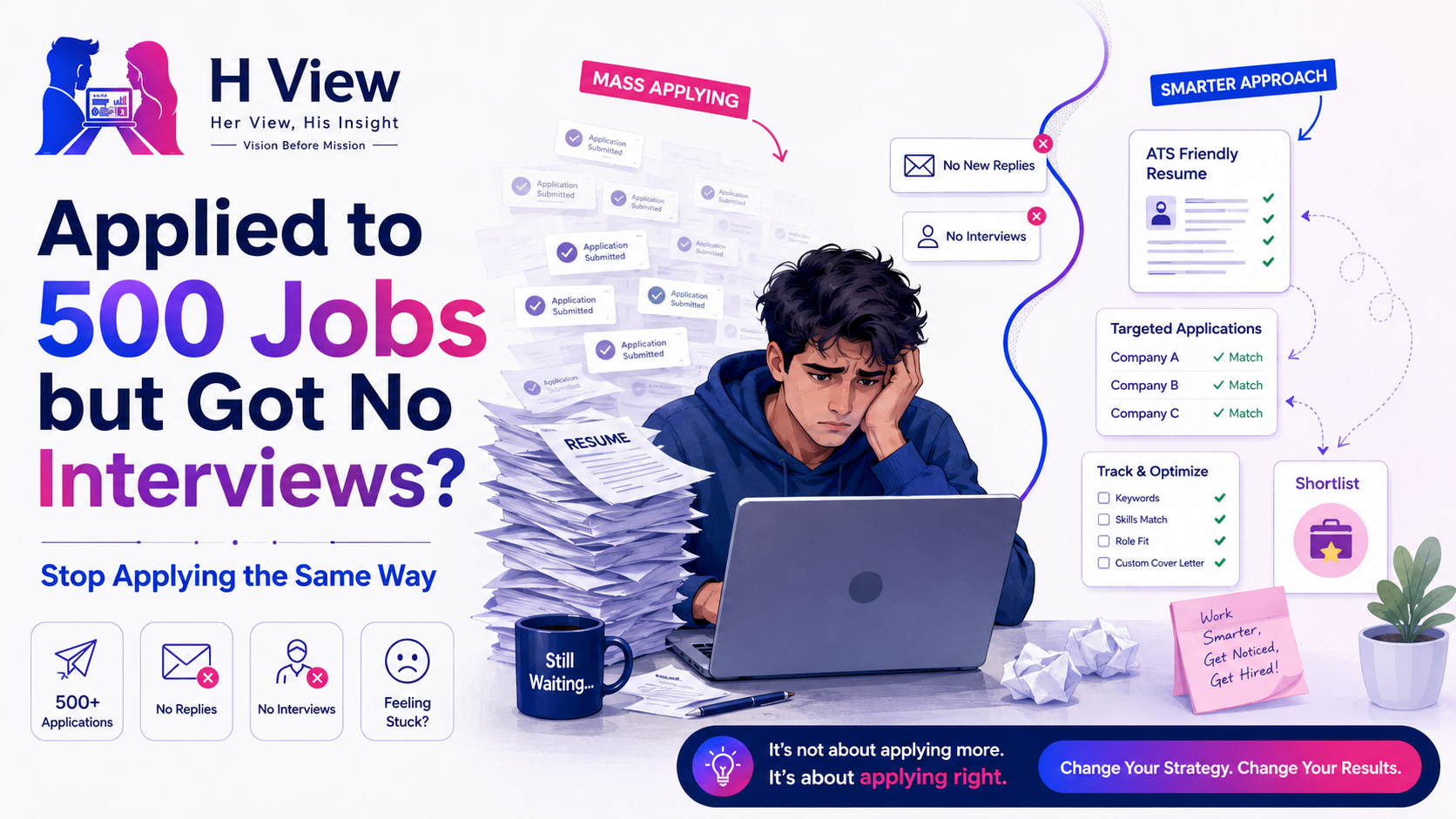
Sending hundreds of job applications without receiving a single interview can be deeply frustrating.
A candidate may spend hours opening job portals, clicking “Apply,” uploading the same resume and waiting for responses that never arrive.
After months of rejection or silence, they begin to wonder:
“Do I have no skills, or is nobody even seeing my application?”
The problem may not always be a complete lack of ability.
Many candidates are applying to unrelated roles, using one generic resume everywhere and depending entirely on crowded job portals. Their projects do not clearly prove their skills, and their resumes may not match the language used in the vacancy.
Modern hiring systems also help employers collect, organise and screen applications. An Applicant Tracking System, commonly called an ATS, may extract information such as skills, job titles, qualifications and certifications before a recruiter reviews suitable profiles.
Submitting more applications without fixing the underlying problem often produces more rejection—not more interviews.
A job search has several stages:
When you receive no interview calls at all, the problem is probably happening before the interview stage.
Your resume may be weak, your profile may not match the role, or you may be applying through ineffective channels.
When you regularly receive interviews but no offers, your resume is probably doing its job. The next improvement should focus on technical knowledge, communication and interview performance.
Do not change everything at once.
Identify the stage where progress stops.
One of the biggest mistakes unemployed candidates make is applying to unrelated jobs using the same profile.
For example, one person may apply for:
These roles require different skills and different evidence.
A resume trying to appear suitable for all of them usually becomes convincing for none.
Choose one primary role and one closely related backup.
For example:
Primary role: Manual software tester
Backup role: Application-support executive
Your resume, projects and interview preparation should tell one clear career story.
A generic resume may list every course, skill and project you have completed.
A targeted resume highlights the experience most relevant to one vacancy.
Indeed’s current resume guidance recommends adapting a resume to the employer’s requirements and emphasising the qualifications and accomplishments that match the specific job.
This does not mean lying or adding skills you do not have.
It means changing the order and emphasis.
When applying for a testing role, your test cases, defect reports, API testing and attention to detail should be prominent.
When applying for a data role, Excel, SQL, dashboards and analytical findings should appear first.
Read the job description and identify:
Use the same truthful terminology in your resume where it accurately describes your knowledge.
An attractive resume is not always an effective resume.
Complex graphics, rating bars, icons, text boxes and multiple columns may make information harder for some recruitment systems to extract.
Use:
Avoid filling the resume with every technology you have briefly seen.
If you list a skill, be ready to answer questions about it.
Writing “Created an ecommerce website using React” does not tell the recruiter much.
A stronger description explains what you actually built:
Developed a responsive ecommerce application with product search, cart management, API integration and form validation. Deployed the project and documented setup instructions on GitHub.
Your project section should answer:
The 2026 HirePro college-hiring report found that students and employers still evaluate readiness differently, while only a minority of surveyed companies said they had fully shifted to skills-first hiring. This makes clear and verifiable proof of ability especially important for freshers.
Popular vacancies can receive a large number of applications.
Use job portals, but combine them with:
Do not send strangers messages saying only, “Please give me a job.”
Write a focused request:
“I am preparing for junior software-testing roles and have built a portfolio containing test cases, API checks and defect reports. I noticed an opening in your company and would appreciate guidance on the appropriate application process.”
Create a simple spreadsheet containing:
After 30–40 targeted applications, review the results.
If there are no responses, improve the resume and job selection.
If assessments arrive but are not cleared, improve practical skills.
If interviews happen but offers do not, practise answers and project explanations.
Tracking turns rejection into useful information.
Instead of clicking “Apply” 100 times, try this:
Quality does not mean waiting for the perfect job.
It means applying with relevance and evidence.
Her View: Repeated rejection does not always mean a candidate lacks potential. Poor targeting, automated screening and limited visibility can prevent capable people from reaching recruiters.
His Insight: Candidates must still take responsibility for unclear resumes, weak projects and random applications. Effort only becomes useful when it is directed properly.
Both views matter.
Applying more is not always the answer.
Applying better usually is.
If 500 applications produced no interviews, submitting another 500 in exactly the same way is unlikely to solve the problem.
Choose one role. Build relevant proof. Simplify your resume. Match the vacancy honestly and use more than one application channel.
Your goal is not to appear suitable for every available job.
It is to make the right employer quickly understand why you are suitable for one specific role.
Common reasons include applying to unsuitable roles, weak project descriptions, missing relevant keywords, complicated formatting and insufficient proof of current skills.
No. Maintain a strong base resume and adapt the skills, summary and projects for each type of role.
Not always. ATS platforms vary, but they commonly organise and extract application details, helping recruiters identify profiles matching defined criteria.
There is no perfect number. A smaller set of relevant, well-prepared applications is generally more useful than dozens of unrelated submissions.
Referrals can improve visibility, but they do not guarantee selection. Skills and interview performance still matter.
Review your approach after approximately 30–40 targeted applications without meaningful responses.
Satya Hemanth is the founder of H View and writes on careers, sports, leadership, digital trends, and practical decision-making. His articles focus on clear explanations, real-world examples, and useful insights for students, young professionals, and everyday readers.
Share your real experience and help other readers decide better.
No community views yet. Be the first to share yours.
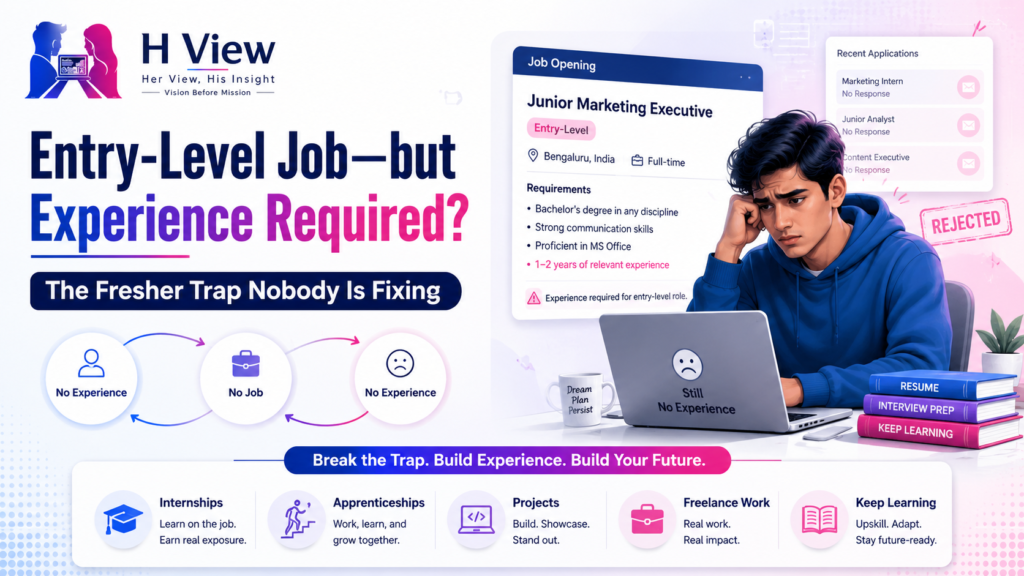
A fresher opens a job portal and finds an attractive vacancy. The title says Entry-Level,…
Satya Hemanth August 9, 2026 
You find a job that perfectly matches your profile. The company looks genuine. The role…
Satya Hemanth August 8, 2026 
For generations, the path to a secure career appeared simple: Study hard, complete a degree…
Satya Hemanth August 7, 2026 
A long employment gap can make job seekers feel that honesty is working against them.…
Satya Hemanth August 4, 2026