
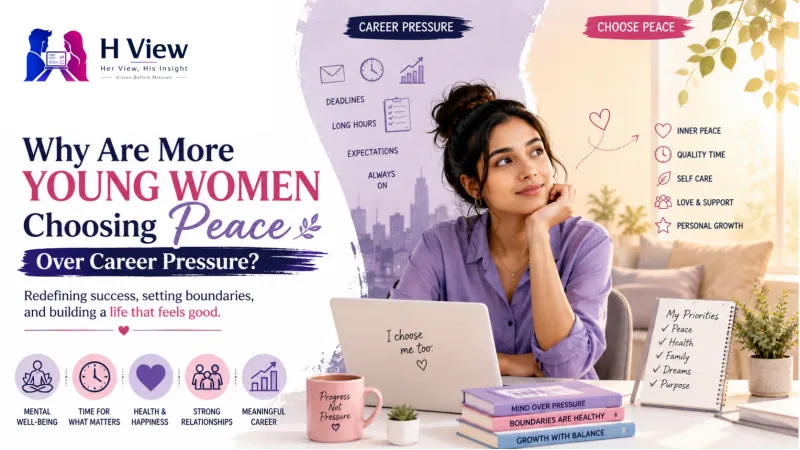
Why Are More Young Women Choosing Peace Over Career Pressure?
For years, career success was often described in very simple terms: work harder, earn more, get promoted, take on bigger responsibilities, and keep moving upward. For many young women, especially those who grew up being told that education and financial independence were essentia
For years, career success was often described in very simple terms: work harder, earn more, get promoted, take on bigger responsibilities, and keep moving upward. For many young women, especially those who grew up being told that education and financial independence were essential, ambition became closely tied to proving that they could succeed in spaces where women once had fewer opportunities.
That progress matters. More women are building careers, earning independently, leading teams, starting businesses, and making decisions that earlier generations may not have had the freedom to make. But a new question is beginning to appear among younger women: if success constantly requires exhaustion, anxiety, and the loss of personal time, is that really the kind of success they want?
Choosing peace does not mean giving up on ambition. For many women, it means becoming more selective about what ambition should cost.
Career Success No Longer Means the Same Thing to Everyone
For previous generations, a prestigious job, higher salary, and promotion could feel like obvious signs of progress. Younger women are still interested in those things, but many are also asking whether the job leaves enough energy for the rest of life.
A promotion can sound impressive until it comes with permanent late nights, weekend calls, constant travel, and the expectation that work should always come first. A higher salary may help financially while still creating a daily routine that feels impossible to sustain.
This is why some young women are redefining career success in more personal terms. They may want stable income, meaningful work, flexibility, manageable stress, and enough time to maintain relationships, health, hobbies, and family responsibilities. That may look less impressive on a résumé, but it can create a life that feels far better to live.
Burnout Has Made Hustle Culture Less Attractive
There was a period when being extremely busy was treated almost like a status symbol. People proudly talked about sleeping four hours, answering emails at midnight, working through weekends, and always having another goal to chase.
That image is losing some of its appeal.
Young professionals have seen what long-term overwork can do. Chronic stress can affect sleep, mood, relationships, concentration, and physical health. Even people who once enjoyed fast-paced careers can reach a point where every achievement feels quickly replaced by the next demand.
For women, burnout can become more complicated because work is often only one part of the total responsibility they carry. A demanding career may exist alongside household work, family expectations, caregiving, social responsibilities, and the mental load of organising everyday life.
When every part of the day demands performance, the idea of “working harder” stops sounding motivational.
 Also readOne More Attempt—or Time to Move On? The Career Risk of Endless Government Exam Preparation→
Women Are Questioning Why Exhaustion Is Treated as Ambition
There is a difference between working seriously and living permanently exhausted.
Many young women are beginning to notice how easily the two are confused. Someone who stays late every evening may be considered more committed than a colleague who finishes efficiently and leaves on time. A woman who refuses unnecessary weekend work may worry that she will be seen as less ambitious.
This creates a culture where boundaries can feel professionally risky.
The problem is that constant availability rarely has a natural stopping point. Once a person becomes known as the employee who always answers, takes extra work, and handles emergencies, that reliability can quickly become the expected standard.
Young women are increasingly realising that being capable does not mean they must be endlessly available.
Financial Independence Has Changed What Women Can Choose
One reason peace is becoming a stronger priority is that financial independence gives women more control over career decisions.
A woman who has savings, skills, and confidence in her ability to earn may feel more comfortable leaving a toxic workplace or refusing a role that would destroy her personal life. She may choose a slightly lower-paying job with better flexibility because she understands that money is important but not the only measure of security.
This is very different from having no choice.
Financial independence does not simply allow women to buy things. It can create the freedom to say no. That may include saying no to a company that expects constant overtime, a manager who repeatedly crosses boundaries, or a promotion that would dramatically increase stress without improving quality of life.
In that sense, choosing peace can actually be a sign of financial maturity rather than a lack of ambition.
Work-Life Balance Is Becoming a Real Career Requirement
Flexible work, reasonable hours, leave policies, supportive managers, and realistic workloads are no longer seen as small workplace benefits by many young women. They are becoming part of how people evaluate whether a job is worth staying in.
This is especially important for women who expect that life will change over time. Marriage, parenting, caring for parents, health issues, relocation, or simply personal priorities can all affect how much energy someone wants to give to work.
A career that only works when life is perfectly uncomplicated is not very flexible.
Young women are therefore looking beyond salary when they assess a job. They are asking whether the company respects personal time, whether flexibility is real or only mentioned in policy documents, and whether people who set boundaries are still given opportunities to grow.
Those questions may become even more important than job titles.
Social Media Has Made Career Comparison More Exhausting
Professional comparison used to happen mainly within offices, friend circles, or industries. Now it follows people everywhere.
Someone opens LinkedIn and sees a former classmate announcing a promotion. Another person has started a company. Someone younger has moved abroad. Another woman is celebrating a major salary milestone.
These posts can be inspiring, but they can also make normal career progress feel inadequate.
What social media rarely shows is the full cost behind an achievement. It does not show whether someone is sleeping badly, struggling with stress, missing important family moments, or quietly questioning whether the career they built still makes them happy.
Young women are becoming more aware of this gap between visible success and lived experience.
That awareness makes it easier to ask a healthier question: do I actually want what this person has, or do I only want the appearance of success it creates?
Some Women Are Choosing Stability Over Constant Growth
Career advice often assumes that everyone should always be moving upward. Higher role, higher salary, bigger team, more responsibility.
But not everyone wants permanent acceleration.
Some women reach a point where their current position provides enough income, reasonable work, and a lifestyle they enjoy. Instead of immediately chasing the next promotion, they may decide to stay there for a while.
That choice can be difficult because modern work culture often treats stability as stagnation.
Yet careers last decades. There is no rule saying every year must contain maximum growth. People can have periods of intense ambition and periods where personal life receives more attention.
Choosing not to chase every opportunity does not mean someone has stopped growing. Sometimes it means she has stopped allowing the workplace to decide what growth should look like.
Peace Does Not Mean Avoiding Difficult Work
There is also a risk of romanticising the idea of a peaceful career.
Every job has pressure. Deadlines happen, difficult colleagues exist, and meaningful work often requires periods of serious effort. Choosing peace cannot mean expecting a career with no discomfort at all.
The difference is sustainability.
A demanding project for two weeks is very different from a workplace where every week feels like an emergency. Taking on extra responsibility for an important opportunity is different from permanently doing the work of three people because the company is understaffed.
The goal is not to eliminate challenge. It is to avoid normalising unnecessary suffering as proof that someone cares about their career.
Younger Women Are Becoming More Protective of Their Time
Time is becoming a form of wealth.
A woman can earn a high salary and still feel poor in time if every weekday belongs to work and every weekend is used for recovery. This is why some younger women are increasingly protective of evenings, weekends, holidays, and personal routines.
They may prefer remote or hybrid roles, reject unnecessary meetings, turn off work notifications after hours, or choose companies where leave can actually be taken without guilt.
These choices can look small, but together they change the relationship someone has with work.
Instead of building a life around a job, the job becomes one part of a larger life.
That distinction is important.
Family Expectations Can Make Career Pressure Even More Complicated
Young women are often managing two competing messages.
One says they should be financially independent, ambitious, and professionally successful. The other still expects them to remain deeply available to family.
A woman may be encouraged to take a demanding leadership role while also being expected to attend every family function, manage household responsibilities, care for parents, and eventually handle a large share of parenting.
When both expectations are treated as equally non-negotiable, exhaustion becomes almost unavoidable.
This is why some women are not rejecting career success. They are rejecting the idea that they must maximise both professional and personal responsibility at the same time.
A more realistic life requires priorities to change across different stages.
 Also readIs Full-Stack Development Still a Good Career—or Just the Most Over-Sold Coding Course?→
Choosing Peace Can Be a Form of Confidence
When people are younger, they often chase external validation because it helps them feel successful. Job titles, salaries, company names, and promotions provide visible evidence that they are doing well.
With experience, some women begin trusting their own definition more.
They may realise that they do not need the most impressive job in the group. They need one that pays fairly, uses their skills, respects their time, and allows them to wake up without constant dread.
That shift requires confidence because it means accepting that other people may not understand the choice.
Someone may say she lacked ambition. A colleague may think she gave up a major opportunity. Family members may wonder why she left a prestigious company.
If the decision creates a healthier life, those opinions become less important.
Her View
For many young women, choosing peace is not about lowering expectations for themselves. It is about refusing to build a successful career at the cost of every other part of life. There is nothing wrong with wanting promotions, leadership, money, or recognition, but those goals should remain choices rather than obligations. A woman should be able to decide that a manageable job, good income, personal time, health, and emotional stability are enough for this stage of her life without being told she has wasted her potential.
His Insight
Men also benefit when career culture stops treating endless work as the only form of ambition. When women are expected to carry both intense careers and major responsibilities outside work, partnerships can become strained even when both people have good intentions. Supporting a woman's career does not mean only encouraging her to chase higher positions. Sometimes support means respecting when she decides that the next promotion is not worth the cost, sharing responsibilities at home, and recognising that protecting time and mental space can be just as rational as pursuing more money.
Ambition Is Changing, Not Disappearing
Young women are not necessarily becoming less ambitious. They may simply be becoming more precise about what they want ambition to achieve.
For one woman, success may still mean becoming a senior executive. For another, it may mean earning well while working reasonable hours. Someone else may build a business so she can control her own schedule, while another may deliberately slow down for a few years and return to aggressive career growth later.
There is room for all of these choices.
The old definition of success often focused on how much a person could achieve. A newer definition may also ask how much of herself she gets to keep while achieving it.
That is why choosing peace over constant career pressure should not automatically be interpreted as giving up. Sometimes it is the result of finally understanding that a good career is supposed to support a good life, not consume it.
And for many young women, that realisation may be one of the most ambitious decisions they make.
Frequently Asked Questions
Many young women still want financial independence and career growth, but they are becoming more selective about what success should cost. Instead of treating long hours, constant availability, and burnout as proof of ambition, they are placing greater value on flexibility, manageable workloads, health, and personal time.
No. Ambition does not have to mean chasing every promotion or working longer hours than everyone else. A woman can be ambitious about earning well, developing strong skills, building financial security, and having a sustainable career without wanting work to dominate her entire life.
Hustle culture often celebrates being constantly busy, sacrificing sleep, working through weekends, and always pursuing the next achievement. Over time, many women are realising that this approach can damage health, relationships, and overall quality of life, especially when professional pressure is combined with responsibilities outside work.
Women may be balancing careers alongside household responsibilities, family expectations, caregiving, relationships, and personal goals. Flexible work, reasonable hours, and supportive workplaces can therefore make a major difference to whether a career remains sustainable over many years.
Yes. A promotion may bring more money and status, but it can also bring longer hours, increased stress, travel, or greater responsibility. Deciding that the trade-off is not worthwhile at a particular stage of life is a personal career decision, not necessarily a lack of ambition.
Women may feel pressure to prove that they are hardworking, capable, and deserving of professional opportunities. This can make setting boundaries feel risky. Social expectations around family and caregiving can add another layer of guilt when women feel they must perform well everywhere at once.
It can. Savings, employable skills, and financial confidence can give women more freedom to leave unhealthy workplaces, take career breaks, reject unsuitable roles, or choose jobs that offer better flexibility even if they do not provide the highest possible salary.
There is no single definition. For one woman it may mean reaching senior leadership, while another may value stable income, flexibility, meaningful work, and enough time for life outside the office. A healthier definition of success allows women to decide which combination suits their priorities.
H View stories follow our editorial policy. Spotted an error? Tell us and we will correct it.
Rate this article
One tap is enough. No comment needed.
Was this article helpful?
Your answer goes straight to our editors.










Comments0
No comments yet. Start the conversation.