

Best Digital Marketing Tools in 2026: What Marketers Actually Need and What They Can Skip
Open LinkedIn for a few minutes and you will probably come across a colourful graphic…
 Harika October 6, 2026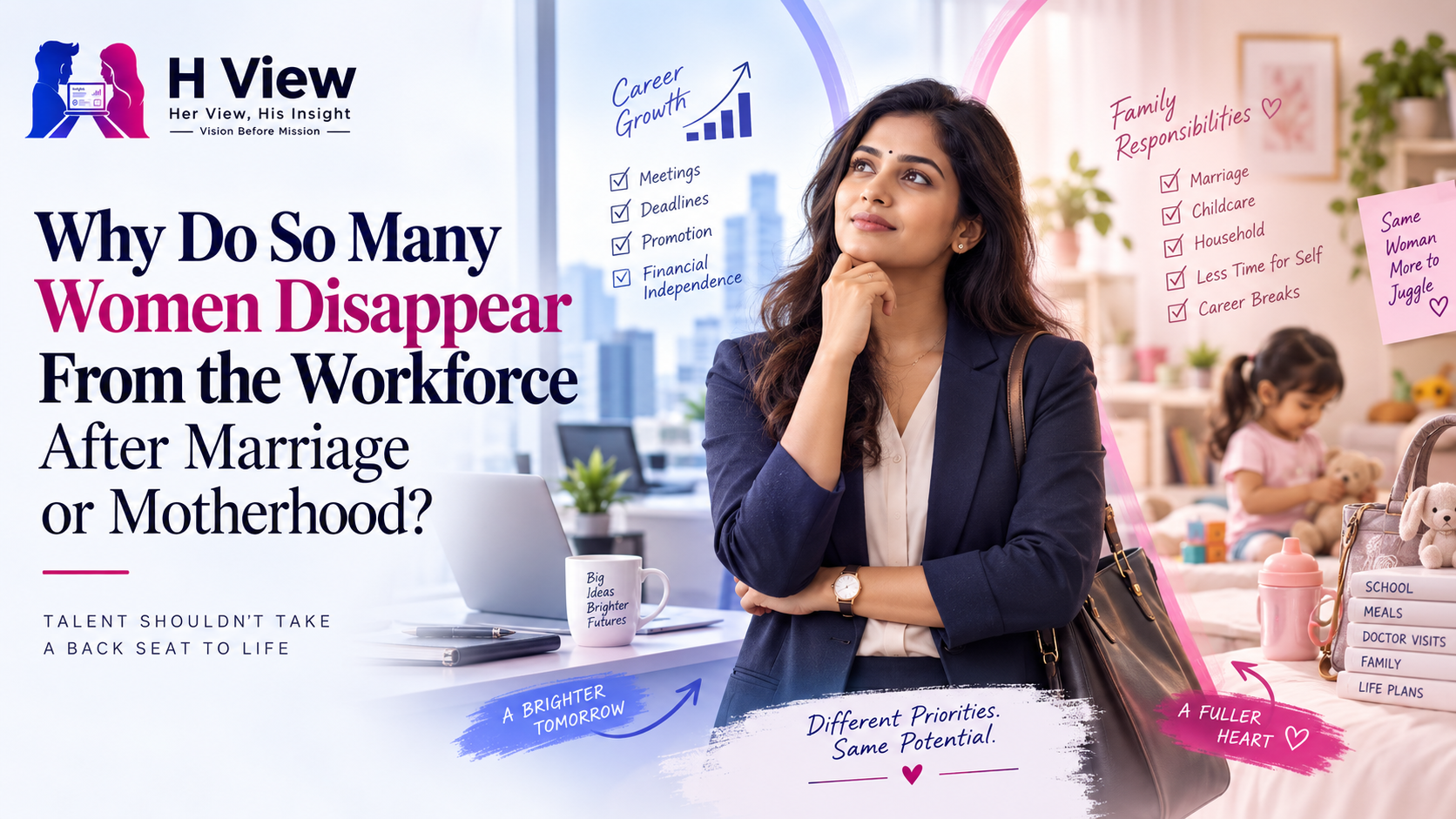
 By AnnapurnaUpdated September 21, 202611 min read30 views
A woman may spend years studying, building qualifications, gaining experience, and creating a professional identity, only to find that marriage or motherhood changes the conditions under which she is expected to work. Her ambition may remain intact, her skills may remain valuable, and her need for financial independence may remain just as strong, yet the structure around her can become far less supportive. The question is therefore not simply why women leave jobs after marriage or childbirth, but why so many households and workplaces still make continued employment unusually difficult once women enter these life stages.
A recent 2026 report by Aspire For Her and Shaadi.org described marriage and motherhood as major triggers behind women leaving the workforce in India. The report stated that 50% of working mothers quit their jobs by age 30 and that only 27% of women who take a career break return to work. Because this is an industry report rather than an official national labour-force survey, the figures should be read as one current estimate rather than a definitive national rate. Even so, the direction of the problem is strongly supported by official time-use data and academic research showing that women continue to carry far more unpaid household and caregiving work than men. (NewsVoir)
The first mistake is assuming that women leave work because their priorities suddenly change and they no longer want careers. In many cases, the desire to work remains, but marriage reorganises the practical conditions around them. A woman may move to another city, take on a longer commute, adapt to a new family structure, manage additional household expectations, or become responsible for tasks that were never part of her life before marriage.
This shift matters because time is finite. A career that was manageable when she controlled most of her own schedule can become much harder when mornings, evenings, weekends, and family obligations are no longer fully her own. If the household assumes that she will continue performing domestic responsibilities regardless of her professional workload, then the issue is not lack of ambition. It is time poverty.
Research on Indian women’s employment increasingly uses this idea of time poverty to explain why paid work becomes difficult to sustain. A 2025 study in Development Policy Review found that unpaid domestic and caregiving work reduces women’s probability of labour-force participation and that working women experience higher levels of time poverty than men across employment categories. (Wiley Online Library)
Motherhood is often discussed as though the main adjustment is maternity leave. In reality, childbirth creates years of recurring care responsibilities, including feeding, school preparation, illness, appointments, emotional support, transport, homework, and the constant coordination required to keep a child’s life functioning.
The burden becomes especially heavy when the mother is treated as the default parent. Even in dual-income households, schools may call her first, relatives may expect her to manage the child’s routine, and family members may assume she will take leave when something goes wrong. A father can be involved and caring while the mother still carries most of the planning.
Official Indian data shows how unequal this distribution remains. In the 2024 Time Use Survey, 41% of women aged 15–59 participated in household caregiving on the reference day, compared with 21.4% of men. Among those who provided care, women spent about 140 minutes per day on it, compared with 74 minutes for men. (Press Information Bureau)
That difference matters because every additional hour of unpaid care competes with paid work, professional learning, rest, and career mobility. One academic study using Indian time-use data found that an additional hour of unpaid care was associated with substantially lower odds of women being employed, self-employed, or pursuing higher education. (OUP Academic)
Average minutes per day among participants in the 2024 Time Use Survey.
| activity | women | men |
|---|---|---|
| Unpaid domestic work | 289 | 88 |
| Unpaid caregiving | 137 | 75 |
When family responsibilities increase, somebody has to reduce something else. The central question is who is expected to make that adjustment.
In many households, the woman’s career is still treated as the more flexible one. If a child is unwell, she may take leave. If the family relocates, she may change jobs. If childcare becomes expensive, she may pause her career. If elderly relatives need attention, she may reorganise her schedule.
These decisions can appear individually reasonable, especially when one partner earns more. However, repeated adjustment can create a long-term pattern in which the woman’s career becomes increasingly fragile while the man’s career continues uninterrupted.
The 2026 “Great Indian Pause” report described this dynamic through several barriers, including relocation for a spouse’s career, lack of childcare, social expectations, maternity penalties, and re-entry difficulties. It also reported that 13% of employed women leave work after marriage and that marriage and childbirth are associated with lower labour-force participation in the sources it cites. (NewsVoir)
A woman may take a break believing it will last six months or a year, but returning is often far more complicated than expected. Technology changes, industries evolve, networks weaken, confidence drops, and employers may question the gap more aggressively than they would a continuous career path.
The longer the break lasts, the easier it becomes for unpaid responsibilities to expand around the available time. Once a woman becomes the person who manages children, household routines, elder care, and family administration, returning to full-time work requires the entire household to reorganise again.
This is why return-to-work programs matter, but they cannot solve the problem alone. If the conditions that forced the woman out remain unchanged, a returnship simply places her back into the same conflict between work and care.
The 2026 report says only 27% of women who take a career break return to work and notes intense demand for structured returnship programs. While that figure comes from the report rather than an official national employment series, it highlights a genuine policy and employer challenge: the loss is not only individual income, but also accumulated skills and professional experience. (NewsVoir)
| Pressure point | What often happens | Long-term career effect |
|---|---|---|
| Marriage | Relocation, new household expectations, longer commute, family obligations | Slower promotions, job changes, or exit |
| Motherhood | Default caregiving, childcare gaps, school and health responsibilities | Reduced hours, leave, career pause |
| Unpaid domestic work | Cooking, cleaning, planning, emotional and family management | Less time for learning, networking, and recovery |
| Workplace inflexibility | Fixed schedules, long hours, limited remote options | Higher likelihood of resignation |
| Career break stigma | Employers question gaps or offer lower-level roles | Lower pay, confidence loss, slower re-entry |
| Unequal family support | Woman expected to “manage everything” | Career gradually becomes secondary |
The important point is that no single pressure necessarily forces a woman out. The exit usually happens when several pressures accumulate until continuing the job becomes practically or emotionally unsustainable.
Working women are often told to become more organised, wake earlier, plan meals, outsource chores, or manage time better. Some of these strategies can help, but they do not solve an unequal system.
The 2024 Time Use Survey shows that women aged 15–59 who participated in unpaid domestic services spent about 305 minutes a day on them, even as women’s participation in paid employment increased compared with 2019. The survey also shows that women remain far more involved than men in unpaid domestic work and caregiving. (Press Information Bureau)
A woman cannot permanently “optimise” her way out of five hours of unpaid work, professional deadlines, parenting, commuting, and the need to sleep. At some point, the solution has to involve redistribution rather than improved efficiency.
The solution requires families, employers, and policymakers to treat women’s continued employment as something worth protecting rather than as a personal preference that can be sacrificed whenever life becomes complicated. Several changes have a direct practical impact:
These changes are practical because they address the actual reason women leave: not lack of capability, but the collision between paid work and a disproportionate share of unpaid responsibility.
For many women, leaving the workforce is not a clean choice between career and family. It is the result of repeated compromises that slowly make the career harder to sustain. A woman may miss one opportunity because of childcare, reject another because relocation is impossible, reduce her hours because the household depends on her availability, and eventually decide that the job is creating more conflict than the family is willing to absorb. If we want women to remain economically independent, we cannot celebrate their education and employment while expecting them to carry most of the unpaid work that makes everybody else’s life possible.
Men have a direct role in whether a woman’s career continues after marriage or motherhood. Support is not limited to agreeing that she should work; it means taking equal ownership of the practical responsibilities that compete with her job. When fathers take leave, handle school routines, manage healthcare, cook, or adjust their own schedules, the household stops treating the woman’s career as the default sacrifice. A modern marriage cannot genuinely support two careers if only one partner is expected to reorganise work whenever family life becomes demanding.
The most important conclusion is that marriage and motherhood do not erase ambition, intelligence, professional experience, or economic potential. What often disappears is the support structure required to keep using those abilities in paid work.
India’s labour-force participation among women has improved in recent years, but official and academic evidence still shows a large imbalance in unpaid domestic and caregiving work. That imbalance is not a private household inconvenience; it directly affects who can remain employed, who can accept promotions, who can return after a break, and who gradually exits the workforce altogether. (Reuters)
If families want financially independent daughters and daughters-in-law, employers want experienced female talent, and the economy wants higher women’s participation, then the answer cannot simply be telling women to work harder. The real work is to redesign what happens around them after marriage and motherhood so that a career remains possible rather than becoming the first thing expected to disappear.
Marriage can change a woman’s daily responsibilities much more than her professional ambitions. Relocation, new household expectations, longer commutes, family obligations, and the assumption that she will manage domestic work can make continued employment harder to sustain. In many cases, the woman does not lose interest in her career; the support structure around her changes.
Motherhood adds continuous caregiving responsibilities, including childcare, school coordination, health appointments, emotional support, and household planning. When mothers are treated as the default parent, these responsibilities can interfere with work schedules, promotions, travel, and long-term career growth.
The second shift refers to unpaid work that begins after paid work ends. It can include cooking, cleaning, childcare, elder care, household planning, and emotional management. When this work falls mainly on women, it can make full-time employment far more exhausting and difficult to sustain.
Career breaks can weaken professional networks, reduce confidence, and create concerns about skill gaps or outdated experience. Employers may also treat career gaps more negatively than continuous work histories, which can make women accept lower-level roles or remain outside the workforce longer than originally planned.
Yes. Family support can significantly influence whether a woman is able to continue working after marriage or motherhood. Shared childcare, household responsibility, support from a partner, and respect for her professional commitments can make the difference between continuing a career and leaving it.
Traditional gender roles continue to influence how household responsibilities are divided. Even in dual-income families, women are often expected to take the lead in cooking, caregiving, planning, and family coordination. This imbalance can reduce the time and energy available for paid work.
Flexible work can help, particularly when combined with reliable childcare and shared household responsibilities. Hybrid work, predictable schedules, phased returns after maternity leave, and realistic working hours can reduce the pressure that pushes some women out of employment.
Employers can create structured returnship programs, assess candidates based on current skills rather than career gaps, provide training where needed, offer flexible schedules, and avoid assuming that women returning after motherhood are less ambitious or committed.
There is no reason this should be treated as an automatic choice. Both career and family require time and support, so the more useful question is whether households, employers, and public systems are structured in a way that allows women to participate in both without carrying an unequal burden.
Annapurna is an H View contributor covering relationships, family, lifestyle, entrepreneurship, and everyday decision-making. Her articles focus on emotional clarity, practical understanding, and human-centered perspectives that help readers think better about personal and professional situations.
Share your real experience and help other readers decide better.
No community views yet. Be the first to share yours.

Open LinkedIn for a few minutes and you will probably come across a colourful graphic…
Harika October 6, 2026 
When an employee resigns, many organisations move quickly into replacement mode. The manager informs HR,…
Harika October 6, 2026 
For many corporate employees, the workday begins long before they actually start working. They wake…
Harika October 5, 2026 
Many projects begin with an assumption that sounds reasonable on paper: the client will explain…
Harika October 1, 2026