

Best Digital Marketing Tools in 2026: What Marketers Actually Need and What They Can Skip
Open LinkedIn for a few minutes and you will probably come across a colourful graphic…
 Harika October 6, 2026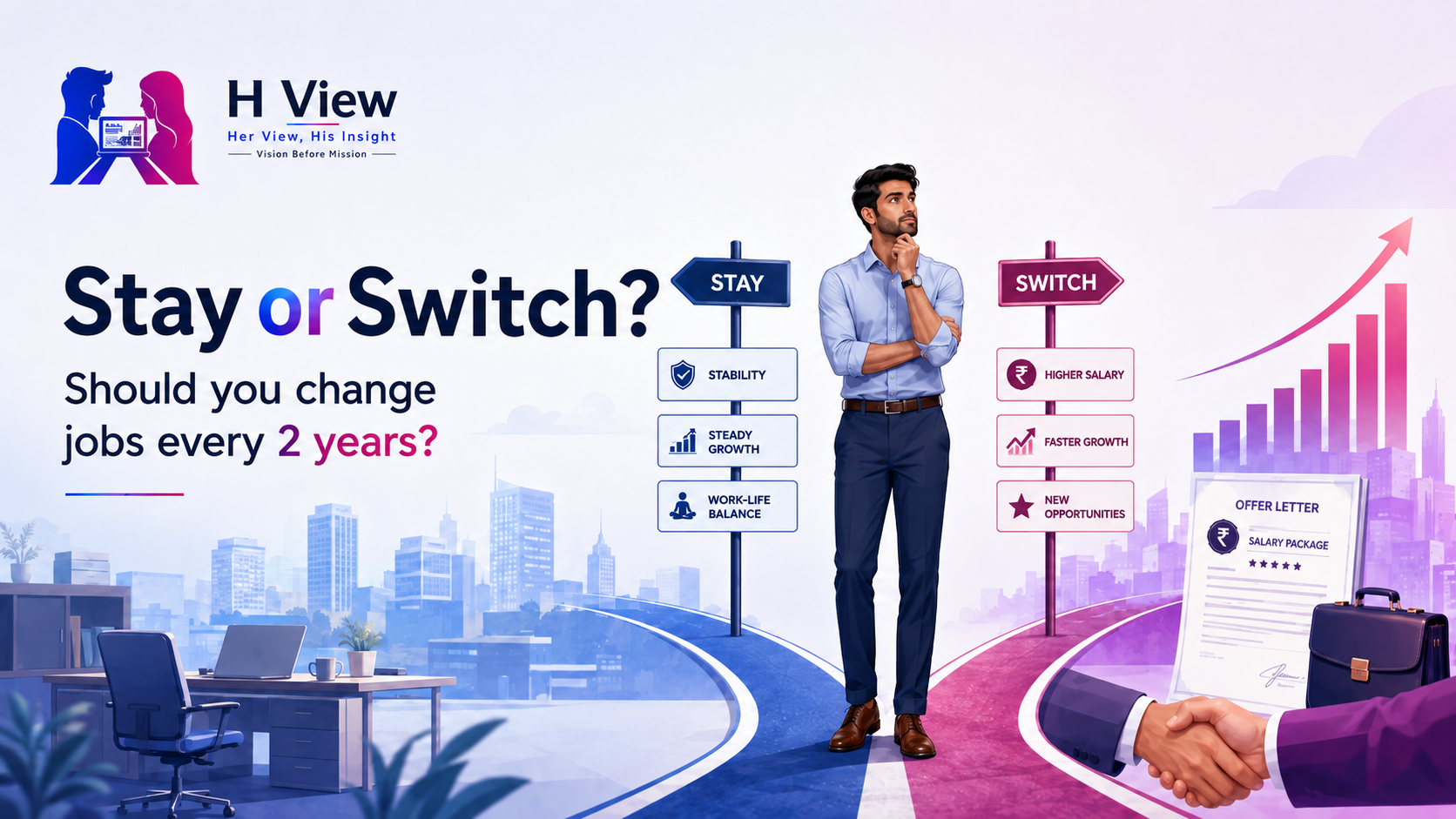
 By Satya HemanthUpdated September 20, 202612 min read31 views
For much of the last decade, one piece of career advice became almost automatic: if you want a serious salary increase, switch companies.
The logic was easy to understand. Annual increments inside a company were often modest, while a new employer might offer 20%, 30% or even more to attract someone with the right experience. Professionals who changed jobs every two or three years sometimes saw their salaries grow much faster than colleagues who stayed with one organisation for long periods. In technology, digital marketing, analytics, finance and several other fast-growing sectors, job switching became less of a warning sign and more of a recognised career strategy.
In 2026, however, that strategy is becoming more complicated.
India Inc. is still giving salary increases. EY expects average salary growth of about 9.1% in 2026, with stronger increases in sectors such as GCCs, financial services, e-commerce and life sciences. At the same time, attrition has moderated, employers are becoming more selective about where they spend on talent, and compensation is increasingly being linked to scarce skills, measurable performance and business value rather than broad salary corrections.
Meanwhile, a new workplace phrase has entered the conversation: job hugging. Instead of leaving quickly for the next offer, employees are staying longer because the external market feels uncertain. Recent surveys cited in coverage of the trend suggest that many workers are remaining in roles not because they are completely satisfied, but because job security currently feels more valuable than taking a risk on an unfamiliar employer.
So does the old two-year switching rule still work?
Sometimes it does. But switching simply because the calendar says it is time may be one of the weaker career strategies in the current market.
To understand what is changing, it helps to remember why frequent switching became so attractive in the first place.
Companies usually manage existing-employee salaries through annual budgets. Even a strong performer may receive an increase that is constrained by internal salary bands, team budgets and company-wide compensation policies. A competing employer, however, is solving a different problem: it needs someone with your skills now. If the role is difficult to fill, the company may be willing to pay substantially above your current salary.
That difference created what many professionals called the switching premium.
Someone earning ₹6 lakh might move to ₹8 lakh, stay for two years and then move again at ₹10 lakh or ₹11 lakh. After several carefully timed changes, the salary difference between that person and someone who remained in one company could become substantial.
Even current career guidance still reflects part of this reality. An Economic Times analysis published in May 2026 suggested that job changes can still produce salary increases in the 10–30% range in favourable cases, compared with smaller internal increments, particularly for early-career professionals who move into roles with greater responsibility rather than simply changing employers sideways.
So the switching strategy has not disappeared.
What has changed is how reliably it works.
The years immediately after the pandemic created unusual conditions. Companies were expanding quickly, employees were resigning in large numbers, and businesses often had to pay aggressively to replace talent.
That environment made switching unusually powerful.
The present market is more cautious. Employers have tighter budgets, AI is changing workforce planning, and companies are increasingly asking whether a candidate’s additional salary demand is justified by an equally meaningful increase in capability.
The Financial Times recently noted that job hopping can still help careers, but the labour market has cooled considerably from the period when switchers could expect a clear wage premium almost automatically. Companies are more risk-conscious, while some professionals are finding that opportunities worth leaving for are simply less abundant.
This creates an important distinction.
A professional moving from ₹8 lakh to ₹10 lakh because they are taking ownership of a larger product, managing a team or entering a high-demand specialisation is making a very different career move from someone changing employers purely to obtain ₹50,000 or ₹1 lakh more annually while doing almost identical work.
The first move increases future market value.
The second may increase only this year’s salary.
The reaction to a more uncertain market has been predictable. Many employees are becoming reluctant to leave.
This is where “job hugging” enters the picture. Robert Walters describes it as workers staying in a role longer than they otherwise might because changing employers feels risky, even when the current role is no longer especially satisfying.
Moneycontrol cited survey findings in which nearly half of respondents said economic uncertainty or fear of switching was a major reason they were staying, while job security and compensation were among the strongest considerations.
There is nothing irrational about caution. If you have a mortgage, children, ageing parents, or uncertainty about your industry’s future, stability has real financial value.
But staying only because you are afraid can create another problem: career stagnation.
Suppose you remain in the same organisation for five years. During that period, your salary grows reasonably, but your responsibilities barely change. You work with the same systems, your network remains internal, and newer technologies gradually enter your profession without becoming part of your daily work.
You may feel secure today while becoming less competitive tomorrow.
The real choice is therefore not between job hopping and job hugging. It is between strategic movement and strategic staying.
One of the easiest mistakes during a job switch is looking only at CTC.
Imagine you currently earn ₹12 lakh in Hyderabad and receive an offer for ₹15 lakh in Bengaluru. A 25% increase looks attractive immediately.
But what changes with the move?
Perhaps rent increases by ₹15,000 per month. Your new company requires five days in the office instead of two. Commute costs rise. Your employer contribution to health insurance is weaker, variable pay makes up a larger part of the CTC, and the first salary arrives later because of the payroll cycle.
Suddenly, the 25% headline increase feels much smaller.
Moneycontrol recently highlighted exactly this issue: switching jobs can create hidden expenses before the first salary even arrives, including relocation, benefit differences, tax implications and temporary cash-flow gaps.
This is why experienced professionals should compare total career value, not simply CTC.
Salary matters. So do fixed versus variable pay, bonuses, insurance, equity, commute, remote flexibility, leave, role stability, promotion prospects and the quality of experience you will gain.
Sometimes a 15% hike into an excellent role is better than a 30% hike into a weak one.
Frequent switching can be particularly useful during the early years of a career because each move can expose someone to new systems, industries, managers and responsibilities.
But the same pattern can become less attractive at senior levels.
A developer with four years of experience may benefit from changing organisations to work with larger systems or better technology. A manager with twelve years of experience needs a different kind of evidence. Employers may want to know whether that person has stayed long enough to build a team, deliver a multi-year transformation, manage consequences and develop people.
Leadership careers require time to produce visible outcomes.
Leaving every eighteen months can eventually create a strange resume: many companies, many titles, but little evidence that the person remained anywhere long enough to own the results.
Even current career guidance around switching increasingly reflects this distinction. Early-career movement may help build skills and pay, while mid-career professionals benefit more from depth, strategic responsibility and reputation.
The right switching frequency therefore changes as the career changes.
Consider two professionals who both begin 2021 at ₹8 lakh per year.
Amit changes companies twice over the next five years. His salary reaches ₹15 lakh, but both moves are into similar roles. He has worked on more projects, but his responsibilities remain broadly the same.
Ravi stays with one employer for four years. His salary reaches only ₹12 lakh, but during that period he moves from individual contributor to team lead, manages a major implementation and develops experience handling enterprise clients. In the fifth year, he changes companies at ₹17 lakh because he is now being hired for a larger role rather than merely being paid to leave.
Amit’s early salary growth looked better.
Ravi’s slower period built leverage for a stronger later move.
This illustrates why career growth should not be measured only year by year. Some periods are for monetising skills. Others are for building the skills and credibility that can later be monetised.
Career advice often treats people like spreadsheets. If another employer offers 25% more, the answer appears obvious: move.
Real life is not always that simple.
Someone may finally have a manager who respects boundaries, a hybrid schedule that allows them to care for family, a team they enjoy working with and enough flexibility to manage life outside work. Leaving all of that for a higher CTC carries a cost that cannot always be represented in rupees.
There are also moments in life when stability itself is valuable. A person planning a major medical procedure, supporting young children or dealing with financial responsibilities may reasonably choose a slightly lower salary in exchange for predictability.
The mistake is not staying.
The mistake is staying unconsciously.
If you know what you are receiving in exchange for remaining—learning, flexibility, stability, promotion prospects or quality of life—the decision can be completely rational.
A good job change should improve at least two dimensions of your career.
Perhaps salary rises and the role becomes more strategic. Maybe the pay increase is moderate but you enter a rapidly growing specialisation. You might accept almost the same salary because the new company gives you leadership responsibility or international exposure that dramatically improves your future options.
If the only improvement is CTC, look more carefully.
This matters increasingly because employers are paying premiums for specific capabilities rather than simply years of experience. EY’s 2026 compensation research points toward stronger skill-based differentiation, particularly around AI and other scarce capabilities.
The strongest negotiating position is not “I have stayed here for two years, so I deserve 30% more somewhere else.”
It is “I can now solve problems that I could not solve two years ago.”
There is no need to wait for an arbitrary anniversary.
A switch becomes worth serious consideration when your learning has flattened, meaningful promotions repeatedly fail to materialise, your compensation is significantly below the market, the work environment is damaging, or your industry is moving in a direction your current employer cannot expose you to.
Limited growth opportunities have become an especially important reason employees leave. EY’s 2026 compensation research indicates that career acceleration and role mobility are increasingly significant retention concerns, in some cases becoming more important than simple pay differences.
That is important because salary stagnation can sometimes be fixed through negotiation.
Career stagnation is harder to repair.
If you have spent three years doing essentially the same work and cannot identify what the fourth year will add, staying may be more dangerous than switching.
Leaving is not always the answer either.
Suppose you are six months away from leading a major product launch that would significantly strengthen your resume. Perhaps a promotion is genuinely close and supported by clear evidence rather than vague promises. Maybe you have unvested equity, a retention bonus or specialised training that will substantially increase your market value.
In those cases, waiting can be strategic.
Similarly, switching into an unstable company solely for a small salary increase can be unnecessary risk. The recent discussion around job hugging exists partly because employees recognise that getting another offer is not the same as finding a better long-term position.
A good decision is based on trajectory.
Ask where each option leaves you two or three years from now, not merely what it pays next month.
The era when switching companies every two years automatically meant a large salary jump is becoming less predictable.
Job changes can still produce excellent increases, particularly for professionals with scarce skills or people moving into substantially larger responsibilities. At the same time, employers are becoming more selective, attrition has moderated, and compensation is increasingly tied to specific capabilities and measurable performance rather than simply a willingness to change companies.
That does not mean loyalty has suddenly become the best career strategy.
Staying too long in a stagnant role can quietly make someone underpaid and less employable. Switching too frequently for small salary increases can create a different problem: a career that grows financially without becoming deeper professionally.
So forget the automatic rule that says you must switch every two years.
Instead, ask what the next move actually changes.
Will you earn more? Will you learn more? Will your responsibilities grow? Will the new role make you more valuable three years from now? Are you leaving because the opportunity is better, or because switching has simply become a habit?
The best career move in 2026 may sometimes be switching.
Sometimes it may be staying.
What matters is that every few years your career value should be growing, even when your company name does not change.
It can be, especially early in a career or when the new role offers scarce skills and greater responsibility. However, the salary premium from switching is less automatic than it was during the unusually strong post-pandemic hiring period.
There is no universal percentage. Salary increases depend heavily on industry, skills, seniority and the urgency of the role. Current guidance still shows substantial switching premiums in some cases, while other market analysis suggests the gap between switchers and stayers has narrowed considerably.
Job hugging refers to employees remaining in their current roles primarily because changing jobs feels risky, even when they are not completely satisfied. The trend has become more visible as economic and hiring uncertainty has increased.
Not automatically. Long tenure can build valuable depth, leadership experience and institutional knowledge. The concern arises when responsibilities, skills, compensation and external market value stop progressing.
It depends on the pattern and seniority. Frequent early-career moves can demonstrate growth, but repeated short tenures without increasing responsibility may raise questions about stability, especially for leadership roles.
Evaluate the complete offer rather than the percentage alone. Compare fixed pay, variable compensation, benefits, location costs, work flexibility, job security, responsibilities and future growth before deciding.
Satya Hemanth is the founder of H View and writes on careers, sports, leadership, digital trends, and practical decision-making. His articles focus on clear explanations, real-world examples, and useful insights for students, young professionals, and everyday readers.
Share your real experience and help other readers decide better.
No community views yet. Be the first to share yours.
Open LinkedIn for a few minutes and you will probably come across a colourful graphic…
Harika October 6, 2026 
When an employee resigns, many organisations move quickly into replacement mode. The manager informs HR,…
Harika October 6, 2026 
For many corporate employees, the workday begins long before they actually start working. They wake…
Harika October 5, 2026 
Many projects begin with an assumption that sounds reasonable on paper: the client will explain…
Harika October 1, 2026