

Best Digital Marketing Tools in 2026: What Marketers Actually Need and What They Can Skip
Open LinkedIn for a few minutes and you will probably come across a colourful graphic…
 Harika October 6, 2026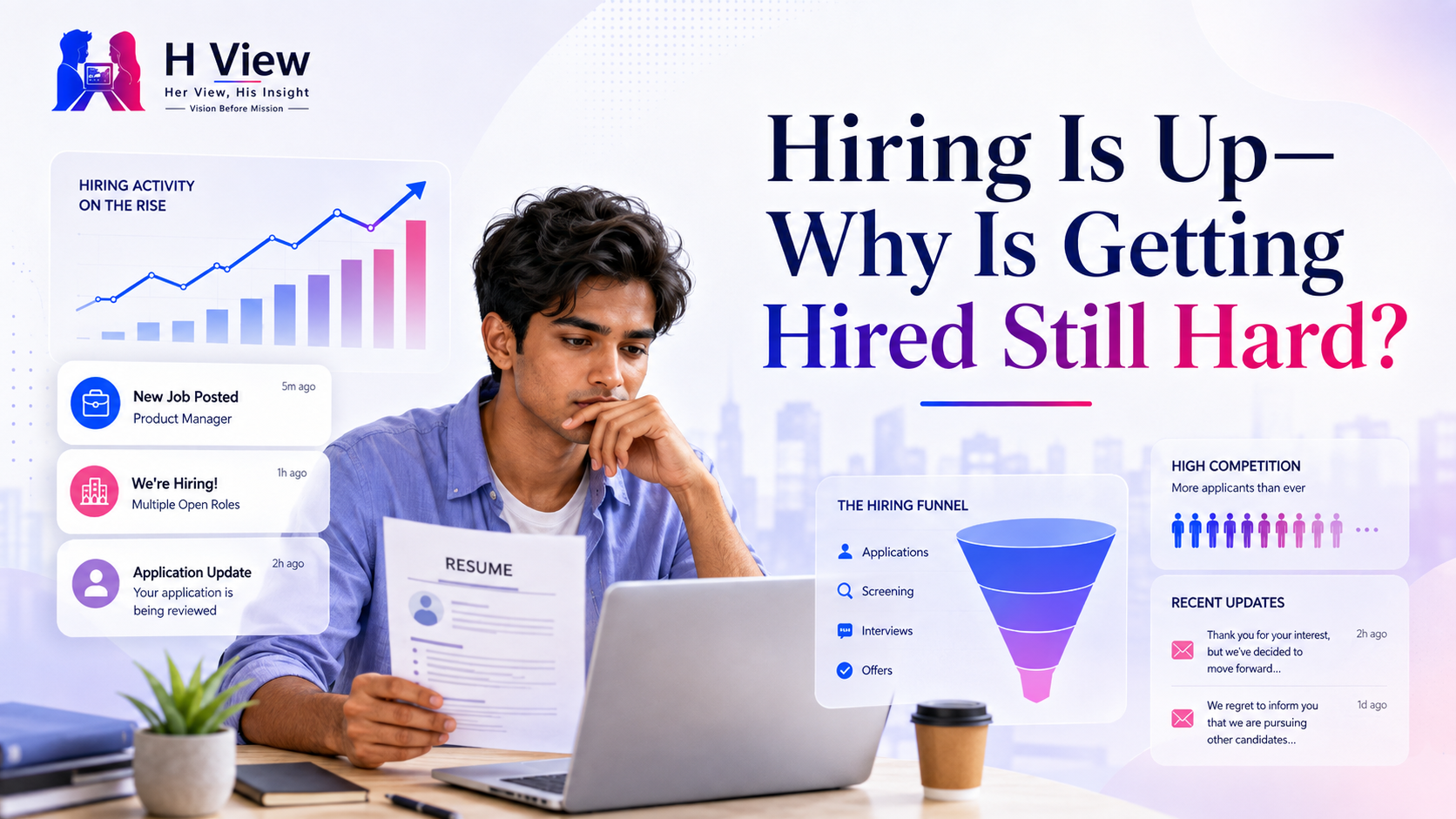
 By Satya HemanthUpdated August 28, 202611 min read35 views
If you look only at hiring reports, India’s job market appears to be improving. Companies are talking about expansion again, fresher hiring intent has strengthened, and senior HR leaders are predicting continued recruitment through the second half of 2026. Naukri’s latest Hiring Outlook found that 79% of senior HR leaders expect new jobs to be created in the second half of the year, while 97% expect some form of hiring activity, including replacement hiring, to continue.
Yet ask someone who has been applying for months and you may hear a completely different story. Resumes disappear into application portals, entry-level jobs ask for experience, interview processes stretch across several rounds, and even candidates who receive offers sometimes wait months for onboarding. Fresh graduates are told that hiring is improving while simultaneously being asked to prove skills that older generations were expected to learn after joining.
Both realities can be true at the same time.
The job market may be creating opportunities overall while becoming harder to enter for the individual candidate. Hiring is no longer distributed evenly across sectors, locations or experience levels. Employers are becoming more selective, AI is changing what companies expect from beginners, and a degree that once acted as proof of readiness is increasingly treated as only the starting point.
For job seekers, the important question is no longer simply, “Are companies hiring?” It is who are they hiring, for what work, and what has changed about the definition of a job-ready candidate?
One reason the current market feels confusing is that national hiring numbers hide major differences between industries.
TeamLease EdTech’s latest fresher outlook found that 75% of 1,097 surveyed employers intended to hire fresh graduates between July and December 2026. That sounds encouraging, but the strongest demand was concentrated in sectors such as retail, e-commerce and technology start-ups, and manufacturing. Retail and e-commerce/tech start-ups reported 93% fresher hiring intent, while manufacturing stood at 89%. IT hiring intent, meanwhile, declined from 81% in the first half of the year to 76% in the second.
That difference matters because many graduates are still searching according to the career market they expected when they entered college.
An engineering student may spend most of their time applying to large IT services companies. A commerce graduate may focus heavily on banking roles. An MBA candidate may wait for a corporate-office position in marketing or consulting. If hiring growth is happening somewhere else, the overall numbers can rise without improving that particular candidate’s experience very much.
This is one reason someone can read that “fresher hiring is up” and still receive no interview calls. Their target role may simply be sitting in one of the slower parts of a growing market.
Another problem is that job-market statistics count opportunities, while job seekers experience fit.
A vacancy may exist, but that does not automatically make it realistic for every applicant. It may require relocation, night shifts, specific software knowledge, prior experience, a lower salary than the candidate can afford, or a qualification they do not have.
Consider a graduate living in Vijayawada who is offered an ₹18,000 role in Bengaluru. The job technically exists, but after rent, food and travel, the economics may be difficult. Another candidate may find plenty of sales jobs but be looking specifically for software testing. A third may see dozens of openings marked “entry level” that still ask for one or two years of relevant experience.
From the employer’s perspective, the vacancy is open.
From the candidate’s perspective, the opportunity may still feel inaccessible.
That gap between jobs available and jobs realistically suitable is one reason national hiring optimism does not always translate into optimism among job seekers.
The expectations placed on freshers have also changed.
Traditional volume hiring, particularly in India’s large IT services sector, often involved recruiting large batches of graduates and training them after joining. That model is becoming more selective. Recent reporting on IT recruitment shows companies increasingly tying fresher intake to project demand rather than maintaining large benches of employees waiting for deployment. Delayed onboarding has also affected some candidates, with joining timelines becoming dependent on business and project requirements.
This changes the meaning of “entry level.”
An employer may still want a graduate with little formal experience, but it increasingly wants that graduate to arrive with some practical exposure. The candidate may be expected to understand Git, data tools, AI assistants, APIs, cloud environments, testing workflows or business software before the company has invested much in training.
The fresher has not necessarily been removed from the market.
The training burden has partly shifted from employer to candidate.
That is a major reason getting hired can feel harder even while companies remain interested in young talent.
The discussion around AI often jumps directly to whether jobs will disappear. The current hiring picture is more complicated.
Naukri’s H2 2026 survey found that 86% of senior HR leaders did not expect significant AI-driven job losses over the following six months. More than one-fifth of HR leaders in IT and BFSI expected AI to create new roles, particularly across IT, marketing and analytics.
The pressure on candidates comes from something subtler. AI allows existing employees to complete certain routine tasks faster. That means companies can expect more output from smaller teams, and the easiest tasks once assigned to beginners may no longer justify hiring another person.
A junior developer may now be expected to use AI coding tools while still understanding the code well enough to debug it. A marketing fresher may be able to draft content faster with AI, so employers may judge them more on strategy, analytics and decision-making. A data candidate can generate formulas or SQL queries quickly, which makes the ability to verify results more valuable.
AI is not simply removing jobs. It is moving the starting line.
Another shift is taking place inside technology employment itself.
Global Capability Centres, or GCCs, have become important employers in India. These are Indian centres operated by multinational companies to handle technology, engineering, analytics, finance, research, product development and other global functions. Recent reporting suggests GCCs are now adding talent faster than traditional IT-services firms in some parts of the market.
That sounds like a direct replacement for slower IT hiring, but the reality is not so simple.
GCCs often hire for more specialised work. They may want candidates with stronger skills in data, cybersecurity, product engineering, cloud platforms or AI. Reporting on fresher hiring suggests GCC intake has increased substantially, but they still do not reproduce the enormous campus hiring volumes that traditional IT-services companies once provided.
So opportunities are not disappearing; they are being redistributed toward different employers and different skill profiles.
A candidate who keeps applying only to the companies that dominated campus hiring five years ago may therefore feel that the job market has collapsed while another part of the market is expanding.
Imagine two engineering graduates, Rahul and Neha.
Both completed their degrees in 2026. Both know basic Python and SQL, and both want an entry-level technology role.
Rahul applies mainly to software developer positions at large IT companies. He sends the same resume to more than 200 openings and spends most of his preparation time practising standard interview questions.
Neha starts in the same way but notices that many current openings mention data engineering, cloud tools, automation and analytics. She spends six weeks building a small project that pulls data through an API, stores it in a database and creates a simple dashboard. She begins applying to GCCs, start-ups, analytics firms and application-support roles alongside traditional IT companies.
Neither candidate is guaranteed a job.
But Neha has adjusted to where demand is moving.
This is increasingly the difference between job searching as an activity and job searching as a strategy.
There is a human cost to this market that hiring reports rarely capture.
A graduate can understand intellectually that 500 people applied to the same job and still feel personally rejected when no response arrives. After enough silence, candidates begin questioning their degree, communication skills, intelligence and sometimes their entire career choice.
This is particularly difficult when headlines insist that companies are hiring.
The candidate thinks, “If the market is improving and I am still unemployed, there must be something seriously wrong with me.”
That conclusion is often too harsh.
A person may be applying in an overcrowded sector, using a weak resume, targeting roles above their current level, living in a location with limited openings or simply arriving late to vacancies receiving thousands of applications.
None of those explanations means nothing needs to change. It means rejection should be treated as information rather than a verdict on personal worth.
A healthier job search asks where the process is breaking down and adjusts that stage specifically.
Hiring optimism is useful, but it does not tell an individual candidate where to apply tomorrow morning.
The more useful signals are much closer to the job description.
Which industries are repeatedly hiring your level of experience? Which tools appear across twenty similar vacancies? Which cities have the strongest demand? Are companies asking for portfolios, certifications or hands-on projects? Do the roles you want still exist in large numbers, or are adjacent roles growing faster?
Naukri’s latest survey shows particularly strong hiring expectations in business development, marketing and IT functions, while 62% of HR leaders expect the greatest hiring activity in the zero-to-three-years experience band.
Those are encouraging numbers, but they become useful only when candidates translate them into decisions.
The candidate who follows yesterday’s career map may struggle in tomorrow’s hiring market.
Job seekers often respond to rejection by trying to fix everything at once.
They rewrite the resume, join another course, learn a new programming language, create a LinkedIn post and apply to fifty more jobs.
A better approach is to identify the stage at which progress stops.
If you send 50 well-matched applications and receive no screening calls, the problem may be targeting or resume presentation. If you regularly receive assessments but fail them, your practical preparation may be weak. If you reach final interviews repeatedly but receive no offer, communication, technical depth or salary expectations may deserve closer attention.
The correct response depends on the failure point.
This sounds obvious, but many candidates spend months improving skills when the resume is not reaching recruiters—or endlessly redesigning resumes when the real issue is that they cannot clear the first assessment.
India’s broader employment picture has improved in recent months. The unemployment rate fell to 5.1% in July 2026, while labour-force participation increased to 55.4%.
Those are positive developments.
They do not mean the path into every professional career has become easier.
Some of the large, predictable hiring channels that once absorbed graduates in volume are changing. Companies have more tools to screen candidates, more applicants to choose from and stronger expectations around practical readiness. Meanwhile, new opportunities are emerging in industries and roles students may not have originally considered.
The market is therefore not simply “better” or “worse.”
It is more selective, more uneven and more dynamic.
That is what job seekers need to respond to.
The job market can be hiring again while getting hired still feels harder because job growth and individual access to those jobs are not the same thing.
Companies are creating roles, but they are not creating them evenly across every sector. Freshers are still wanted, but employers increasingly expect them to demonstrate useful skills before joining. AI has not wiped out employment, but it has changed the value of routine work. GCCs and emerging industries are creating new opportunities while some traditional hiring engines are becoming more selective.
For job seekers, this means the strategy has to change with the market.
Do not apply to 500 jobs simply because they contain your degree in the eligibility section. Identify where hiring is actually expanding. Understand what employers repeatedly ask for. Build evidence around one or two realistic roles and widen your search to adjacent sectors rather than constantly switching careers.
Most importantly, do not allow optimistic hiring headlines or repeated rejection emails to tell you the whole story.
The market may genuinely be improving.
Your route into it may still need to change.
Current hiring surveys suggest employers remain optimistic. Naukri’s H2 2026 Hiring Outlook found that 79% of senior HR leaders expect new job creation, while TeamLease EdTech reported that 75% of surveyed employers intended to hire freshers between July and December.
Hiring growth is uneven across sectors, while employers are also becoming more selective about practical skills and workplace readiness. Candidates may therefore struggle if they target crowded roles or depend only on academic qualifications.
TeamLease’s H2 2026 outlook showed particularly strong fresher hiring intent in retail, e-commerce and technology start-ups, and manufacturing, with improvements also reported in FMCG, travel and hospitality, engineering/infrastructure and logistics.
Yes, but the market is changing. Employers are becoming more selective, and demand is shifting toward areas such as AI, cloud, data, automation, cybersecurity and specialised engineering rather than only traditional large-scale entry-level hiring.
Not immediately. First check whether your applications match the roles, whether the resume demonstrates relevant skills and whether your target sector is actually hiring. Sometimes an adjacent role or industry is a better adjustment than a complete career change.
AI is changing some entry-level tasks and raising employer expectations, but current employer surveys do not suggest broad immediate job destruction. The more important shift is that candidates are increasingly expected to use modern tools while still demonstrating judgement and practical ability.
Satya Hemanth is the founder of H View and writes on careers, sports, leadership, digital trends, and practical decision-making. His articles focus on clear explanations, real-world examples, and useful insights for students, young professionals, and everyday readers.
Share your real experience and help other readers decide better.
No community views yet. Be the first to share yours.
Open LinkedIn for a few minutes and you will probably come across a colourful graphic…
Harika October 6, 2026 
When an employee resigns, many organisations move quickly into replacement mode. The manager informs HR,…
Harika October 6, 2026 
For many corporate employees, the workday begins long before they actually start working. They wake…
Harika October 5, 2026 
Many projects begin with an assumption that sounds reasonable on paper: the client will explain…
Harika October 1, 2026