

Best Digital Marketing Tools in 2026: What Marketers Actually Need and What They Can Skip
Open LinkedIn for a few minutes and you will probably come across a colourful graphic…
 Harika October 6, 2026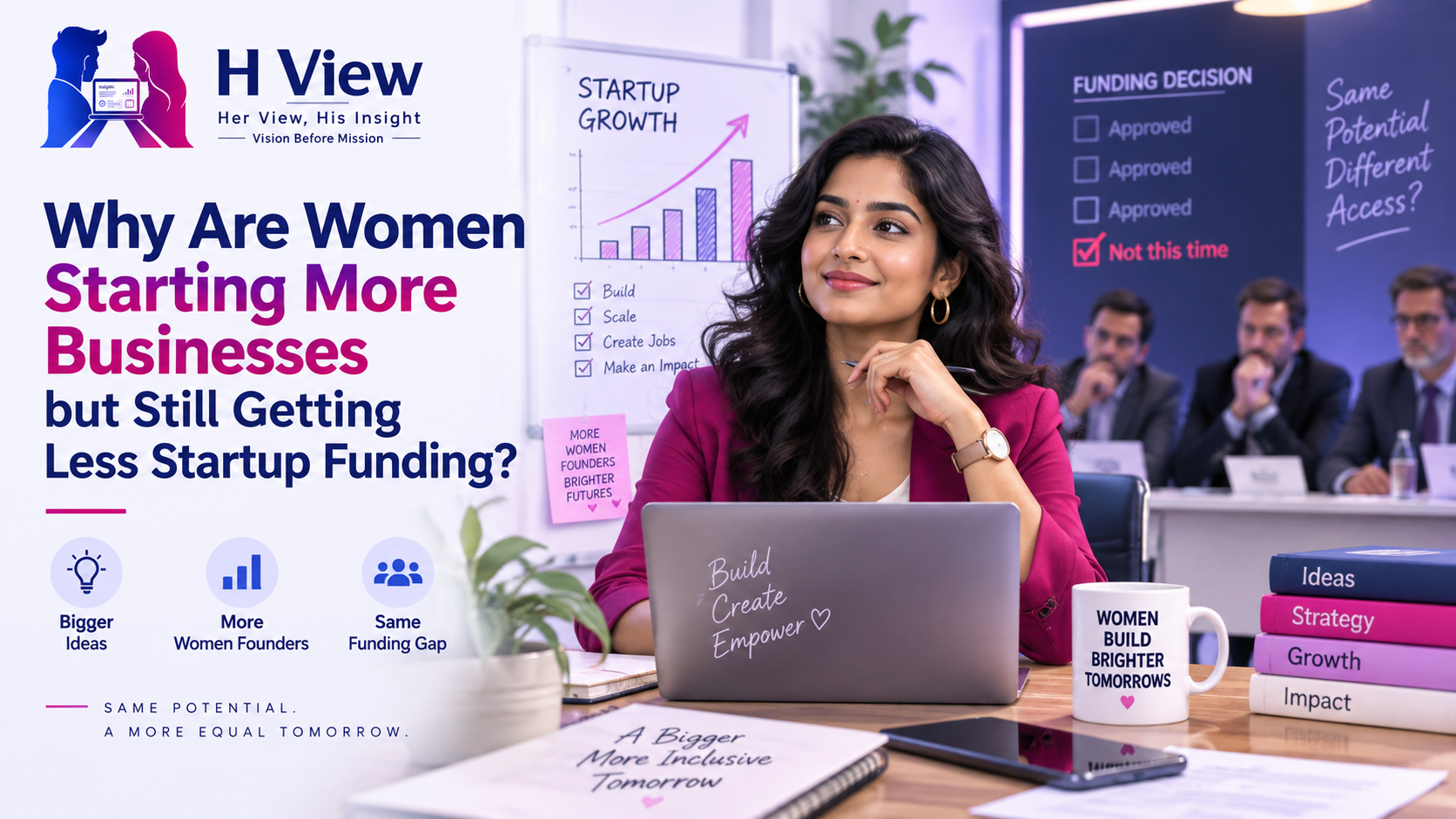
 By AnnapurnaUpdated September 21, 202614 min read16 views
India’s startup story is increasingly becoming a women’s story too, but the money has not caught up with the participation. More women are starting companies, joining founding teams, formalising businesses, using digital platforms to reach customers, and entering industries that were once overwhelmingly male. Government data shows that as of January 31, 2026, 1,02,054 of India’s 2,12,283 DPIIT-recognised startups had at least one woman director or partner, which means women were represented in roughly 48% of recognised entities.
That is an encouraging sign, but it creates an uncomfortable question. If women are appearing across such a large part of India’s startup ecosystem, why does venture capital flowing to women-founded businesses remain disproportionately small? Tracxn reported that women co-founded Indian technology startups raised around $1 billion in 2025, and its FY 2025–26 analysis placed women co-founded companies at roughly 11% of overall startup funding. Another 2026 industry report estimated that women-only founding teams in India received only about 2.3% of venture funding, illustrating how dramatically the number changes depending on whether we count women-only or mixed-gender founding teams.
This is therefore not simply a story about women needing more confidence, better pitches, or stronger business ideas. The funding gap sits at the intersection of who enters entrepreneurship, who enters the networks that produce venture-scale companies, which businesses investors traditionally favour, who can afford to take startup risk, and who gets invited into the rooms where capital relationships are built.
Before discussing the funding gap, one distinction is essential. Starting a business and building a venture-funded startup are not the same thing, even though both are forms of entrepreneurship.
A woman running a profitable consultancy, D2C brand, food company, boutique manufacturing unit, education business, healthcare service, local enterprise, or digital agency may never need venture capital. She may grow through customer revenue, personal savings, bank credit, government schemes, family capital, or retained profits instead. Venture investors, by contrast, generally seek companies capable of growing rapidly enough to produce very large returns, which naturally narrows the kinds of businesses they are willing to finance.
This partly explains why rising women’s entrepreneurship does not automatically translate into a matching venture-capital share. Government figures also show strong participation by women in self-employment and smaller-scale financing. For example, women have received a large majority of loans issued under the Pradhan Mantri Mudra Yojana, demonstrating that entrepreneurship exists far beyond the technology startup ecosystem usually covered by venture-capital headlines.
The real concern appears when women are building businesses that do fit the venture model, seek institutional capital, demonstrate traction, and still encounter barriers that male founders may experience less frequently.
The contrast becomes clearer when participation and capital are placed beside each other.
| Indicator | Latest reported figure | What it actually tells us |
|---|---|---|
| DPIIT-recognised startups with at least one woman director or partner | 1,02,054 of 2,12,283 as of January 31, 2026 | Women have broad representation within recognised startup entities |
| Women co-founded tech startup funding in 2025 | About $1 billion | Capital is flowing, but remains a minority of total technology funding |
| Women co-founded share of total startup funding in FY 2025–26 | About 11% | Mixed-gender and women co-founded teams collectively receive a larger share than women-only teams |
| Estimated funding share for women-only founding teams | About 2.3% | The gap becomes much sharper when companies founded entirely by women are isolated |
| Startup India Seed Fund approvals to women-led startups | Around ₹294 crore of approximately ₹592 crore approved through incubators by Jan. 2026 | Some public funding mechanisms show much stronger women participation than private VC |
Sources: DPIIT/PIB, Tracxn and the Arise Ventures Diversity Report. The categories use different definitions, so they should not be treated as directly interchangeable percentages.
That final point matters. Statistics about “women-led,” “women-founded,” “women co-founded,” and startups with “at least one woman director or partner” describe different populations. Combining them carelessly can exaggerate either progress or inequality, which is why serious discussion needs to look beyond a single headline percentage.
Startup mythology suggests that a brilliant founder walks into a room, presents an extraordinary idea, and receives investment because the numbers speak for themselves. Real venture capital is considerably more relationship-driven.
Investors discover founders through former colleagues, other founders, accelerators, universities, angel groups, portfolio companies, professional networks, and trusted introductions. A founder who already knows ten people inside the startup ecosystem may reach an investor much faster than an equally capable entrepreneur who begins without those connections.
This appears to be one of the important structural gaps identified in recent research. Kalaari Capital’s CXXO initiative reported in 2026 that, within influential startup networks studied, women founders received roughly ₹4 for every ₹100 raised by men. The report also argued that women were less likely to emerge as founders from elite networks despite increasing participation in education and professional pipelines.
The difference is subtle but powerful. If women reach investors later, receive fewer warm introductions, know fewer repeat founders, and have less access to informal investor circles, then the funding gap begins before the formal pitch meeting even happens.
Women entrepreneurs are often highly visible in consumer brands, education, healthcare, beauty, wellness, food, fashion, social commerce, and services. These can become excellent businesses, but some venture investors historically place larger bets on areas such as enterprise software, fintech infrastructure, deep technology, artificial intelligence, cybersecurity, and other sectors capable of very rapid scaling.
This creates a second structural question. Are women receiving less funding simply because investors underestimate women, or are fewer women reaching the sectors, networks, technical founding teams, and previous-founder pipelines where the largest pools of venture capital are concentrated?
The answer can be both. Women can face genuine bias while also being underrepresented in highly funded technical founder networks. Solving the capital gap therefore requires more than asking venture firms to write more cheques; it also requires improving access to technical education, founder networks, early-stage experimentation, mentorship, accelerators, and experienced co-founders.
The 2025 funding environment also affected the picture. Tracxn reported that women co-founded technology startups raised approximately $1 billion in 2025, compared with $1.1 billion in 2024, while the number of funding rounds fell from 574 to 405. This means capital remained relatively stable but was concentrated across significantly fewer transactions.
The stage-by-stage numbers tell an even more useful story. Early-stage funding rose 12% to $533 million, while seed-stage funding fell to $261 million and late-stage funding declined to $213 million. Investors were still willing to back companies they believed had strong fundamentals, but they became considerably more selective about which founders reached that point.
| Funding stage | 2025 funding for women co-founded tech startups | Year-on-year direction |
|---|---|---|
| Seed stage | $261 million | Down approximately 24% |
| Early stage | $533 million | Up approximately 12% |
| Late stage | $213 million | Down approximately 35% |
This matters for first-time founders because tighter seed markets disproportionately hurt entrepreneurs who have less personal capital, fewer wealthy contacts, and weaker access to angel networks. A founder with family wealth or an established professional network can often continue developing a business while fundraising takes longer. A founder without that cushion may have to close, return to employment, or deliberately keep the company small.
Entrepreneurship already involves uncertainty, but the cost of that uncertainty is not always distributed equally. A woman considering leaving a salaried job may simultaneously be thinking about marriage, childcare, elder care, household expectations, financial dependence, maternity, and whether her family will continue supporting the business if it takes several years to succeed.
This does not mean women are naturally more risk-averse. The more useful question is whether they are being asked to take the same entrepreneurial risk while carrying different responsibilities outside the company.
A male founder working fourteen-hour days may be praised for being obsessively committed to his startup. A woman founder working the same hours may also have to explain why she is unavailable for household responsibilities or childcare. When entrepreneurship requires extreme time flexibility, unequal domestic expectations can become an invisible disadvantage long before investors examine the financial model.
The capital problem therefore cannot be separated entirely from the broader unpaid-work problem. If women have less discretionary time, less personal wealth, fewer professional networks, and greater pressure to choose predictable income, fewer will remain in the venture pipeline long enough to raise multiple funding rounds.
It would be misleading to attribute every rejected funding application to gender bias. Most startups fail to raise institutional capital, including those founded by men, because venture investors reject far more companies than they fund.
However, repeated differences in capital access justify examining whether founders are evaluated differently. Research and industry discussions have long questioned whether women are asked more risk-focused questions while men receive more growth-oriented questions, whether leadership styles are interpreted differently, and whether pattern-matching causes investors to favour founders who resemble entrepreneurs they have successfully backed before.
Pattern recognition is useful in investing, but it can become self-reinforcing. If historically successful venture-backed founders were disproportionately men from certain professional and educational networks, investors may unconsciously define that profile as what a “fundable founder” looks like. The result can be a system in which past inequality quietly influences future capital allocation.
The answer cannot be reduced to creating a few women-only pitch competitions around Women’s Day. Sustainable improvement requires strengthening the capital pipeline before, during, and after fundraising.
Several interventions could make a meaningful difference:
One dangerous feature of startup culture is the tendency to treat fundraising as though it were the product. A company announcing a $10 million round receives attention, while a founder quietly building a profitable business without investors may receive very little recognition.
Women entrepreneurs should not be encouraged to copy this definition of success blindly. Capital is useful when it accelerates a proven opportunity, but external funding also brings dilution, growth expectations, investor influence, governance responsibilities, and pressure to produce an eventual exit.
For some businesses, venture capital is exactly the right tool. For others, strong cash flow, customer revenue, moderate debt, and slower ownership-preserving growth may produce a better outcome.
The funding gap deserves attention because women should have equal access to capital when they need it, not because every woman-owned business needs to become venture-backed.
The frustrating part of the funding conversation is that women are often told to become more confident, network harder, pitch better, and think bigger, as though the capital gap can be solved entirely through personal improvement. Founders certainly need those skills, but women also need access to the networks, financial buffers, technical ecosystems, mentors, and investors that make entrepreneurship easier to sustain through its uncertain early years. Equality in entrepreneurship does not mean guaranteeing investment to women; it means ensuring that a strong company founded by a woman has the same realistic opportunity to reach capital as an equally strong company founded by a man.
Men who already occupy influential positions in startup networks have an important role that goes beyond publicly supporting women entrepreneurs. Founders, investors, executives, and mentors can make introductions, invite women into informal founder networks, recommend them for accelerators, challenge assumptions in investment discussions, and share access that may otherwise take years to build. A healthier ecosystem does not require replacing merit with gender; it requires recognising that merit cannot be judged fairly when access to opportunity is uneven before evaluation even begins.
India no longer needs much evidence that women can become entrepreneurs. Women are already building companies, directing startups, accessing government schemes, creating digital businesses, entering technology, employing people, and raising institutional capital.
The more useful question is what happens between starting a business and gaining access to the capital required to scale it. Current data suggests that women have become increasingly visible across India’s startup base while remaining underrepresented in private venture funding, particularly when women-only founding teams are considered.
Closing that gap will require more than inspirational stories about successful female founders. It requires stronger networks, broader access to technical entrepreneurship, better early-stage financing, more transparent investment data, family structures that allow women to take entrepreneurial risk, and investors willing to examine whether familiar founder patterns are causing unfamiliar talent to be overlooked.
The encouraging part is that the pipeline is no longer empty. Women are already entering entrepreneurship in substantial numbers. The next stage of India’s startup evolution will be determined by whether its capital networks evolve quickly enough to recognise them.
Women founders can face several barriers at the same time, including weaker access to investor networks, lower representation in venture-backed sectors, fewer warm introductions, smaller personal financial buffers, and unequal domestic responsibilities. The gap is therefore not explained by one factor alone, and it should not be reduced to the idea that women simply need better pitches or more confidence.
Yes, women are increasingly visible across India’s startup and entrepreneurship ecosystem. Government data shows a large number of recognised startups now include at least one woman director or partner, although that figure should not be confused with the share of startups founded entirely by women. The distinction is important when comparing participation with venture-capital funding.
Women-only founding teams often have less access to established founder and investor networks, particularly in sectors where large venture rounds are common. Mixed-gender teams may also benefit from broader professional connections and founder histories, which can influence how quickly they reach institutional investors.
Bias can be part of the problem, but it is not the only explanation. Sector concentration, founder networks, access to capital, previous startup experience, personal financial risk, and the type of business being built can all influence funding outcomes. A serious analysis has to look at these factors together.
No. Many successful businesses can grow through customer revenue, bank finance, government schemes, retained profits, strategic investors, or bootstrapping. Venture capital is most suitable for companies that need rapid scale and can support the high-growth expectations that institutional investors usually require.
Women founders are highly visible in consumer brands, healthcare, education, wellness, food, fashion, digital services, and social commerce. Their participation is also growing in SaaS, fintech, AI, enterprise technology, climate-tech, and other technical sectors, although representation remains lower in some of these capital-intensive categories.
Founders can improve their position by building strong networks, joining accelerators, seeking experienced mentors, developing measurable traction, understanding the right funding stage, and targeting investors whose portfolio matches the business. However, the burden should not fall entirely on founders; investors and startup ecosystems also need to improve access and transparency.
Investors can widen sourcing networks, publish clearer data on who they fund, review whether pattern-matching is excluding unfamiliar founder profiles, and create more structured access for first-time women founders. Early-stage investors can also help by offering warm introductions, mentorship, and better pathways into institutional capital.
Yes, especially when entrepreneurship requires long hours, uncertain income, travel, and repeated fundraising. If household and caregiving responsibilities remain heavily concentrated on the woman, the business can become harder to sustain even when the idea itself is strong.
No. Funding is a tool, not the final measure of success. A profitable, sustainable business with strong customer revenue may be healthier than a heavily funded company with weak economics, and founders should choose capital based on business needs rather than treating fundraising as the primary definition of success.
Annapurna is an H View contributor covering relationships, family, lifestyle, entrepreneurship, and everyday decision-making. Her articles focus on emotional clarity, practical understanding, and human-centered perspectives that help readers think better about personal and professional situations.
Share your real experience and help other readers decide better.
No community views yet. Be the first to share yours.
Open LinkedIn for a few minutes and you will probably come across a colourful graphic…
Harika October 6, 2026 
When an employee resigns, many organisations move quickly into replacement mode. The manager informs HR,…
Harika October 6, 2026 
For many corporate employees, the workday begins long before they actually start working. They wake…
Harika October 5, 2026 
Many projects begin with an assumption that sounds reasonable on paper: the client will explain…
Harika October 1, 2026