

Navratri Day 1, 2026: Why Maa Shailputri Is Worshipped First and What Ghatasthapana Really Means
Sharad Navratri begins today, Sunday, October 11, 2026, and the first morning carries a different…

By Dr. A. Alimelu Annapurna
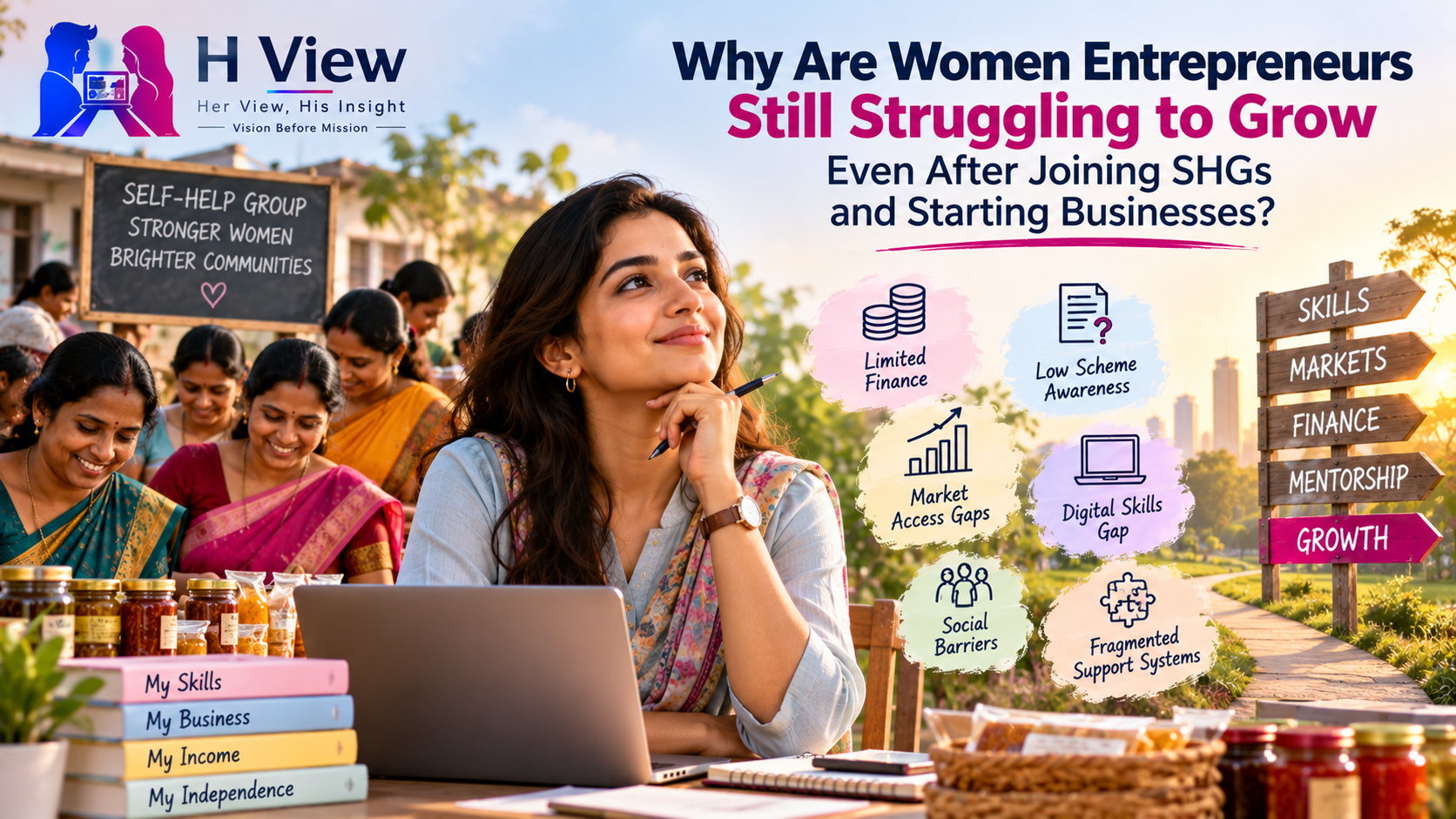
Women’s entrepreneurship is often discussed as though the most difficult step is simply getting a woman to start a business. Once she joins a Self-Help Group, receives a micro-loan, begins selling a product, or registers a small enterprise, it can appear that the major barrier has already been crossed. The reality on the ground is more complicated. Starting a business may be the first breakthrough, but sustaining it, growing it, formalising it, reaching larger markets, and building long-term financial independence require a much stronger support system.
A recent district-level study from East Godavari provides a clear picture of this transition problem. The research, based on 504 women entrepreneurs across manufacturing, trade, and service activities, shows that women are entering entrepreneurship in meaningful numbers and that entrepreneurship is strongly associated with economic empowerment. At the same time, the study finds that many enterprises remain financially fragile, early-stage, weakly connected to formal support systems, and constrained by social and institutional barriers.
The central question, therefore, is no longer whether women can become entrepreneurs. They already are. The more important question is why so many women-led enterprises struggle to move from basic participation into sustained growth.
One of the strongest findings in the study is that entrepreneurship is clearly connected with economic empowerment. The statistical analysis found a strong positive relationship between entrepreneurship and empowerment, with a Spearman correlation of 0.637 and a significance level below 0.001. The regression analysis also showed entrepreneurship as a positive predictor of empowerment, with the model explaining 64.54% of the variation in empowerment outcomes.
These numbers are important because they confirm something women entrepreneurs themselves have been demonstrating for years. Earning through enterprise can improve decision-making power, confidence, household contribution, and the ability to participate more actively in economic life.
The study found that 90.87% of respondents reported some improvement in quality of life, while 65.87% believed that entrepreneurship had strengthened their ability to make decisions. These are meaningful outcomes, but they also need to be interpreted carefully. The improvements are real, yet they are generally modest rather than transformational.
The gap between improvement and transformation is where the policy challenge begins.
The profile of the respondents reveals why the enterprise transition remains fragile. Nearly 98.02% had less than one year of entrepreneurial experience, showing that most women in the study were still operating at the beginning of their business journey.
The typical respondent was a married woman aged between 31 and 40, with secondary education, living in a nuclear household, and managing significant family responsibilities. Around 60.12% reported having four dependents, which means that business decisions are closely tied to household obligations.
This matters because early-stage entrepreneurship requires experimentation, learning, networking, customer development, and risk-taking. A woman who is simultaneously responsible for dependents, household management, and family expectations may not have the same freedom to invest time, money, or attention into business growth.
The study therefore suggests that entrepreneurship policy cannot treat women entrepreneurs as isolated economic actors. Their businesses are embedded within family structures, household responsibilities, and community expectations.
One of the most striking findings is that 90.08% of respondents were members of Self-Help Groups. This makes SHGs the strongest existing platform for identifying women with entrepreneurial potential, mobilising them, linking them to credit, and providing peer support.
However, the study also reveals a critical weakness. Around 91.07% of respondents used micro-loans to start their businesses, while only 5.95% reported using bank loans and 2.98% relied on personal savings.
This dependence on micro-credit highlights the transition problem. Micro-loans can help women begin, but they may not be sufficient for working capital, machinery, formalisation, packaging, marketing, technology adoption, or business expansion.
The report therefore recommends moving from an SHG-centred model toward an enterprise graduation pathway. SHGs should help identify and prepare women entrepreneurs, but women who demonstrate potential should then be connected to larger financial systems, growth services, markets, and mentoring.
The study identifies finance as the most immediate barrier to enterprise growth. Around 51.79% of respondents reported no access to financial resources, while 44.84% reported limited access. A further 59.13% said that credit barriers occurred occasionally or frequently.
The difficulty, however, is not simply the absence of loans. The report makes an important distinction between credit availability and credit readiness. Many entrepreneurs need support in costing, bookkeeping, repayment planning, cash-flow management, and separating household finances from business finances before larger formal credit becomes useful.
This is reinforced by other findings. Around 45.44% said they needed financial-management skills, while 72.82% had never created a budget or business plan.
A stronger financial support model therefore has to combine money with capability.
| Financial challenge | What the study shows | What is needed |
|---|---|---|
| No or limited finance | 51.79% report no access; 44.84% limited access | Formal bank linkage and assisted documentation |
| Micro-loan dependence | 91.07% started through micro-loans | Graduation toward larger enterprise finance |
| Weak financial planning | 72.82% never created a budget or business plan | Costing, cash flow, bookkeeping and planning |
| Limited financial confidence | 45.44% want financial-management skills | Practical financial-capability training |
| One-time credit approach | Many enterprises remain early-stage | Repeat finance based on records and performance |
The report’s recommendation of quarterly Women Enterprise Credit and Financial Capability Clinics is especially practical because it combines SHG mobilisation, MSME screening, bank support, financial literacy, and case follow-up rather than treating loan sanction as the end of the process.
One of the strongest policy signals in the report concerns scheme awareness. Around 71.23% of respondents were not aware of women-enterprise schemes, while 27.58% were aware but had not used them. Only 1.19% reported being aware of and actually using such schemes.
This tells us that the presence of government schemes does not automatically mean that women can access them. Awareness itself is only the first stage. Women may still struggle with eligibility, documentation, application processes, bank linkage, formalisation, or follow-up.
The report therefore makes an important recommendation: scheme promotion should move from awareness campaigns to assisted access. Mandal-level help days should provide screening, document checklists, Udyam or formalisation guidance where relevant, bank referrals, training referrals, and a named follow-up contact.
This is a major shift in thinking. Women entrepreneurs should not be expected to understand and navigate the entire government support system on their own.
Another important finding is that women are asking for practical growth tools. Around 38.10% said they wanted marketing tools, another 38.10% wanted technology resources, and 20.83% wanted market insights.
The capability gaps are equally significant. Around 78.37% did not feel confident managing money and resources effectively. About 69.44% said they did not regularly think about improving products, services, or systems, while 86.31% were neutral about adopting new technology or methods. At the same time, 46.43% had already used technology at least once to solve a problem, expand an idea, or start a venture.
This shows that women are not rejecting technology. Many simply need structured exposure and practical guidance.
The report proposes a three-level capability ladder:
This kind of staged model is far more useful than one-time generic training.
The study makes it clear that business performance cannot be separated from the social environment surrounding the entrepreneur. Around 57.14% reported experiencing gender expectations sometimes or often, while 34.92% identified family resistance as a common social barrier.
Women also appear to be solving problems in relative isolation. Around 56.75% tended to deal with challenges alone, while only 18.06% collaborated with others. Nearly 69.64% had not previously collaborated to achieve a business or community goal, and 85.12% were neutral about their confidence in building useful professional relationships.
This explains why mentoring and peer networks should not be dismissed as secondary support. They directly influence access to information, confidence, persistence, and growth.
A woman may have enough resilience to keep going, but resilience should not become an excuse for weak support systems.
Perhaps the strongest recommendation in the entire report is that East Godavari already has most of the institutions it needs. SHG networks, MSME support systems, banks, training centres, higher-education institutions, and mentoring capacity already exist. The larger problem is fragmentation.
The report proposes a district-level Women Enterprise Facilitation Network that would connect these institutions rather than creating yet another isolated programme. Its design principle is particularly powerful: the entrepreneur should not have to understand the entire government ecosystem; the ecosystem should organise itself around her.
That means SHGs can identify women with potential, MSME or DIC can help formalise and guide them, training institutions can build capabilities, banks can provide finance, and mentors can support the first months of growth.
The report proposes an eight-stage enterprise graduation pathway that offers a much clearer way to think about women’s entrepreneurship:
This is the kind of pathway that can convert entrepreneurship from a short-term livelihood activity into sustainable economic empowerment.
Women do not need to be told repeatedly that they should become entrepreneurs. Many have already taken that first step. What they need now is a system that understands the difference between starting and growing. A small loan may help a woman begin, but long-term independence requires financial capability, larger market access, technology, professional networks, mentoring, and a family environment that recognises her enterprise as serious work.
Families, institutions, bankers, and local business networks must also recognise that enterprise growth is a shared ecosystem responsibility. When women are expected to overcome financial barriers, paperwork, technology gaps, family pressure, weak networks, and market limitations entirely on their own, resilience becomes a burden rather than a strength. Supporting women entrepreneurs should mean helping them build stronger enterprises, not simply celebrating the fact that they managed to start one.
The East Godavari evidence sends a clear message. Entrepreneurship is positively associated with women’s economic empowerment, but the impact becomes weaker when barriers remain unresolved. The study also shows a moderate negative relationship between challenges and enterprise growth, confirming that constraints are not peripheral problems; they directly affect whether businesses progress.
The next phase of women’s entrepreneurship policy should therefore move beyond counting SHG members, loans, training sessions, or scheme registrations. Success should be measured by whether enterprises survive, increase revenue, adopt digital tools, access repeat credit, reach wider markets, create jobs, and strengthen women’s decision-making power.
The women have already entered the entrepreneurial journey. The real responsibility now is to ensure that they are not left halfway between livelihood activity and sustainable enterprise.
This article draws on a cross-sectional questionnaire of 504 women in MSME-registered business units in East Godavari district, Andhra Pradesh. Fieldwork ran from June to December 2024 and covered manufacturing, trade, and services. The findings describe this district sample; they should not be read as proof that entrepreneurship alone caused the reported outcomes or as representative of all women entrepreneurs in India.
The research brief also records 336 missing responses (66.67%) to its question about access to skill-development or training programmes. That measure needs particular caution. The policy recommendations discussed here are the researcher’s interpretation of the district findings.
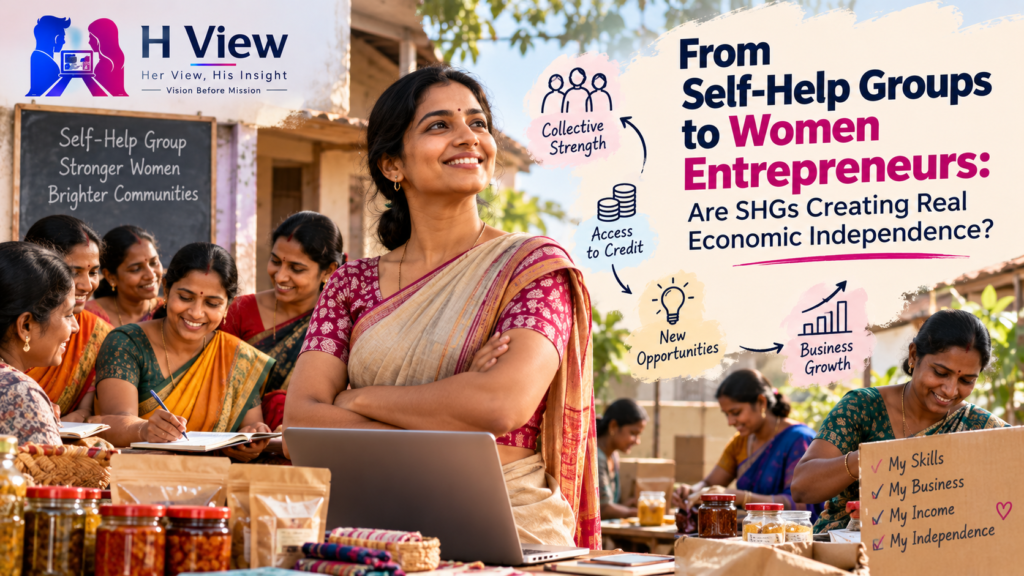
For a related H View perspective, read From Self-Help Groups to Women Entrepreneurs: Are SHGs Creating Real Economic Independence?
Annapurna is an H View contributor covering relationships, family, lifestyle, entrepreneurship, and everyday decision-making. Her articles focus on emotional clarity, practical understanding, and human-centered perspectives that help readers think better about personal and professional situations.
Share your real experience and help other readers decide better.
No community views yet. Be the first to share yours.
Sharad Navratri begins today, Sunday, October 11, 2026, and the first morning carries a different…
Software projects are often estimated using a particular team structure, toolset, workflow, and development speed.…
Every festive sale in India begins with the same visual language: giant discount percentages, crossed-out…
By Dr. A. Alimelu Annapurna For millions of rural women in India, the first step…