
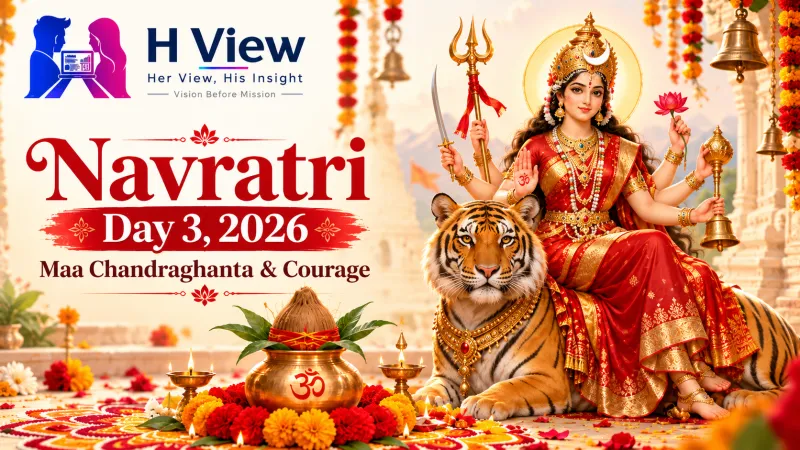
Navratri Day 3, 2026: Maa Chandraghanta and the Courage to Remain Calm Under Pressure
Navratri Day 3 honours Maa Chandraghanta, who brings grace and battle-readiness together. Her story, the red colour of the day, milk bhog and what courage with calm looks like today.
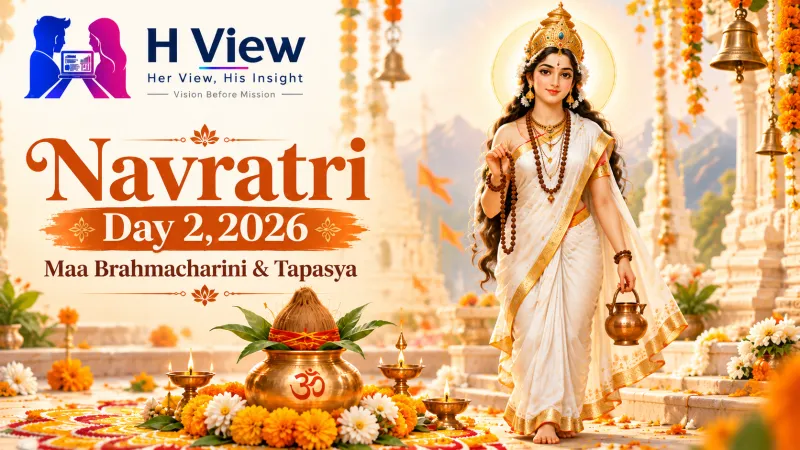
By the third day of Navratri, the journey shifts from inner discipline toward outward courage. After Maa Brahmacharini’s tapasya on Day 2, the goddess now steps forward ready to protect.
Navratri Day 3 2026 falls on Tuesday, October 13, and is dedicated to Maa Chandraghanta, the third form of Navdurga. The popular colour for the day is red. Chandraghanta Puja is performed on Tritiya, and some traditions also observe Sindoor Tritiya on this day.
Maa Chandraghanta is one of the most striking forms of Durga because she brings grace and battle-readiness together. Her name refers to the bell-shaped crescent moon (ghanta) on her forehead. She is usually shown riding a tiger or lion, carrying weapons while also showing gestures of protection and blessing.
That combination matters. Chandraghanta does not stand for uncontrolled aggression. She stands for the ability to face danger without losing balance. Her image tells us that peace and strength are not opposites, because real peace sometimes needs the courage to defend what should not be surrendered.
The Story Behind Maa Chandraghanta
The traditional story is linked to the marriage of Parvati and Shiva. After Parvati’s long tapasya, Shiva agreed to marry her. Some narratives describe him arriving in a fearsome ascetic form, accompanied by unusual attendants, which alarmed her family. Parvati then took on a radiant, powerful form and persuaded Shiva to appear in a gentler form for the wedding.
There are several regional retellings, but the symbolism stays the same: Parvati gives up neither love nor self-respect. She can be devoted and still act firmly when the moment demands it.
Later traditions associate Chandraghanta with courage in battle and the destruction of negative forces. She becomes the form of Durga who represents alertness, bravery and the ability to protect peace, rather than simply hoping it will last on its own.
Navratri Day 3 at a Glance
| Detail | Day 3 Information |
|---|---|
| Date | Tuesday, October 13, 2026 |
| Tithi | Tritiya |
| Goddess | Maa Chandraghanta |
| Popular colour | Red |
| Vehicle | Tiger or lion in common depictions |
| Main symbol | Bell-shaped crescent moon |
| Core quality | Courage with composure |
| Common bhog | Milk, kheer or milk-based sweets |
| Simple mantra | Om Devi Chandraghantayai Namah |
 Also readNavratri Day 7, 2026: Maa Kalaratri and the Courage to Face What We Usually Avoid→
Why the Bell Matters
The bell in Chandraghanta’s name carries a lovely devotional meaning. Temple bells mark sacred space, call attention and signal the move from ordinary life into worship. In her iconography, the bell-like crescent stands for alertness and the power to drive away negativity.
There is a useful modern reading too. Courage is not always about speaking louder. Sometimes it is about becoming clear enough to recognise what truly needs action. If you cannot tell the difference between an inconvenience and a real threat, you may panic over small things or stay passive when courage is genuinely needed.
Chandraghanta represents courage that is conscious, not impulsive.
Red on Day 3: Energy Without Losing Balance
Red is the popular colour for October 13 in the Navratri sequence. It naturally carries energy, passion and strength, which suits a goddess whose form expresses readiness and confidence. (See the full colour list in our Navratri 2026 guide.)
Red can also stand for emotions that become hard to manage, especially anger. That creates a meaningful contrast. Chandraghanta holds enormous power, yet she is never shown as emotionally chaotic. Her strength stays directed toward protection and righteousness.
That may be the most useful Day 3 lesson: anger can tell us that something matters, but courage decides what we actually do with it.
How to Observe Navratri Day 3 at Home
- Offer milk, kheer or a milk-based sweet as bhog
- Chant Om Devi Chandraghantayai Namah during your puja
- Ring the puja bell mindfully – a small reminder of her name and symbol
- Wear or use red if your family follows the colour tradition
Her View: Being Peaceful Does Not Mean Being Easy to Silence
Women are often encouraged to stay calm, polite and accommodating, even when the situation calls for firmness. A woman who sets a strong boundary may be called difficult, while the same behaviour in someone else is praised as leadership.
Chandraghanta offers a more balanced picture of feminine strength. She is neither passive nor permanently aggressive. She stays graceful while being fully prepared to defend what matters.
That symbolism is worth carrying beyond the puja room. Peace means something when it is chosen from strength, not imposed through fear.
 Also readNavratri Day 6, 2026: Maa Katyayani and Why Strength Is Not the Same as Anger→
His Insight: Courage Is Often Needed Before Confidence Arrives
We assume brave people act because they are not afraid. Usually, courage exists precisely because fear is present. Someone applies for the difficult job, speaks up against something wrong, leaves an unhealthy situation or starts again after failure, all without knowing how it will turn out.
Waiting for fear to disappear can become another form of avoidance. Chandraghanta’s symbolism suggests that action can happen while uncertainty remains.
The goal is not recklessness. It is recognising that fear deserves to be heard, but does not always deserve the final vote.
H View Verdict
Navratri Day 3 brings a clear change in energy. After Shailputri’s stability and Brahmacharini’s discipline, Chandraghanta introduces courage: the ability to protect what the first two days helped us build.
Her story also breaks the false choice between gentleness and strength. You can be peaceful without being powerless, and courageous without becoming cruel. That balance is increasingly valuable at home, at work and in public life, where disagreements are so often pushed to extremes.
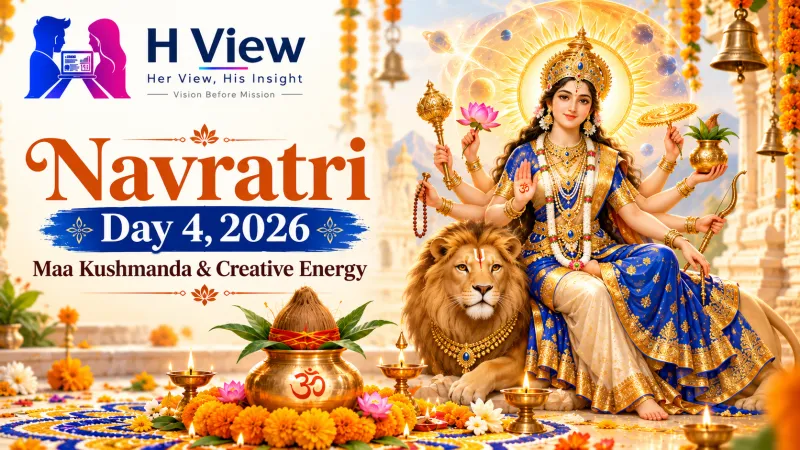
The red of Day 3 is more than festive brightness. It reminds us that energy is useful only when it is directed wisely. Next, the journey turns to creation with Maa Kushmanda on Navratri Day 4.
Frequently Asked Questions
Which goddess is worshipped on Navratri Day 3?
Maa Chandraghanta is worshipped on Tuesday, October 13, 2026, which is Tritiya in the 2026 Navratri sequence.
What is the Navratri Day 3 colour in 2026?
Red is the popular colour for the third day of Navratri 2026.
Why is she called Chandraghanta?
Her name refers to the crescent moon on her forehead, which is traditionally described as being shaped like a bell (ghanta).
What is offered as bhog to Maa Chandraghanta?
Milk, kheer and milk-based sweets are the offerings most commonly associated with Day 3.
H View stories follow our editorial policy. Spotted an error? Tell us and we will correct it.
Rate this article
One tap is enough. No comment needed.
Was this article helpful?
Your answer goes straight to our editors.








Comments0
No comments yet. Start the conversation.