

Amazon Great Indian Festival 2026 Laptop Deals: Are the Discounts Really Worth It or Just Inflated MRP Marketing?
Every festive sale in India begins with the same visual language: giant discount percentages, crossed-out…

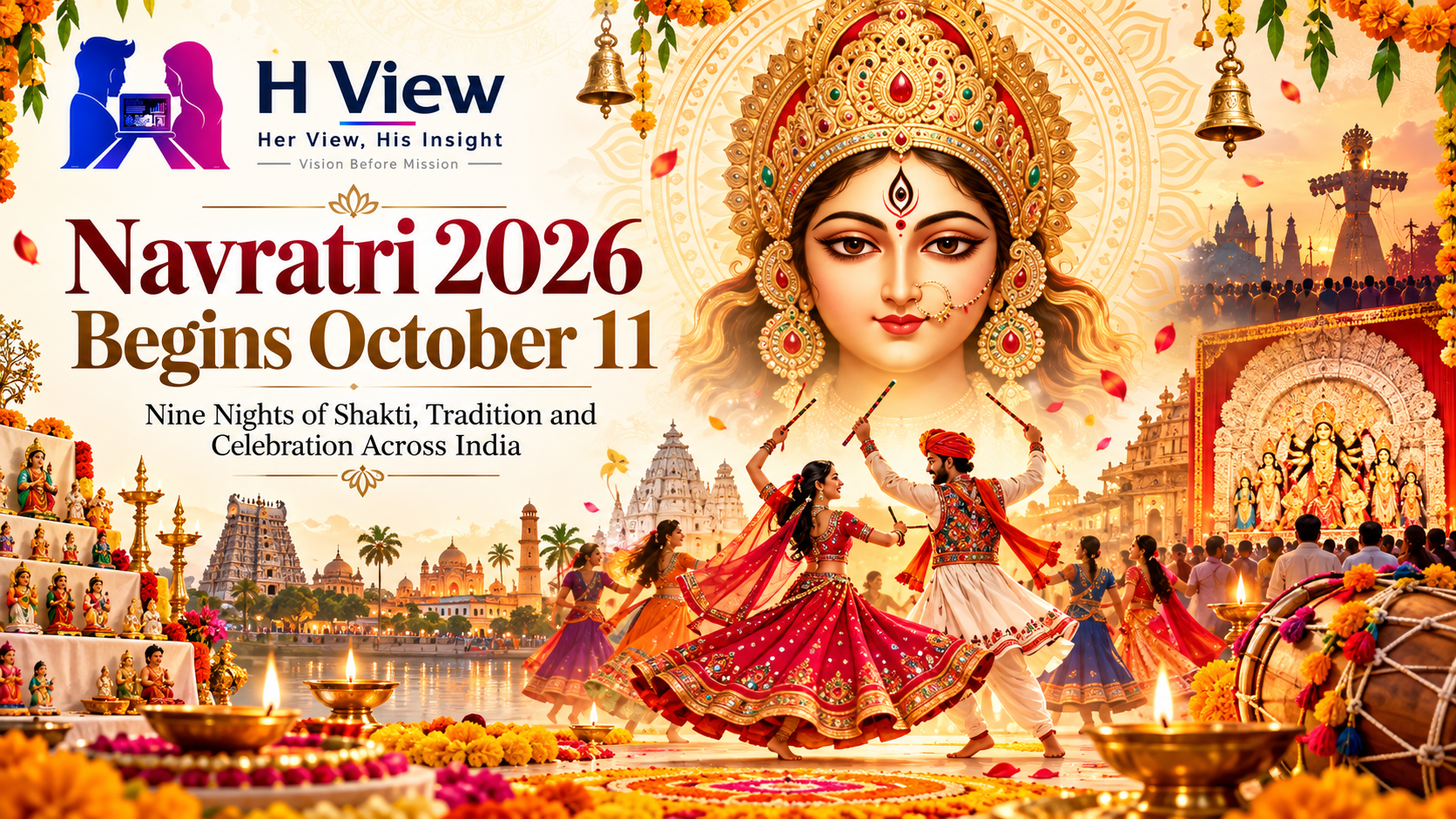
There are festivals we celebrate for a day, and then there are festivals that gradually transform the atmosphere around us. Navratri belongs to the second kind. For nine nights, temples become busier, homes prepare for puja, families change their food routines, music and Garba fill public grounds, Durga Puja pandals take shape in eastern India, Golu displays brighten homes in the south, and the celebrations eventually move toward Vijayadashami, one of the most culturally significant days in the Indian calendar.
Sharad Navratri 2026 begins on Sunday, October 11, and the nine-night observance continues through Monday, October 19, followed by Vijayadashami or Dussehra on Tuesday, October 20. Government of India tourism information lists the main Navratri period as October 11–19, while Dussehra falls on October 20. The festival honours the divine feminine, particularly the nine forms of Goddess Durga collectively known as Navdurga, and celebrates the recurring Indian idea that strength guided by righteousness ultimately overcomes destructive forces.
What makes Navratri particularly beautiful is that India does not celebrate it in one identical way. In Gujarat, the nights come alive through Garba and Dandiya; in West Bengal and much of eastern India, the period reaches its grandest expression through Durga Puja; in Karnataka, Mysuru Dasara transforms an entire city into a cultural spectacle; and in Andhra Pradesh, temples such as Vijayawada’s Kanaka Durga Temple become major centres of worship. Across parts of South India, families arrange Golu or Bommai Kolu displays and give special importance to Saraswati Puja and Ayudha Puja, while northern celebrations often connect Navratri with fasting, Kanya Puja, Ramlila and the eventual burning of Ravana effigies on Dussehra.
That diversity makes Navratri much more than a nine-day religious schedule. It is simultaneously a devotional observance, a celebration of feminine divinity, a community gathering, a performing-arts festival, a period of fasting and reflection, and a cultural bridge connecting traditions that may look very different on the surface but share a common idea of renewal, discipline and the victory of good over evil.
The word Navratri literally refers to “nine nights.” Sharad Navratri is observed during the lunar month of Ashwin and is among the most widely celebrated forms of Navratri in India. The festival centres on Shakti, the divine feminine principle, and many traditions worship nine manifestations of Goddess Durga in a sequence that moves from Shailaputri on the first day to Siddhidatri on the ninth.
One of the best-known narratives associated with the festival describes Goddess Durga’s battle against Mahishasura. According to the tradition, the battle continues through the period of Navratri and culminates in the triumph of the Goddess, symbolising the defeat of arrogance, disorder and destructive power by divine strength. This story is especially significant in Mysuru, where Chamundeshwari’s victory over Mahishasura forms a central part of the city’s celebrated Dasara tradition.
North Indian Dussehra traditions also connect Vijayadashami with Lord Rama’s victory over Ravana in the Ramayana. Bengal concludes Durga Puja with Vijaya Dashami and the immersion of Durga idols, while Mysuru celebrates Chamundeshwari’s victory over Mahishasura. Rather than making the festival contradictory, these traditions show how different regions have expressed the same larger theme through their own histories, stories and cultural memories.
The 2026 calendar has one detail that readers should understand before following a simple “one goddess per date” graphic. Hindu festival observances follow tithis, which do not always fit perfectly into midnight-to-midnight calendar days. In 2026, Saptami extends across two sunrise periods, while Ashtami transitions into Navami on October 19, which is why some panchangs assign the final forms and rituals slightly differently across October 18 and 19.
| Date | Day | Main Navratri association | Goddess / observance | Common 2026 colour |
|---|---|---|---|---|
| October 11 | Sunday | Day 1 / Pratipada | Ghatasthapana, Maa Shailaputri | Orange |
| October 12 | Monday | Day 2 / Dwitiya | Maa Brahmacharini | White |
| October 13 | Tuesday | Day 3 / Tritiya | Maa Chandraghanta | Red |
| October 14 | Wednesday | Day 4 / Chaturthi | Maa Kushmanda | Royal Blue |
| October 15 | Thursday | Day 5 / Panchami | Maa Skandamata | Yellow |
| October 16 | Friday | Day 6 / Shashthi | Maa Katyayani; Saraswati Avahan in some traditions | Green |
| October 17 | Saturday | Saptami | Maa Kalaratri; Saraswati Puja in some traditions | Grey |
| October 18 | Sunday | Extended Saptami / festival continues | Traditions vary; many popular nine-day calendars associate the day with Mahagauri | Purple |
| October 19 | Monday | Ashtami transitioning to Navami | Durga Ashtami, Mahagauri, Siddhidatri traditions, Sandhi Puja and Maha Navami | Peacock Green |
| October 20 | Tuesday | Vijayadashami | Ayudha Puja in many traditions, Navratri Parana, Durga Visarjan and Dussehra | — |
Drik Panchang’s 2026 calendar lists October 11 as Ghatasthapana and Shailaputri Puja, followed by Brahmacharini, Chandraghanta, Kushmanda, Skandamata, Katyayani and Kalaratri through October 17. It then shows the extended Saptami on October 18 and places Durga Ashtami, Mahagauri Puja, Sandhi Puja and Maha Navami on October 19, with Vijayadashami on October 20. Popular cultural colour sequences still commonly map Purple to October 18 and Peacock Green to October 19.
Because these observances depend on tithi and local sunrise calculations, families following a specific sampradaya, temple calendar or regional panchang should continue following that tradition rather than changing practice based on a generic online chart. The spiritual sequence of Navdurga remains Shailaputri, Brahmacharini, Chandraghanta, Kushmanda, Skandamata, Katyayani, Kalaratri, Mahagauri and Siddhidatri; what becomes unusual in 2026 is how the last few tithis fall across civil dates.
Navratri begins on October 11 with Pratipada and the worship of Maa Shailaputri. The first day also includes Ghatasthapana or Kalash Sthapana, through which many households formally begin the nine-day observance. The kalash symbolises auspiciousness and the presence of divine energy, and families may sow grains alongside it as a representation of life, fertility and renewal.
Ghatasthapana timings are location-specific because they depend on local sunrise and panchang calculations. For example, the New Delhi calculation lists a morning window from approximately 6:19 a.m. to 10:12 a.m. and an Abhijit window around midday, but devotees in other cities should check their own local panchang rather than copying Delhi timings.
Shailaputri represents the beginning of the spiritual journey, which makes the symbolism especially appropriate for the opening day. Rather than viewing the first day simply as the start of another festive period, many devotees use it to set intentions for discipline, prayer and self-reflection during the nine nights.
The second day is associated with Maa Brahmacharini, representing devotion, austerity and disciplined pursuit. Chandraghanta follows on the third day and is commonly associated with courage and protection, while Kushmanda on the fourth day represents creative and life-giving energy. Skandamata, worshipped on the fifth day, emphasises the nurturing and maternal dimension of Shakti, whereas Katyayani on the sixth represents determination and the powerful force that confronts injustice.
This progression is one reason Navratri can be understood as more than a sequence of different names of the Goddess. Each form highlights a different dimension of strength, including patience, courage, nurturing, creativity, protection and decisive action. Together, they portray feminine divinity not as a single personality but as a spectrum of qualities necessary for life.
On October 16, Saraswati Avahan also begins in some traditions, bringing the worship of knowledge, learning and the arts more directly into the later phase of Navratri. That connection becomes particularly important in southern India, where books, instruments and tools eventually become part of Saraswati Puja and Ayudha Puja observances.
Maa Kalaratri, associated with the seventh stage, is one of Durga’s fiercest forms and represents the destruction of fear, ignorance and darkness. The following form, Mahagauri, is associated with serenity, purity and transformation, while Siddhidatri, the ninth form, represents spiritual fulfilment and accomplishment. The movement from Kalaratri to Mahagauri is particularly symbolic because the sequence moves from confronting darkness toward clarity and grace.
In 2026, however, the calendar requires some explanation. Saptami extends across October 17 and part of October 18, and Ashtami begins on October 18 before continuing through the sunrise of October 19. Ashtami then ends at around 10:51 a.m. on October 19 in several Indian panchang calculations, after which Navami begins, which is why Durga Ashtami, Sandhi Puja and Maha Navami are concentrated on October 19 in many calendars.
This is also why readers may find one website calling October 18 the Mahagauri day while another formally places Mahagauri Puja on October 19. Neither automatically means the other calendar is careless; some popular day-by-day calendars preserve the nine-night sequence, while stricter panchang listings follow the tithi present at sunrise. Families should therefore follow the convention they normally use, especially for formal pujas and fasting completion.
Durga Ashtami is among the most important days of the festival because it represents the climactic phase of the Goddess’s battle against destructive forces. Many devotees observe special prayers, fasting, havan and Kanya Puja around Ashtami or Navami according to their family tradition. In Kanya Puja, young girls are worshipped symbolically as manifestations of the divine feminine and are offered food and gifts.
Sandhi Puja takes place at the transition between Ashtami and Navami and has particular importance in Durga worship. In the 2026 calendar, the Sandhi Puja window falls on October 19, around the time Ashtami concludes and Navami begins; panchang calculations for several Indian cities place it roughly between 10:27 a.m. and 11:15 a.m., though devotees should check local timings.
The ritual is traditionally associated with Goddess Chamunda and the destruction of Chanda and Munda. Its significance is not simply dramatic mythology, because the moment represents transition—the point at which one stage of struggle gives way to another and the final victory approaches.
Fasting practices vary significantly between regions, communities and individual families. Some devotees observe a complete fast, some eat one meal a day, and many follow a satvik diet that excludes regular grains, onion, garlic, meat and alcohol. Others may observe only selected days such as the first day, Ashtami or Navami, so there is no single food rule that applies universally to every Hindu household.
Common Navratri foods include:
Recent Navratri food coverage highlights dishes such as sabudana khichdi, kuttu puri, makhana kheer, sama rice khichdi and onion-free potato preparations as common festive foods. The purpose of fasting, however, is traditionally connected to restraint and spiritual discipline rather than simply replacing everyday food with an elaborate alternative menu.
Few places visually represent Navratri as spectacularly as Gujarat. For nine nights, communities gather in large circles for Garba and Dandiya, wearing colourful traditional clothing while devotional music, folk rhythm and social celebration combine in the same space. Gujarat Tourism’s Vibrant Navratri Festival 2026 is scheduled from October 11 to 20 at Ahmedabad’s GMDC Ground, with cultural performances, Maha Aarti, handicrafts and large-scale Garba celebrations.
Garba itself carries symbolism beyond entertainment. Traditional Garba is performed around a lamp or representation of Shakti, and the circular movement reflects continuity, collective participation and the centrality of divine energy. That spiritual origin is easy to overlook when Garba becomes a glamorous public event, but it explains why dance and devotion have remained so closely connected during Navratri.
Dandiya Raas adds another energetic dimension through rhythmic sticks and coordinated movement. Modern events may include massive stages and celebrity performers, yet local neighbourhood Garba remains equally important because Navratri is fundamentally a community festival rather than only a tourism spectacle.
In West Bengal and much of eastern India, the later days of Navratri are dominated by the grandeur of Durga Puja. Elaborately designed pandals, artistic Durga idols, dhak music, community meals and large crowds transform cities such as Kolkata into cultural landscapes of their own. The focus is strongly connected with Goddess Durga’s victory over Mahishasura and reaches its emotional conclusion on Vijaya Dashami through immersion ceremonies.
Durga Puja is also an extraordinary meeting point between devotion and public art. Pandal themes can draw from mythology, architecture, social ideas and contemporary design, while artisans spend months creating idols and temporary structures. This makes the festival not only a religious observance but also a major cultural economy supporting craftspeople, performers, food businesses, designers and local communities.
The final immersion carries both celebration and emotion because devotees symbolically bid farewell to the Goddess after days of intense worship. The departure does not represent an ending in the absolute sense, because the expectation of her return the following year is part of the festival’s emotional rhythm.
In many South Indian homes, Navratri takes on a quieter but equally beautiful character through Golu or Bommai Kolu, where dolls and figurines are arranged on tiered displays. The arrangements may depict gods, saints, villages, everyday life, animals, mythology and even contemporary social themes. Families visit one another, exchange prasadam and celebrate music, storytelling and community alongside worship.
The final phase gives special importance to Saraswati, the Goddess of knowledge, music and learning. Books, musical instruments and educational tools may be placed respectfully for worship, symbolising gratitude for the knowledge through which people build their lives. Children beginning education may also participate in Vidyarambham traditions depending on the region.
Ayudha Puja expands this idea from books to tools of livelihood. Vehicles, machinery, instruments, computers and professional equipment may be cleaned and worshipped because the tradition recognises that work itself depends on the tools that make it possible. In a modern office, this may look very different from an artisan’s workshop or farmer’s field, but the underlying idea—respect for one’s means of livelihood—remains remarkably adaptable.
Andhra Pradesh has its own strong Navratri and Dussehra traditions, especially around the Sri Durga Malleswara Swamy Varla Devasthanam at Vijayawada. During the festival, Goddess Kanaka Durga is worshipped through elaborate daily alankarams, with large numbers of devotees visiting Indrakeeladri Hill. Andhra Pradesh Tourism describes the observance as a major nine-night celebration of divine Shakti that culminates on Vijayadashami.
Proddatur in Kadapa district also has a distinctive Dussehra tradition centred on the Sri Vasavi Kanyaka Parameswari Temple. The celebrations include elaborate adornments, pujas, homams and processions and are prominent enough for Proddatur’s festival to be popularly compared with Mysuru’s grandeur.
These examples matter because they show that Navratri is not something Andhra Pradesh merely observes as a national festival. Local temple traditions, alankarams, processions and devotional practices give the festival a strongly regional identity while still connecting it with the wider worship of Shakti.
Mysuru Dasara is among India’s most visually distinctive Dussehra celebrations. The tradition connects the city with Goddess Chamundeshwari’s victory over Mahishasura, and the celebration is deeply associated with Mysuru Palace, the Wodeyar legacy, cultural performances and the famous Jamboo Savari procession. Incredible India lists the 2026 Mysuru Dasara period beginning October 11 and extending into the Vijayadashami celebrations.
The illuminated palace has become one of the most recognisable images of Indian festive tourism. Yet Mysuru Dasara is more than lighting and procession; music, dance, exhibitions, food, sports and heritage events turn the entire city into a cultural stage. This is a good example of how a religious festival can evolve into a broader celebration of regional identity without losing its devotional centre.
The practice of wearing a particular colour on each day is especially popular in Gujarat and Maharashtra and has spread widely through workplaces, schools and social media. The sequence is linked to the weekday on which Navratri begins, so the colours are not permanently attached to the same Goddess every year. For 2026, commonly followed calendars list Orange, White, Red, Royal Blue, Yellow, Green, Grey, Purple and Peacock Green across October 11–19.
These colours have become a joyful social tradition, but devotees should not feel that wearing the correct colour is a mandatory religious requirement everywhere. Navratri practices differ greatly across India, and family customs or temple traditions may place much less emphasis on a colour schedule. The colours are best understood as a celebratory cultural layer rather than a test of religious correctness.
One of the reasons Navratri feels especially relevant is the way it represents feminine strength through several different forms rather than a single stereotype. The Goddess appears as a daughter, ascetic, warrior, mother, creator, protector and source of knowledge. Strength is therefore not presented only as aggression; it can appear as patience, care, intelligence, discipline, courage and the ability to confront darkness when necessary.
That idea feels particularly meaningful in a society where women are often given contradictory expectations. They may be told to be independent but not “too ambitious,” caring but never exhausted, confident but never intimidating, and professionally successful while still carrying disproportionate responsibility at home. Navratri’s symbolism is powerful precisely because Shakti is not limited to one acceptable personality.
A modern celebration of divine feminine power becomes more meaningful when respect for women continues after the festival. Worshipping the Goddess while tolerating discrimination, harassment or violence in everyday life would reduce a profound cultural tradition to ritual alone. The festival invites devotion, but it should also invite reflection on what respect for Shakti looks like when the temple doors close.
Dussehra imagery makes good and evil easy to recognise because the stories give them clear forms. Real life is rarely so convenient. Ego, anger, jealousy, addiction, dishonesty and indiscipline do not arrive dressed like mythological villains, and people can spend years defending qualities within themselves that they would immediately condemn in someone else.
That is where the nine nights can become personally meaningful even for someone who does not perform elaborate rituals. Fasting can become a lesson in self-control, prayer can create a pause from constant distraction, and the repeated story of overcoming darkness can encourage people to examine habits they normally avoid questioning. A festival becomes more powerful when its symbolism produces even a small change in behaviour.
The idea of victory over evil therefore need not remain confined to a story remembered once a year. Sometimes the hardest Ravana or Mahishasura to defeat is not outside us but in the behaviour we have learned to excuse within ourselves.
Navratri 2026 begins on October 11, but describing it only as a nine-day festival does not explain why it has remained so powerful across generations. It brings together devotion, fasting, dance, music, art, family, food, feminine divinity and regional identity in a way few celebrations can. Gujarat’s Garba, Bengal’s Durga Puja, South India’s Golu and Saraswati worship, Andhra Pradesh’s Kanaka Durga traditions and Mysuru’s royal Dasara may look dramatically different, yet all of them circle around renewal, Shakti and the eventual triumph of constructive power over destructive forces.
The unusual 2026 tithi pattern also reminds us that Indian festival calendars cannot always be reduced to a simple nine-box social-media graphic. Saptami extends across October 17–18, while Ashtami and Navami converge on October 19 before Vijayadashami arrives on October 20. Families should therefore follow their established local panchang or temple tradition for precise puja observances rather than worrying when different calendars organise the final days differently.
For H View, the most beautiful interpretation of Navratri is not only that the Goddess defeats evil at the end of nine nights. It is that strength appears in many forms before that victory becomes possible: discipline through Brahmacharini, courage through Chandraghanta, creativity through Kushmanda, nurturing through Skandamata, determination through Katyayani, fearlessness through Kalaratri, transformation through Mahagauri and fulfilment through Siddhidatri.
That sequence gives the festival a message far beyond ritual. Strength is not one dramatic moment of victory; it is something built gradually through patience, courage, knowledge, discipline and the willingness to confront what must change. Perhaps that is why, after centuries of celebration, Navratri can still feel both ancient and completely relevant to the way we live today.
Sharad Navratri begins on Sunday, October 11, 2026, and the nine-night festival runs through Monday, October 19. Vijayadashami or Dussehra follows on Tuesday, October 20, 2026, marking the culmination of the larger festive period.
The difference occurs because festival observances follow lunar tithis rather than ordinary midnight-to-midnight dates. In 2026, Saptami extends across October 17 and part of October 18, while Ashtami transitions into Navami on October 19, so panchangs that follow sunrise tithis and popular nine-day cultural calendars can label the final days differently. Families should follow their usual regional or temple panchang for formal puja.
The Navdurga sequence is Maa Shailaputri, Maa Brahmacharini, Maa Chandraghanta, Maa Kushmanda, Maa Skandamata, Maa Katyayani, Maa Kalaratri, Maa Mahagauri and Maa Siddhidatri. Each form represents a different dimension of Shakti, ranging from discipline and nurturing to courage, protection, transformation and spiritual fulfilment.
The commonly followed 2026 sequence begins with Orange on October 11, followed by White, Red, Royal Blue, Yellow, Green, Grey, Purple and Peacock Green through October 19. Colour traditions are especially prominent in western India and may not carry the same religious importance in every region or household.
Common panchang calculations place Durga Ashtami and Maha Navami observances on Monday, October 19, 2026, because Ashtami transitions into Navami during the day. Sandhi Puja occurs around this junction, although precise timings should be checked according to the devotee’s city and local panchang.
Vijayadashami falls on Tuesday, October 20, 2026. The day marks the culmination of Navratri and is celebrated through different traditions across India, including Rama’s victory over Ravana, Durga’s victory over Mahishasura, Durga Visarjan, Ayudha Puja and regional Dasara celebrations.
Harika is the co-founder of H View and covers AI, technology, gadgets, digital tools, online platforms, and modern internet trends. Her articles focus on simplifying complex topics with practical explanations, balanced opinions, and reader-first insights.
Share your real experience and help other readers decide better.
No community views yet. Be the first to share yours.
Every festive sale in India begins with the same visual language: giant discount percentages, crossed-out…
By Dr. A. Alimelu Annapurna For millions of rural women in India, the first step…
There is an unusual leadership problem that appears when an employee is preparing to leave…
Open LinkedIn for a few minutes and you will probably come across a colourful graphic…