

Entry-Level Job—but Experience Required? The Fresher Trap Nobody Is Fixing
A fresher opens a job portal and finds an attractive vacancy. The title says Entry-Level,…
 Satya Hemanth August 9, 2026
  By Satya HemanthUpdated September 20, 20266 min read56 views
Many students believe that working in technology means becoming a software developer.
When they struggle with programming, they assume the entire technology industry is closed to them. Some continue joining coding courses they do not enjoy, while others give up on tech careers completely.
But technology companies do not employ only programmers.
They also need people who understand customers, analyse data, test software, design user experiences, document requirements, support business systems, coordinate projects and help teams deliver products successfully.
The technology job market is changing quickly, but one point remains clear: employers need both technical understanding and strong human skills. The World Economic Forum identifies technological literacy, analytical thinking, creative thinking, resilience and collaboration among the skills expected to remain important through 2030.
The better question is not:
“Can I enter tech without coding?”
It is:
“Which technology role matches my strengths, and what proof can I build?”
Every application or digital service involves several teams.
Before developers begin coding, someone must understand the business problem. Designers decide how users will interact with the product. Testers check whether it works properly. Analysts study performance and customer behaviour.
Operations and support teams keep the service running after launch.
Possible non-coding and low-coding roles include:
Some of these roles may require basic SQL, analytics tools or automation. However, they do not demand the same programming depth as software-development positions.
Data analysis is one of the strongest options for students who enjoy numbers, patterns and business questions.
A beginner can start with:
The goal is not merely to create colourful charts. A data analyst must explain what happened, why it matters and what action the business should take.
India’s technology hiring has continued to show demand in data analytics, cloud and cybersecurity-related areas, while employers frequently report difficulty finding candidates with practical experience.
Portfolio idea: Analyse a public ecommerce, sales or employment dataset and create a dashboard with five useful business insights.
UI/UX may suit students who are interested in design, psychology, user behaviour and problem-solving.
Useful beginner skills include:
A beautiful screen alone is not a strong portfolio.
The candidate should explain the user problem, design decisions, feedback received and improvements made.
Portfolio idea: Redesign a confusing booking, hospital or local-business website and document the complete process.
Testing is often misunderstood as randomly clicking buttons until something breaks.
Professional software testing involves:
This role suits people who notice details, ask “what if?” questions and enjoy finding problems before users experience them.
Portfolio idea: Select a public website or demo application and prepare test cases, bug reports and an improvement summary.
A business analyst connects business teams with technical teams.
They may gather requirements, map processes, prepare documentation and help developers understand what the customer actually needs.
Important skills include:
This role can suit commerce, management and non-engineering students who understand business processes and communicate clearly.
Portfolio idea: Prepare a complete requirement document for a help-desk, hospital appointment or employee-management system.
Businesses use systems such as CRMs, ERPs, help desks and project-management platforms to manage daily operations.
These systems need people who can:
These roles often require strong product understanding rather than advanced coding.
They can be particularly suitable for graduates from commerce, business, operations and administration backgrounds.
Technology companies need people who can attract users and explain products clearly.
Useful skills include:
A certificate alone is not enough. Employers want evidence that the candidate can improve reach, leads or engagement.
Portfolio idea: Build a small website or blog, conduct keyword research and document traffic or ranking improvements.
Some people enter technology careers through support roles and later move into product, implementation, operations or quality assurance.
Strong support professionals need:
This work is not simply answering calls. Good support teams protect customer trust and help companies identify recurring product problems.
Students have different strengths.
Someone who is weak in programming may still be excellent at analysis, design, communication, testing or process management.
Forcing every student into a development course can waste time, money and confidence.
Technology companies need complete teams, not only coders.
Avoiding programming does not mean avoiding effort.
A UI/UX designer must understand digital products. A business analyst should understand APIs and databases at a basic level. A tester should know how applications behave. A marketer must understand analytics.
Candidates still need practical knowledge, tools, projects and the ability to explain their work.
The label “non-coding” should not become an excuse to remain technically unaware.
Choose two possible roles. Study their responsibilities and complete beginner lessons.
Learn the main tools and complete small exercises every week.
Create one complete portfolio project, publish it and prepare to explain your decisions.
Do not attempt data analysis, UX, testing, marketing and business analysis together.
Choose one direction and build depth.
A tech career without deep coding is absolutely possible.
But the job will not come simply because the role is labelled non-technical.
Choose a field that matches your natural strengths. Learn the tools used in that role. Build a project that proves practical ability. Improve communication and become comfortable with basic technology concepts.
The industry does not only need people who can write code.
It needs people who can understand problems, improve products and help technology create real value.
Yes. Roles in testing, analytics, UI/UX, business analysis, support, digital marketing and product operations are available to candidates who build relevant skills.
The easiest option depends on personal strengths. Excel-based analysis, manual testing, CRM administration and basic digital marketing can be approachable starting points.
Beginners can start with Excel and dashboards, but SQL is important. Python may become useful for advanced analysis.
Yes. Programming is not compulsory, though basic knowledge of how websites and applications work can improve collaboration with developers.
No. Projects, case studies, practical exercises and clear explanations usually provide stronger proof of ability.
Business analysis, customer success, technical support, implementation and project coordination can be suitable options.
Satya Hemanth is the founder of H View and writes on careers, sports, leadership, digital trends, and practical decision-making. His articles focus on clear explanations, real-world examples, and useful insights for students, young professionals, and everyday readers.
Share your real experience and help other readers decide better.
No community views yet. Be the first to share yours.
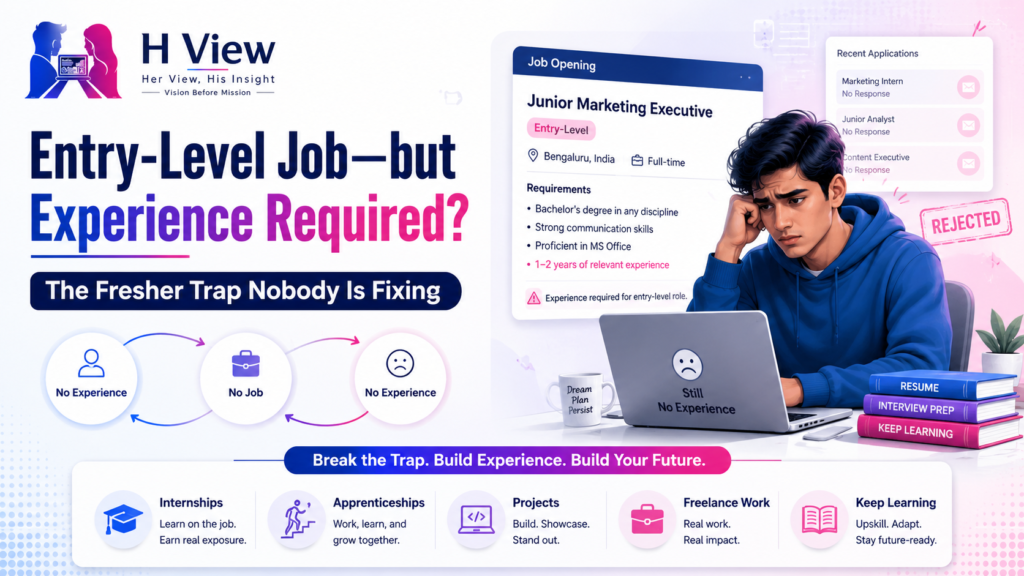
A fresher opens a job portal and finds an attractive vacancy. The title says Entry-Level,…
Satya Hemanth August 9, 2026 
A stranger messages you with what sounds like an easy opportunity. “Use your bank account…
 Harika August 9, 2026
You find a job that perfectly matches your profile. The company looks genuine. The role…
Satya Hemanth August 8, 2026 
For generations, the path to a secure career appeared simple: Study hard, complete a degree…
Satya Hemanth August 7, 2026