

Best Digital Marketing Tools in 2026: What Marketers Actually Need and What They Can Skip
Open LinkedIn for a few minutes and you will probably come across a colourful graphic…
 Harika October 6, 2026
  By HarikaUpdated October 1, 202614 min read7 views
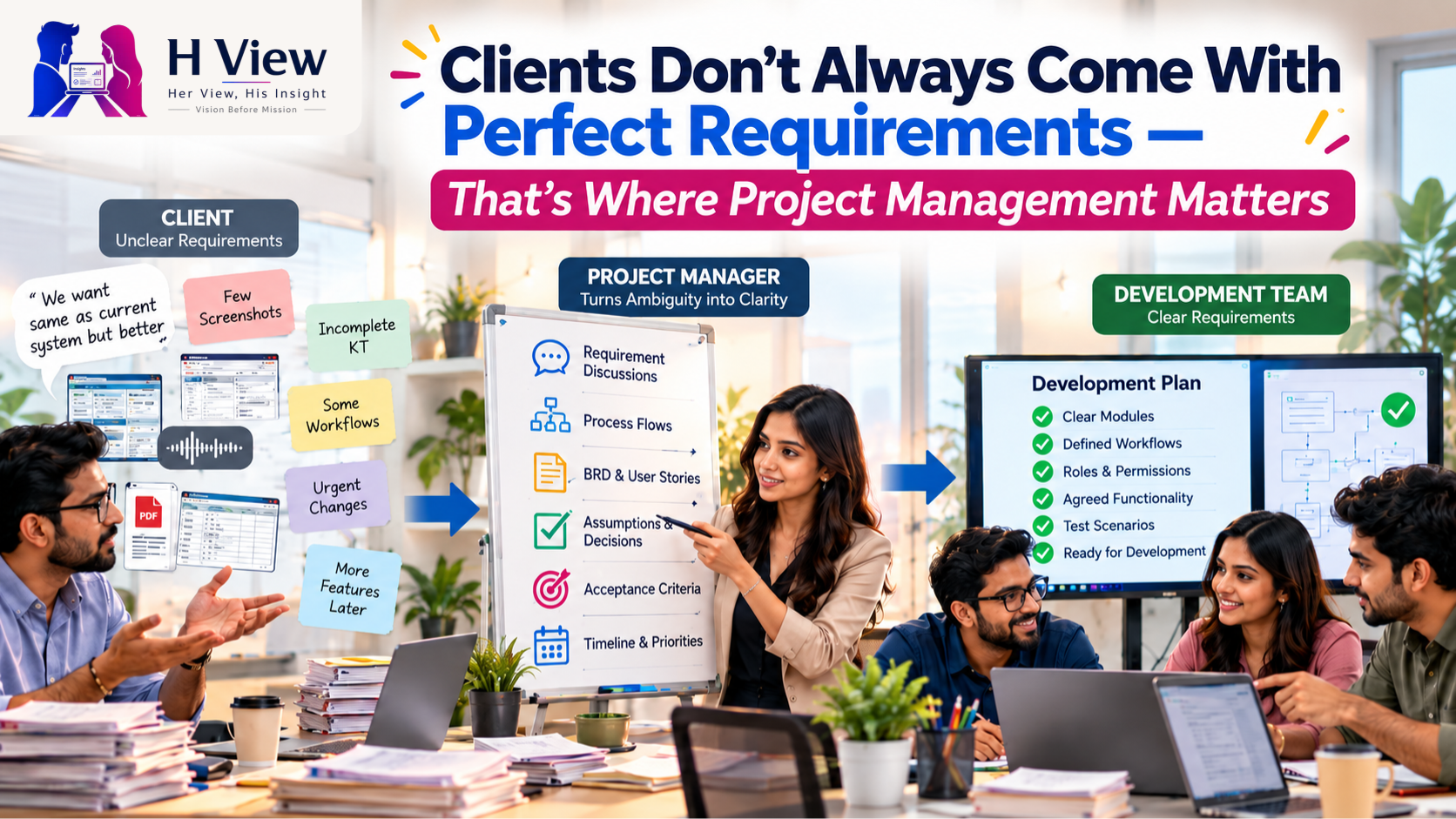
Many projects begin with an assumption that sounds reasonable on paper: the client will explain what they need, the project team will understand it, the requirements will be documented, and development will begin. In reality, projects are rarely that clean. Clients often know their business problem very well, but they may not know how to convert that problem into a structured requirement document, a workflow, a detailed use case, or a technical specification.
This gap becomes especially visible in software projects. A client may explain that they want a process to “work like the current system but better,” share a few screenshots, describe a workflow verbally, and assume the development team now understands the full requirement. At the same time, developers may receive incomplete context, missing edge cases, unclear approval rules, and inconsistent information from different stakeholders.
When this happens, the project manager becomes far more important than someone who simply tracks deadlines and sends status updates. The project manager becomes the person responsible for converting ambiguity into clarity before ambiguity becomes rework.
That is where real project management begins.
A common mistake in project delivery is expecting the client to behave like a business analyst or technical writer. Clients understand their operational problems, business goals, customer expectations, internal processes, and pain points. However, they may not always know how to explain those details in a format that a development team can immediately execute.
For example, a finance team may say that they need an approval process for expenses. To the client, this may sound clear because everyone inside the organisation already understands who approves which expense, what happens when someone is absent, which amounts need additional approval, and how exceptions are handled.
The development team does not automatically know any of this.
If the project manager simply forwards the statement “build an expense approval workflow” to the developers, the team is being asked to make decisions that belong to the business. Those assumptions may eventually result in a technically correct feature that still does not match the client’s expectation.
This is why project management must bridge the gap between what the client knows and what the team needs to know.
In an ideal project, the client may provide a complete BRD, process map, system documentation, reference screens, user roles, approval flows, sample data, exception cases, and acceptance criteria. In many real-world projects, some or most of these things will be missing.
Waiting indefinitely for perfect documentation can stall the project. Starting development without enough clarity can create even bigger problems later.
A capable project manager has to work between those two extremes.
The role is not to invent requirements on behalf of the client, but to help extract, structure, validate, and document the information that already exists in the client’s business knowledge.
These practices do not require the client to arrive with perfect documentation. They require the project manager to create enough structure for both sides to understand what is being built.
Unclear requirements do not remain harmless for long. Once development begins, every missing decision has a cost.
A developer may implement an approval process based on one interpretation. A tester may validate it using another assumption. The client may review the same feature using a completely different expectation. At that point, everyone may genuinely believe they are correct because the original requirement was never clear enough.
The result is often described as “rework,” but the real issue began much earlier.
The code may be changed, screens redesigned, database structures modified, and test cases rewritten. Meanwhile, management may see the delay as a development problem even though the root cause was requirement ambiguity.
This is why requirement clarity is not administrative overhead. It is a form of risk management.
One of the weakest project-management patterns is forwarding raw client messages directly to the development team without interpretation, context, or prioritisation.
A client may send a voice note, a screenshot, or a message saying that a screen should “work differently.” If the PM simply forwards that message and asks the developer to complete it, the developer is forced to perform requirement analysis, business interpretation, and implementation at the same time.
This creates unnecessary pressure and increases the chance of misunderstanding.
A stronger PM would first identify what exactly is changing, why the change is required, which users are affected, whether the change impacts existing workflows, and whether the client has confirmed the expected behaviour.
The difference becomes clearer when we compare the two approaches.
| Weak Requirement Handling | Strong Project Management |
|---|---|
| Forwards raw client messages directly to developers | Converts client input into structured requirements |
| Assumes missing details | Documents assumptions and gets confirmation |
| Starts development before critical questions are resolved | Resolves high-risk ambiguity before execution |
| Treats every change as a quick request | Evaluates impact, priority, and dependencies |
| Leaves developers to interpret business logic | Provides business context and expected outcomes |
| Blames development when expectations differ | Owns requirement clarity and traceability |
The table highlights an important point: the PM’s job is not only to move information. It is to make the information usable.
Another common project challenge appears during KT. A client or existing team may conduct one or two sessions, explain the major modules, share a few documents, and assume the project team now understands the entire system.
In practice, KT rarely works that way.
Complex systems contain historical decisions, exceptions, workarounds, legacy dependencies, and business rules that may not appear in formal documentation. Some details become visible only when the team starts working on actual scenarios.
This means KT should continue through structured clarification rather than being treated as a one-time handover.
A strong project manager can improve KT by recording open questions, validating workflows after the session, identifying areas where the team still lacks context, and organising follow-up discussions around those gaps.
This approach reduces the pressure to understand everything in a single meeting and creates a more realistic learning process.
Clients sometimes provide screenshots of an existing application and say they want the new system to work in the same way. Screenshots are useful because they show layout, fields, and visible workflows, but they rarely explain the full logic behind the screen.
A screenshot cannot tell the development team why a button is disabled, which role can access it, what validations apply, what happens when data is missing, or how the process behaves in an exception.
If the PM treats screenshots as complete requirements, the project may reproduce the visible interface without reproducing the actual business behaviour.
A stronger approach is to use the screenshot as a starting point and then ask the questions needed to understand the logic behind it.
Questions like these convert a visual reference into something the development team can actually build and test.
One of the hardest project-management problems is not missing information but conflicting information.
A finance manager may describe one workflow, an operations employee may explain a different version, and a senior stakeholder may later expect something else entirely. Each person may be speaking honestly from their own experience.
This is where the PM must become a facilitator rather than simply recording every statement.
The project manager should identify contradictions, bring the relevant stakeholders together, and obtain one agreed direction before the development team proceeds. Without this step, the project may repeatedly move between different interpretations depending on who spoke most recently.
This is especially important when approval rules, access permissions, reporting logic, or financial calculations are involved. Conflicting business rules should be resolved at the stakeholder level rather than left for developers to decide.
Developers should absolutely ask questions when something is unclear. However, they should not be expected to carry the entire burden of requirement discovery.
A developer’s primary responsibility is to translate agreed behaviour into a working system. When developers are repeatedly pulled into unstructured clarification calls, stakeholder disagreements, and business process interpretation, the project loses focus.
Strong project management creates a buffer between raw ambiguity and execution.
This does not mean hiding the client from developers. Direct technical conversations can be extremely valuable, especially when complex implementation decisions are involved. The difference is that those conversations should happen with enough structure that developers are solving technical problems rather than repeatedly discovering the basic business requirement.
Another area where PM skill becomes visible is change management.
Clients may realise during development that an earlier decision no longer works or that they need additional functionality. This is normal because projects evolve as users see the system taking shape.
The problem appears when every new request is immediately labelled urgent and added to the sprint without understanding its impact.
A professional PM should evaluate whether the change affects existing screens, APIs, database structures, test cases, reports, documentation, or delivery dates. Even a request that sounds small may create significant downstream work.
| Client Request | PM Responsibility Before Development |
|---|---|
| “Add one more approval level.” | Check role logic, workflow impact, notifications, and existing approvals |
| “Change this field to mandatory.” | Check historical data, validations, imports, and API impact |
| “Add one more status.” | Check reports, dashboards, permissions, workflows, and automation |
| “Make this screen like the old system.” | Confirm which behaviour should be retained and what should change |
| “We need this today.” | Assess priority, effort, dependencies, and what other work must move |
Good change management does not mean saying no to the client. It means making the consequences visible before saying yes.
Documentation is sometimes treated as bureaucracy, especially when teams are under pressure to start development quickly. In reality, good documentation protects everyone involved.
For the client, it provides evidence that the project team understood the requirement correctly. For the developers, it gives a stable reference when implementation questions arise. For testers, it defines expected behaviour. For management, it provides traceability when scope, timelines, or responsibilities are questioned.
Documentation does not need to become hundreds of pages.
The goal is useful clarity rather than paperwork for its own sake.
A practical requirement package may include process flows, user stories, acceptance criteria, role matrices, decision logs, screenshots, and important assumptions. Together, these create a shared source of truth that reduces dependence on memory.
One of the hardest things for a project manager to do is delay development when the requirement is still too unclear.
There is often pressure to show progress quickly. Starting coding creates visible activity, while requirement clarification can look slow from the outside.
However, developing against unstable requirements usually creates artificial progress.
The team may complete screens and functionality only to rebuild them later once the actual expectation becomes clear. That creates frustration for developers, testers, clients, and management.
A strong PM understands which questions must be answered before development begins and which questions can safely be resolved later.
Critical business logic, user roles, workflow direction, integrations, and approval rules usually need greater clarity before implementation. Minor UI details may be easier to refine iteratively.
This judgement is a real project-management skill.
The project manager does not need to know every technical detail, and they do not need to understand the client’s business better than the client. Their value lies in recognising where uncertainty exists and making sure that uncertainty is reduced before it causes unnecessary damage.
This requires strong communication, structured questioning, documentation, stakeholder coordination, risk identification, and the confidence to challenge unclear expectations professionally.
A project manager who does this well may prevent problems that nobody else ever sees because the ambiguity was resolved before it reached development.
That invisible prevention is one of the most valuable parts of the role.
From the delivery team’s perspective, one of the most frustrating situations is being held accountable for an expectation that was never documented or communicated clearly.
Developers can only build against the information they receive and the assumptions that are agreed. If a client later reveals an important business rule that was never discussed, the project should treat that as new information rather than automatically treating the existing implementation as a development failure.
This is where transparent documentation becomes essential. It gives everyone a fair reference point and prevents project discussions from becoming arguments based on memory.
A healthy project culture recognises that requirement gaps can happen without immediately searching for someone to blame. The priority should be understanding how the gap occurred, correcting it, and improving the process so that the same issue does not repeat.
A project with perfect requirements, complete documentation, stable priorities, and fully aligned stakeholders is easier to manage. The project manager’s capability becomes much more visible when those conditions do not exist.
When clients are unsure, stakeholders disagree, KT is incomplete, and requirements keep evolving, the PM has to create structure without pretending that uncertainty has disappeared.
The best project managers do not simply push the ambiguity toward the development team and ask everyone to work faster. They organise the ambiguity, identify what matters, obtain decisions, track assumptions, and make sure execution begins with the strongest possible shared understanding.
That is the difference between coordinating a project and actually managing one.
Clients will not always arrive with perfect requirement documents, detailed workflows, complete KT, or clearly written acceptance criteria. In many cases, they should not be expected to, because their primary expertise is the business problem rather than software documentation.
This does not mean teams should build based on guesswork.
It means project management has to bridge the gap.
A strong PM takes scattered client conversations, screenshots, voice explanations, old-system behaviour, stakeholder opinions, and evolving expectations and gradually converts them into something the project team can execute with confidence.
When that work is done properly, developers spend more time developing, testers receive clearer expectations, clients see fewer surprises, and management deals with fewer avoidable escalations.
Project management therefore becomes most valuable not when everything is already clear, but when clarity has to be created.
The best project managers do not merely manage deadlines. They manage uncertainty before uncertainty becomes rework.
A complete BRD can be extremely helpful, but not every client will have one. The project team can still proceed successfully if requirements are structured through workshops, user stories, process flows, acceptance criteria, and documented decisions. The important requirement is shared clarity, not a particular document format.
Requirement clarity is a shared responsibility between the client, business stakeholders, project manager, business analyst where applicable, and delivery team. However, the project manager plays a critical role in identifying gaps, organising clarifications, tracking decisions, and ensuring that the team is not developing against unresolved assumptions.
The PM should document the conflicting inputs and bring the relevant stakeholders together for a decision. Development should not proceed based on whichever opinion was received most recently when the contradiction affects important business logic.
Yes, especially in iterative or agile projects, but the requirements for the work currently entering development should be sufficiently clear. Teams can refine future functionality later, but critical ambiguity inside the current development scope increases the risk of expensive rework.
Incomplete KT can leave the project team unaware of historical decisions, exception cases, business rules, or dependencies that are not visible in the application itself. Structured follow-up clarification and documentation help reduce this risk as the team gains deeper understanding.
Change requests should be understood, documented, and assessed for impact before they are committed. The PM should clarify the business reason, scope, priority, dependencies, and impact on timelines so that the client and team understand the trade-off before implementation begins.
Harika is the co-founder of H View and covers AI, technology, gadgets, digital tools, online platforms, and modern internet trends. Her articles focus on simplifying complex topics with practical explanations, balanced opinions, and reader-first insights.
Share your real experience and help other readers decide better.
No community views yet. Be the first to share yours.

Open LinkedIn for a few minutes and you will probably come across a colourful graphic…
Harika October 6, 2026 
When an employee resigns, many organisations move quickly into replacement mode. The manager informs HR,…
Harika October 6, 2026 
For many corporate employees, the workday begins long before they actually start working. They wake…
Harika October 5, 2026 
Many companies proudly talk about new hires, growing teams, expanding departments, and increasing headcount. On…
Harika September 30, 2026