

Best Digital Marketing Tools in 2026: What Marketers Actually Need and What They Can Skip
Open LinkedIn for a few minutes and you will probably come across a colourful graphic…
 Harika October 6, 2026
  By HarikaUpdated September 29, 202614 min read9 views
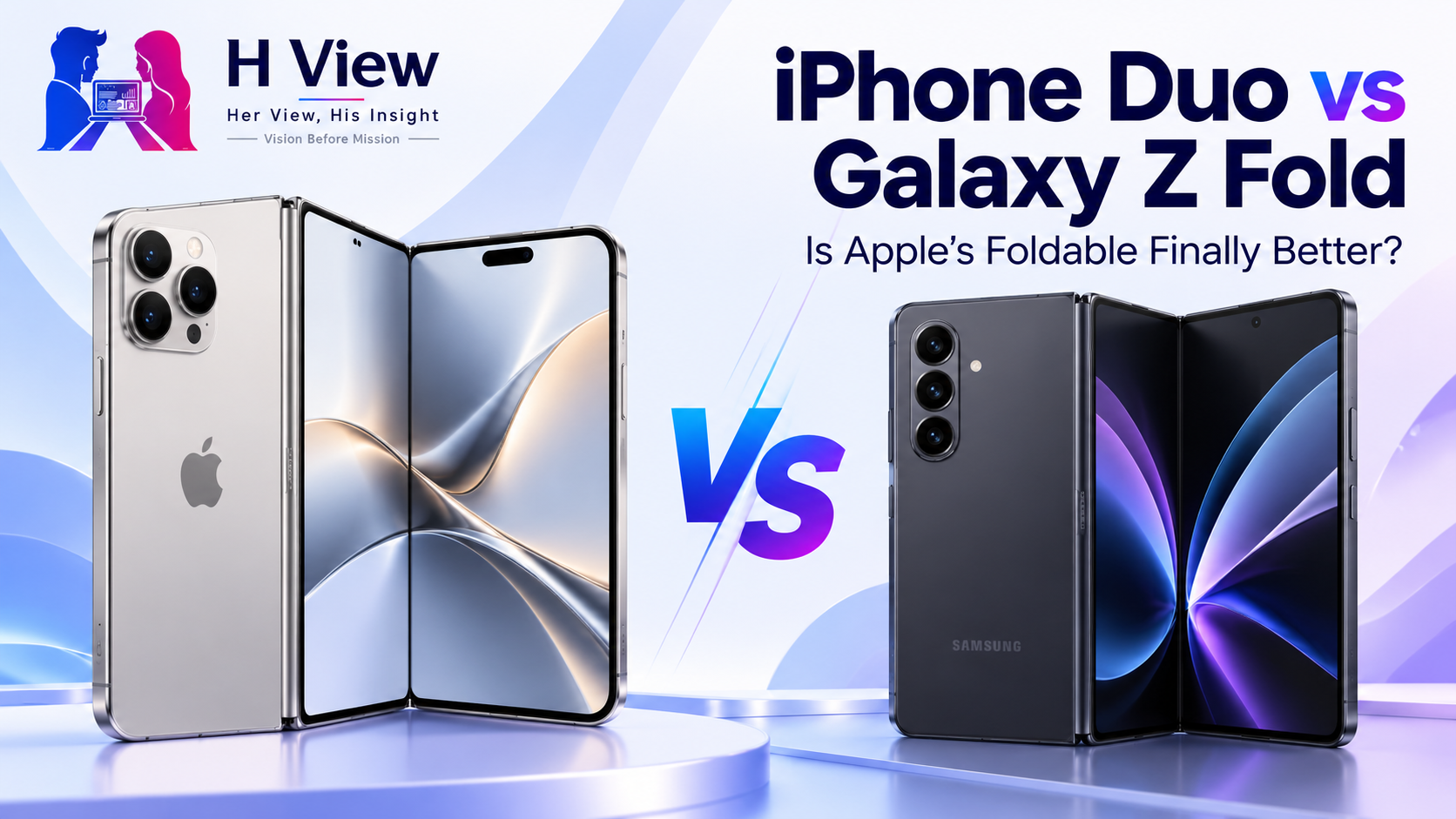
For years, Apple watched the foldable-phone market from the sidelines while Samsung experimented, failed, improved and gradually turned the Galaxy Z Fold into a serious premium product. That changed on September 9, 2026, when Apple officially introduced the iPhone Duo, its first foldable iPhone. The device will open for pre-orders in India on October 16 and go on sale from October 23, with prices starting at a remarkable ₹2,99,900. (apple.com)
That price immediately makes the comparison unavoidable because Samsung’s Galaxy Z Fold8 starts at ₹1,79,999 in India. Apple is therefore asking roughly ₹1.2 lakh more for its first attempt at a book-style foldable, which raises a difficult question before we even start comparing specifications. (samsung.com)
The question is not simply whether Apple has finally made a foldable. It is whether Apple has done enough with the iPhone Duo to justify entering the market this late and charging substantially more than the most mature Galaxy Fold Samsung has ever made. Apple brings a nearly crease-free 7.6-inch display, IP68 protection, Apple Pencil support, A20 Pro, a foldable version of iOS 27 and deep Apple ecosystem integration. Samsung counters with a thinner and much lighter design, eight generations of foldable experience, Galaxy AI, a lower starting price and a form factor that has already been refined through years of real-world use. (apple.com) (samsung.com)
This is therefore not a simple Apple-versus-Samsung brand fight. It is a comparison between a first-generation product arriving with enormous expectations and an eighth-generation foldable that already understands many of the compromises buyers are willing to accept.
The iPhone Duo uses a familiar book-style design. When closed, it has a 5.4-inch outer OLED display, while opening it reveals a 7.6-inch folding Super Retina XDR display with ProMotion up to 120Hz, 3,000 nits peak outdoor brightness and a nano-texture finish designed to reduce glare. (apple.com)
Samsung’s Galaxy Z Fold8 follows a very similar idea, with a roughly 7.6-inch inner display, a 120Hz Dynamic AMOLED 2X panel and an outer screen intended to make the device usable like a normal smartphone when closed. (samsung.com)
The similarity matters because Apple is not pretending the basic foldable concept needed to be reinvented. Instead, the company appears to be saying that the category has finally matured enough for Apple to enter. Where Apple is trying to differentiate itself is in the transition between screens and the software that responds to those changes. Both Duo displays use a related aspect-ratio structure so that content can scale more naturally when moving between the compact outer screen and the larger inner display.
Apple has also designed iOS 27 around new positions and interactions, including side-by-side multitasking, hands-free FaceTime and partially folded viewing modes. If those transitions feel natural, the real innovation may not be the hinge itself but how little the user has to think about the hinge while using the device. (apple.com)
Foldable displays have improved enormously, but the crease has never completely disappeared. Apple says the iPhone Duo uses a newly engineered display structure and hinge system designed to make the crease significantly less visible, and early hands-on coverage has highlighted the inner fold line as being unusually subtle compared with many existing foldables. (theverge.com)
Samsung has also made progress in this area. The Galaxy Z Fold8 uses a new Armor FlexHinge and additional titanium reinforcement beneath the display, helping the fold area appear flatter than on earlier Fold generations. (samsung.com)
The real difference, however, will only become clear after months and years of use. A crease that looks minimal on launch day may become more visible after thousands of folding cycles, while hinge resistance, dust intrusion, screen protectors and long-term panel wear can matter far more than showroom impressions. This is one area where Samsung’s experience counts heavily because Apple may have produced an impressive first-generation hinge, but Samsung has already spent eight generations learning what goes wrong after real customers carry these devices every day.
Samsung has a very clear advantage when it comes to portability. The iPhone Duo weighs 254 grams, measures 5.2mm thick when open and 11.3mm when folded. (apple.com)
The Galaxy Z Fold8 weighs only 201 grams, measures around 4.5mm thick when open and roughly 9.7mm when folded. (samsung.com)
That 53-gram difference is significant because a phone is something you carry in your pocket, hold while scrolling and sometimes use one-handed. Apple may have made the Duo compact when closed, but 254 grams pushes it closer to small-tablet territory than a normal flagship phone.
Samsung’s Fold8 reaching 201 grams is one of the clearest signs of how far foldable engineering has matured. If comfort, portability and one-handed handling matter heavily, Samsung has a strong advantage before software even enters the comparison.
| Feature | iPhone Duo | Galaxy Z Fold8 |
|---|---|---|
| India starting price | ₹2,99,900 | ₹1,79,999 |
| Inner display | 7.6-inch OLED, up to 120Hz | 7.6-inch Dynamic AMOLED 2X, up to 120Hz |
| Outer display | 5.4-inch OLED | Approx. 5.45-inch AMOLED |
| Weight | 254g | 201g |
| Unfolded thickness | 5.2mm | 4.5mm |
| Folded thickness | 11.3mm | Approx. 9.7mm |
| Processor | A20 Pro | Snapdragon 8 Elite Gen 5 for Galaxy |
| Rear cameras | 48MP Main + 48MP Ultra Wide | 50MP Main + 50MP Ultra Wide |
| Zoom | Up to 2x optical-quality | Up to 2x optical-quality |
| Battery claim | Up to 31h video inner / 44h outer | Up to 26h video playback |
| Water/dust resistance | IP68 | IP48 |
| Stylus | Apple Pencil USB-C | No S Pen support |
| Software | iOS 27.1 | Android / One UI with Galaxy AI |
| Storage | Up to 2TB | Up to 1TB |
The table shows why this is an unusual comparison. Apple wins some important categories, but Samsung is dramatically cheaper, lighter and thinner, which makes the Fold8 easier to justify as a practical everyday purchase.
One of the more surprising features is Apple Pencil USB-C support. Apple has historically kept Pencil support exclusive to iPad, so adding it to the Duo signals that the company wants people to treat the unfolded phone as more than just a larger screen. (apple.com)
That opens useful possibilities for note-taking, document annotation, sketching and precision editing. A professional reviewing contracts, a student annotating PDFs or a designer making quick visual notes could all benefit from having a stylus on a device that still folds into a pocketable shape.
Samsung, somewhat surprisingly, has removed S Pen support from the Galaxy Z Fold8. Samsung says the current hinge and display architecture prioritises a flatter and lighter foldable experience, and the Fold8 does not support the S Pen. (samsung.com)
For professionals who genuinely use a stylus, this gives Apple an unexpected advantage. The Pencil remains another accessory to buy and carry, so the benefit matters only if it fits the user’s workflow, but the option itself is valuable.
Apple has equipped the iPhone Duo with a 48MP Main camera and 48MP Ultra Wide, plus a 12MP Center Stage front camera and an under-display FaceTime camera. The phone supports 0.5x, 1x and 2x shooting, with 2x being optical-quality crop zoom rather than a dedicated telephoto lens. (apple.com)
That is capable, but it is not Apple’s best camera system. The iPhone 18 Pro has a dedicated telephoto system and much more advanced zoom capability, which shows that Apple has clearly prioritised thickness and foldable engineering over putting its absolute best camera hardware into Duo.
Samsung takes a similar approach. Galaxy Z Fold8 offers 50MP Wide and 50MP Ultra Wide cameras with up to 2x optical-quality zoom rather than the extreme telephoto hardware found on Samsung’s Ultra flagships. (samsung.com)
This is one of the realities of foldables. You are paying heavily for the folding screen and engineering, not necessarily for the best camera system available at the price. At ₹2.99 lakh, that compromise becomes much harder to ignore on the iPhone because buyers may reasonably expect the absolute best Apple offers across every category.
The Duo uses Apple’s A20 Pro, with a 6-core CPU, 7-core GPU with Neural Accelerators and a Dual 16-core Neural Engine. Apple also uses vapour cooling to sustain performance despite the thin chassis. (apple.com)
Samsung uses the customised Snapdragon 8 Elite Gen 5 for Galaxy, with advanced CPU, GPU and NPU hardware. (samsung.com)
For normal users, both phones are enormously powerful, so benchmark differences are unlikely to matter in daily use. The more important question is how effectively applications take advantage of the large screen because the real reason to buy a foldable is multitasking, productivity and viewing content, not merely opening apps slightly faster.
That is where software becomes more important than raw chip performance.
Samsung has had years to refine multitasking on foldables. Galaxy Fold users can run multiple apps side by side, use drag-and-drop workflows and take advantage of a mature Android multitasking environment, while Galaxy AI adds tools around summarisation, editing and contextual assistance.
Apple is arriving much later, but that delay may have allowed it to redesign iOS specifically for a foldable instead of slowly adapting an existing interface. The Duo supports side-by-side applications, flexible viewing positions, hands-free FaceTime and a new interaction model designed around moving between the external and internal displays. Siri AI and Apple Intelligence are also integrated throughout the experience. (apple.com)
Apple’s strength has always been consistency. If developers update major apps properly, the transition between a compact outer screen and a tablet-like inner display could feel extremely polished and easier to understand than some Android foldable workflows.
The weakness is equally clear: this is version one. Samsung already knows where foldable users experience frustration because millions of customers have tested previous generations in the real world, while Apple is learning those lessons for the first time.
Apple rates the iPhone Duo at IP68, while Samsung’s Galaxy Z Fold8 carries an IP48 rating. Samsung describes that as sufficient protection against accidental spills and everyday exposure, but it is clearly not equivalent to Apple’s rating on paper. (samsung.com)
For foldables, dust protection matters particularly because the hinge contains moving components and small particles can become a long-term problem. If Apple’s IP68 implementation performs reliably in real-world use, it would be an impressive first-generation achievement and one of the Duo’s strongest technical advantages.
That said, no ₹3 lakh foldable should be treated casually around water, dust or sand. Ratings reduce risk, but they do not make folding displays indestructible, and repair costs on premium foldables can be substantial.
Apple has not published the Duo’s battery capacity in mAh, but it uses a dual-battery system and claims up to 31 hours of video playback on the inner display and up to 44 hours using the outer display. (apple.com)
Samsung uses a 4,800mAh battery and claims up to 26 hours of video playback. (samsung.com)
Apple’s claimed endurance is impressive considering the two displays and A20 Pro performance, but real-world testing will matter much more. Users buying a foldable may spend hours multitasking on the larger 7.6-inch screen, which is a much more demanding workload than simple video playback.
Still, battery efficiency could become another area where Apple Silicon gives the Duo an advantage, especially if Apple’s hardware and software integration helps manage power more consistently than a more fragmented Android ecosystem.
The Duo starts at ₹2,99,900 for 256GB, while the 512GB version costs ₹3,24,900, 1TB reaches ₹3,74,900 and 2TB climbs to an extraordinary ₹4,49,900. (apple.com)
Samsung’s Galaxy Z Fold8 starts at ₹1,79,999, so the entry-level price difference is roughly ₹1.2 lakh. That is not a small premium because the difference alone is enough to buy a very good laptop, a tablet or even another flagship smartphone.
This is what makes the “better foldable” question different from the “better value” question. The iPhone Duo may be technically better in several areas while still being much worse value overall, especially for someone who does not already live inside Apple’s ecosystem.
The Duo is clearly not designed as a mainstream iPhone replacement. It makes the most sense for existing Apple users who already own a Mac, AirPods, Apple Watch and perhaps an iPad, and who want a foldable without leaving that ecosystem.
It may also appeal to professionals who want a larger mobile workspace, Apple Pencil support and very high storage capacities. A designer, executive or creator who already depends on iCloud, AirDrop, Apple Notes and other Apple services may see enough value in the ecosystem continuity to justify paying more.
For an Android user simply looking for the most capable foldable, the Galaxy Z Fold8 may be much easier to justify because it delivers a mature foldable experience for substantially less money. The Duo is therefore partly a technology product and partly a luxury ecosystem product, and buyers need to understand which of those two they are actually paying for.
What interests me most about the iPhone Duo is not that Apple finally made a folding screen. Samsung and other Android manufacturers proved years ago that folding phones can work, so Apple’s real opportunity is to make the format feel simpler and more natural.
Foldables can sometimes feel like devices designed mainly for technology enthusiasts who enjoy configuring multitasking layouts and experimenting with unusual screen positions. Apple’s strength has always been taking complicated technology and hiding much of that complexity from the user. If the Duo really makes switching between a normal phone and a larger workspace feel effortless, that could matter more than winning any specification comparison.
My biggest hesitation is the price because nearly ₹3 lakh is not an experimental purchase for most people. Apple needs the experience to feel exceptional almost everywhere because buyers will understandably have very little tolerance for first-generation compromises.
Samsung deserves more credit in this comparison than it may receive once Apple marketing takes over the foldable conversation. The Galaxy Z Fold8 exists because Samsung spent eight generations solving problems that Apple did not have to solve publicly.
Foldable hinges, fragile screens, awkward aspect ratios, excessive weight and software optimisation all improved through years of iteration. The fact that Fold8 now weighs only 201 grams while Apple’s new Duo weighs 254 grams shows how much that accumulated experience matters.
Apple appears to have advantages in display refinement, IP68 protection, Pencil support and ecosystem integration. Samsung has advantages in weight, thickness, price and maturity. That does not make one universally better, but it does make the competition much more interesting than simply declaring Apple the winner because it arrived later with a more expensive product.
Apple has not simply copied the Galaxy Z Fold and added an Apple logo. The iPhone Duo brings several genuinely interesting ideas to the foldable category, including a nearly crease-free 7.6-inch display, matching screen proportions, Apple Pencil support, strong claimed battery life, IP68 protection, A20 Pro performance and an iOS interface redesigned around folding positions. (apple.com)
Samsung still wins some of the categories that matter most in everyday ownership. Galaxy Z Fold8 is considerably lighter, thinner and dramatically cheaper, while also benefiting from eight generations of experience and a mature multitasking ecosystem. (samsung.com)
So is the iPhone Duo finally better than the Galaxy Z Fold? In some areas, yes. Apple appears to have pushed display refinement, dust and water resistance, Pencil support and ecosystem integration forward immediately, but as an overall purchase Galaxy Z Fold8 currently looks like the better value, while iPhone Duo looks like the more ambitious luxury option.
The most important outcome is that Apple has finally made the foldable market competitive in a new way. Samsung no longer gets to define the category alone, and Apple no longer gets to pretend the category does not matter. That rivalry may ultimately benefit everyone buying foldables over the next few years.
The iPhone Duo starts at ₹2,99,900 for 256GB. The 512GB version costs ₹3,24,900, the 1TB version costs ₹3,74,900 and the 2TB model reaches ₹4,49,900. (apple.com)
Pre-orders begin at 5:30 PM IST on October 16, 2026, with general availability starting October 23. Buyers interested in the first generation should still consider waiting for independent durability and battery testing before placing an order. (apple.com)
The Duo has a 7.6-inch inner Super Retina XDR folding OLED display and a 5.4-inch outer display. Both support ProMotion up to 120Hz, allowing the phone to work as a compact device when closed and a much larger workspace when opened. (apple.com)
No. iPhone Duo weighs 254 grams, while Galaxy Z Fold8 weighs only 201 grams. The difference is large enough that Samsung should feel noticeably lighter during extended use and everyday carrying. (samsung.com)
Yes. Apple officially lists support for Apple Pencil USB-C, which can make the larger inner display useful for notes, annotation and precision input. Galaxy Z Fold8 does not support S Pen, giving Apple a meaningful productivity advantage for stylus users. (apple.com)
Apple rates the Duo at IP68, while Galaxy Z Fold8 has an IP48 rating. These ratings indicate resistance rather than complete immunity, so users should still be careful around water, dust and sand, particularly because foldables contain moving hinge components.
Both use dual high-resolution rear-camera systems. iPhone Duo has 48MP Main and Ultra Wide cameras, while Galaxy Z Fold8 has 50MP Wide and Ultra Wide cameras. Neither device offers the extreme telephoto capability found on their respective Pro or Ultra flagship phones, so buyers should not assume the most expensive foldable automatically provides the brand’s best camera system.
For most buyers, Galaxy Z Fold8 offers stronger value because it is significantly cheaper, lighter and already mature as a foldable platform. The Duo makes more sense for Apple ecosystem users who specifically want a foldable iPhone, Apple Pencil support, iOS integration and Apple’s approach to foldable software.
Harika is the co-founder of H View and covers AI, technology, gadgets, digital tools, online platforms, and modern internet trends. Her articles focus on simplifying complex topics with practical explanations, balanced opinions, and reader-first insights.
Share your real experience and help other readers decide better.
No community views yet. Be the first to share yours.

Open LinkedIn for a few minutes and you will probably come across a colourful graphic…
Harika October 6, 2026 
When an employee resigns, many organisations move quickly into replacement mode. The manager informs HR,…
Harika October 6, 2026 
For many corporate employees, the workday begins long before they actually start working. They wake…
Harika October 5, 2026 
Many projects begin with an assumption that sounds reasonable on paper: the client will explain…
Harika October 1, 2026