

Best Digital Marketing Tools in 2026: What Marketers Actually Need and What They Can Skip
Open LinkedIn for a few minutes and you will probably come across a colourful graphic…
 Harika October 6, 2026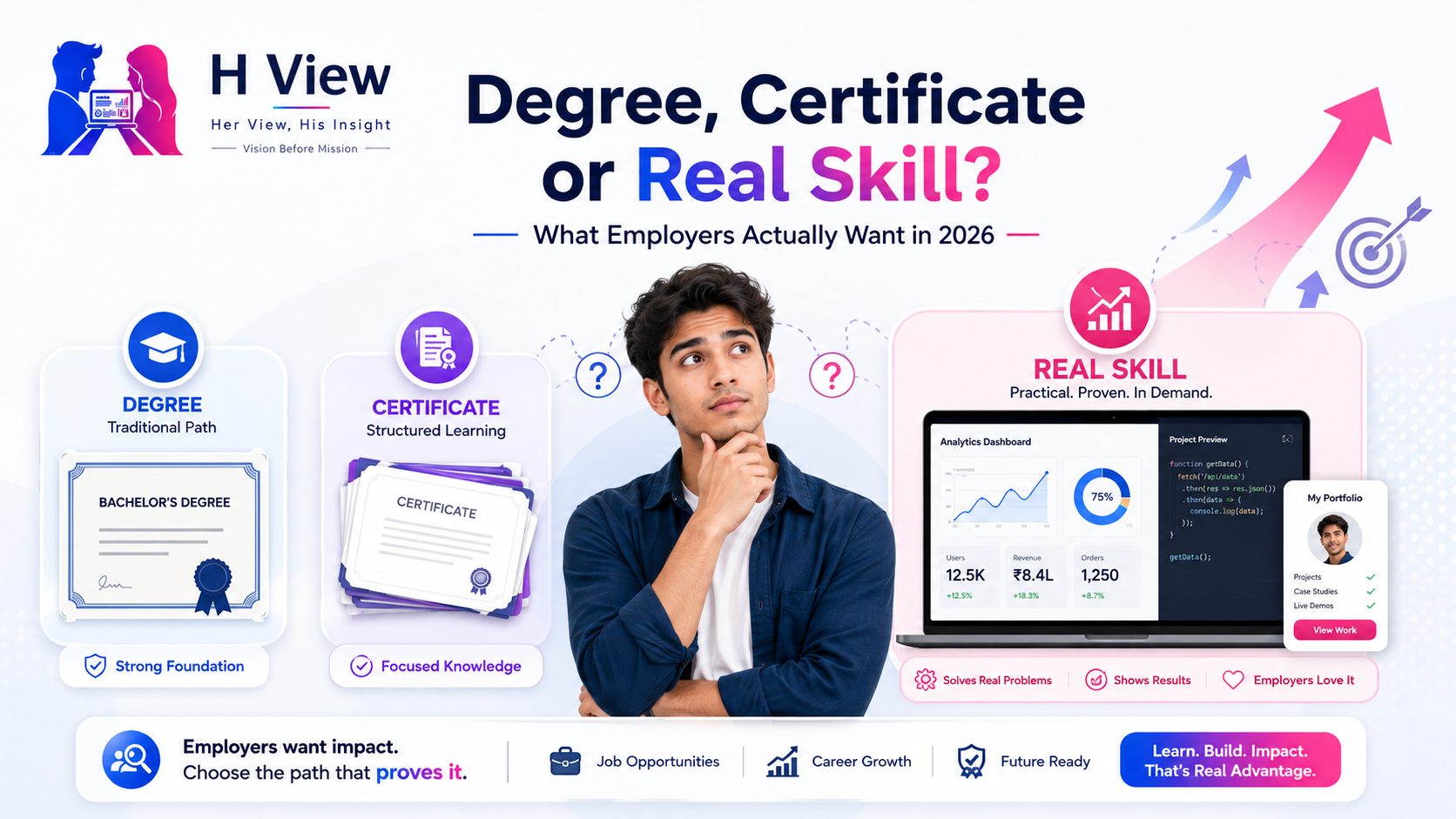
 By Satya HemanthUpdated September 20, 202611 min read53 views
For years, students were given a fairly predictable career formula. Complete a degree, collect a few additional certificates, prepare a respectable resume and begin applying for jobs. The qualification was expected to prove that you had learned enough to enter the workplace, while the employer would teach you most of what came next.
That model has not disappeared, but it is becoming less comfortable for freshers.
Employers are increasingly asking candidates to demonstrate what they can actually do with the knowledge written on their resumes. A degree may help someone become eligible for an interview, and a recognised certificate can still show that they completed structured training, but neither automatically proves that the candidate can solve a problem, work with a team or complete an unfamiliar task without constant guidance.
This is the reality behind the growing discussion around skills-first hiring.
NACE’s Job Outlook 2026 survey found that 70% of participating employers were using skills-based hiring, compared with 65% the previous year. Employers reported using the approach particularly during interviews and screening, where candidates are increasingly expected to provide evidence of their competencies rather than relying only on educational credentials.
For students, the message is not that qualifications have become useless. It is that qualifications increasingly need something beside them: proof.
The idea that degrees no longer matter makes for an attractive headline, but it does not accurately describe the 2026 job market.
Formal education still matters for many roles. Some employers use degrees as an eligibility requirement, campus hiring continues to give graduates direct access to recruiters, and professions such as medicine, law, engineering and other regulated fields naturally depend on formal qualifications.
India’s hiring market also shows that the shift towards skills-first recruitment remains incomplete. HirePro’s 2026 study of more than 10,000 students, over 100 colleges, 80-plus companies and more than 100 campus recruiters found that only 21% of participating companies said they had fully moved beyond CGPA in their hiring approach.
That means students should be careful with claims such as “companies do not care about marks anymore.” Many still do, particularly during the first stage of high-volume fresher recruitment.
What has changed is what happens after eligibility.
Consider two engineering graduates applying for the same junior software role. Both hold a B.Tech degree, and both list JavaScript, React and SQL on the resume. One candidate completed several online courses but has never built anything beyond tutorial exercises. The other built and deployed a small application, connected it to a database, handled authentication and can explain the problems encountered during development.
The degree may allow both candidates to enter the hiring process. The project gives the second candidate something stronger to discuss once the interview begins.
Certificates have a legitimate place in learning because students often need structure. A well-designed course can explain a subject in sequence, provide exercises and help someone enter an unfamiliar field without having to construct an entire learning path independently.
The problem begins when completing courses starts replacing practising the skill.
It is easy to see how this happens. A student completes a Python certificate and feels progress, then adds cloud computing, data science, generative AI, cybersecurity and digital marketing courses because each credential adds another line to LinkedIn. After several months, the resume looks impressive, but the candidate may struggle when an interviewer asks for a practical example of how one of those skills was used.
The certificate itself is not the problem. The missing application is.
A better way to judge any course is to ask what you can do after completing it that you genuinely could not do before. If you finish a data-analysis course, can you take an unfamiliar dataset, clean it, find patterns and explain what those patterns mean? If you complete a digital-marketing programme, can you analyse a campaign and identify why conversions are weak?
When the answer is yes, the certificate has supported a real skill. When the answer is only that you watched every lesson and passed a multiple-choice test, the credential may have much less value in an interview.
One of the most revealing findings in India’s 2026 fresher market is how differently students and employers define readiness.
HirePro found that 68% of surveyed students believed they were ready to contribute from their first day at work, while only 9% of participating employers agreed. The same research described employers as increasingly focused on practical ability, learning agility and business readiness alongside academics.
That gap probably does not mean students know nothing. It reflects a difference between knowing a subject and working with it professionally.
A student may say, “I know JavaScript,” because they understand syntax, functions and basic React development. An employer may be asking a much broader question: can this person read someone else’s code, understand a ticket, use Git correctly, debug a problem, communicate when blocked and complete a small change without having every step explained?
The workplace adds ambiguity that classroom exercises often remove.
An assignment usually tells you what problem to solve. Real work may begin with a vague requirement from somebody who is not technical. Part of the job is understanding what the problem actually is.
That is why employers increasingly value examples of how candidates have used their knowledge rather than simply asking whether they possess it.
Skills-first hiring does not mean resumes disappear or every company stops checking educational qualifications. Instead, employers try to gather more direct evidence of whether a candidate can perform the work.
NACE reports that employers using skills-based hiring most commonly apply it during interviews and screening. Its 2026 guidance also says employers value candidates who can describe specific situations where they used their skills to solve problems.
The assessment naturally changes depending on the job. A software developer may receive a coding task and then be asked to explain the reasoning behind the solution. A data candidate may receive a dataset rather than a theoretical statistics question. A marketing applicant might be shown a weak campaign and asked what they would change, while a business analyst could receive an unclear client requirement and be expected to identify what information is missing.
These exercises reveal something that lists of credentials cannot: how a person behaves when the answer is not already known.
Interviewers can observe whether the candidate asks sensible questions, breaks the problem into smaller parts, notices limitations and communicates clearly when uncertain.
A candidate does not always need to produce the perfect answer. Sometimes the thinking process itself creates confidence.
Artificial intelligence has made polished output dramatically easier to produce. A fresher can now generate a professional-looking resume, improve a cover letter, create documentation, prepare likely interview questions and even produce starter code with very little effort.
That creates useful opportunities for students, but it also changes the meaning of surface-level evidence.
If almost anyone can create a polished README or generate a convincing project description, employers have more reason to ask candidates what they personally understood and contributed.
HirePro’s current recruitment products themselves reflect this concern, placing significant emphasis on candidate authenticity, AI-assisted cheating detection and deeper assessment of skill correctness rather than relying on resumes alone.
For candidates, the safest approach is not to avoid AI. It is to use AI without allowing it to replace understanding.
If you build an application with AI assistance, be able to explain the architecture. If the model wrote part of the code, understand what that code is doing. If you automated a workflow, know where it can fail and why.
“Used ChatGPT” is no longer an especially interesting skill.
Being able to show how AI helped you solve a genuine problem is much more valuable.
Imagine two commerce graduates applying for an operations analyst position.
The first candidate lists Advanced Excel and Power BI alongside several certificates. The second has fewer credentials but helped a neighbourhood store organise several months of sales data. They cleaned inconsistent entries, built a dashboard, separated fast- and slow-moving products and explained which categories were contributing most to revenue.
The second candidate may not know every advanced Excel function.
What they possess is a story about using a tool to solve something real.
This principle applies across careers. A marketing student could run a small campaign for a local business and document the result. A UI/UX student could redesign a confusing checkout flow and explain the decisions. A computer-science student could build and deploy a small application that real users can access.
The project does not have to be revolutionary.
It has to be yours, and you have to understand it.
The shift towards skills-based hiring can be encouraging for students because it creates another route to stand out beyond college name and academic marks. Someone studying at a lesser-known institution can still build strong work, develop communication skills and gradually create evidence that deserves an employer’s attention.
At the same time, students should not be told that qualifications suddenly have no value. Access to internships, mentors, professional networks and high-quality project opportunities is not equal for everyone. Formal education can still provide structure and credibility, particularly for students who do not already have industry connections.
The healthier approach is therefore not choosing between qualification and skill. It is using education as a foundation while deliberately creating experiences that turn what you learned into something visible.
From the employer’s side, hiring is partly a problem of uncertainty. Every candidate can claim to be hardworking, adaptable and good at problem-solving, and modern AI tools make it easier than ever to make those claims sound polished.
Evidence reduces some of that uncertainty.
A candidate who can explain a real project, describe what failed and defend the decisions they made gives the interviewer more information than someone whose resume contains ten impressive skill labels with no context.
This is why the move towards skills-first hiring is likely to continue even if degree requirements remain in many organisations. Employers are not necessarily rejecting education; they are searching for better signals of whether education has translated into capability.
The biggest practical change is to stop waiting until placement season before creating evidence of employability.
Choose the type of role you actually want, study several genuine job descriptions and look for repeated requirements. Then learn enough of those skills to complete one meaningful project rather than trying to become a beginner in ten unrelated areas.
NACE’s 2026 employer research continues to emphasise experiential learning and examples of using competencies to solve problems. Employers reported valuing internships, co-ops, apprenticeships and other experiences that give students an opportunity to connect academic learning with professional skills.
The project should also be explainable. You should know what problem you were trying to solve, why you chose a particular approach, what failed, what you personally contributed and what you would change if you started again.
Those answers demonstrate far more than technical knowledge. They show ownership.
The 2026 hiring market is not asking students to choose between a degree, a certificate and a real skill as though only one can matter.
The stronger candidate usually combines them.
A degree can provide academic foundation and eligibility. A good certificate can provide structured learning. Practical work proves that the learning survived outside the course.
That last part is becoming increasingly difficult for employers to ignore.
NACE’s latest employer data shows skills-based hiring continuing to grow, while India’s HirePro research shows that the transition remains incomplete and traditional academic filters still matter in many companies.
For students, that mixed reality is actually useful because it gives a clearer strategy. Protect your academics enough to keep opportunities open, but do not assume marks alone will make you employable. Take courses when they teach something you genuinely need, but do not measure progress through the number of certificates collected.
Then build.
Create one project you understand deeply. Solve one genuine problem. Complete an internship where you actually contribute. Document your work and practise explaining why you made each decision.
A qualification tells an employer that you studied.
A certificate tells them that you completed training.
Practical evidence gives them a reason to believe you can do the work.
In 2026, that difference matters more than ever.
Skills-based hiring is an approach in which employers give greater weight to competencies and demonstrated ability instead of depending mainly on academic credentials or GPA. NACE reports that 70% of employers participating in its Job Outlook 2026 survey now use skills-based hiring.
No. HirePro’s 2026 India research shows that only 21% of participating companies said they had fully moved beyond CGPA, demonstrating that academic filters remain relevant in many organisations.
They can be useful when the course teaches a relevant skill and you can demonstrate how you have applied it. A certificate becomes much weaker when it is the only evidence that you understand the subject.
Projects, internships, apprenticeships, freelance work, college activities, volunteering and practical case studies can all provide evidence. Employers increasingly value examples showing how candidates used their skills to solve actual problems.
HirePro’s 2026 research found that 68% of surveyed students considered themselves ready from day one, compared with only 9% of employers. The difference reflects the gap between academic knowledge and the wider practical, communication and problem-solving abilities employers expect in real work.
Yes, particularly where AI is relevant to the role, but simply listing AI tools is increasingly unlikely to stand out. Candidates should understand how the technology can be applied to practical workflows and be able to explain the result, limitations and their own contribution.
Satya Hemanth is the founder of H View and writes on careers, sports, leadership, digital trends, and practical decision-making. His articles focus on clear explanations, real-world examples, and useful insights for students, young professionals, and everyday readers.
Share your real experience and help other readers decide better.
No community views yet. Be the first to share yours.
Open LinkedIn for a few minutes and you will probably come across a colourful graphic…
Harika October 6, 2026 
When an employee resigns, many organisations move quickly into replacement mode. The manager informs HR,…
Harika October 6, 2026 
For many corporate employees, the workday begins long before they actually start working. They wake…
Harika October 5, 2026 
Many projects begin with an assumption that sounds reasonable on paper: the client will explain…
Harika October 1, 2026