

How H View Reviews Products, Tools, and Services
Online reviews are everywhere. Before buying a product, choosing a tool, selecting hosting, trying software,…
 H View May 23, 2026
  By H ViewUpdated August 12, 202614 min read60 views
Most people do not make important decisions in the same way they did ten or fifteen years ago. Before buying a phone, choosing a service, paying for software, joining a course, starting a website or even trying a new restaurant, we usually search online first. We read reviews, compare prices, watch videos, check comments and look for someone who has already made the same choice.
In theory, this should make decision-making easier. In reality, it often creates a different problem: too much information without enough clarity.
A person looking for one simple answer can quickly end up with ten tabs open, three conflicting recommendations and more questions than they had at the beginning. One review sounds enthusiastic, another sounds overly technical, and a third seems written mainly to push a product. Sometimes the facts are correct, but they are not explained in a way that helps the reader understand what those facts actually mean.
That gap between information and understanding is one of the main reasons we started H View.
We did not want to create another website that simply repeats specifications, copies popular opinions or tells readers that everything is “best” for everyone. We wanted to build something more useful: a place where a reader can understand the experience, the practical value, the limitations and the bigger picture before making a decision.
That idea became the foundation of H View.
The question behind H View was simple: why is it still so difficult to make the right decision online when so much information is already available?
We kept seeing the same problem in different forms. A beginner searching for web hosting could find pages full of terms like bandwidth, uptime, CDN, SSL, caching and storage, but still not know which plan would actually be suitable for a small blog. Someone comparing smartphones could read specifications for an hour and still wonder which phone would feel better in everyday use. A small business owner could compare five software tools and remain unsure whether any of them were worth paying for.
The internet has become very good at presenting information. It is not always as good at helping people interpret it.
That difference matters. A specification tells you what something has. A price tells you what it costs. A marketing page tells you why a company wants you to buy it. A useful article should help you understand whether any of that matters in your situation.
That is the kind of gap H View is meant to fill.
If someone is starting a website for the first time, for example, the useful question is not simply which hosting company has the longest list of features. The better question is whether the platform is easy enough for a beginner, whether the introductory price becomes expensive later, how support behaves when something goes wrong and whether the service will still be suitable as the website grows.
Those are the kinds of questions we try to explore in articles such as How to Start a Blogging Website in India on a Low Budget and Best WordPress Hosting for Beginners in India. The aim is not just to provide options, but to explain what those options mean in practice.
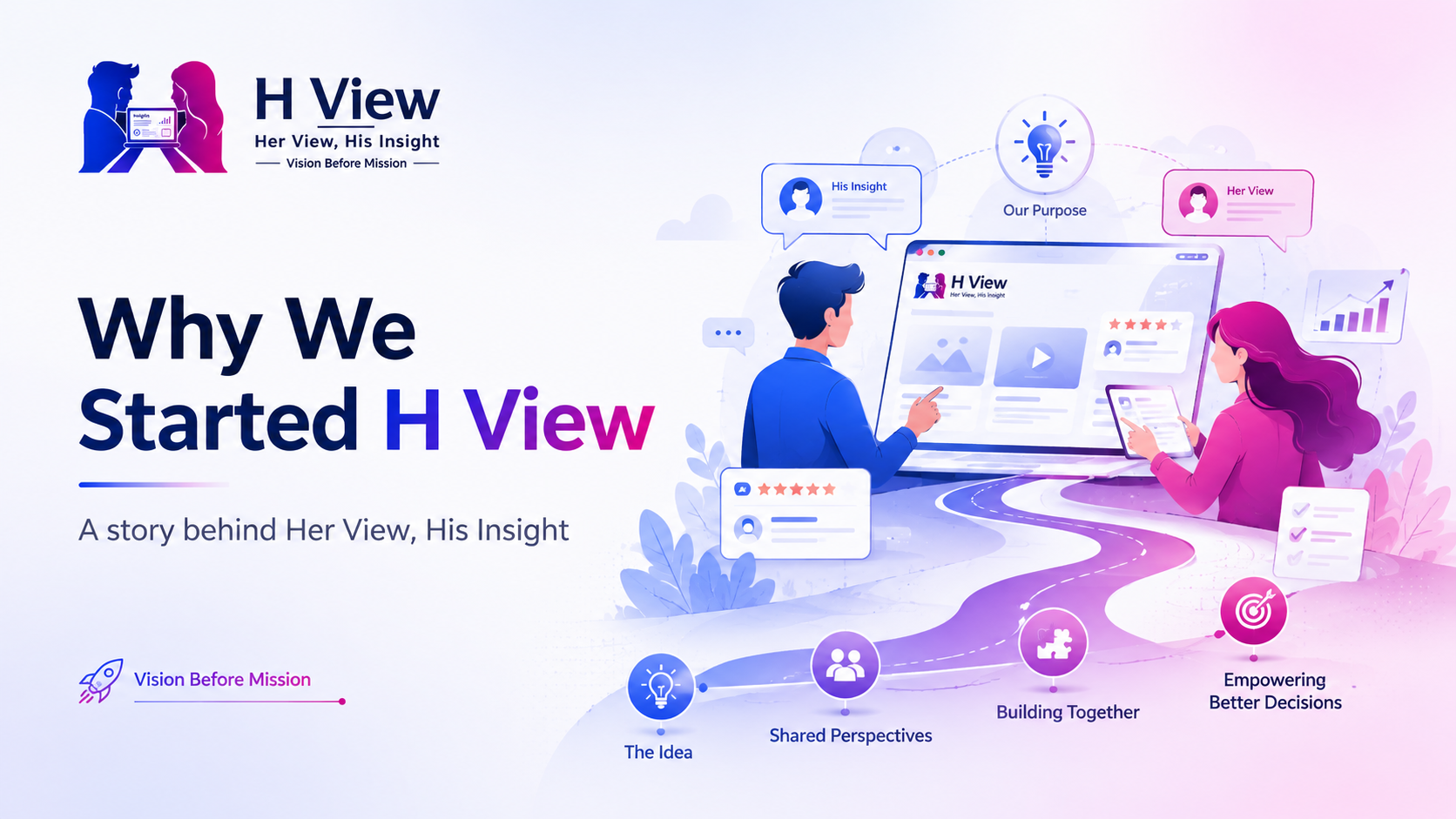
The phrase Her View, His Insight grew naturally from the way we wanted to approach decisions.
We noticed that many reviews lean too heavily in one direction. Some focus almost completely on experience: how something looks, feels or works in day-to-day use. Others focus on analysis: pricing, performance, specifications and comparisons. Both are useful, but either one on its own can leave part of the picture missing.
That is why H View is built around two perspectives.
Her View represents the human side of the experience. It looks at comfort, usability, clarity, learning curve and the everyday details that often do not appear in a specification sheet.
His Insight brings the analytical side. It considers value, performance, limitations, pricing, reliability and whether the decision still makes sense after the first impression wears off.
The two ideas are not meant to create a strict division between men and women. They represent two complementary ways of thinking. One asks how something feels in real use. The other asks whether the choice makes practical sense.
Together, they help us look at a decision more completely.
A product or service can look excellent on paper and still be frustrating in real life. That is where the experience side becomes important.
Imagine someone opening a design tool for the first time. The company may advertise thousands of templates, AI features, collaboration tools and premium assets. Those features sound impressive, but a beginner may be thinking about something much simpler: can I actually create a decent design without spending half a day learning the software?
That is the kind of question Her View pays attention to.
When we discuss a tool such as Canva, the useful part is not only listing what the platform offers. It is understanding whether a blogger, student or small business owner can use it comfortably without professional design experience. The Canva Review for Bloggers and Small Businesses is the type of article where that real-world experience matters as much as the feature list.
The same principle applies beyond products. In a relationship article, it is easy to write that communication is important. It is harder, but much more useful, to talk about what happens when two people speak every day but still feel emotionally disconnected. In a career article, telling someone to improve their skills is simple advice; understanding the frustration of applying for dozens of jobs without receiving a response requires a more human perspective.
Her View keeps that human experience visible.
Experience matters, but it cannot be the whole story. Something can be easy to use and still be poor value. A service can look affordable initially and become expensive after renewal. A phone can have an attractive design while falling behind competitors in important areas.
His Insight is where we step back and examine those practical questions.
If we are looking at web hosting, for example, a clean dashboard is useful, especially for a beginner. But we also need to consider renewal pricing, backups, server performance, storage limits, customer support, security and upgrade options. Our Hostinger Review for WordPress Bloggers in India is an example of where that broader evaluation becomes important.
The same type of thinking applies to AI tools. A tool may save time, but it is worth asking whether the paid version is necessary, whether the output is reliable enough for the task and whether the user is becoming dependent on it for work they should still understand themselves.
That kind of analysis helps turn a recommendation into something more useful than a simple yes or no.
Most real decisions involve a mixture of emotion, practicality and personal circumstance. That is why a single answer is rarely enough.
Take smartphones. One person may care most about battery life because they travel regularly. Another may prioritise the camera. A third may want clean software and long-term updates. A phone that is perfect for one buyer can be completely wrong for another, even if both buyers have the same budget.
That is why we have tried to move beyond simple “winner and loser” thinking in technology articles. When we compare brands such as Nothing and CMF, the useful question is not only which one has the stronger specification sheet. It is also who each product is actually meant for.
Finance works in a similar way. It is easy to say that investing is important for long-term wealth, but a person without an emergency fund may need to think differently from someone with stable savings and fewer financial responsibilities. In Saving vs Investing: Why Saving Alone Is Not Enough to Build Wealth, the real value comes from understanding the balance rather than treating one option as universally correct.
H View is not built around the idea that every question has one perfect answer. It is built around helping readers understand the factors that should shape their own answer.
Another idea that became closely connected to H View is Vision Before Mission.
We use that phrase because many poor decisions happen when action comes before clarity. People buy software because somebody recommended it, join courses because a particular career is trending, replace gadgets because a sale looks attractive or start businesses because they have seen someone else succeed in the same field.
The problem is not taking action. The problem is taking action without first understanding the purpose behind it.
Consider someone planning to build a website. Before comparing hosting providers, plugins and themes, it helps to decide what the website actually needs to do. A personal blog, a local business site and an online store are three very different projects, even though all of them may use WordPress. Understanding the purpose first can save money and prevent a beginner from paying for features they will never use.
The same thinking applies to AI subscriptions. One person may genuinely save several hours a week by using AI for research, drafting or repetitive communication. Another may subscribe because the tool feels important and then barely use it. The software is the same in both cases, but the value is completely different because the need is different.
Even smartphone shopping can benefit from the same approach. A large discount can make a new phone look like an opportunity, but the discount does not automatically create a need. If the current phone still performs well, receives updates and does everything the user requires, waiting another year may be the smarter choice.
That is what Vision Before Mission means to us. It is not about overthinking every decision. It is about understanding why you are doing something before committing your time, money or attention to it.
H View began with a strong focus on reviews and buying decisions, but over time we realised that the same need for clarity appears in many other parts of life.
People are trying to understand whether coding is still worth learning as AI changes software development. They are trying to recognise fake job offers, suspicious loan apps and online scams. They are deciding whether convenience-driven services are actually making their lives easier or simply encouraging more spending. Families and couples are dealing with communication, expectations and emotional distance. Young professionals are trying to understand why a degree alone may not be enough to start a career.
These may look like unrelated topics, but the underlying problem is often the same: people need context before they act.
That is why H View now covers technology, artificial intelligence, careers, money, business, relationships, family, lifestyle, consumer awareness and sports. The categories may be different, but we want the reader experience to remain consistent. A good H View article should make a complicated subject easier to understand and help the reader see a decision from more than one angle.
Our article on whether coding is still worth learning in 2026 looks at a career question many students and professionals are now asking. Our guide to spotting a fake job consultancy or genuine recruiter deals with trust and safety. Our article on dark patterns in online shopping apps looks at the less obvious ways digital platforms can influence buying behaviour.
Different topics, but the same objective: understand first, then decide.
We do not want someone to finish an H View article and feel that they have simply read another version of information they already saw elsewhere.
A useful article should leave something behind.
Maybe the reader realises that the cheaper option is not necessarily better value. Maybe they discover a limitation that was not obvious in the advertisement. Maybe a complicated topic finally makes sense. Maybe they decide that they do not actually need to buy the product they were researching.
That last outcome is important.
A website built around reviews should be comfortable saying that a reader may not need to spend money at all. Not every premium plan is necessary. Not every upgrade is worth making. Not every trend needs to be followed immediately.
Sometimes the best advice is to wait.
Sometimes it is to keep what you already have.
Sometimes it is to choose a simpler option.
If that is the conclusion that best serves the reader, then that is the conclusion we want to be able to give.
Publishing advice online carries more responsibility than it may seem.
Someone can spend thousands of rupees because of a review. A student can choose a course based on an article. A job seeker can trust or reject an opportunity because of what they read. A person dealing with money, relationships or career uncertainty may arrive at an article while already feeling stressed or confused.
That is why we do not want confidence in our writing to be mistaken for certainty.
Where a topic is subjective, we should say so. Where there are limitations, they should be explained. Where information changes, it should be updated. Where we are expressing an opinion, it should not be presented as an unquestionable fact.
Trust is difficult to build and easy to lose.
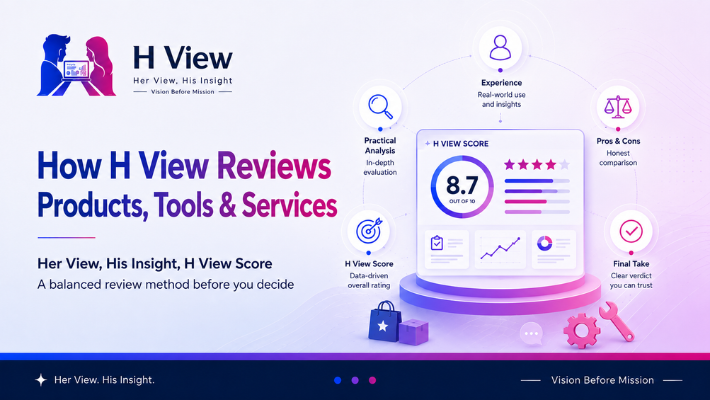
For readers who want to understand more about our approach, we have also explained the broader process in How H View Reviews Products, Tools and Services.
For me, H View becomes meaningful when we remember that every search comes from a real situation.
A person researching a budget phone may be a student trying to make one purchase last for several years. Someone searching for career advice may have already spent months applying for jobs and may be questioning their own ability. A relationship article may be read by someone who is not looking for a perfect answer, but simply wants their home to feel calmer.
Those situations should shape how we write.
I do not want H View to sound like a manual talking at people. I want the content to feel as though someone has understood the situation first and then tried to explain it clearly.
That human connection is what Her View means to me.
For me, useful insight begins when we move beyond the first impression.
A product can be popular and still be wrong for a particular buyer. A cheap service can become expensive over time. An impressive feature can sound important while adding very little value in everyday use.
That is why I believe a good article should ask what happens after the excitement is gone. Does the decision still make sense after six months? Is there a hidden cost? Is there a simpler alternative? Is the reader choosing something because they need it or because they have been convinced that they should want it?
H View should not make choices on behalf of readers. It should give them enough context to make those choices with more confidence.
H View started because we were looking for something we often wanted ourselves: information that came with perspective.
There is already more content online than anyone can realistically consume. Publishing more words is not enough. What matters is whether those words help someone understand something better.
Her View reminds us to look at the human experience behind a decision. His Insight reminds us to examine the practical side, including value, limitations and long-term usefulness. Vision Before Mission reminds us that clarity should come before action.
Those ideas are still the foundation of H View.
If an article helps someone avoid a poor purchase, recognise a risk, understand a difficult topic or simply feel more certain about their next step, then the article has done something useful.
That is the kind of H View we want to continue building.
H View is a content, review and insight platform focused on helping readers understand products, technology, careers, business, money, relationships, lifestyle and other everyday decisions more clearly. The aim is to explain not only what something is, but also what it may mean for the person reading about it.
Her View, His Insight represents two complementary perspectives. Her View focuses on the human experience, including usability, comfort and everyday realities, while His Insight looks more closely at value, performance, limitations and practical decision-making.
Vision Before Mission means understanding the purpose of a decision before acting on it. Whether the decision involves a purchase, a career, a business idea or a digital tool, H View believes it is better to know why you are doing something before committing time or money to it.
No. Reviews are part of H View, but the platform also covers technology, AI, business, careers, money, relationships, family, lifestyle, consumer awareness and sports. The common thread is helping readers understand choices, risks and trade-offs more clearly.
No. Sometimes the most useful conclusion may be that a reader should wait, keep what they already have, choose a cheaper option or avoid a product entirely. A recommendation should serve the reader, not simply encourage a purchase.
H View writer sharing practical, balanced, and reader-first insights.
Share your real experience and help other readers decide better.
No community views yet. Be the first to share yours.
Online reviews are everywhere. Before buying a product, choosing a tool, selecting hosting, trying software,…
H View May 23, 2026