

Best Digital Marketing Tools in 2026: What Marketers Actually Need and What They Can Skip
Open LinkedIn for a few minutes and you will probably come across a colourful graphic…
 Harika October 6, 2026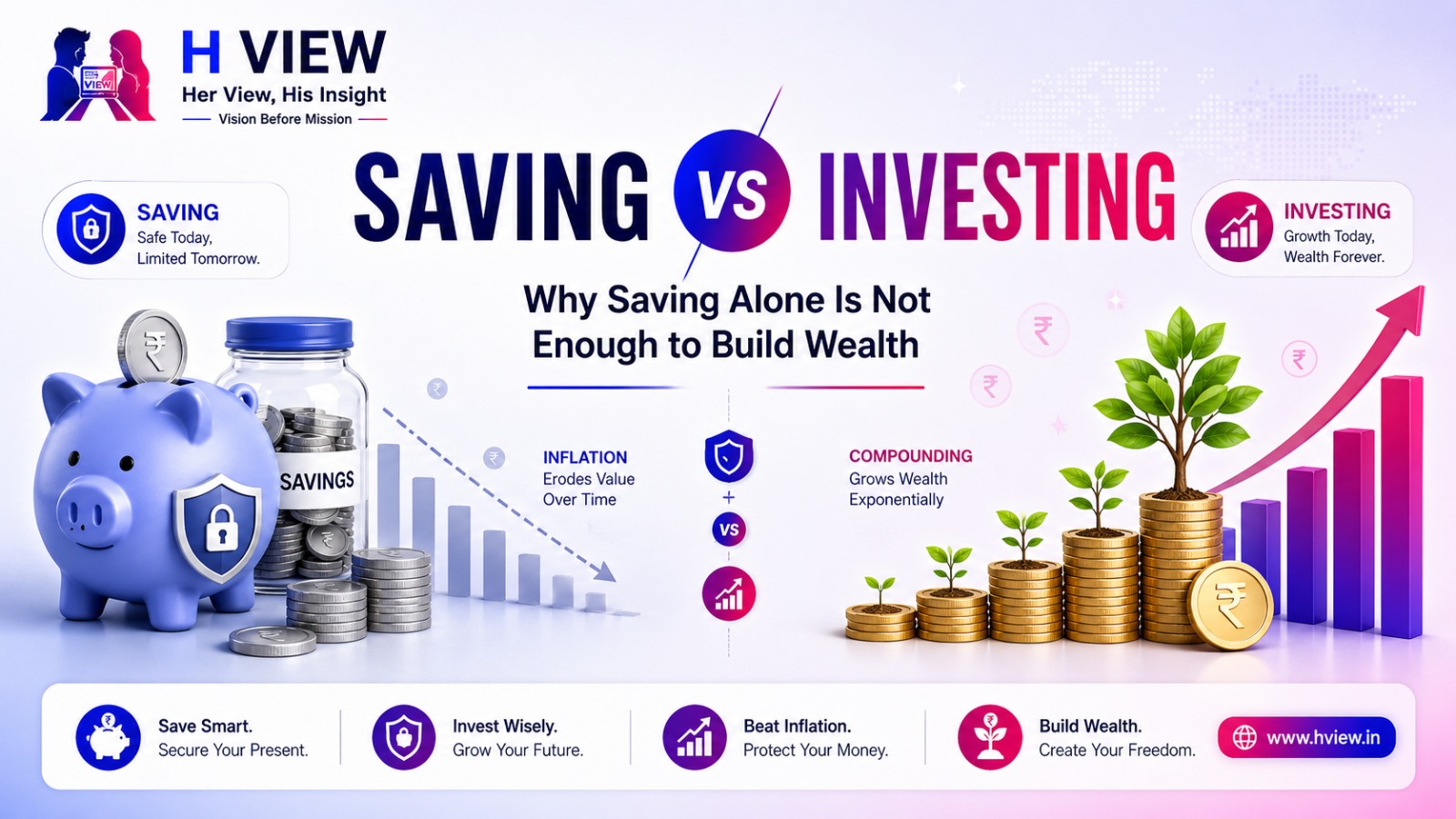
 By PraveenUpdated June 5, 20265 min read69 views
If you grew up in a middle-class Indian household, you have probably heard some version of this advice:
“Save money for a rainy day.”
For years, our households have been more inclined toward saving than investing. Even today, if you visit most Indian homes, you will find plenty of discussions around how to save money, reduce expenses, and build financial security.
And honestly, there is nothing wrong with that. In fact, developing a habit of saving early in life provides several benefits. When a person starts saving from the moment they begin earning, it helps them:
These are valuable life skills that often stay with a person for decades. Saving is not just a financial habit. It is a behavioral habit. And that is where many people get it right. Unfortunately, that is also where many people stop.
While many people save diligently, they often fail to invest those savings effectively. As a result, the money remains safe, but it does not grow. In some cases, it may actually be losing value every single day without the owner realizing it. The biggest reason behind this silent erosion of wealth is inflation.
Let us assume you have ₹100 today. Go to the market and buy rice, flour, vegetables, or any other daily necessities. Take note of how much you can purchase with that ₹100.
Now imagine you keep that same ₹100 safely inside your cupboard for one year. After one year, take that ₹100 back to the market and try buying the exact same quantity of goods. In most cases, you will not be able to. Why?
Because the prices of those goods have increased. That increase in prices is called inflation.
What actually happened here?
The ₹100 note did not change. But the amount of goods and services you could buy with it decreased. In simple words, inflation reduces the purchasing power of money over time. And that is how inflation silently eats away the real value of your savings.
Suppose you save ₹5,000 every month and keep it entirely in cash. After one year, the money is still there. It feels safe. But it has not grown. In fact, because of inflation, the real value of that money has reduced.
Now suppose you keep the same money in a savings account. The bank pays some interest, and your corpus grows slightly.
The important question is not: “Did my money increase?”
The important question is: “Did my money grow faster than inflation?”
If your money grows slower than inflation, your purchasing power is still declining. If your money grows faster than inflation, your purchasing power is increasing. That is the lens through which money should be viewed. Not just the amount you have. But what that amount can actually buy.
The purpose of investing is simple. It is to ensure that your hard-earned savings continue to grow and retain their value over time.
Saving helps you accumulate money. Investing helps you grow money. Both are important. One should not replace the other. Rather, they should work together.
The challenge, however, is deciding where to invest. And that is where things become slightly more complicated.
There are many investment options available today.
Some are relatively safe, such as:
Others involve higher risk and volatility, such as:
Each investment option has its own advantages, disadvantages, risks, and expected returns. There is no single investment that is perfect for everyone.
The art of investing is not about finding the highest return. It is about choosing the right investment instrument for your specific situation.
That choice depends on:
A person saving for a home purchase in three years may need a very different strategy from someone investing for retirement thirty years away.
The right investment for one person may be completely wrong for another. That is why investing should always begin with understanding the goal before choosing the instrument.
Saving creates a sense of security.
There is comfort in knowing that money is available when needed. For many families, especially those who have experienced financial hardships, saving feels safer than investing.
And that feeling is completely understandable.
The goal should never be to stop saving.
The goal should be to ensure those savings continue to work for you.
Saving and investing solve two different problems.
Saving protects money.
Investing grows money.
A healthy financial life requires both. If you only invest without saving, you may struggle during emergencies. If you only save without investing, inflation may quietly reduce your wealth over time.
Financial success often comes from understanding when to use each.
Saving is the foundation of financial discipline.
Investing is the engine of wealth creation.
One teaches you how to keep money. The other teaches your money how to grow. The mistake is not saving too much. The mistake is believing that saving alone is enough. Because in a world where prices rise every year, protecting wealth is no longer just about preserving money.
It is about preserving purchasing power.
And that is where investing becomes essential.
The journey to financial freedom does not begin with investing.
It begins with saving.
But it does not end there.
Praveen is an H View contributor covering general reviews, leadership, sports, and practical opinion-based topics. His writing focuses on balanced analysis, clear explanations, and reader-friendly insights that help people understand products, ideas, trends, and real-world decisions with more clarity.
Share your real experience and help other readers decide better.
No community views yet. Be the first to share yours.

Open LinkedIn for a few minutes and you will probably come across a colourful graphic…
Harika October 6, 2026 
When an employee resigns, many organisations move quickly into replacement mode. The manager informs HR,…
Harika October 6, 2026 
For many corporate employees, the workday begins long before they actually start working. They wake…
Harika October 5, 2026 
Many projects begin with an assumption that sounds reasonable on paper: the client will explain…
Harika October 1, 2026