

Entry-Level Job—but Experience Required? The Fresher Trap Nobody Is Fixing
A fresher opens a job portal and finds an attractive vacancy. The title says Entry-Level,…
 Satya Hemanth August 9, 2026
  By Satya HemanthUpdated September 20, 202610 min read88 views
Many students complete course after course because certificates feel like visible proof of progress.
A learner may finish Python, Java, web development, cloud computing, data analytics and artificial intelligence programmes. Their resume may contain an entire section filled with badges and completion credentials.
But when they apply for a job, another candidate with fewer certificates may be selected because they can demonstrate a working application, explain how they built it and solve a practical problem during the interview.
This creates an important question for students and freshers:
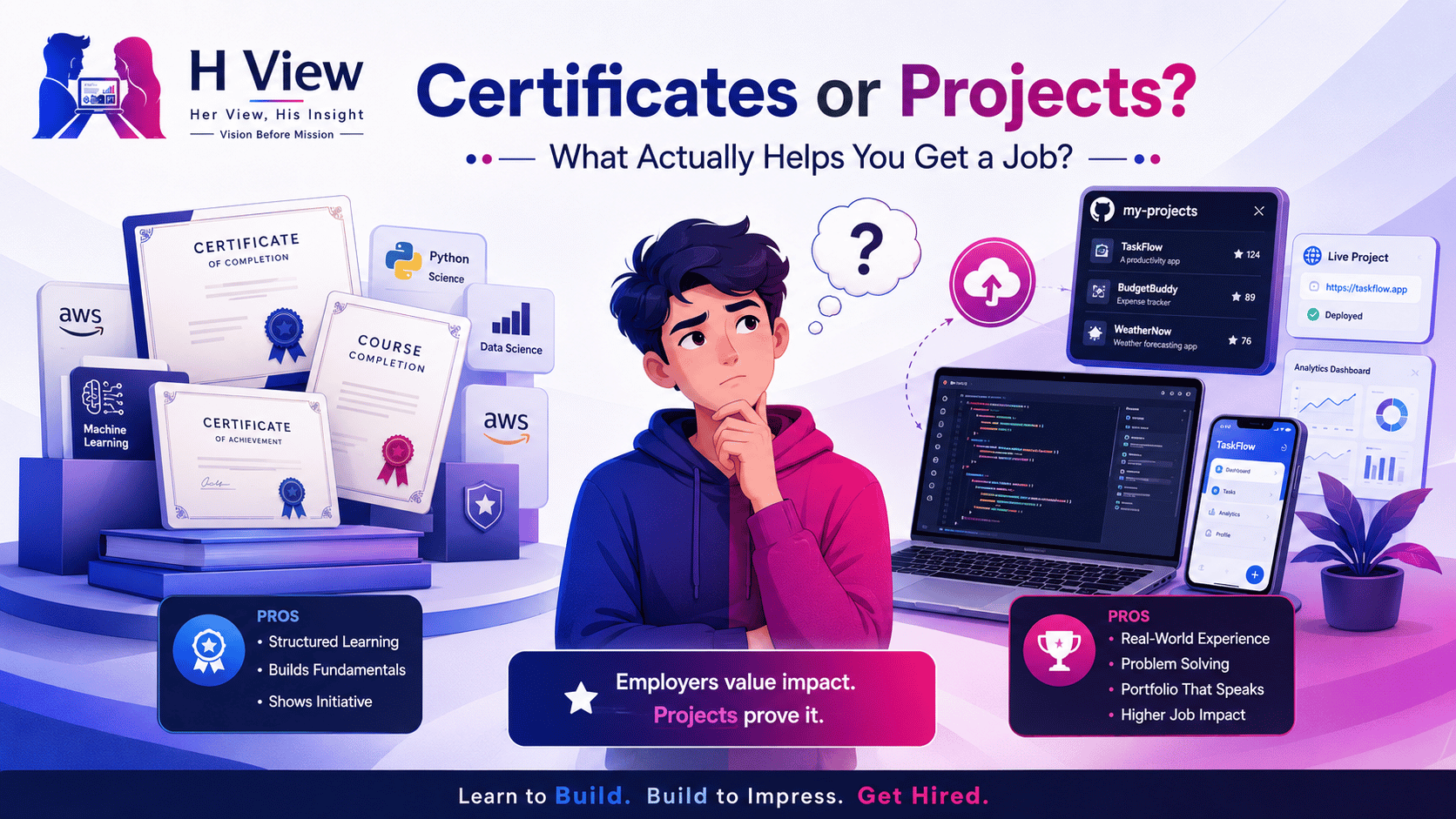
What actually helps you get a job—certificates or projects?
The answer is not that certificates are useless.
A relevant certificate can show that you followed a structured learning path, studied a particular subject and completed an assessment. Some certifications are also respected because they test specific professional knowledge.
However, a certificate mainly shows that you completed a course.
A project shows what you can do with what you learned.
For most entry-level technology roles, the strongest profile is not built by collecting the highest number of certificates. It is built by combining useful learning credentials with practical projects, clear explanations and skills that can be demonstrated.
Certificates are attractive because they provide a quick sense of achievement.
After completing a course, the learner receives something that can be:
Projects are more difficult.
A project may fail repeatedly. The learner must make decisions, search for solutions, fix errors and complete work without knowing whether the final result will look impressive.
A certificate has a clear ending.
A project may take weeks and expose what the learner does not yet understand.
This is why some students keep beginning new courses instead of building anything with the knowledge they already have.
They remain active but do not become job-ready.
Certificates can be useful when they come from a meaningful learning experience.
A structured programme may help a beginner understand:
A certificate can also be valuable when an employer needs evidence of specialised knowledge in areas such as cloud platforms, cybersecurity, networking, project management or enterprise software.
The World Economic Forum’s Future of Jobs Report 2025 found that employers expect a significant transformation in workforce skills through 2030, with technological literacy, AI and big data, networks and cybersecurity among the fastest-growing skill areas. This makes structured upskilling important—but the report also emphasises broader capabilities such as analytical thinking, adaptability and lifelong learning.
A relevant certification may therefore strengthen a profile when it is connected to a clear career path.
The problem is not having certificates.
The problem is expecting the certificate to speak louder than the learner’s actual ability.
A certificate usually confirms that someone registered for a programme and met its completion requirements.
Those requirements may range from a serious proctored examination to simply watching videos and answering basic quizzes.
Recruiters understand this difference.
Two candidates may hold the same certificate while having completely different levels of understanding.
One may have practised every concept and built original work. The other may have skipped lessons, copied assignments or used online answers to complete the assessment.
This is why certificates alone rarely remove the need for:
A certificate can help someone enter the conversation.
It usually cannot complete the conversation for them.
A useful project demonstrates several abilities at the same time.
It can show that the candidate knows how to:
GitHub’s guidance for junior developers specifically recommends building public projects that showcase both technical ability and responsible use of AI tools. It also encourages learners to develop core workflows, review code and strengthen debugging skills rather than relying only on code generation.
A working project gives the interviewer something concrete to discuss.
Instead of asking only, “What did you study?” the conversation can become:
These questions reveal real understanding.
Many candidates believe a portfolio should contain as many projects as possible.
They add calculators, weather applications, task managers, landing pages and copied ecommerce websites.
The problem is that recruiters may have seen the same tutorial projects hundreds of times.
A stronger portfolio may contain only two or three projects, provided they are complete and thoughtfully built.
For example, an employee-management application can become meaningful when it includes:
The topic does not need to be unique.
The implementation and understanding should be genuine.
One complete project that solves a real problem is usually more convincing than ten incomplete projects copied from tutorials.
Beginners should not feel ashamed of following tutorials.
Tutorials teach structure. They show how files connect, how libraries are used and how an application is built step by step.
The problem begins when a learner presents the tutorial output as proof of independent ability.
A better process is:
This transforms imitation into learning.
The best project depends on the target role.
Build a responsive application with forms, API integration, loading states, validation and accessibility.
Create APIs with authentication, databases, permissions, logging and error handling.
Build a complete product that includes frontend, backend, database and deployment.
Use a real dataset, clean it, explain the analysis and present useful findings through dashboards or reports.
Prepare test cases, bug reports, automation scripts and a clear testing strategy for an application.
Create a safe lab project involving log analysis, vulnerability identification or secure system configuration.
Show research, user flows, wireframes, design decisions, prototypes and usability improvements—not only final screens.
The project should resemble the work expected in the role.
For coding-related careers, a properly maintained GitHub profile can help recruiters and interviewers inspect how a candidate works.
GitHub reported record levels of development activity in its 2025 Octoverse report, including large volumes of merged pull requests and public project contributions. This reflects the platform’s continuing role in modern software development and collaboration.
A useful GitHub profile should include:
A profile filled with copied repositories or one large final upload provides less evidence of the development process.
Employers do not expect every fresher to have thousands of contributions.
They want signs that the candidate understands their own work.
AI can help learners create projects faster.
It can suggest architecture, explain code, identify bugs, generate tests and assist with documentation. GitHub has described AI compatibility and AI-assisted development as increasingly normal parts of developer workflows.
However, an AI-generated project becomes weak evidence when the candidate cannot explain it.
During an interview, the employer may ask the candidate to:
If the learner only managed prompts, the gap will become visible.
Using AI is not automatically dishonest.
Presenting AI-generated work as personal expertise without understanding it is the problem.
A certificate is generally stronger when it:
A certificate is weaker when it:
Do not add every course certificate to the resume.
Select the few that strengthen your career story.
An employer hiring a fresher is trying to reduce uncertainty.
They want to know:
A certificate offers limited evidence for these questions.
A project, interview performance, internship, contribution or practical task can provide much stronger evidence.
This is why skills-based hiring is becoming more important across many industries. The changing job market is increasing the value of demonstrated ability, adaptability and continuous learning rather than relying only on traditional credentials.
For a fresher, the resume should not dedicate half the page to certificates.
A stronger order may be:
Each project should briefly mention:
Do not merely write “Created a web application using React.”
Explain what the application does and what technical responsibility you handled.
A practical approach is:
Learn → Practise → Build → Explain → Improve
A certificate can represent the learning stage.
A project represents practice and building.
An interview tests whether you can explain.
Feedback and iteration show whether you can improve.
Skipping any of these stages weakens the profile.
Her View: Certificates can provide structured learning, credibility and evidence of specialised study. They can help beginners stay focused and strengthen a resume when chosen carefully.
His Insight: Employers cannot hire a certificate. They hire a person who can solve problems, build useful work and explain decisions. Projects reveal practical ability more clearly than a long list of course completions.
Both views are valid.
Certificates and projects are not enemies.
They serve different purposes.
Projects usually matter more than certificates when applying for entry-level technology roles.
But the strongest candidate uses both correctly.
Choose one structured course or certification to build foundations. Then stop collecting credentials for a while and apply what you learned.
Build two or three complete projects. Deploy them. Document them. Break them. Fix them. Improve them. Prepare to explain every important choice.
A certificate says:
“I studied this.”
A project says:
“I used it.”
During hiring, the second statement is usually more powerful.
Yes, especially when they are relevant, verifiable and connected to a recognised assessment. However, certificates rarely replace practical skills, projects and interview performance.
For many fresher and entry-level technology roles, projects provide stronger evidence because they show how the candidate applies knowledge and solves problems.
Two or three complete, original and well-documented projects are usually better than many copied or unfinished projects.
They can be included after meaningful changes are made. Learners should rebuild, customise and extend tutorial projects rather than presenting unchanged copies as original work.
It is not compulsory for every role, but it is valuable for coding careers because it allows candidates to show source code, documentation and project history.
Yes, but you must understand, test and explain the generated work. AI should support learning and development rather than replace your involvement.
Certificates requiring meaningful assessments, practical labs and role-relevant knowledge generally carry more value than simple completion badges.
Explain the problem, technologies, architecture, your contribution, challenges, errors, security, deployment and what you would improve.
Satya Hemanth is the founder of H View and writes on careers, sports, leadership, digital trends, and practical decision-making. His articles focus on clear explanations, real-world examples, and useful insights for students, young professionals, and everyday readers.
Share your real experience and help other readers decide better.
No community views yet. Be the first to share yours.
A fresher opens a job portal and finds an attractive vacancy. The title says Entry-Level,…
Satya Hemanth August 9, 2026 
You find a job that perfectly matches your profile. The company looks genuine. The role…
Satya Hemanth August 8, 2026 
For generations, the path to a secure career appeared simple: Study hard, complete a degree…
Satya Hemanth August 7, 2026 
Sending hundreds of job applications without receiving a single interview can be deeply frustrating. A…
Satya Hemanth August 6, 2026