

Entry-Level Job—but Experience Required? The Fresher Trap Nobody Is Fixing
A fresher opens a job portal and finds an attractive vacancy. The title says Entry-Level,…
 Satya Hemanth August 9, 2026
  By Satya HemanthUpdated September 20, 202611 min read47 views
Learning coding has become a major career goal for students, freshers and working professionals.
Everywhere we look, coaching centres promise full-stack development, Python, Java, data science, cloud computing, cybersecurity and artificial intelligence courses. Advertisements often claim that learners can become job-ready in three or six months, receive placement assistance and start earning attractive salaries.
For someone who feels confused about where to begin, joining a structured programme can appear to be the safest option.
A coaching institute provides a timetable, trainer, classmates, assignments and a defined syllabus. It may reduce the effort of searching for learning resources and deciding what to study next.
But coding can also be learned through free documentation, YouTube videos, online courses, communities and practical projects.
This creates an important question:
Do you really need a coaching institute to learn coding, or can you become job-ready through self-learning?
The honest answer is that coaching can help some learners, but it is not compulsory for everyone.
The value of an institute depends on the quality of teaching, mentorship, projects, placement support and the learner’s own discipline. Paying a high course fee does not automatically produce skills or employment.
Most beginners do not join coaching because learning material is unavailable.
They join because the amount of available material is overwhelming.
A learner may find hundreds of courses on Python, JavaScript, React, Java and databases. Different instructors recommend different learning paths. Some begin with theory, while others immediately build projects.
A beginner may struggle to answer basic questions:
A good coaching programme can answer these questions through structure.
It can provide:
For learners who struggle with consistency or need direct explanation, this structure can be valuable.
From one perspective, joining a good institute can shorten the learning journey.
A beginner does not have to spend weeks comparing tutorials or building a syllabus. The trainer can introduce concepts in a logical sequence and explain difficult topics based on the learner’s level.
Live classes also provide accountability.
A self-learner may postpone practice repeatedly. A scheduled batch creates a reason to attend, complete assignments and remain connected with the subject.
Coaching can be especially useful for:
The strongest advantage is not access to videos or notes.
It is access to a trainer who can identify why a learner is stuck and explain what should happen next.
The problem is that not every institute provides meaningful training.
Some centres focus more on admissions than learning outcomes. Their sales teams may create urgency by promising limited seats, guaranteed placement or salaries that are not realistic for every learner.
The Central Consumer Protection Authority issued specific guidelines in 2024 to prevent misleading advertisements in the coaching sector. The guidelines address false claims involving course details, faculty credentials, student results, rankings, success rates and guaranteed selection or employment.
This is important because the phrase “placement assistance” does not necessarily mean the institute will secure a job.
It may only mean:
A learner should never interpret placement assistance as a guaranteed offer.
The government has also taken action against coaching advertisements that misrepresented student results, showing that promotional claims should be verified rather than accepted at face value.
Most coding concepts are already available online.
Learners can access:
Therefore, paying a large fee only for recorded lessons or basic notes may offer poor value.
What should justify the fee is the service around the content:
A course that provides only videos and copied projects may offer little more than a free playlist.
Self-learning can work very well for disciplined learners.
You may not require a coaching institute when you can:
Self-learning does not mean learning alone.
A learner can use online communities, mentors, AI tools, documentation and peer groups while remaining responsible for the overall plan.
Many developers build their skills through a combination of college education, self-study, online courses and real project experience rather than one coaching programme.
A structured institute may be useful when:
A clear curriculum can prevent random learning.
Deadlines and classmates can improve consistency.
Some concepts become easier when a trainer responds to questions immediately.
Career switchers may benefit from a focused roadmap and interview preparation.
A mentor can identify weaknesses in code, project structure and communication.
Reliable placement partnerships can provide opportunities that are difficult to access independently.
The decision should be based on the support required—not on fear created by advertisements.
A poor-quality institute often reveals itself before admission.
Be cautious when it:
A trustworthy institute should be comfortable answering detailed questions.
Before joining, speak with the institute and preferably with past students.
Ask for the trainer’s experience, not only the founder’s profile.
Some institutes use senior trainers for demo classes and assign junior instructors later.
Confirm live classes, recordings, assignments, projects, code reviews, mock interviews and placement support.
A very large batch may reduce personal attention.
Check whether there are live sessions, mentor calls, forums or only recorded explanations.
Ask whether students design their own projects or copy the same application from the trainer.
Request a written explanation.
Ask for alumni contacts, company names, roles and dates—with the students’ consent.
Read the terms before paying, especially for instalments and loan-based programmes.
A marketing presentation is not the same as an actual technical class.
Many coding courses advertise practical learning but guide every student through identical projects.
Everyone builds the same ecommerce website, task manager, weather application or employee-management system using the same code.
The student may receive a project certificate but gain limited problem-solving ability.
During an interview, the weakness becomes visible when the candidate cannot explain:
A useful project should force the learner to make decisions.
Trainer support is valuable, but the trainer should not do all the thinking.
Price does not reliably indicate quality.
A ₹60,000 course may include strong mentorship and placement support. It may also contain the same lessons available online for a small fraction of the price.
A ₹5,000 online course may provide excellent content but no personal guidance.
The right comparison is not cheap versus expensive.
It is:
What support am I receiving for the money?
Consider the cost per useful outcome:
Do not pay a premium only for attractive branding, a certificate or access to recorded videos.
Even the best institute cannot make someone job-ready without independent effort.
A learner must still:
Attending classes can create the feeling of progress.
Real progress is visible when the learner can solve a new problem without copying the trainer.
A student who attends six months of coaching but rarely practises may remain weaker than a self-learner who builds consistently.
For many learners, the best solution is not purely coaching or purely self-learning.
It is a hybrid approach.
A practical model could be:
This prevents learners from paying large fees before understanding whether the career suits them.
It also helps them evaluate coaching quality more intelligently.
Her View: A good coaching institute can provide structure, motivation, mentoring and career support. For beginners who feel lost or inconsistent, the right programme can save time and reduce confusion.
His Insight: Coaching advertisements can create unrealistic expectations. Expensive fees, copied projects and vague placement promises do not guarantee skills or employment. Learners still need independent practice.
Both views are valid.
Coaching is a support system.
It should not be mistaken for a shortcut.
You do not need a coaching institute to learn coding.
You may need one to learn with greater structure, accountability or mentorship.
The correct decision depends on how you learn best.
A disciplined person with a clear roadmap can build strong skills through self-learning. A beginner who repeatedly becomes confused or inconsistent may benefit from live guidance.
Before paying, verify the trainer, syllabus, batch size, projects, reviews, refund terms and placement claims. Do not join only because the advertisement creates urgency or promises a guaranteed career.
Most importantly, remember that the institute can teach concepts—but it cannot practise for you.
A good course can open the door.
You still have to walk through it by writing code, solving problems and building work you can confidently explain.
No. Coding can be learned through self-study, online courses, documentation and projects. Coaching is useful mainly for learners who need structure, mentorship, accountability or placement support.
Yes, provided you follow a structured roadmap, practise consistently, use documentation and build original projects. Watching videos alone is not enough.
Verify the trainer, syllabus, batch size, student projects, alumni outcomes, placement process, refund policy and access to doubt support before paying.
Guaranteed placement claims should be treated cautiously. Ask for written terms and distinguish between placement assistance, interview opportunities and an actual job guarantee.
It may be worth it when it provides strong mentorship, personal feedback, original project guidance and credible placement support. High price alone does not indicate quality.
It may include resume support, mock interviews, job alerts, placement drives or resume forwarding. The exact meaning differs between institutes and should be confirmed in writing.
Yes. Spending a few weeks learning fundamentals helps you confirm your interest and evaluate whether the institute’s teaching is genuinely useful.
Practice matters more. Coaching can guide the learner, but real skill develops through writing code, debugging and building projects independently.
Satya Hemanth is the founder of H View and writes on careers, sports, leadership, digital trends, and practical decision-making. His articles focus on clear explanations, real-world examples, and useful insights for students, young professionals, and everyday readers.
Share your real experience and help other readers decide better.
No community views yet. Be the first to share yours.
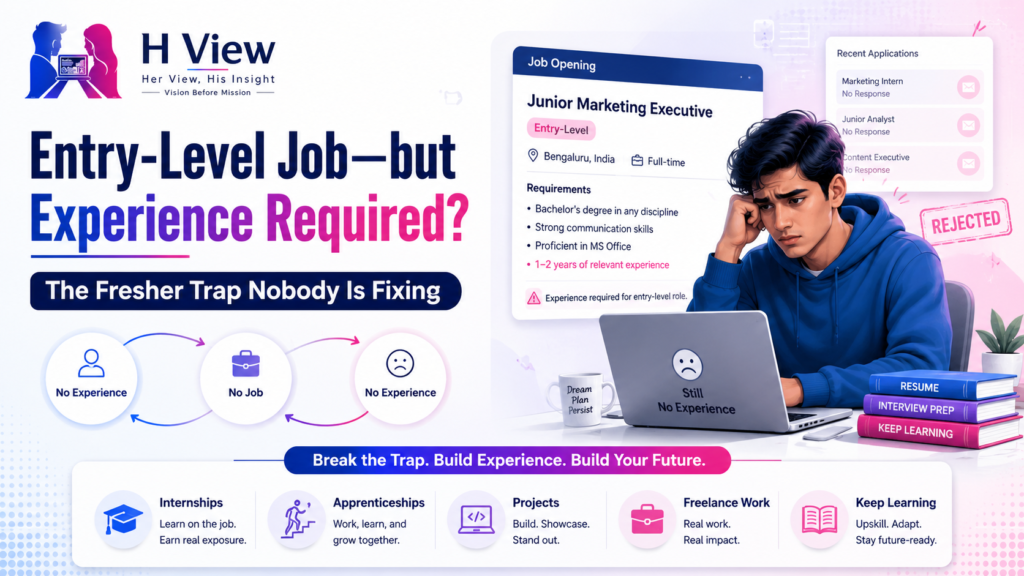
A fresher opens a job portal and finds an attractive vacancy. The title says Entry-Level,…
Satya Hemanth August 9, 2026 
A stranger messages you with what sounds like an easy opportunity. “Use your bank account…
 Harika August 9, 2026
You find a job that perfectly matches your profile. The company looks genuine. The role…
Satya Hemanth August 8, 2026 
For generations, the path to a secure career appeared simple: Study hard, complete a degree…
Satya Hemanth August 7, 2026