

Hiring Is Up—So Why Are Freshers Still Not Getting Jobs?
Open any job portal today and you will see thousands of vacancies. Companies announce hiring…
 Satya Hemanth August 11, 2026
  By Satya HemanthUpdated September 20, 20267 min read57 views
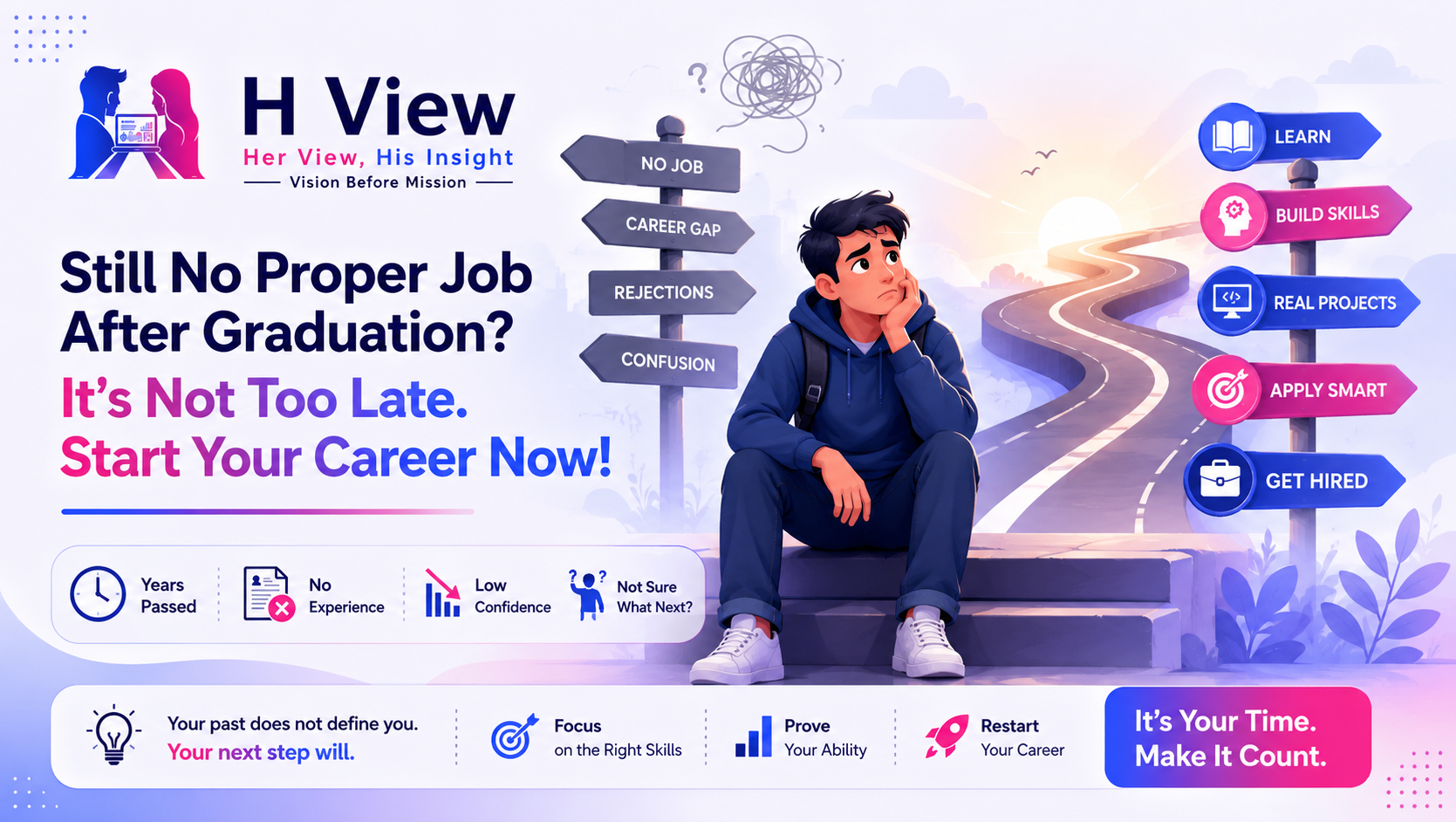
Graduation is usually presented as the beginning of professional life.
But for many young people, that beginning never happens as expected.
Some finish college and spend years preparing for government examinations. Some complete course after course but never receive a genuine opportunity. Others accept temporary, unrelated or low-quality work that gives them neither a stable income nor useful experience.
For some, it has been two years since graduation. For others, six, eight or even more.
The exact number is not the main issue.
The real problem is this:
They have not yet been able to start a proper career.
As time passes, job applications become emotionally harder. Friends move ahead, relatives keep asking questions and employers begin questioning the gap. Many candidates eventually feel that they have missed their chance permanently.
But a delayed career start is not the same as a finished career.
Restarting after a long gap requires more than motivational advice. It needs honesty, recent proof of ability, a realistic job target and protection from the frauds that often exploit unemployed youth.
Not everyone remains unemployed because they were careless or unwilling to work.
A career may be delayed by:
Some graduates also spend years moving between Python, Java, full-stack development, data science, digital marketing and other courses without becoming confident in any one role.
They remain busy learning but never create enough practical proof to convince an employer.
Employers usually want clarity on three points:
A long gap becomes more difficult when the candidate has no clear explanation and nothing recent to demonstrate.
The goal is not to hide the past. It is to show that the present is different.
A candidate who graduated years ago but recently built two strong projects, completed practical assignments and prepared seriously for a specific role may appear more convincing than a recent graduate with only certificates.
Candidates with a long gap are frequently targeted by consultancies offering fake experience letters, salary slips, relieving letters or background-verification support.
They may say:
“Without experience, no company will hire you. Pay us and we will show two years of employment.”
This can destroy a career instead of restarting it.
Employers may verify the company, provident-fund history, salary records, references and project details. Even when documents appear genuine, technical questions can expose that the candidate never performed the claimed work.
A long and honest gap can be explained.
Fraudulent experience can lead to rejection, termination and lasting damage to professional credibility.
Your explanation should be truthful, brief and focused on what you are doing now.
For example:
“After graduation, I prepared for competitive examinations and later struggled to enter the private job market. I have now chosen software testing as my career path, completed practical testing projects and prepared recent work samples. I am looking for an entry-level opportunity where I can contribute and grow.”
Another example:
“My career start was delayed because of family responsibilities and a lack of clear direction. Those responsibilities are now manageable. Over the last few months, I have trained in data analysis and built Excel, SQL and Power BI projects that I can demonstrate.”
Do not invent employment. Do not give a long emotional explanation. Do not apologise repeatedly.
Acknowledge the gap, explain the reason and quickly move toward your current readiness.
After years without a proper job, another general course may feel like progress.
But the better question is:
What recent proof can I show an employer?
Depending on the chosen role, that proof could be:
One focused portfolio is more useful than several unrelated certificates.
Yes, when you have not gained genuine professional experience.
Apply for roles such as:
Do not restrict yourself only to vacancies mentioning the latest graduating batch. Some employers care more about present ability, communication and salary expectations than the year printed on the degree.
At the same time, do not pretend to be an experienced professional merely because many years have passed since graduation.
Long-term unemployed candidates are easy targets because fraudsters know they are under pressure.
Treat these as serious warning signs:
A genuine employer pays the employee. The candidate should not have to purchase the job.
Select one primary job role and one closely related backup. Stop applying randomly to unrelated positions.
Study only what the chosen role requires. Practise daily and complete one strong, original project.
Create a focused resume, update LinkedIn, organise your portfolio and prepare an honest gap explanation.
Apply to relevant openings, seek referrals and track every application. Practise interviews aloud several times each week.
The objective is not to solve the entire career in 90 days. It is to create visible, consistent movement.
Her View: A career may be delayed by circumstances, poor guidance and limited opportunities. People should not be permanently judged for failing to begin at the expected age.
His Insight: Employers still need evidence. Sympathy cannot replace current skills, practical work, communication and dependable preparation.
Both views matter.
The gap explains your situation.
Your recent actions prove your readiness.
Not starting a proper career after graduation—even after many years—does not mean it is too late.
But the restart must be honest and focused.
Do not buy fake experience. Do not keep joining unrelated courses. Do not apply to every available role with the same resume.
Choose a realistic career path, build recent proof and begin with an entry-level opportunity if necessary.
Your first proper job may arrive later than expected. It may also begin with a smaller salary or title than you once imagined.
That first role is not the final destination.
It is the bridge between a long period of waiting and the career you are finally ready to build.
Yes. Build current skills, recent projects and a clear explanation for the delay. You may need to begin with a trainee, junior or entry-level role.
No. Provide accurate educational details and focus the resume on recent learning, projects and relevant ability.
No. Verification or detailed questioning may expose it, leading to rejection, termination or permanent credibility problems.
Only when it fills a specific gap related to your chosen role. Avoid collecting certificates without practical output.
State the genuine reason briefly and explain what you have recently done to become ready for employment.
Do not pay for an interview, offer letter or guaranteed job. Verify every consultancy and employer independently before sharing money or documents.
Satya Hemanth is the founder of H View and writes on careers, sports, leadership, digital trends, and practical decision-making. His articles focus on clear explanations, real-world examples, and useful insights for students, young professionals, and everyday readers.
Share your real experience and help other readers decide better.
No community views yet. Be the first to share yours.
Open any job portal today and you will see thousands of vacancies. Companies announce hiring…
Satya Hemanth August 11, 2026 
For many young Indians, a government job is not just employment. It represents stability, respect,…
Satya Hemanth August 10, 2026 
A fresher opens a job portal and finds an attractive vacancy. The title says Entry-Level,…
Satya Hemanth August 9, 2026 
You find a job that perfectly matches your profile. The company looks genuine. The role…
Satya Hemanth August 8, 2026