

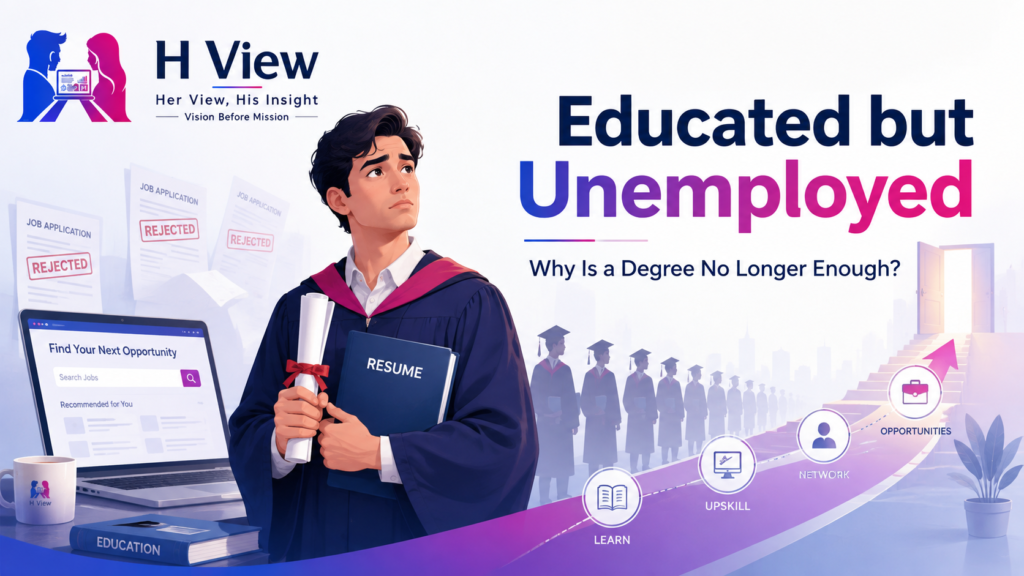
Educated but Unemployed: Why Is a Degree No Longer Enough?
For generations, the path to a secure career appeared simple: Study hard, complete a degree…
 Satya Hemanth August 7, 2026
  By Satya HemanthUpdated September 20, 20267 min read46 views
For many young Indians, a government job is not just employment.
It represents stability, respect, predictable income, family approval and long-term security.
That is why lakhs of candidates spend years preparing for UPSC, SSC, banking, railways, state public-service commissions and other competitive examinations. Some move to coaching hubs, reduce social activities and structure their entire lives around one goal.
There is nothing wrong with serious preparation.
The problem begins when preparation continues year after year without a backup plan, recent work experience or another employable skill.
At that point, the question becomes difficult but necessary:
When does government-job preparation stop being a career plan and start becoming a career delay?
Recent reporting has highlighted growing frustration among young people over competitive-exam disruptions, limited vacancies and the uncertainty surrounding government recruitment. For candidates who spend several years preparing, every cancelled exam, delayed result or missed cutoff can carry a much larger personal cost.
The attraction is understandable.
Government careers can offer:
For candidates from families that have experienced unstable private employment, this security can feel more valuable than a higher starting salary elsewhere.
In many households, government jobs are also treated as the safest route to adulthood—especially for marriage, loans and long-term family planning.
So the goal itself is not the problem.
The risk is making it the only possible future.
Competitive exams encourage candidates to think in attempts.
One missed cutoff becomes:
“I was close. I will try once more.”
That may be reasonable.
But repeated attempts can slowly consume:
The cost is easy to ignore because it does not arrive as one large bill.
It appears gradually.
A candidate may wake up several years after graduation with strong exam knowledge but little evidence of workplace experience.
It would be unfair to tell every aspirant to quit quickly.
Competitive exams are difficult by design. Good preparation may genuinely require sustained effort.
Some candidates improve significantly after their first attempt. Others may be preparing while managing family responsibilities, financial limitations or weak educational foundations.
A serious aspirant may reasonably choose to spend dedicated time preparing when:
The problem is not taking time.
The problem is continuing indefinitely without measuring whether the strategy is working.
A career plan needs checkpoints.
If the strategy is simply:
“I will keep trying until I succeed,”
there is no point at which the candidate is forced to reassess.
That can turn ambition into inertia.
A better approach is to define:
A Plan B does not mean you have stopped believing in Plan A.
It means one result will not control your entire future.
After several years of preparation, candidates often worry about private-sector interviews.
The question may come:
“What were you doing after graduation?”
There is no need to hide exam preparation.
A clear answer can be:
“I spent the last few years preparing seriously for government examinations. During that time, I also developed Excel and data-analysis skills and completed practical projects. I have now decided to build my career in operations and analytics.”
That is stronger than pretending the gap never happened.
The real weakness is not the exam preparation.
It is reaching the end of that period with nothing current to demonstrate.
For many candidates, the safest approach is not choosing government preparation or employability.
It is maintaining both.
Keep a structured timetable, mock tests, revision plan and clear attempt schedule.
Maintain one employable skill.
Depending on your background, this could be:
You do not need to become an expert in five fields.
One practical alternative can prevent several years from becoming an empty resume gap.
Sometimes yes.
A private job can provide:
The obvious disadvantage is less study time.
So the decision depends on the exam.
A candidate preparing for a highly competitive examination may need a period of full-time preparation.
But after repeated unsuccessful attempts, a lower-intensity preparation model alongside employment may be healthier than indefinite unemployment.
Another option is work that offers predictable hours, remote flexibility or weekend study time.
The goal is not to maximise salary immediately.
It is to keep life moving.
Consider reassessing when:
That last point is especially important.
Do not spend another three years preparing only because you are afraid to explain the previous three.
Competitive-exam preparation can also become expensive.
Candidates may repeatedly purchase:
A new course does not automatically solve weak preparation.
Before paying again, identify the specific reason you are underperforming.
Is it knowledge?
Revision?
Time management?
Mock-test performance?
Exam strategy?
Do not buy another full programme when the real problem is one narrow weakness.
Sometimes candidates continue not because they want to, but because their family has built expectations around the government-job dream.
Quitting may feel like disappointing everyone.
That is why career discussions should focus on outcomes rather than prestige.
A stable private-sector career, business, skilled trade or professional role is not a failure simply because it lacks a government designation.
Financial independence and meaningful work matter more than the label on the employer.
Every six months, ask:
If the answer to the last question is:
“I have no idea,”
that is the strongest signal that a Plan B is overdue.
Preparing for a government job is not wasted time when it is deliberate, disciplined and connected to a realistic plan.
But years of preparation should not remove every other career option.
Set limits. Track progress. Build one employable skill alongside your preparation. Consider part-time or private work when needed. Keep your resume alive.
A Plan B is not an admission of defeat.
It is protection against uncertainty.
The strongest career strategy is not:
“I must get this one job.”
It is:
“I will pursue this goal seriously, but I will not allow one exam to decide my entire future.”
No. It can be reasonable when progress is visible, finances are manageable and the candidate has a clear attempt strategy.
Start one early. A backup skill or career path should ideally exist even while preparation is going well.
It can, but the gap can be explained honestly. Maintaining practical skills and projects makes the transition easier.
It depends on the exam and your financial situation. A predictable job can provide income and experience while allowing continued preparation.
There is no universal number. Decide based on progress, age limits, financial pressure and personal motivation.
No. Changing direction can be a rational career decision when the original plan is no longer sustainable.
Satya Hemanth is the founder of H View and writes on careers, sports, leadership, digital trends, and practical decision-making. His articles focus on clear explanations, real-world examples, and useful insights for students, young professionals, and everyday readers.
Share your real experience and help other readers decide better.
No community views yet. Be the first to share yours.
For generations, the path to a secure career appeared simple: Study hard, complete a degree…
Satya Hemanth August 7, 2026 
A long employment gap can make job seekers feel that honesty is working against them.…
Satya Hemanth August 4, 2026 
Graduation is usually presented as the beginning of professional life. But for many young people,…
Satya Hemanth July 31, 2026