

Best Digital Marketing Tools in 2026: What Marketers Actually Need and What They Can Skip
Open LinkedIn for a few minutes and you will probably come across a colourful graphic…
 Harika October 6, 2026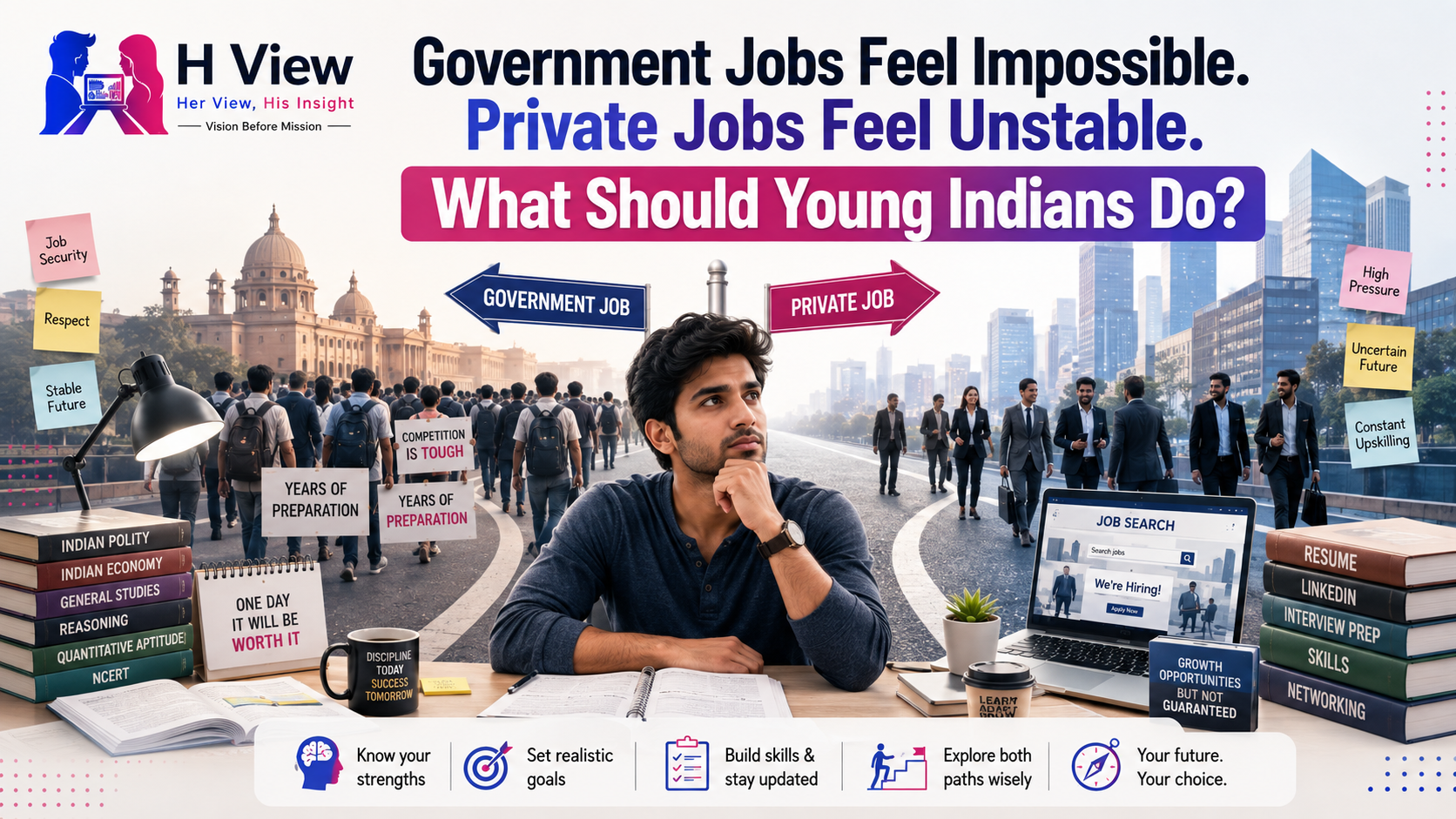
 By Satya HemanthUpdated September 20, 202613 min read51 views
For many young Indians, choosing a career no longer feels like choosing between two good options.
Government jobs promise stability, social respect and a career that appears protected from sudden layoffs. The problem is getting one. A single recruitment notification can attract lakhs of applicants, and candidates may spend years preparing without knowing whether the next attempt will finally work.
Private-sector employment seems to offer the opposite route. Instead of waiting years for one competitive examination, a graduate can apply immediately, gain experience and start earning. Yet that path has its own uncertainty. Companies restructure, technology changes quickly, entry-level requirements keep rising and some sectors are learning to grow without adding employees at the rate they once did.
So a young person finishing college today may hear two completely different warnings.
“Do not waste your twenties preparing endlessly for government exams.”
And then:
“Private jobs are not secure anymore. Government service is safer.”
Both arguments contain some truth. Neither is enough to make a career decision.
India’s current employment picture itself reflects this contradiction. The national unemployment rate for people aged 15 and above fell to 5.1% in July 2026, the lowest level in four months, while labour-force participation improved. At the same time, competition for the government jobs that many young people consider desirable remains extraordinary. More than one lakh engineering graduates recently applied for just 629 Assistant Executive Engineer posts in Andhra Pradesh’s power utilities.
The question H View believes young people should be asking is therefore not simply, “Government job or private job?”
It is more personal:
How much uncertainty can you afford, what progress are you actually making, and are you keeping enough doors open while you decide?
It is easy to dismiss the attraction of government employment as an old-fashioned family preference. That would ignore the economic reality behind it.
For a household that has seen private employees lose jobs during a slowdown, a government position represents something much larger than monthly salary. It can mean predictability. Parents know roughly what the career path looks like. Transfers, promotions and retirement benefits vary by service, but the structure itself feels more visible than many private careers.
There is also social confidence attached to the job. In many families, saying that a son or daughter has joined a government department immediately answers several questions about stability, respectability and future income. A private employee earning more today may still be asked, “But how secure is the company?”
That concern is not completely irrational. Private employment really is changing. India’s top ten private banks collectively reduced their workforce by more than 10,000 positions in FY26 as digitisation, automation and AI enabled them to expand parts of the business without increasing staffing proportionately. At the same time, other sectors are hiring aggressively, which shows why “private jobs are disappearing” is also too simplistic.
Government employment therefore appeals partly because people are comparing risk, not merely salary.
But the safety of the job after selection should not be confused with the probability of obtaining that job in the first place.
Consider railway recruitment.
Official Railway Ministry data shows that a recent graduate-level NTPC recruitment process for 5,810 vacancies involved roughly 25.9 lakh candidates. Undergraduate NTPC recruitment for 3,058 vacancies involved about 33 lakh candidates. Even recruitment for 434 paramedical vacancies attracted more than three lakh candidates.
Those numbers do not mean an individual candidate has no chance. Every selected employee ultimately comes from the same applicant pool.
But they do change how preparation should be understood.
Aspirants sometimes hear motivational advice such as, “Do not look at how many people applied. You only need one seat.”
Emotionally, that can help. Strategically, it can be dangerous if it prevents a realistic assessment of competition.
Government recruitment is not like passing a college examination where everyone crossing a certain mark succeeds. In many cases, candidates are competing for rank within a limited number of vacancies. Being capable of answering the questions is only part of the challenge; being stronger than a very large number of other serious candidates is what determines selection.
That is why a government job can be extremely secure after you get it while government-job preparation can remain financially and professionally uncertain before you get it.
Those are two very different kinds of safety.
The opposite mistake is to talk about “the private sector” as though it were one career.
The current fresher market shows how uneven private hiring has become. A TeamLease EdTech survey of 1,097 employers found that 75% intended to hire freshers during the second half of 2026. Yet demand was not evenly distributed. Retail and e-commerce/technology start-ups reported particularly strong hiring intent, while manufacturing was also expanding entry-level recruitment. Information technology, meanwhile, weakened compared with the first half of the year.
That matters because many graduates are still preparing for the private job market they expected when they entered college, not the one that exists now.
An engineering student may have imagined one of the large IT services companies as the natural destination after graduation. A commerce graduate may expect banking. An MBA student may be waiting only for a corporate-office role.
Meanwhile, employers may be hiring in manufacturing operations, retail, logistics, infrastructure, healthcare technology, data centres, specialised digital roles and consumer businesses.
So when somebody says, “I tried private jobs and there are no opportunities,” the first question should be: which jobs, in which industries, at what level and in which locations?
There may genuinely be limited opportunity in the candidate’s preferred path. That does not automatically mean the entire private economy is closed.
The most difficult situation is not a candidate who chooses government preparation or one who chooses private employment.
It is someone who remains suspended between both.
Imagine a graduate who finishes college at 22 and begins preparing for government exams. The first year is serious. The second year includes several attempts and near misses. By the third year, family pressure increases, but walking away feels impossible because so much time has already been invested.
The candidate occasionally applies for private jobs, but the resume has not been updated, the technical skills learned in college have faded and there is little recent project work to discuss.
At 26, the problem is no longer only whether the next government exam will be cleared.
The private alternative has also become harder because the candidate has allowed it to weaken.
That is the situation young people should try to avoid.
A government-job dream does not have to create an empty private-sector profile.
There is something unfair about telling every unsuccessful aspirant that they “wasted” their years.
Preparing seriously for competitive examinations can build discipline, quantitative ability, general awareness, reading habits and mental endurance. For some candidates, repeated preparation is a rational choice because their scores are improving and the job genuinely matters to them.
Families also need to recognise that selection is not completely under a candidate’s control. Vacancies change, cut-offs move and competition can vary dramatically from one cycle to another. A hardworking aspirant can still miss selection.
But there is a difference between respecting someone’s effort and pretending that time has no cost.
Financial independence gets delayed. Work experience does not accumulate. Parents may continue funding coaching, rent and exam fees. Confidence can become increasingly tied to one result.
A healthy career plan should allow someone to pursue a difficult ambition without making every other version of adulthood feel like failure.
Most government-versus-private discussions make an unfair comparison.
They compare the best feature of a government job after selection with the worst feature of a private job during uncertainty.
Of course the government option looks better.
The more useful comparison is:
And what is the realistic private alternative available to you—not the imaginary ₹25 lakh package shown in a motivational reel?
A candidate offered a ₹25,000 private role with meaningful work, training and growth should evaluate that opportunity differently from a ₹12,000 role involving no useful experience and twelve-hour shifts.
Likewise, an aspirant repeatedly missing a government cutoff by a small margin should evaluate continuing differently from someone whose performance has remained far below qualifying levels for several years.
Career decisions become more rational when the individual situation replaces slogans.
One of the biggest myths around government preparation is that having a backup shows weak commitment.
It does not.
The backup can take many forms depending on circumstances. Someone preparing full-time might maintain one employable skill and build occasional projects. Another person may take a private job and prepare during evenings and weekends. Someone with strong financial support may choose one final full-time year of preparation, with a clearly defined date after which the strategy changes.
The point is not that everybody must work and prepare simultaneously. Some examinations genuinely demand an intensive period of study.
The point is to avoid reaching the end of several years with no recent evidence that you can do anything except prepare for another examination.
India’s National Career Service portal reported more than 17.68 lakh active vacancies as of 15 July 2026 across private and government opportunities. That figure does not mean every vacancy is suitable, well-paid or accessible to every graduate, but it is an important reminder that the labour market is broader than the small number of careers most aspirants repeatedly target.
Sometimes the sensible backup is not your dream career.
It is simply a path that keeps income, experience and confidence moving forward.
There is no universal age or number of attempts at which an aspirant should stop. A 24-year-old with rapidly improving scores and strong financial support is in a different position from a 29-year-old supporting a family whose performance has remained unchanged.
Instead of asking strangers online, “Should I quit preparation?”, look at evidence from your own situation.
You need to know whether your mock scores and actual results are improving, whether you still meet the eligibility window for your target exams, whether your family can realistically support another year and whether you still want the job itself—or merely fear admitting that the plan did not work.
That last distinction matters more than most aspirants realise.
After investing several years, continuing can feel easier than changing direction. The thought becomes, “If I stop now, all those years were wasted.”
That is sunk-cost thinking.
The years have already happened. The correct question is what gives the next two years the best chance of producing a meaningful career.
Private employment becomes especially valuable when a candidate has access to a role that builds transferable skills.
The first salary may not be impressive. But two years of genuine experience can create something government-exam preparation cannot: professional evidence.
You learn how teams operate, how managers evaluate work, how deadlines feel, how customers behave and how your own strengths change outside an academic setting.
That experience compounds.
A junior support employee may move into implementation. An operations executive may become an analyst. A trainee in manufacturing can build specialised domain knowledge. A salesperson may eventually move into account management or business development.
Private careers are not automatically secure, but they are also not permanently unstable. Security in the modern private sector often comes from employability rather than one employer—the ability to carry useful skills and experience from one organisation to another.
For some people, that kind of mobility is worth more than spending years waiting for one highly secure position.
This discussion is not only about fresh graduates.
Experienced professionals who lose jobs sometimes begin preparing for government recruitment because private employment suddenly feels unreliable. That decision can make sense, particularly when the candidate is still eligible and has always wanted public service.
But previous experience should not be abandoned casually.
If someone already has three or five years of professional experience, staying away from their industry for several more years can make re-entry harder. In that situation, continuing to apply privately while preparing for selected government examinations may be more sensible than completely resetting the career.
The government path should be chosen because the role genuinely fits the person’s priorities—not purely as an emotional response to one layoff or difficult company.
Government jobs remain excellent careers for many people.
Private-sector employment can also offer strong growth, international exposure, higher earning potential and faster career progression.
Neither path deserves blind worship.
The danger comes when government employment is treated as the only respectable form of stability or when private employment is presented as an easy solution available to anyone willing to “upskill.”
Both markets contain opportunity.
Both contain competition.
Both can disappoint people who enter without understanding the trade-offs.
The smartest career strategy is therefore less dramatic than choosing one side.
Know your numbers. Know your financial runway. Know your progress. Keep your skills current. Make sure that every year you spend trying for one future does not permanently damage every other future available to you.
Young Indians are facing a genuinely difficult employment environment, but the choice is not simply between an impossible government exam and an unstable private company.
Government jobs offer extraordinary security once secured, yet getting there can require years of competition against applicant pools that run into lakhs or even millions. Private employment carries more visible risk, but current hiring data also shows opportunities expanding in sectors that many graduates may not initially consider.
So do not decide based only on fear.
If government service is your genuine goal and your performance shows realistic progress, prepare seriously. But decide how much time and money you are willing to invest before the next reassessment.
If a good private opportunity appears, do not reject it automatically because it feels less prestigious or secure. Ask whether it gives you skills, experience and room to grow.
And whatever you choose, avoid the most dangerous option of all: spending year after year waiting without building either a stronger government-exam profile or a stronger professional one.
A career does not become successful because it was government or private.
It becomes successful when the path is sustainable, the work fits your priorities and your future is not dependent on one result you cannot fully control.
Yes, for candidates who genuinely want public-sector work, remain eligible and are making realistic progress. The important part is understanding the level of competition and setting regular checkpoints rather than preparing indefinitely without reassessment.
Some sectors are undergoing restructuring and automation, but private hiring has not stopped. Fresher hiring intent remained strong overall in the second half of 2026, with particularly strong demand in retail, e-commerce, manufacturing and several other sectors.
There is no single answer. Consider your exam performance, remaining eligibility, finances, family responsibilities and the quality of the private opportunity. A role offering meaningful experience may be worth taking even while continuing limited preparation.
It can become one when you later return to the private market without recent work or practical skills. The preparation itself can be explained honestly, but maintaining some employable ability or real-world experience makes the transition easier.
Many people do, although it requires a more selective exam strategy and disciplined study schedule. It may be preferable for candidates who need income or want to maintain professional experience.
Government careers can offer predictability, perceived job security, structured progression and strong social acceptance. In an uncertain private market, those qualities become especially attractive, even when competition for vacancies is extremely high.
Satya Hemanth is the founder of H View and writes on careers, sports, leadership, digital trends, and practical decision-making. His articles focus on clear explanations, real-world examples, and useful insights for students, young professionals, and everyday readers.
Share your real experience and help other readers decide better.
No community views yet. Be the first to share yours.

Open LinkedIn for a few minutes and you will probably come across a colourful graphic…
Harika October 6, 2026 
When an employee resigns, many organisations move quickly into replacement mode. The manager informs HR,…
Harika October 6, 2026 
For many corporate employees, the workday begins long before they actually start working. They wake…
Harika October 5, 2026 
Many projects begin with an assumption that sounds reasonable on paper: the client will explain…
Harika October 1, 2026