

Hiring Is Up—So Why Are Freshers Still Not Getting Jobs?
Open any job portal today and you will see thousands of vacancies. Companies announce hiring…
 Satya Hemanth August 11, 2026
  By Satya HemanthUpdated August 13, 20266 min read51 views
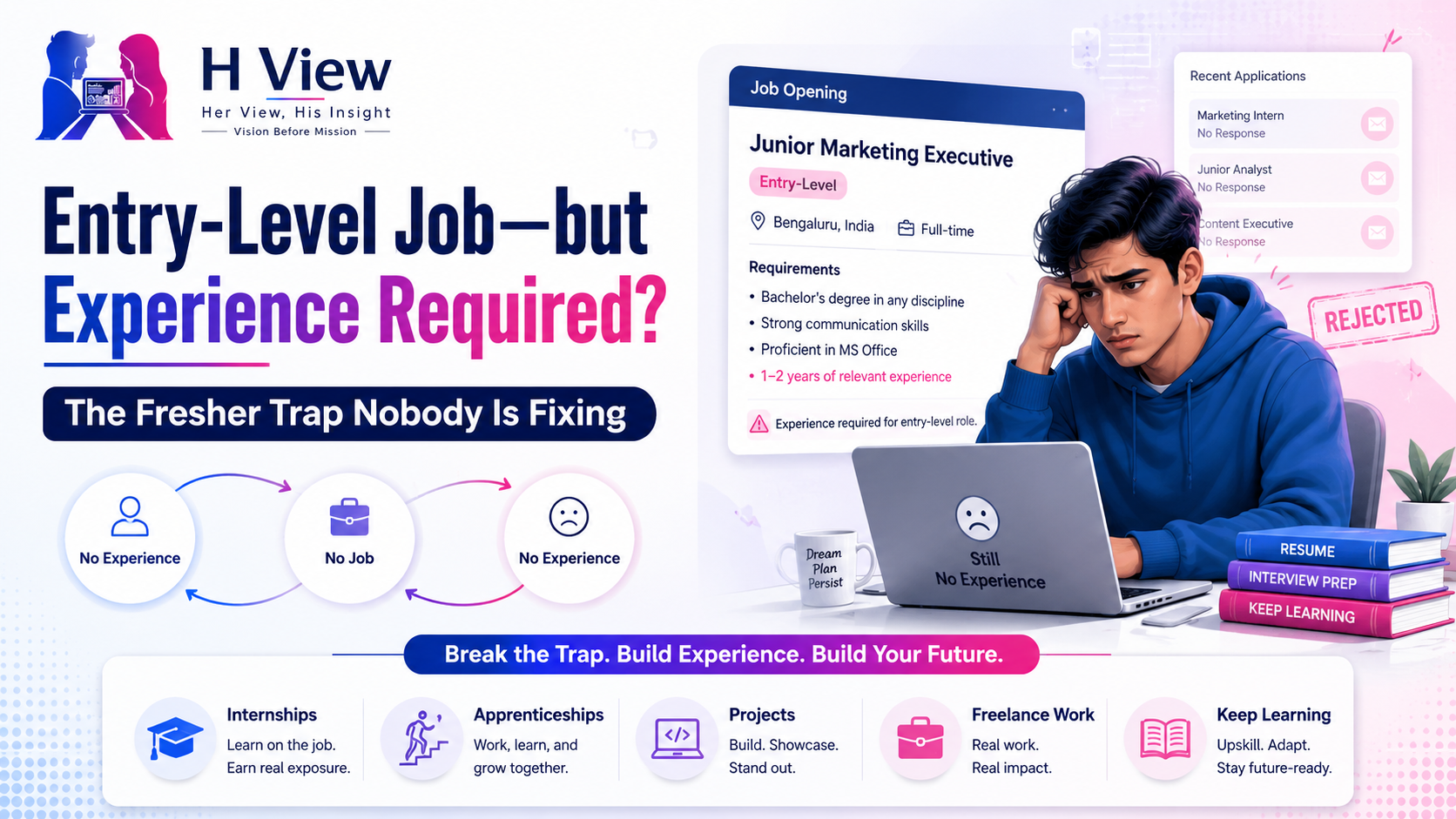
A fresher opens a job portal and finds an attractive vacancy.
The title says Entry-Level, Junior, Associate or Trainee.
Then comes the requirement:
“Minimum 1–2 years of experience required.”
Another listing asks for experience with multiple tools, live projects and production environments. A third says freshers may apply—but candidates with previous experience will be preferred.
This creates one of the most frustrating problems in today’s job market:
How is a fresher supposed to gain experience if even entry-level jobs already require experience?
Recent reporting in India highlighted survey findings suggesting that 72% of entry-level jobs were asking for prior experience, while 61% of job seekers said they often received no response after applying.
The contradiction becomes even clearer in technology hiring. Overall IT recruitment reportedly grew 10% year-on-year in July 2026, but the share of fresher hiring fell from 32% to 24%, suggesting that companies are hiring while increasingly favouring experienced candidates.
The problem is not simply that freshers have no experience.
It is that the definition of entry-level itself is changing.
Employers increasingly want candidates who can contribute quickly.
Training a new employee takes time. Managers must explain tools, review work, correct mistakes and provide supervision.
When companies receive hundreds of applications, they may prefer someone who already understands:
That is why some employers use “experience” as shorthand for practical readiness.
But there is an important difference between asking for practical exposure and demanding two years of formal employment for a role marketed as entry-level.
When every beginner position demands previous employment, the career ladder loses its first step.
Companies cannot hire purely based on degrees.
A student may have excellent academic marks while having little experience solving real workplace problems.
Employers increasingly value internships, projects, communication and practical readiness alongside qualifications.
From the employer’s perspective, a candidate who has already completed genuine internships, freelance work or substantial projects may require less supervision.
That expectation is understandable.
Students should therefore not wait until graduation to begin gaining practical exposure.
The problem begins when employers expect experienced performance while offering beginner-level salaries and titles.
A vacancy cannot reasonably demand:
and still behave as though it is designed for someone entering the workforce for the first time.
This creates an unfair cycle:
No experience → no job → no experience → no job.
Freshers are then pushed toward unpaid internships, fake experience certificates and questionable consultancies simply because legitimate first opportunities are difficult to obtain.
Employers should distinguish between:
Must-have professional experience
and
Practical exposure that can come from projects, internships or apprenticeships.
Often, yes.
Job descriptions are frequently written as ideal profiles rather than absolute checklists.
If the role asks for one year of experience but you match most of the required skills and have relevant projects or internships, applying can still make sense.
However, be realistic.
If a vacancy clearly requires someone who has independently managed production systems, clients or specialised responsibilities, a beginner project may not be equivalent.
Do not lie about experience.
Show equivalent evidence instead.
This is where candidates need to think differently.
A genuine internship can provide workplace experience, references and real project exposure.
Prioritise internships that include actual tasks and mentorship rather than certificates alone.
Apprenticeships can provide a stronger transition from education into employment because the candidate learns while working in a structured environment.
A small paid assignment for a local business can become real experience.
For example, you might:
Be truthful about the nature of the work.
Nonprofits, student groups and community organisations often need technical, marketing, design and administrative support.
Real responsibility matters even when the project is unpaid.
A self-built project is not professional employment, but it can still demonstrate technical ability.
The key is building something substantial enough to discuss during an interview.
Do not simply write:
“Created an employee-management system.”
Explain what you actually accomplished:
“Built and deployed an employee-management application with role-based login, leave requests, employee records, database integration and validation.”
Be prepared to explain:
A recruiter may still prefer formal experience, but a strong project gives them evidence beyond a certificate.
A fresher might build six months of meaningful exposure through a combination of:
That does not magically become “two years of experience.”
But it gives the candidate something valuable to discuss.
The resume can honestly state:
Practical Experience
instead of falsely presenting everything as full-time employment.
The entry-level experience trap has unfortunately created a market for fake employment records.
Consultancies may promise:
Do not use them.
A difficult fresher profile is safer than a career built on fabricated employment.
Employers can ask detailed questions about projects, managers, workflows and workplace situations that cannot easily be memorised.
Students cannot solve this problem alone.
Employers should create more:
Recent hiring data illustrates why this matters. Technology hiring can grow while fresher participation still falls, leaving young candidates excluded from an expanding market.
Companies that never invest in beginners may eventually struggle to build their own future experienced workforce.
Today’s senior employee was once someone’s fresher hire.
Instead of waiting for the perfect “0 experience required” job:
Your goal is to reduce the employer’s biggest concern:
“Can this person actually work in a real environment?”
Freshers are caught in a genuine contradiction.
Companies want experience because experience reduces hiring risk.
But someone must eventually give a beginner their first opportunity.
Until hiring practices improve, candidates need to broaden what they consider valid experience.
Internships, apprenticeships, freelance assignments, volunteering and serious projects can help create credible evidence of ability.
They will not always replace formal employment.
But they can help you cross the first barrier without lying.
An entry-level role should ideally be the place where a career begins.
Freshers should prepare harder for that opportunity—but employers should also remember what entry-level is supposed to mean.
Employers often want candidates who require less training and already understand practical workplace expectations.
Yes, when they meet most other requirements and have relevant practical exposure. Avoid applying when the role clearly requires advanced professional responsibility.
Yes. Genuine internships provide practical experience and should be clearly described on the resume.
Not completely, but strong projects can prove technical ability and improve a fresher’s chances of getting an interview.
No. False employment records can create serious background-verification and career risks.
Use internships, apprenticeships, freelance work, volunteering, open-source contributions and substantial personal projects.
Satya Hemanth is the founder of H View and writes on careers, sports, leadership, digital trends, and practical decision-making. His articles focus on clear explanations, real-world examples, and useful insights for students, young professionals, and everyday readers.
Share your real experience and help other readers decide better.
No community views yet. Be the first to share yours.
Open any job portal today and you will see thousands of vacancies. Companies announce hiring…
Satya Hemanth August 11, 2026 
You find a job that perfectly matches your profile. The company looks genuine. The role…
Satya Hemanth August 8, 2026 
For generations, the path to a secure career appeared simple: Study hard, complete a degree…
Satya Hemanth August 7, 2026 
Sending hundreds of job applications without receiving a single interview can be deeply frustrating. A…
Satya Hemanth August 6, 2026