

Best Digital Marketing Tools in 2026: What Marketers Actually Need and What They Can Skip
Open LinkedIn for a few minutes and you will probably come across a colourful graphic…
 Harika October 6, 2026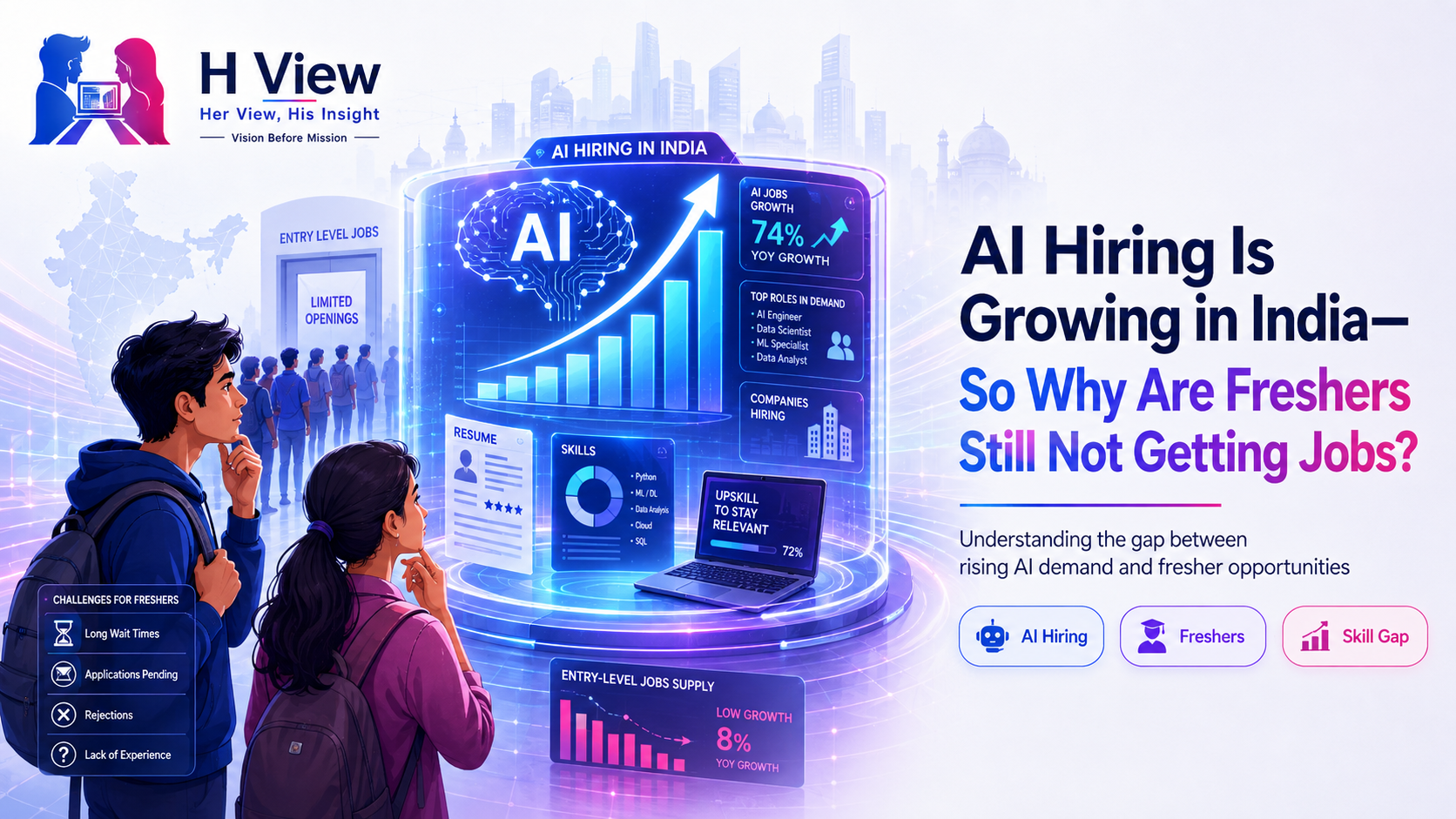
 By Satya HemanthUpdated September 20, 20268 min read44 views
Artificial intelligence is creating new jobs in India. Companies are hiring machine-learning engineers, data specialists, AI product professionals and employees who can integrate generative AI into existing business processes.
Yet many graduates are experiencing a completely different reality.
They apply for hundreds of jobs, receive few responses, encounter delayed onboarding and repeatedly see “entry-level” vacancies asking for one to three years of experience. Some eventually accept unpaid internships, unrelated positions or expensive training programmes promising guaranteed placement.
Both realities can be true at the same time: AI hiring is growing, but the opportunities are not being distributed equally across the job market.
Naukri JobSpeak data reported by Reuters showed that AI-related hiring within India’s IT sector increased by 16% year over year in June 2026, while overall IT recruitment declined by 3%.
Across multiple industries, AI and machine-learning vacancies reportedly grew by approximately 25%. This indicates that companies are not completely stopping recruitment. Instead, they are redirecting part of their hiring budgets towards specialised AI capabilities.
This distinction matters.
A headline such as “AI hiring rises in India” may sound encouraging to every graduate. However, much of that demand is concentrated in specialised or experienced roles—not necessarily in large-scale fresher recruitment.
Companies may need an AI architect, data engineer or machine-learning specialist, but that does not mean they need hundreds of entry-level programmers.
For decades, India’s IT-services model depended heavily on recruiting large batches of graduates, training them and assigning them to client projects.
AI is beginning to change that relationship.
Automation tools can now assist with coding, testing, documentation, customer support, data processing and routine analysis. A smaller team using AI effectively may complete work that previously required a larger workforce.
Reuters reported that multinational companies and Global Capability Centres in India are becoming more selective as AI changes their required skill mix. Hiring has not disappeared, but companies increasingly want candidates who combine technical knowledge, business understanding and adaptability.
This creates a difficult situation for freshers: organisations want advanced capabilities but are less willing to spend months developing those capabilities from the beginning.
One of the biggest problems is the mismatch between how prepared graduates believe they are and how employers evaluate them.
According to HirePro’s State of College Hiring in India 2026 report, 68% of students believed they were ready to work from their first day, but only 9% of employers agreed. More than half of the surveyed companies believed fresh graduates required at least a month of structured training before contributing meaningfully.
This does not mean graduates are unintelligent or unwilling to work.
Many students successfully complete examinations without receiving enough exposure to:
A degree proves that someone completed an academic programme. It does not automatically prove that the person can independently solve workplace problems.
Earlier, a fresher might have been hired mainly for basic programming ability and then trained internally.
Today, the same candidate may be expected to:
Research involving educators and hiring professionals found that responsible AI use, critical evaluation of AI output and independent learning are becoming increasingly important. Employers also reported larger gaps in graduates’ foundational abilities—not only in AI-specific knowledge.
The important lesson is that learning how to enter prompts into an AI tool is not enough.
Companies need people who can determine whether the output is correct, secure, useful and appropriate for the actual business problem.
A company recruiting an AI engineer may expect experience with Python, statistics, model evaluation, data pipelines, cloud deployment and production monitoring.
Someone who has completed a short generative-AI course may understand the terminology but still be unable to perform the role independently.
This explains why job advertisements and social-media posts can show strong demand while individual freshers continue to struggle.
The market may have:
The phrase “AI jobs are growing” should therefore not be interpreted as “every fresher who learns AI will immediately get hired.”
Freshers are often blamed entirely for being unemployable, but that is unfair.
Many educational institutions continue teaching outdated material, provide weak internship support and treat final-year projects as formalities. Some training institutes exaggerate placement outcomes while selling the same recorded course to thousands of students.
Employers also contribute to the problem when they:
Recent reporting indicates that Indian IT companies have become more selective, while delayed onboarding and fewer conventional entry-level openings are increasing uncertainty for graduates.
The skills gap is real, but it should not become an excuse for every company to avoid developing young talent.
Ten certificates cannot replace one useful project that solves a real problem.
A strong portfolio should show:
Recruiters increasingly value meaningful projects, internships, hackathons and self-directed work over generic academic submissions.
A fresher targeting software or AI roles should first become comfortable with:
AI knowledge should be added to these foundations, not used as a substitute for them.
Candidates should know how to use AI for research, coding assistance and productivity. They should also be able to explain every important decision in their project.
During an interview, “the AI generated it” is not a convincing explanation.
Freshers often concentrate only on major service companies or global brands.
Smaller technology companies, SaaS businesses, agencies, manufacturing companies, hospitals, fintech firms and Global Capability Centres may also need developers, analysts, automation professionals and technical-support employees.
The first job does not need to be perfect. It should provide genuine work, learning and evidence for the next opportunity.
Be cautious when an institute or consultancy:
Training can be valuable. Paying merely to receive a job offer is a serious warning sign.
Freshers should not be told that their unemployment is entirely their fault.
Many students followed the path society recommended: complete a degree, obtain certificates and apply for campus placements. The market changed faster than their education prepared them for.
They need honest guidance, affordable practical learning and companies willing to offer genuine entry-level opportunities—not more shame and false promises.
AI is not eliminating every job, but it is reducing the value of routine work.
The safest response is neither panic nor blind enthusiasm. Freshers must become people who can understand a problem, use AI as a tool, verify its output and take responsibility for the final result.
That combination will remain valuable even when individual technologies change.
Do not abandon a career merely because your first applications fail. At the same time, do not spend another year collecting certificates without producing evidence of practical ability.
Choose one realistic role, study the actual requirements from at least 20 genuine job descriptions, build two strong projects and practise explaining your decisions clearly.
AI hiring is increasing—but the opportunity belongs mainly to candidates who can demonstrate what they can do, not merely list what they have studied.
Yes. AI and machine-learning hiring is growing across IT and several other industries. However, many opportunities require specialised skills or prior practical experience.
No. Slower economic demand, selective hiring, outdated education, weak practical exposure and the gap between student and employer expectations also contribute.
Every fresher should understand how AI affects their chosen profession. However, not everyone needs to become a machine-learning engineer. Strong fundamentals in the selected career remain essential.
Projects cannot guarantee employment, but strong, original and properly explained work can demonstrate practical ability when formal experience is absent.
A certificate may provide structure and introduce concepts, but it has limited value without practical projects, foundational knowledge and the ability to solve problems independently.
Satya Hemanth is the founder of H View and writes on careers, sports, leadership, digital trends, and practical decision-making. His articles focus on clear explanations, real-world examples, and useful insights for students, young professionals, and everyday readers.
Share your real experience and help other readers decide better.
No community views yet. Be the first to share yours.
Open LinkedIn for a few minutes and you will probably come across a colourful graphic…
Harika October 6, 2026 
When an employee resigns, many organisations move quickly into replacement mode. The manager informs HR,…
Harika October 6, 2026 
For many corporate employees, the workday begins long before they actually start working. They wake…
Harika October 5, 2026 
Many projects begin with an assumption that sounds reasonable on paper: the client will explain…
Harika October 1, 2026