

Best Digital Marketing Tools in 2026: What Marketers Actually Need and What They Can Skip
Open LinkedIn for a few minutes and you will probably come across a colourful graphic…
 Harika October 6, 2026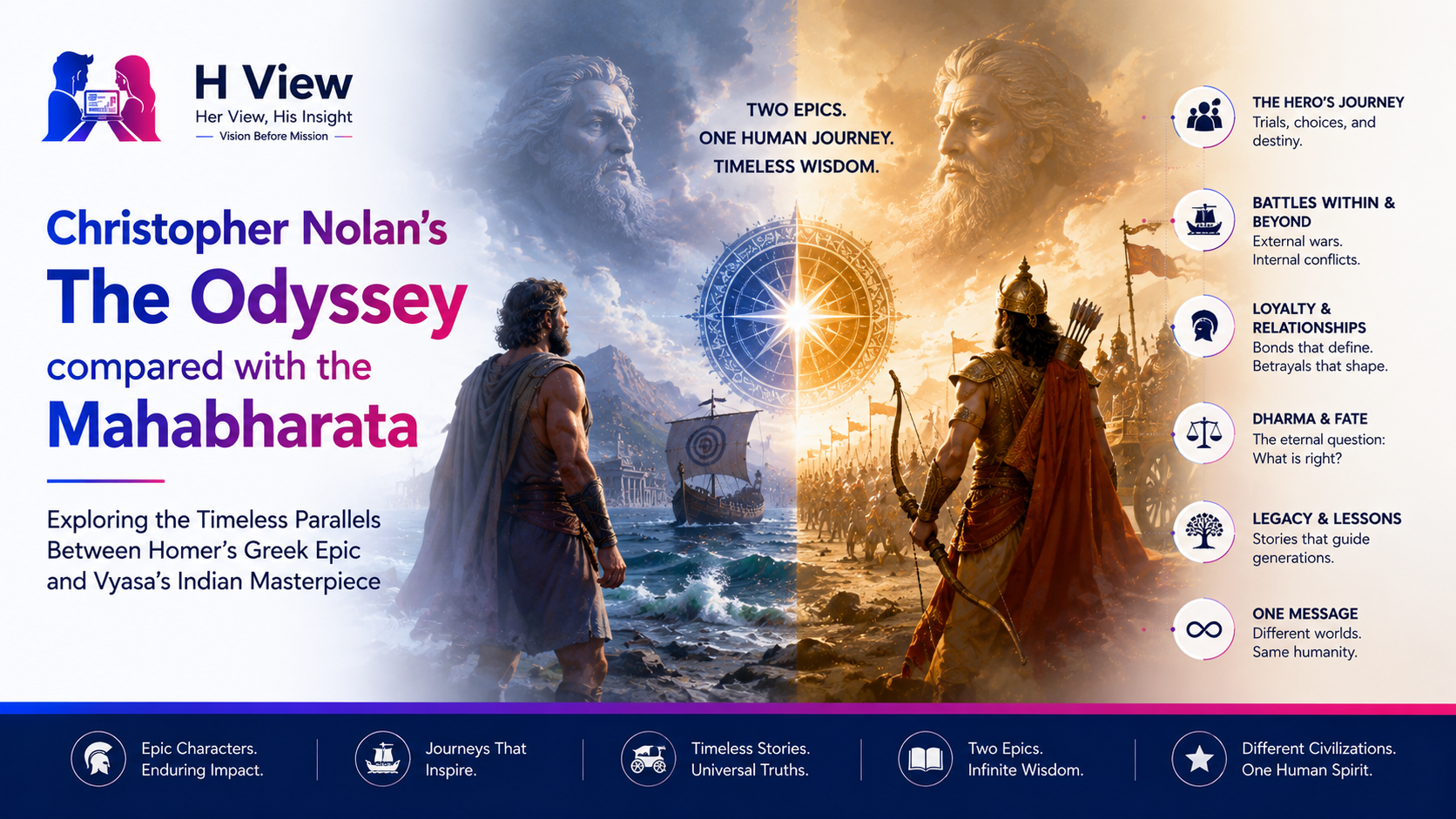
 By PraveenUpdated September 20, 20267 min read48 views
“Separated by continents. Written in different languages. Yet united by the same search for what it means to be human.”
Christopher Nolan has built a career exploring ideas that linger long after the credits roll. Memento questioned memory, Interstellar explored love and time, and Oppenheimer examined the burden of knowledge. His latest film, The Odyssey, returns to one of humanity’s oldest stories—the journey of Odysseus, a king trying to find his way home after the Trojan War.
For many audiences, it will be their first encounter with Homer’s timeless epic. For Indian readers, however, much of it may feel surprisingly familiar.
Not because Homer borrowed from Vyasa.
Not because Ancient Greece borrowed from Ancient India.
But because two great civilizations, separated by geography and culture, wrestled with the same enduring questions. What makes a hero? Can wisdom overcome strength? Is destiny fixed, or do our choices shape our future? And what does it truly mean to return home?
The answers differed, but the questions remain as relevant today as they were three thousand years ago.
Ancient Greece and Ancient India developed along very different paths. Greece looked outward, shaped by exploration, trade, and warfare. Its heroes pursued kleos—the glory of leaving behind a name that would never be forgotten.
India looked inward. Its philosophers and storytellers focused on dharma—living in harmony with moral responsibility and the greater order of life.
Yet despite these differences, Homer and Vyasa reached a remarkably similar conclusion: civilizations may evolve, but human nature changes very little. We still struggle with ambition, fear, loyalty, pride, loss, and purpose. That is why the Odyssey and the Mahabharata continue to speak across centuries.
The first conversation between these two epics begins with a simple question: Who deserves to be called a hero?
Odysseus is not Greece’s strongest warrior. That honour belongs to Achilles. His greatest strength is his ability to think, adapt, and endure. Whether escaping the Cyclops or navigating impossible situations, he survives because intelligence guides his courage.
The Mahabharata offers a broader answer. Instead of one ideal hero, it presents many. Arjuna embodies skill, Bhima strength, Yudhishthira righteousness, Karna loyalty, and Krishna wisdom. None is perfect, and that is precisely the point.
Both epics reject the idea of flawless heroes. They remind us that greatness is not the absence of weakness but the courage to act despite it. Leadership, whether on a battlefield or in everyday life, demands judgment as much as bravery.
On the surface, The Odyssey is about returning to Ithaca. The Mahabharata is about reclaiming Hastinapura. Yet neither story is truly about geography.
After winning the Trojan War, Odysseus spends ten years battling storms, monsters, and temptation before reaching home. The Pandavas lose everything in a game of dice and spend thirteen years in exile before reclaiming their kingdom.
In both epics, exile is not a punishment but a preparation.
The sea teaches Odysseus patience.
The forest teaches the Pandavas resilience.
Neither returns as the person who left.
This idea remains deeply relevant today. Careers are shaped by setbacks as much as promotions. Leaders are often forged during failures rather than successes. The most valuable lessons rarely come from comfort; they emerge from uncertainty, hardship, and perseverance.
Perhaps that is the real meaning of home. It is not merely a destination but a state of readiness—a moment when experience has prepared us to carry greater responsibility.
Popular culture often celebrates physical power. Ancient storytellers admired something more enduring.
Odysseus’ greatest victories come through strategy rather than force. The Trojan Horse is remembered not because it was powerful, but because it was ingenious.
The Mahabharata echoes this lesson repeatedly. Bhima’s strength and Arjuna’s unmatched archery are extraordinary, yet the war ultimately turns on Krishna’s wisdom. He understands timing, diplomacy, psychology, and the consequences of every decision.
Modern organizations reveal the same truth. Talent matters, but judgment matters more. Strength may win today’s battle; wisdom determines tomorrow’s future.
Here the two civilizations begin to diverge.
For the Greeks, greatness was measured through kleos—earning a legacy that would outlive death. Heroes sought honour, reputation, and lasting fame.
The Mahabharata places dharma above recognition. Krishna never promises Arjuna glory. Instead, he asks him to fulfil his duty without attachment to success or failure.
One tradition asks, “How will history remember me?”
The other asks, “Did I do what was right?”
These perspectives are not contradictory. Together they reveal that lasting leadership requires both ambition and integrity. Achievement without values can become destructive, while values without courage rarely inspire change.
Both epics explore destiny, but neither removes human responsibility.
Greek mythology often portrays fate as inevitable. Prophecies unfold despite every attempt to avoid them.
The Mahabharata offers a subtler view. Destiny may influence our lives, but karma and choice continue to shape the future. The Bhagavad Gita reaches its most profound moment when Krishna shares his wisdom and then tells Arjuna to reflect and choose for himself.
The message is timeless.
Circumstances may not always be within our control.
Character always is.
That is why both Odysseus and the heroes of the Mahabharata remain compelling. Their defining moments are not the battles they fight but the choices they make when every option carries a cost.
Every great epic celebrates warriors. The greatest ones also remember those who wait.
Penelope preserves Ithaca through patience and unwavering hope. Kunti guides her sons through exile, Draupadi’s humiliation becomes the moral turning point of the Mahabharata, and Gandhari reminds us that every victory leaves behind immeasurable grief.
Their stories reveal that wars are not remembered only through those who fight them, but also through those who endure their consequences. Behind every celebrated hero stands someone whose quiet resilience makes that journey possible.
Artificial Intelligence can summarize books within seconds. Search engines can answer almost any factual question. Yet people continue returning to stories written nearly three thousand years ago.
Why?
Because information is not wisdom.
Technology changes rapidly, but human nature changes slowly. We still seek meaning, wrestle with difficult decisions, struggle with ambition, and hope to live lives of purpose.
That is why Homer’s Odyssey and Vyasa’s Mahabharata continue to resonate. They do not tell us what to think. They invite us to think more deeply.
Every hero leaves. Someone always waits.
Penelope’s courage lies not in defeating enemies but in preserving hope. Kunti’s strength is measured not by victories but by the resilience with which she watches her sons endure exile. Draupadi reminds us that silence in the face of injustice can shape the destiny of an entire civilization.
Perhaps the emotional heart of every epic is not found on the battlefield, but in the homes where people continue loving, waiting, and believing despite uncertainty.
What fascinates me most is not that Greece and India produced extraordinary epics. It is that they asked remarkably similar questions while arriving at different answers.
The Greeks pursued glory. The Indians pursued dharma.
One celebrated excellence. The other emphasized responsibility.
Together, Homer and Vyasa remind us that civilizations are remembered not by the wealth they accumulated or the wars they won, but by the conversations they preserved about courage, justice, loyalty, and what it truly means to live a meaningful life.
Christopher Nolan’s The Odyssey will introduce a new generation to one of history’s greatest epics. For Indian audiences, however, it offers something even more valuable—an opportunity to rediscover the Mahabharata through a different lens.
These stories have survived not because of mythical creatures, divine interventions, or spectacular battles, but because they reveal timeless truths about the human condition. Across continents and centuries, Homer and Vyasa remind us that while civilizations may differ in language, philosophy, and culture, they are united by the same enduring questions.
What makes us courageous?
What makes us just?
And what does it truly mean to find our way home?
Perhaps that is why great epics never become outdated.
They do not merely preserve history.
They preserve humanity.
Praveen is an H View contributor covering general reviews, leadership, sports, and practical opinion-based topics. His writing focuses on balanced analysis, clear explanations, and reader-friendly insights that help people understand products, ideas, trends, and real-world decisions with more clarity.
Share your real experience and help other readers decide better.
No community views yet. Be the first to share yours.

Open LinkedIn for a few minutes and you will probably come across a colourful graphic…
Harika October 6, 2026 
When an employee resigns, many organisations move quickly into replacement mode. The manager informs HR,…
Harika October 6, 2026 
For many corporate employees, the workday begins long before they actually start working. They wake…
Harika October 5, 2026 
Many projects begin with an assumption that sounds reasonable on paper: the client will explain…
Harika October 1, 2026