

Best Digital Marketing Tools in 2026: What Marketers Actually Need and What They Can Skip
Open LinkedIn for a few minutes and you will probably come across a colourful graphic…
 Harika October 6, 2026
  By HarikaUpdated September 20, 202612 min read49 views
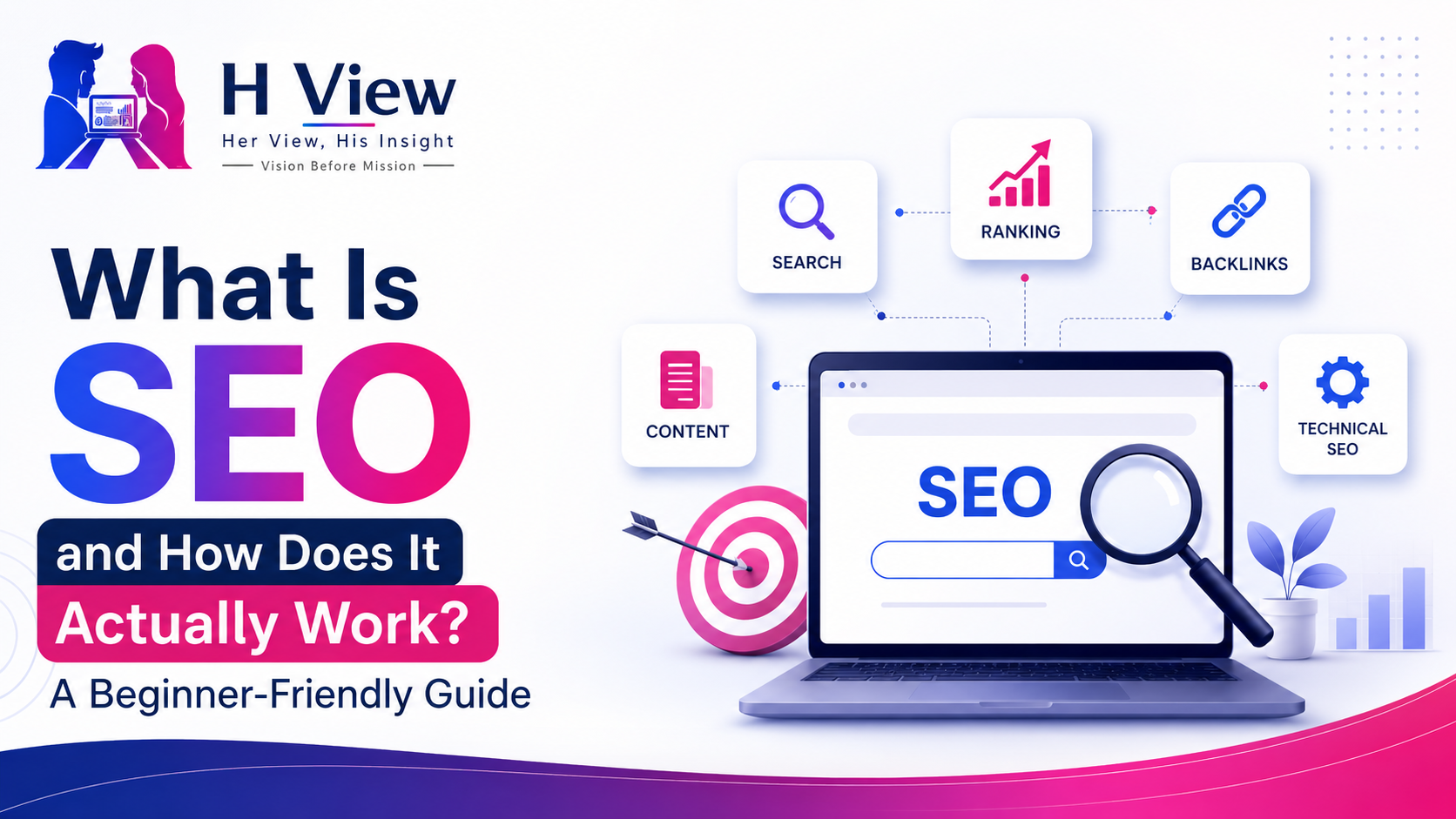
If you have ever published an article or built a website and then wondered why nobody is finding it through Google, you have already reached the point where SEO begins to matter. Search Engine Optimization is often made to sound more complicated than it needs to be, especially when beginners are introduced immediately to keyword scores, backlinks, plugins, technical audits and ranking tools.
At its core, SEO is much simpler. It is the process of helping search engines understand your pages while making those pages useful enough that people actually want to find, read and trust them. Google itself describes SEO in similar terms: helping search engines understand content and helping users discover websites through Search.
That means SEO is not about repeating a keyword twenty times or getting a green score inside a WordPress plugin. A page can be technically perfect and still fail to rank if it does not answer the searcher’s question well. Understanding how discovery, crawling, indexing, relevance and competition work together gives beginners a much more realistic picture of SEO.
SEO stands for Search Engine Optimization, but the word “optimization” sometimes creates the wrong expectation. It can make people think there is a secret formula that turns any article into a top-ranking result if the correct boxes are checked.
In reality, Google is trying to choose useful results from an enormous number of possible pages. If someone searches for how to start a blog in India, the search engine has to decide which pages best answer that need. An article about starting a general business may be related but not specific enough, while an outdated blogging guide may no longer be useful even if it uses the correct keyword.
SEO helps your page become a stronger candidate by making its topic clear, ensuring search engines can access it and improving the usefulness of the information provided. It does not guarantee a position because your page is always being evaluated alongside competing pages.
Before a page can appear in search results, Google first needs to know that it exists. Google uses automated crawlers, often referred to as Googlebot, to follow links around the web and discover new or updated content.
A new article can be discovered through links from your homepage, category pages, another article, an XML sitemap or an external website. This is why internal linking is useful for more than helping visitors navigate the site. It also creates pathways that search engines can follow.
Imagine your website has a Digital Marketing category linked from the main navigation. That category links to your new beginner SEO guide, while another related article also links to it naturally. Google has several routes through which it can encounter the page.
An important article with almost no internal links is much harder to discover and understand in context. Good website structure therefore supports both readers and search engines at the same time.
One of the most common SEO misunderstandings appears when a website owner sees that an article has been indexed and expects it to immediately appear near the top of Google.
Indexing does not mean ranking.
Crawling happens when Google discovers and visits a URL. Indexing happens when Google processes the page and decides that information about it may be stored in its search index. Ranking, or serving, happens later when somebody performs a search and Google’s systems decide which indexed pages are relevant enough to show.
A page can therefore be indexed correctly and still receive almost no search traffic. Nothing necessarily has to be technically broken. Google may simply believe that competing pages answer the query better, have stronger signals of trust or match the search intent more closely.
For website owners using Google Search Console, seeing an article marked as indexed should therefore be treated as the beginning of the competition rather than proof that SEO work is complete.
Search intent means understanding what somebody is really trying to accomplish when they type a query.
Suppose a person searches for best WordPress hosting for beginners. They are probably not looking for a long history of web hosting or a dictionary definition of servers. They are likely trying to compare providers based on price, ease of use, support, performance and whether the service is suitable for someone building a first website.
An article can contain the exact keyword many times and still fail if it does not satisfy that need.
This is why keyword research should lead to an understanding of the reader rather than a writing formula. Some searches are informational because people want to learn. Others involve comparison, buying, finding a specific brand or completing a particular action.
Before writing, ask what someone would reasonably expect to find after clicking the result. Answering that expectation well is more valuable than forcing an exact phrase into every heading.
Keywords remain useful because they show us how real people describe the information they are looking for. If people commonly search for “keyword research,” using completely unrelated wording in the title would make the article unnecessarily difficult to understand.
The mistake is treating the keyword as though Google can understand only that exact phrase.
An article about WordPress SEO might naturally discuss Search Console, sitemaps, internal links, page titles, indexing, images, site speed and content quality. Those related ideas help explain the topic properly without repeating “WordPress SEO” in every paragraph.
Good keyword usage usually feels ordinary to the reader. The main phrase belongs naturally in important places such as the title, introduction and relevant headings, while the rest of the article should concentrate on explaining the subject.
If a sentence sounds strange because a keyword was inserted for SEO, rewriting the sentence naturally is usually the better choice.
On-page SEO covers the work you do directly on a webpage to make its content and structure easier to understand. This includes clear titles, logical headings, descriptive URLs, internal links, useful images, sensible metadata and, most importantly, content that answers the topic properly.
Many of these practices are also simply good usability.
A URL such as example.com/keyword-research-for-beginners gives both the reader and the search engine more context than example.com/post?id=5829. In the same way, a heading such as How to Find Keywords Your Audience Searches For tells the reader what is coming next, while Section Four tells them almost nothing.
On-page SEO works best when it improves clarity rather than making the article look as if it was written for an algorithm.
Technical SEO focuses on whether search engines can access, interpret and navigate the website correctly. Common areas include crawling, indexing, XML sitemaps, robots directives, canonical URLs, mobile usability, structured data, HTTPS and page performance.
The subject can sound intimidating, but small WordPress websites often encounter very basic technical problems before advanced ones become relevant.
A website may accidentally discourage search engines through WordPress settings. A page may point to the wrong canonical URL, important articles may have very few internal links, or the sitemap may not be working correctly. A slow or difficult mobile experience can create another layer of problems.
Before paying for complicated audits, it is worth checking these fundamentals first. Search Console’s URL Inspection tool can also help website owners understand whether Google has discovered and indexed a specific URL.
Off-page SEO refers broadly to signals that exist outside the page itself, with backlinks being the best-known example. A backlink is simply a link from another website to your page.
Links can help search engines discover content, but they can also indicate that another website considers a resource useful enough to reference. This is why backlinks became such an important part of SEO strategy.
Unfortunately, they also created an industry around artificial link building.
Buying large quantities of irrelevant links or placing them across unrelated websites solely to manipulate rankings is very different from earning a reference because someone genuinely found your content useful. Sustainable authority usually comes from publishing something worth citing, such as original research, practical tools, detailed tutorials, unique data or genuinely useful analysis.
Building something worth linking to takes more effort, but that effort usually creates value beyond SEO as well.
The internet already contained enormous amounts of basic information before generative AI arrived. AI has now made it possible to create generic articles at a scale that would have required large writing teams only a few years ago.
That makes ordinary information less valuable.
An article explaining that “SEO improves visibility and increased visibility can bring traffic” adds very little because thousands of pages already say essentially the same thing. The stronger opportunity is to add something useful that existing results do not explain particularly well.
For an Indian beginner, that might mean examples involving WordPress, Search Console problems, realistic blogging budgets or screenshots from actual indexing issues. For another publisher, it might mean original research, personal testing or a clearer explanation of a difficult concept.
The question should therefore move from “Can we publish an article about this keyword?” to “What can our article contribute that makes it worth reading?”
That is becoming increasingly important as the cost of producing average content continues to fall.
Using AI does not automatically prevent a page from performing in Google. The more important issue is what the final page offers to the reader.
There is a meaningful difference between using AI to help organise research, improve clarity or support editing and publishing hundreds of shallow pages simply because automation makes it inexpensive. A generic article remains generic whether it was written manually or produced by AI.
Website owners should therefore review AI-assisted content critically. Check facts, remove repetition, add genuine experience and make sure the article reflects an actual editorial point of view rather than simply rearranging information already available everywhere else.
AI can speed up part of the workflow, but usefulness still has to be earned.
Search is changing because Google now provides generative experiences such as AI Overviews and AI Mode alongside traditional results. Understandably, this has made publishers wonder whether conventional SEO is becoming irrelevant.
The more practical interpretation is that SEO is expanding.
Search engines and AI systems still need accessible, understandable and trustworthy information. Technical accessibility, strong content, internal linking, useful page structure and genuine expertise remain valuable even when the final search experience does not look like the traditional list of ten blue links.
What may change is how success is measured. Some informational searches may produce fewer clicks because users receive more information directly in search. At the same time, publishers that create genuinely useful material have opportunities to become sources across several forms of discovery.
The durable question is no longer only, “How do we rank number one?” It is also, “How do we become a source worth discovering wherever people search?”
WordPress users often install Yoast SEO, Rank Math or another SEO plugin and become focused on turning every indicator green. These plugins are useful for managing metadata, sitemaps, schema and other settings, but their scores should not be confused with Google’s ranking decisions.
A plugin cannot determine whether your explanation is better than the current results, whether readers trust your examples or whether the article genuinely satisfies the query.
This is why chasing a perfect plugin score can sometimes make writing worse. A writer may repeat a keyword unnecessarily simply because the tool wants another occurrence, even though the sentence already reads naturally.
Use SEO plugins as assistants rather than judges. They can help you remember technical elements, but editorial quality still requires human judgement.
SEO becomes much less intimidating when you stop treating Google like a machine that must be tricked. Beginners often become overwhelmed because every SEO tool discovers another warning: the title is too long, the keyword appears too few times, the authority score is low or another backlink is supposedly required.
Some of those recommendations can be useful, but they should never replace the reader’s experience.
If someone arrives on the page, understands the answer, finds the information trustworthy and feels that the article respected their time, much of the important work has already been done. SEO should help that useful page get discovered rather than turn writing into a checklist.
The biggest misconception about SEO is believing that optimization can rescue content that was weak from the beginning. Titles, metadata, internal links and technical improvements matter, but there is a limit to what they can achieve when the page adds nothing useful to the subject.
The strongest process starts earlier. Choose a real search problem, understand why people are searching for it and create an answer that deserves to compete. Then make sure search engines can crawl, index and interpret that answer correctly.
That order matters because technical SEO improves access, while editorial quality provides the reason someone should care once the page is found.
SEO, or Search Engine Optimization, is the process of improving a website so that search engines can understand its pages and users can discover those pages when searching for relevant information. It combines useful content, clear site structure and technical accessibility.
SEO is commonly divided into on-page SEO, technical SEO and off-page SEO. On-page SEO focuses on content and individual webpages, technical SEO deals with crawling and website infrastructure, while off-page SEO includes external signals such as backlinks.
No. Indexing means Google has processed the page and may store information about it. Ranking is a separate process in which Google decides whether that page is relevant enough to appear for a particular search and where it should be shown.
There is no fixed timeline because results depend on competition, search demand, website history, content quality and technical accessibility. Some pages may receive impressions quickly, while others can take months or may require substantial improvement before gaining meaningful visibility.
Yes, because keywords reveal how people describe what they are searching for. The goal, however, is to understand the intent behind the keyword and answer it naturally rather than repeating the exact phrase unnecessarily.
Yes. Search interfaces are changing through AI Overviews, AI Mode and other generative experiences, but websites still need to be accessible, understandable and genuinely useful if they want to participate in search discovery.
Harika is the co-founder of H View and covers AI, technology, gadgets, digital tools, online platforms, and modern internet trends. Her articles focus on simplifying complex topics with practical explanations, balanced opinions, and reader-first insights.
Share your real experience and help other readers decide better.
No community views yet. Be the first to share yours.
Open LinkedIn for a few minutes and you will probably come across a colourful graphic…
Harika October 6, 2026 
When an employee resigns, many organisations move quickly into replacement mode. The manager informs HR,…
Harika October 6, 2026 
For many corporate employees, the workday begins long before they actually start working. They wake…
Harika October 5, 2026 
Many projects begin with an assumption that sounds reasonable on paper: the client will explain…
Harika October 1, 2026