

Best Digital Marketing Tools in 2026: What Marketers Actually Need and What They Can Skip
Open LinkedIn for a few minutes and you will probably come across a colourful graphic…
 Harika October 6, 2026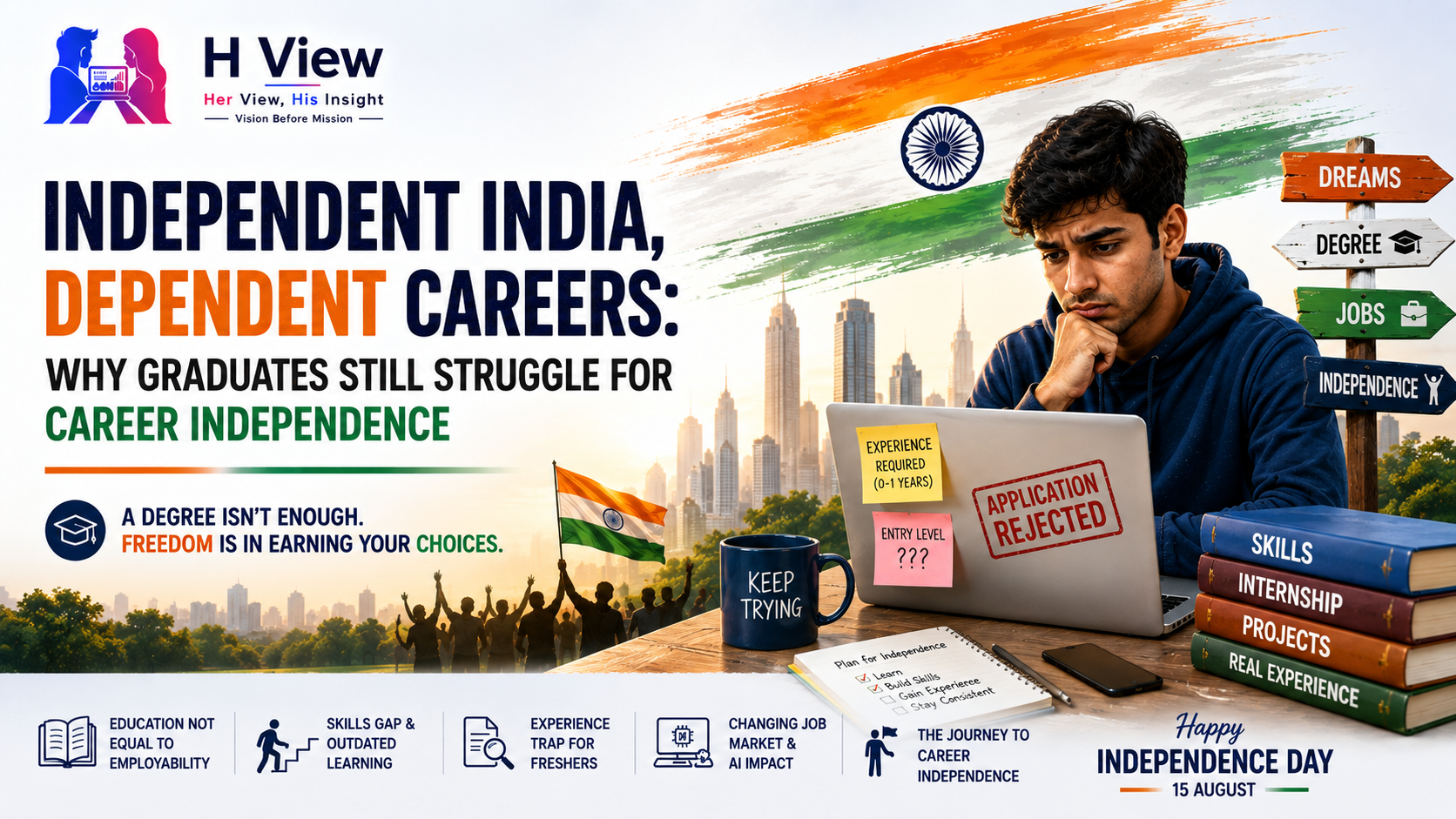
 By Satya HemanthUpdated September 20, 202611 min read33 views
On the morning of August 15, a young graduate may watch the national flag being raised, read messages about freedom, and feel genuinely proud of the country’s journey. A few hours later, the same person may be back on LinkedIn, Naukri or company career pages, applying for another batch of jobs and wondering why almost every “entry-level” opening seems to want experience.
That contrast does not diminish the meaning of India’s Independence Day. Political independence and unemployment are not the same thing, and it would be unfair to pretend they are. But Independence Day does give us a useful moment to ask what independence means in the everyday life of a generation that was born into a free country.
For many young Indians, one of the first meaningful forms of personal independence is the ability to earn. A salary is not simply money arriving in a bank account. It can mean contributing at home, paying your own expenses, choosing where to live, leaving a workplace that treats you badly, postponing marriage without feeling financially helpless, or taking a career risk without asking someone else to fund it.
That is why the transition from education to employment deserves more attention. India has millions of educated and ambitious young people, yet completing a degree does not automatically give them the economic freedom they expected it would.
For generations of Indian families, higher education represented security.
Parents saved money, took loans, moved children to better colleges and encouraged them toward degrees that appeared to offer stable careers. The understanding was fairly simple: study well, graduate, find a respectable job and begin standing on your own feet.
The degree still matters. The mistake is assuming that it still functions as a guaranteed ticket into employment.
India’s latest official labour data shows some improvement in youth unemployment. According to the Periodic Labour Force Survey, the unemployment rate for people aged 15–29 declined from 10.3% in 2024 to 9.9% in 2025. That is encouraging, but it also leaves a significant number of young people struggling with the transition into work.
The challenge becomes more complicated when education is considered. World Bank data for India shows unemployment among people with advanced education at 17.7% in 2025, illustrating an uncomfortable reality: more education does not automatically translate into easier employment.
The problem is therefore not that education has no value. It is that the connection between qualification and employment has become less automatic.
Consider a fairly ordinary example.
A student completes a B.Tech degree after four years. The family has spent several lakhs on tuition, accommodation, transport and other expenses. The student has passed exams, completed assignments and perhaps even earned respectable marks.
Then the job search begins.
A software opening asks for Java, Spring Boot, SQL, APIs, Git and cloud knowledge. Another requires React and Node.js. A supposedly fresher-friendly role asks for one year of experience. The student realises that much of what employers expect was never practised deeply in college.
So another phase begins.
They join a six-month course. They earn another certificate. They build two projects copied partly from tutorials. After that, recruiters begin asking whether the projects were deployed, whether the candidate can explain database decisions, whether they have worked in teams, and whether they understand how an application behaves outside a classroom exercise.
At this point the graduate often starts thinking, “What exactly was the degree preparing me for?”
That frustration deserves to be taken seriously.
At the same time, blaming universities alone is too easy. Technology changes quickly, employers want productive employees sooner, and companies themselves are not always willing to invest enough in training entry-level candidates. Students also sometimes chase marks and certificates without building practical competence because the education system has taught them that completing the requirement is the goal.
The result is a gap in which everyone expects someone else to finish preparing the fresher.
The phrase “skills gap” is used so often that it can begin to sound meaningless, but there is evidence behind it.
A 2026 government release citing the India Skills Report says graduate employability has risen to 56.4%, compared with 46% in 2020. That improvement matters. It suggests that skilling programmes, stronger industry awareness and changing education practices are having an effect.
But look at that number from the perspective of a graduate.
If employability is improving but still far from universal, thousands of students can finish formal education believing they are ready for the labour market only to discover that employers evaluate readiness differently.
India has also expanded skilling and apprenticeship programmes substantially. Government figures released in February 2026 said more than 1.64 crore candidates had been trained and certified under PMKVY, while over 51 lakh apprentices had been engaged through the National Apprenticeship Promotion Scheme since 2016–17.
The scale is impressive. The next question should be about outcomes.
A certificate is useful only when it creates a capability someone is willing to pay for.
One of the most common complaints from fresh graduates is also one of the most understandable: how can someone gain experience if every employer wants experience before hiring them?
Companies have their own logic. A small business may not have the time or resources to spend three months training every new employee. A startup working under pressure may prefer someone who can contribute almost immediately. Recruiters therefore use internships, projects or previous work as evidence that a candidate understands more than theory.
But employers should recognise the contradiction they are creating.
When genuinely junior positions begin demanding one or two years of professional experience, the first rung of the ladder effectively disappears.
That pushes graduates toward unpaid internships, questionable training programmes or roles completely unrelated to what they studied simply to place something under “experience” on a résumé.
H View has already explored the strange entry-level job but experience required trap because it is more than a frustrating job advertisement. It represents a broader failure in the school-to-work transition.
A healthier employment market needs genuine beginner roles where employers expect learning rather than pretending every new hire must arrive fully formed.
Whenever there is anxiety, someone eventually builds a business around solving it.
A graduate who cannot find a job is an ideal customer for courses promising “100% placement assistance,” expensive bootcamps, résumé packages, interview programmes and job-linked certifications.
Some of these programmes are genuinely valuable. A focused course taught by experienced professionals can give a student practical exposure that college did not provide.
The problem begins when fear becomes the marketing strategy.
“You have a degree, but companies won’t hire you without this certification.”
“Pay ₹50,000 and become industry-ready in three months.”
“Limited seats with guaranteed placement support.”
A young person who already feels left behind can become extremely vulnerable to these promises. The family may pay again because the original degree has not yet delivered the expected job.
Career independence should not become a never-ending sequence of purchasing qualifications.
At some stage, learning has to turn into demonstrable ability.
The arrival of generative AI makes this transition even more complicated.
Entry-level employees traditionally handled a lot of repetitive work while learning more difficult responsibilities. Junior developers wrote simpler code, analysts prepared first drafts of reports, marketers created basic copy, and assistants summarised or organised information.
AI can now perform portions of that work quickly.
This does not mean AI is eliminating every entry-level career. It does mean companies may expect a fresher to accomplish more from the beginning. The World Bank has noted that generative AI could particularly affect pathways into good jobs because young graduates often enter professions through tasks that are increasingly automatable.
The sensible response is not to tell every student to “learn AI” as if that solves everything.
Young professionals need to become capable of using AI while still understanding the work underneath it. A developer who can generate code but cannot debug it remains dependent on the tool. A marketer who asks AI for every campaign idea without understanding customers has automation, not expertise.
Career independence in the AI era will require being able to work with technology without becoming helpless without it.
There is another uncomfortable truth hidden inside employment statistics.
Getting a job does not automatically mean becoming independent.
Imagine a graduate working in Bengaluru for ₹22,000 per month. After rent, travel, food and basic expenses, almost nothing remains. They cannot afford to leave the job without another offer in hand, cannot save enough to create a financial buffer and may still need help from parents during emergencies.
That person is employed, but their career gives them very little freedom.
Compare that with someone earning moderately more who has built useful skills, maintains savings and knows they could move to another employer if necessary. The second person has something beyond employment: options.
Employment gives you income. Career independence gives you choices.
That distinction matters because young Indians should not be encouraged to chase only the first salary. The long-term objective is to build enough competence, experience and financial stability that one company, one qualification or one bad manager does not control the entire future.
Unemployment after graduation has an emotional side that employment statistics rarely capture. The first few rejections can be manageable, but after several months the questions begin to feel personal. Friends announce new jobs on LinkedIn, relatives ask what you are doing now, and family members who genuinely want to help may unknowingly increase the pressure by asking for updates every few days.
The dangerous moment comes when a young person begins interpreting unemployment as evidence that they are personally incapable. A difficult labour-market transition becomes an identity problem. We need to become better at separating those things. A graduate may need more practical skills, better communication, stronger projects or a different strategy, but none of that requires humiliation. Career preparation works better when people are helped to identify what is missing rather than repeatedly being told that they are not enough.
India’s challenge is not simply producing more graduates or announcing more skilling programmes. The real test is how quickly a young person can move from education into productive work.
Colleges need stronger practical exposure, but employers must also restore genuine entry-level hiring and structured training. Students, meanwhile, need to stop treating certificates as accumulated proof of competence and start building work that can actually be demonstrated. Government skilling efforts can help create the bridge, but numbers trained should ultimately matter less than the number who gain meaningful and sustainable employment.
The strongest employment ecosystem would not ask students to choose between education and skills. It would make practical competence part of education itself.
India’s political independence gave generations of Indians the freedom to imagine and build their own future. For today’s graduates, one important expression of that freedom is the ability to turn education into economic agency.
That does not mean every graduate is entitled to an immediate high-paying job. Careers require learning, adaptation and effort. But a system in which students complete years of education, purchase additional certifications and then discover that even beginner roles expect prior experience deserves examination.
A degree should not be sold as a guaranteed job ticket.
Nor should young people be told that the degree is worthless simply because the labour market has changed.
The better goal is to shorten the distance between learning something, becoming capable of doing it, and finding someone willing to pay for that capability.
On Independence Day, that is a form of freedom worth thinking about. A country can be politically independent while its young people are still working toward personal economic independence. Helping more graduates cross that distance is not merely an employment challenge.
It is part of creating a generation that has the confidence and financial ability to make choices of its own.
There is no single reason. Employers increasingly expect practical skills, projects, communication ability and some evidence of workplace readiness alongside formal qualifications. In some sectors, there is also stronger competition for entry-level jobs and a mismatch between what students learn academically and what companies immediately need.
No. Degrees remain essential for many professions and still provide important foundational education. The change is that a degree increasingly works as a starting qualification rather than a guarantee of employment. Practical capability and experience now play a larger role in many hiring decisions.
Employers often want evidence that candidates can apply what they have learned in real situations. However, genuinely entry-level roles demanding substantial previous professional experience can make it unnecessarily difficult for freshers to enter the workforce. Internships, apprenticeships and meaningful projects can help bridge this gap, but employers also need to provide real beginner opportunities.
Official PLFS data shows that India’s unemployment rate among people aged 15–29 declined from 10.3% in 2024 to 9.9% in 2025. That is an improvement, although youth employment and the transition from education to good-quality work remain important challenges.
Only when the course addresses a clearly identified skill gap. Buying another certificate simply because employment has not arrived can become expensive without improving employability. Before enrolling, a graduate should know exactly what practical capability the course will add and whether employers in the desired role actually value it.
Career independence means having enough employable ability, experience and financial stability to make meaningful career choices. It is broader than simply having a job because someone can be employed while still feeling unable to leave, change direction or manage financially without support.
Satya Hemanth is the founder of H View and writes on careers, sports, leadership, digital trends, and practical decision-making. His articles focus on clear explanations, real-world examples, and useful insights for students, young professionals, and everyday readers.
Share your real experience and help other readers decide better.
No community views yet. Be the first to share yours.

Open LinkedIn for a few minutes and you will probably come across a colourful graphic…
Harika October 6, 2026 
When an employee resigns, many organisations move quickly into replacement mode. The manager informs HR,…
Harika October 6, 2026 
For many corporate employees, the workday begins long before they actually start working. They wake…
Harika October 5, 2026 
Many projects begin with an assumption that sounds reasonable on paper: the client will explain…
Harika October 1, 2026