

₹50,000 Coding Course vs Free YouTube: What Are You Really Paying For?
A student searching for a coding career often faces two very different options. The first…
 Satya Hemanth July 29, 2026
  By Satya HemanthUpdated September 20, 202612 min read74 views
One of the first questions almost every coding beginner asks is:
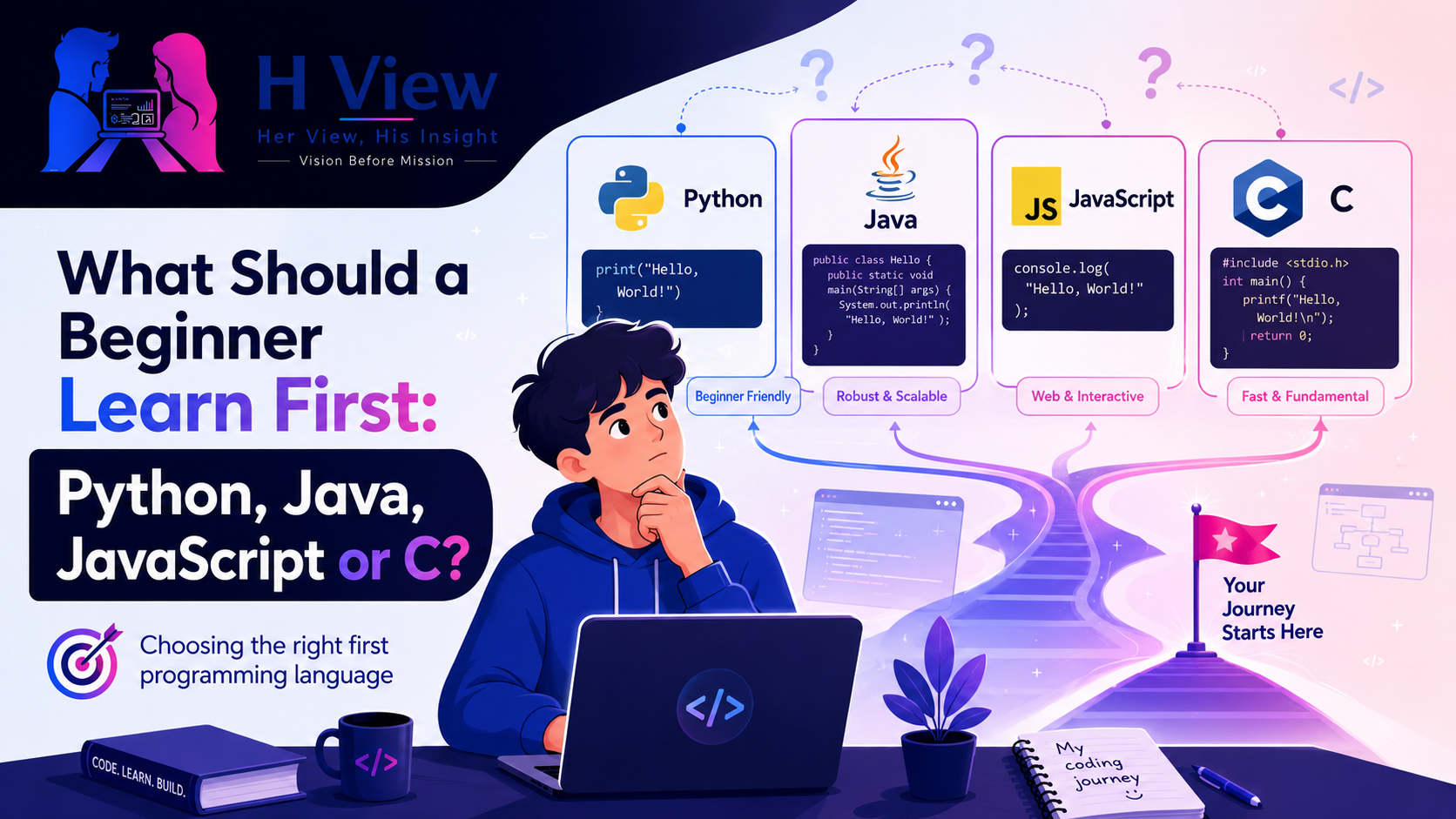
Which programming language should I learn first—Python, Java, JavaScript or C?
Unfortunately, the internet rarely gives a simple answer.
One person says Python is the easiest. Another says Java gives better job opportunities. Web developers recommend JavaScript, while engineering students are often told to begin with C because it builds stronger fundamentals.
The result is confusion before learning even begins.
The truth is that there is no universally perfect first programming language.
The right choice depends on what you want to build, how quickly you want visible results, the kind of career you are considering and how deeply you want to understand computer fundamentals.
A student interested in websites may benefit more from JavaScript. Someone interested in automation or data may find Python more practical. Java may suit learners targeting enterprise applications, while C can provide a deeper understanding of how programming works closer to the system level.
The best first language is not necessarily the most popular one.
It is the language that helps you begin consistently and move toward a clear goal.
Beginners often worry that choosing the wrong language will waste several months or damage their career.
That fear is usually exaggerated.
Programming languages differ in syntax, tools and common use cases, but they share many fundamental ideas:
Once a learner understands these ideas properly in one language, learning another language becomes easier.
The first language is therefore not a permanent career decision.
It is the environment in which you learn how to think like a programmer.
The larger mistake is not choosing Python instead of Java or JavaScript instead of C.
The larger mistake is repeatedly changing languages before understanding any one of them.
From one perspective, beginners should choose the language that helps them build something useful quickly.
Early progress matters.
When learners see a program running, automate a task or create a simple webpage, they gain confidence. That confidence helps them continue through more difficult concepts.
A language with readable syntax and strong beginner resources can reduce unnecessary frustration.
Python is often recommended for this reason. Its official documentation describes it as powerful and relatively easy to learn, with support for scripting and rapid application development. However, the official Python tutorial also notes that it is intended for programmers new to Python rather than complete beginners with no programming background.
The important lesson is that no language teaches itself.
Even an approachable language requires structured lessons, exercises and projects.
A beginner-friendly language can help someone start, but an easy beginning does not automatically create a strong developer.
Learners may write short Python programs without understanding memory, data types or how applications are organised. They may create websites with JavaScript without developing problem-solving ability.
A language should not be selected only because a social-media video promises that it can be mastered in a few days.
Coding involves more than syntax.
The learner still needs to understand:
A simple language can reduce the effort of writing code.
It cannot remove the effort of learning how to solve problems.
Python is one of the most practical first-language choices for many beginners.
Its syntax is generally readable, allowing learners to focus more on programming logic and less on punctuation or lengthy setup.
Python is commonly used for:
Python’s adoption accelerated in the 2025 Stack Overflow Developer Survey, where it was used by 57.9% of respondents, reflecting its broad relevance across professional development, education and data-related work.
Python can hide some lower-level details. A learner may become comfortable writing programs without understanding memory management, strict type systems or compilation.
That is not a reason to avoid Python.
It simply means the learner should consciously study computer-science fundamentals alongside it.
H View recommendation: Python is the safest general-purpose starting choice for learners who have no specific career direction yet.
JavaScript is the core programming language of interactive web experiences.
It is used to handle buttons, forms, animations, dynamic content, user interactions and application logic inside the browser. MDN describes JavaScript as the language used to add interactivity to websites, including validation, button behaviour, games, dynamic styling and animation.
With Node.js and modern frameworks, JavaScript can also be used on the server. This allows learners to use one language across frontend and backend development.
JavaScript is commonly used for:
MDN provides a structured beginner web-development curriculum covering HTML, CSS, JavaScript and essential frontend practices.
JavaScript can behave in ways that initially feel inconsistent. Its ecosystem also changes quickly, with many frameworks, packages and tools.
Beginners can become distracted by trying to learn React, Node.js and several libraries before understanding core JavaScript.
The correct order should be:
H View recommendation: Choose JavaScript first when your main goal is web or full-stack development.
Java has been used for decades across enterprise systems, backend services, financial applications, large organisational platforms and Android-related development.
It is more verbose than Python, but that structure can encourage beginners to understand types, classes, objects and application organisation.
Java is commonly used for:
Java requires more setup and more code for simple tasks than Python. This can feel slow during the first few weeks.
However, the additional structure can help learners understand:
A beginner should not reject Java merely because the first program looks longer.
Its value becomes clearer when applications grow.
H View recommendation: Choose Java first when you want a structured path toward enterprise backend development or when your education and target employers strongly use Java.
C is one of the most influential programming languages.
It gives learners greater exposure to memory, pointers, manual data handling and the relationship between software and computer hardware.
C is commonly used in:
C is less forgiving.
A small mistake involving memory or pointers may cause confusing behaviour. Building visually attractive projects also takes longer than with web or scripting languages.
This can reduce motivation for learners who want immediate results.
However, C teaches valuable discipline.
It makes the learner think carefully about:
H View recommendation: Choose C first when your goal is computer fundamentals, embedded systems or academic strength—not merely fast application development.
TypeScript is a language built on JavaScript that adds stronger type checking and improved tooling for larger applications.
GitHub’s 2025 Octoverse report found that TypeScript became the most-used language on GitHub by contributor activity in August 2025, overtaking Python and JavaScript. GitHub connected part of this growth to modern frameworks and the increasing importance of typed languages in AI-assisted development.
However, TypeScript is usually not the best very first language for someone with no web-development foundation.
A better route is:
JavaScript fundamentals → TypeScript → frontend or backend framework
This helps the learner understand what TypeScript is improving rather than treating its type system as random extra syntax.
Choose Python when you want:
Choose JavaScript when you want:
Choose Java when you want:
Choose C when you want:
Career opportunities matter, but popularity should not be the only factor.
The 2025 Stack Overflow Developer Survey showed broad professional usage across JavaScript, Python and other established languages. GitHub’s 2025 data also showed strong contributor growth for TypeScript and Python.
However, language popularity changes.
A learner who only follows rankings may switch repeatedly as new trends appear.
Employers usually hire for a larger skill set:
A language opens the path.
It does not complete the career.
Yes—but not at the same time during the beginning.
A practical approach is:
Possible combinations include:
The second language should expand your ability, not distract from incomplete foundations.
A non-technical learner should generally begin with either Python or JavaScript.
Choose Python when you want to automate work, analyse information or understand general programming.
Choose JavaScript when you are motivated by websites and visible interfaces.
Do not begin with the language that sounds most impressive.
Begin with the one that supports a small project you genuinely want to build.
Motivation matters because consistency matters more than the theoretical perfection of the language choice.
Learn variables, conditions, loops, functions, input, output and basic debugging.
Solve small problems and build two mini-projects.
Learn files, APIs, databases or browser interaction based on the language.
Build, test, document and publish something you can explain independently.
At the end of 90 days, do not ask only:
“How much syntax do I remember?”
Ask:
“Can I solve a new problem using what I learned?”
Her View: Beginners should choose an approachable language connected to a project they are excited to build. Early progress and motivation can make learning more sustainable.
His Insight: Choosing an easy or popular language is not enough. Strong careers still require logic, debugging, databases, APIs, testing and consistent project work.
Both views are correct.
The first language should help you enter programming.
Your practice determines how far you go.
For most complete beginners, Python is the best general starting language.
For someone clearly interested in web development, JavaScript is the better first choice.
For learners targeting enterprise backend careers, Java remains highly useful.
For students who want deep computer fundamentals, embedded systems or low-level understanding, C provides the strongest foundation.
Do not spend months searching for the perfect language.
Choose based on your goal, study consistently and build something real.
The most successful beginner is not the person who selected the theoretically best language.
It is the person who stayed with one language long enough to understand programming.
Python is generally considered one of the most approachable languages because of its readable syntax. Beginners must still learn programming logic and practise regularly.
Both support strong career paths. Python is common in automation, data and backend work, while Java is widely used in enterprise backend systems. The better choice depends on the target role.
Learn JavaScript first when your main goal is web development. Choose Python first for general programming, automation, data or AI-related learning.
C can be challenging because it exposes memory and lower-level concepts. It remains a strong choice for engineering students and people interested in systems or embedded development.
Most beginners should first understand JavaScript fundamentals and then move to TypeScript. This makes the additional type system easier to understand.
It is possible, but complete beginners usually progress faster by focusing on one language first and adding another after building basic projects.
JavaScript or TypeScript is practical because it can be used in both frontend and backend development. Python and Java are also strong backend options.
No. Developers commonly learn multiple languages. The first language mainly helps build foundational programming and problem-solving skills.
Satya Hemanth is the founder of H View and writes on careers, sports, leadership, digital trends, and practical decision-making. His articles focus on clear explanations, real-world examples, and useful insights for students, young professionals, and everyday readers.
Share your real experience and help other readers decide better.
No community views yet. Be the first to share yours.

A student searching for a coding career often faces two very different options. The first…
Satya Hemanth July 29, 2026 
Learning coding has become a major career goal for students, freshers and working professionals. Everywhere…
Satya Hemanth July 25, 2026 
A few years ago, learning to code was widely presented as one of the safest…
Satya Hemanth July 25, 2026