

Best Digital Marketing Tools in 2026: What Marketers Actually Need and What They Can Skip
Open LinkedIn for a few minutes and you will probably come across a colourful graphic…
 Harika October 6, 2026
  By HarikaUpdated September 20, 202613 min read49 views
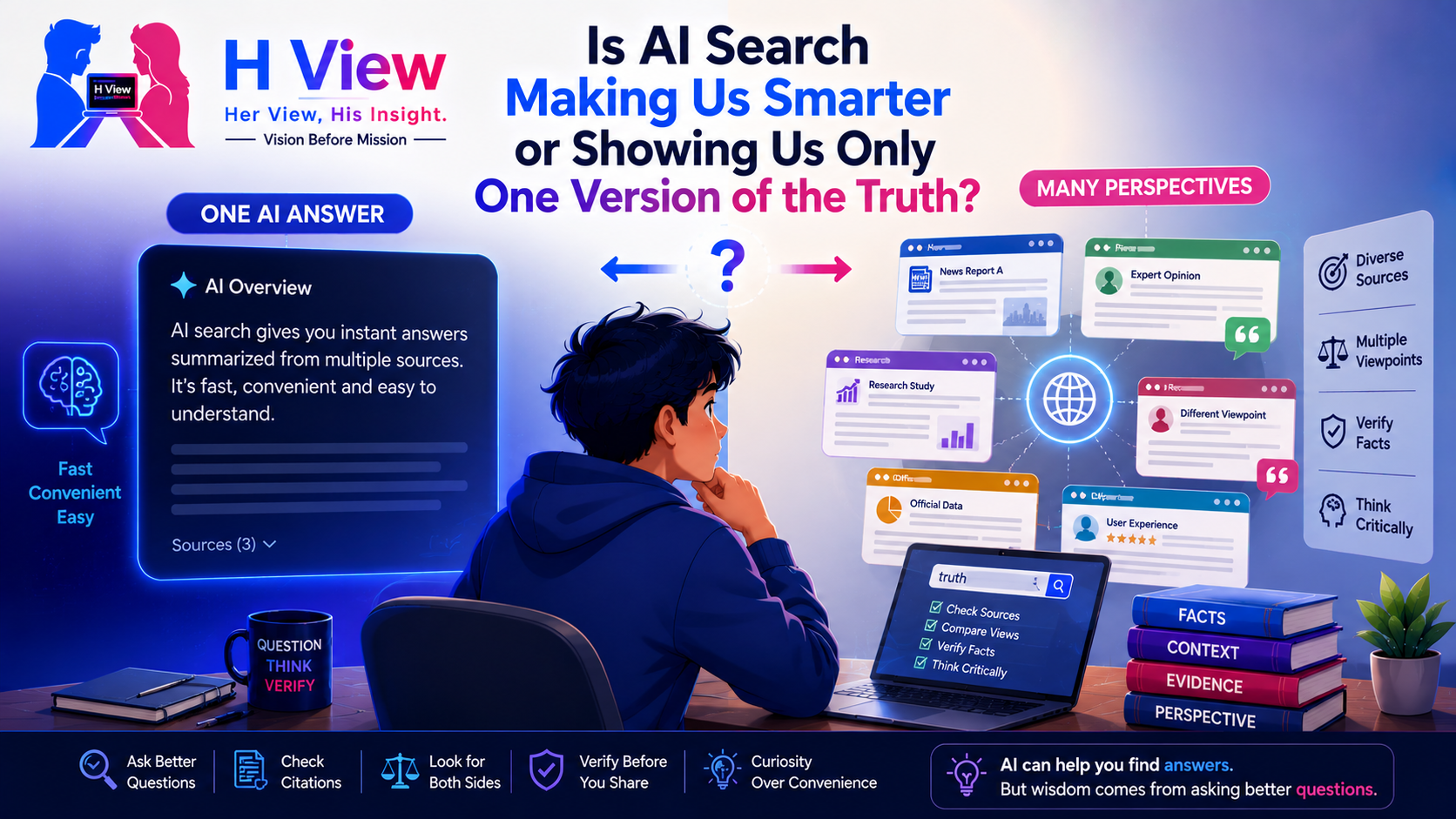
Searching for information used to involve opening several websites, comparing headlines, reading different opinions, checking dates, and deciding which source seemed most trustworthy.
Now, the experience is changing.
Instead of showing only a list of links, AI-powered search can generate a complete answer at the top of the page. It can summarise several sources, explain a complex topic, compare options, and respond to follow-up questions within seconds.
For users, this feels incredibly convenient.
There is less scrolling, less reading, and less confusion. A question that once required ten tabs may now appear to be answered in one neat paragraph.
But this convenience creates a deeper concern:
Is AI search helping us understand the world more clearly, or is it showing us one machine-generated version of the truth?
AI search can make knowledge faster and more accessible. It can also decide which sources are included, which details are ignored, and how conflicting views are presented.
When one answer replaces a page of possibilities, searching becomes easier—but questioning may become harder.
Traditional search engines mainly act as gateways.
A user enters a query and receives a ranked list of websites, videos, images, news reports, forum discussions, and other results. The search engine influences what appears first, but the user still decides which links to open.
AI search takes a different approach.
It attempts to understand the question, gather information, and generate a direct response. Some systems include citations or links, while others may present a summary with fewer visible sources.
Google describes AI Mode as a search experience designed for longer and more complex questions, with reasoning, follow-up conversations, multimodal input, and links to relevant web pages. It was introduced in India in 2025 as part of the company’s wider expansion of AI-powered search.
This creates a more conversational experience.
Instead of searching:
“Best laptop for video editing under ₹80,000”
and opening several reviews, a person can ask:
“I need a laptop under ₹80,000 for video editing, occasional gaming, and five years of use. Compare the compromises and recommend what I should prioritise.”
AI can combine the request into one organised answer.
That ability is useful. But the result is also a form of interpretation.
The AI is not merely finding information. It is choosing how to frame it.
AI search reduces the effort required to understand unfamiliar subjects.
It can:
For someone trying to understand a complicated topic, this can feel far better than opening several poorly written or advertisement-heavy pages.
A student can ask for a simple explanation. A shopper can compare features. A professional can get an overview before beginning deeper research.
AI search also allows users to ask questions in natural language rather than guessing the right keywords.
Google reported that early AI Mode testers were asking queries two to three times longer than traditional searches, suggesting that users were bringing more complicated and nuanced questions to the system.
This is a meaningful improvement.
Search can become less about finding the right phrase and more about expressing the real problem.
From one perspective, AI search can help people become better informed.
Traditional search results are not always easy to navigate. Users may face sponsored links, repetitive articles, technical explanations, paywalls, and pages written mainly to rank rather than help.
AI can remove some of that friction.
It can bring the main ideas together and present them in a clearer structure. Someone unfamiliar with a subject may finally understand enough to ask better questions.
AI search can be especially useful for:
It can also encourage curiosity.
A person can begin with one question and continue asking for examples, opposing arguments, simpler explanations, or deeper detail.
In this form, AI does not reduce learning. It can make exploration easier.
The risk begins when users treat a generated summary as the complete truth.
Most complex questions do not have one neutral answer.
Questions about politics, health, economics, history, education, technology, culture, or public policy often involve competing evidence and different interpretations.
Even product recommendations depend on priorities, budgets, locations, and personal preferences.
When an AI system creates one response, it must decide:
These choices may not be obvious to the user.
The answer may appear balanced even when it is built from a narrow group of sources.
A 2026 study examining more than 200,000 real-world ChatGPT interactions found that generative AI enabled users to ask a broader range of questions than traditional search. However, for comparable searchable queries, AI responses were less diverse than Google results across most topics. The researchers also observed a feedback loop in which the diversity of AI answers influenced the diversity of users’ later questions.
This suggests that AI can widen the kinds of questions we ask while narrowing the range of answers we encounter.
A generated answer can feel complete because it is written in a smooth and confident way.
But it is still a summary created from selected information.
The source may contain:
When users do not open the original source, they lose the ability to examine these details.
This matters because AI-generated summaries are not always fully supported by their citations.
A Stanford-led evaluation of generative search systems found that, on average, only 51.5% of generated claims were fully supported by citations, while roughly three-quarters of citations actually supported the statements linked to them.
The technology has evolved since that study, but the underlying lesson remains important:
A citation beside an answer does not automatically guarantee that the claim has been represented correctly.
One of the most visible changes caused by AI search is that users may stop visiting websites.
A Pew Research Center analysis of browsing activity from March 2025 found that users clicked a traditional search result in 8% of visits when an AI summary appeared. When no AI summary was shown, they clicked a result in 15% of visits.
This does not prove that users learned less. The summary may have answered the question successfully.
But it does show that AI summaries can change how people interact with information.
When fewer users open sources, they may encounter:
This also affects the websites that produce original reporting, research, analysis, and educational content.
AI search depends on information from the web, yet it may reduce the number of people who visit the websites that created that information.
People often judge an answer by whether it sounds reasonable.
But the quality of an answer also depends on the diversity and credibility of the sources behind it.
Imagine asking AI about the impact of remote work.
A response based mostly on employer surveys may focus on productivity and office costs. A response based on employee surveys may focus on flexibility, isolation, and work-life balance.
Both may contain accurate information, but they may lead to different conclusions.
The same issue applies to:
Research into AI search citation patterns has found that news citations may be heavily concentrated among a relatively small group of outlets, even when different AI providers use somewhat different sources.
Another 2026 audit of four generative search engines found that around 16% of cited sources in its dataset showed evidence of being AI-generated. The study also observed repeated reliance on a relatively narrow set of frequently cited domains.
These findings do not mean every AI answer is unreliable. They show why users should care about where information comes from.
Social-media filter bubbles are created when algorithms repeatedly show users content similar to what they previously engaged with.
AI search may create a different kind of bubble.
Instead of showing a feed of selected posts, it may produce one personalised synthesis shaped by:
A user may not notice what was excluded because excluded sources are invisible.
Traditional search also ranks and filters information, so it is not perfectly neutral. The difference is that traditional results usually expose several competing links.
AI search compresses that competition into one narrative.
This makes the answer easier to consume, but it also gives the system greater influence over what the user considers relevant.
The wording of a question has always influenced search results.
With AI, that influence can become stronger because the system attempts to interpret intent and construct a complete response.
Compare these questions:
“Why is remote work effective?”
“Why does remote work reduce productivity?”
“What are the strongest arguments for and against remote work?”
The first two questions may encourage the AI to search for evidence supporting the assumption built into the wording. The third invites a broader comparison.
A 2026 empirical comparison of Google Search, AI Overviews, and Gemini found major differences in the sources surfaced by each system. It also reported that AI Overviews were less consistent across repeated runs and less robust to small changes in query wording.
This makes prompt awareness an important part of modern information literacy.
Users should not only question the answer. They should question how their own wording shaped it.
People naturally prefer information that supports their existing beliefs.
This is known as confirmation bias.
AI can unintentionally strengthen it.
A user may ask:
“Why is this diet unhealthy?”
“Why is this political leader successful?”
“Why is this investment a good choice?”
“Why is office work better than remote work?”
The AI may respond within the frame of the question rather than challenging the assumption.
The user then receives a well-written explanation that feels like independent validation.
A healthier approach is to ask:
AI becomes more valuable when it is asked to test our thinking rather than comfort it.
AI search works well as a starting point for:
It is especially useful when the user knows enough to evaluate the response or is willing to verify important claims.
Users should search more broadly when the topic involves:
These situations require multiple sources, current information, and careful judgment.
An AI summary can help organise the issue, but it should not end the investigation.
AI search does not need to be rejected.
It needs to be used with stronger habits.
Request direct citations, official documents, research papers, and primary evidence.
Do not rely only on the generated interpretation.
Tell the AI to present the strongest disagreement, not a weak or simplified counterargument.
Ask which parts are established facts, estimates, opinions, or uncertain claims.
Information about laws, prices, products, health guidance, technology, and current events can become outdated quickly.
Remove assumptions from the question and compare the result.
Compare AI search with traditional search, official websites, reputable journalism, academic databases, and expert guidance.
A convincing AI answer can still spread misinformation when posted without verification.
Before accepting an AI-generated search answer, ask:
Where did this information come from?
What important perspective may be missing?
Is the information current and supported?
Would I trust this answer if the topic affected my health, money, rights, or reputation?
These questions restore some of the judgment that direct answers can remove.
Her View: AI search can simplify complicated information, reduce wasted time, support natural-language questions, and help more people understand subjects that once felt inaccessible.
His Insight: A smooth summary can hide weak citations, missing viewpoints, source concentration, outdated details, and assumptions shaped by the question. One answer should not be mistaken for the full truth.
Both views are valid.
AI search can make us smarter when it encourages understanding and deeper exploration.
It can make us intellectually passive when the first generated answer becomes the final answer.
The future of search is not only about finding information faster.
It is about deciding how much thinking we are willing to hand over while finding it.
AI can gather, summarise, compare, and explain. These abilities can save time and make knowledge more accessible.
But truth is not always a single paragraph.
It may exist across competing sources, incomplete evidence, historical context, expert disagreement, and details that do not fit neatly into a generated summary.
The smartest user is not the person who receives an instant answer.
It is the person who knows when that answer is enough—and when it is only the beginning of the search.
AI search should help us ask better questions.
It should never make us forget that important answers still deserve investigation.
AI search uses generative artificial intelligence to understand questions, retrieve information, and produce direct answers or summaries instead of showing only a traditional list of links.
Not automatically. AI search may explain information more clearly, but it can also misunderstand sources, omit context, present outdated claims, or generate unsupported details. Traditional results also require evaluation.
Yes. Bias can enter through training data, source selection, ranking systems, prompt wording, and the way the AI summarizes competing viewpoints.
Opening citations helps users confirm whether the source supports the claim, review missing context, check publication dates, and judge the credibility of the original information.
Research indicates that users are less likely to click traditional search results when an AI summary appears. The impact differs by query, platform, website, and user intent.
It may narrow information exposure by synthesizing selected sources into one response. Users can reduce this risk by requesting opposing views and consulting several independent sources.
Medical, legal, financial, political, academic, safety-related, and reputation-sensitive questions should be checked through multiple reliable and current sources.
Use AI for orientation and explanation, ask for credible sources, open important links, test alternative prompts, verify key claims, and retain human judgment.
Harika is the co-founder of H View and covers AI, technology, gadgets, digital tools, online platforms, and modern internet trends. Her articles focus on simplifying complex topics with practical explanations, balanced opinions, and reader-first insights.
Share your real experience and help other readers decide better.
No community views yet. Be the first to share yours.
Open LinkedIn for a few minutes and you will probably come across a colourful graphic…
Harika October 6, 2026 
When an employee resigns, many organisations move quickly into replacement mode. The manager informs HR,…
Harika October 6, 2026 
For many corporate employees, the workday begins long before they actually start working. They wake…
Harika October 5, 2026 
Many projects begin with an assumption that sounds reasonable on paper: the client will explain…
Harika October 1, 2026