

Love Doesn’t Keep a Marriage Alive—Daily Habits Do
Lasting relationships aren’t built by grand gestures. They’re built by the small things couples choose…
 Annapurna August 11, 2026
 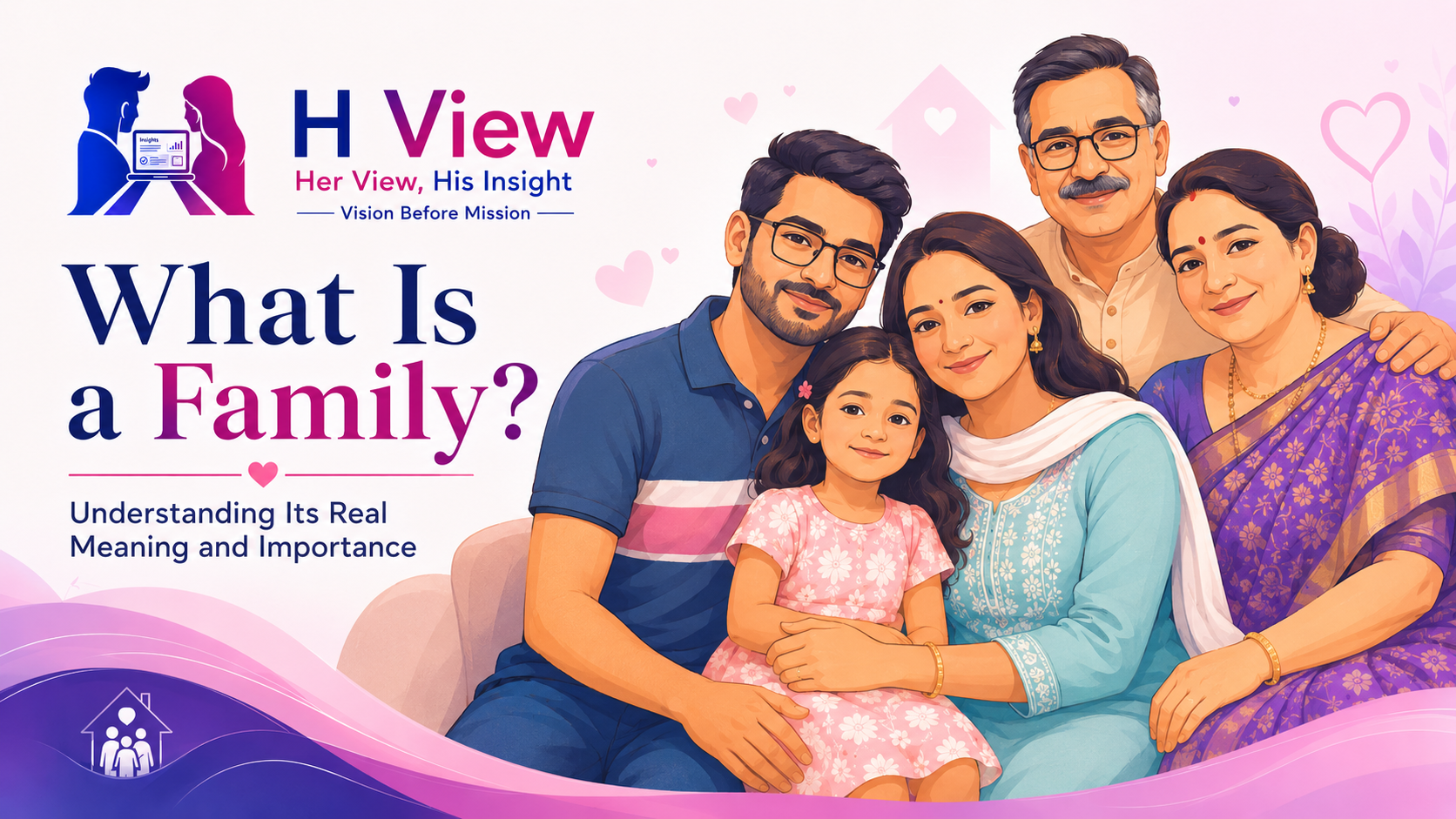 By AnnapurnaUpdated September 20, 202612 min read38 views
When we hear the word “family,” most of us immediately think of parents, children, grandparents, brothers, sisters, husbands, wives, and relatives. We imagine people living together, celebrating festivals, attending weddings, sharing meals, and supporting one another during difficult times.
But is that all a family means?
A family is not created only by blood relations, marriage, or living under the same roof. A family becomes meaningful when people feel loved, respected, protected, heard, and accepted.
Some people live in large families but still feel lonely. Others may live far away from their relatives yet remain emotionally connected and supportive. This shows that family is not defined only by the number of people in a home. It is defined by the quality of the relationships between them.
A strong family is not one where everyone is forced to obey without question. It is one where every member understands their responsibilities, respects the dignity of others, and helps create a safe and peaceful environment.
A family is a group of people connected through birth, marriage, adoption, care, commitment, or emotional bonds.
Traditionally, a family may include parents and children. In many Indian households, it may also include grandparents, uncles, aunts, cousins, daughters-in-law, sons-in-law, and other relatives living together or staying closely connected.
However, families today can take many forms.
There are nuclear families, joint families, single-parent families, adoptive families, blended families, child-free couples, and families where grandparents raise children. Some people also consider close friends as family because of the emotional support and trust they share.
The structure may change, but the purpose remains similar.
A family should provide:
Without these values, people may be related to one another but may not truly experience the comfort of family.
Family plays an important role in almost every stage of life.
From childhood, family influences how we understand love, trust, responsibility, communication, discipline, relationships, and self-worth. The way a child is treated at home often shapes how that child later behaves as a friend, spouse, parent, employee, or member of society.
A healthy family can give a person confidence and emotional strength. It can become a place where someone can return without fear of judgment.
During failure, illness, financial stress, pregnancy, parenthood, ageing, or personal loss, family support can make a major difference.
However, family becomes valuable not simply because people are related. Its importance comes from the support, care, and emotional security people provide to one another.
A family that constantly criticises, controls, insults, compares, or humiliates its members may weaken them instead of strengthening them.
That is why preserving a family should never mean preserving harmful behaviour.
A house is a physical place. A home is an emotional experience.
A beautiful house may have expensive furniture, modern facilities, and many family members. But if the people inside it are afraid to speak, constantly criticised, treated unequally, or emotionally neglected, it may not feel like home.
A simple home can still feel peaceful when people:
The real strength of a home is not measured by its size, wealth, or social status. It is measured by how safe people feel inside it.
A strong family is supported by four essential foundations: love, respect, trust, and responsibility.
These foundations work together. Love creates emotional connection, respect protects dignity, trust creates security, and responsibility keeps the family stable.
When even one of these foundations becomes weak, relationships can begin to suffer.
Love is not limited to saying, “I care about you.”
It is expressed through patience, kindness, attention, emotional support, protection, and presence.
A parent may deeply love a child, but if that love is always shown through fear, pressure, or control, the child may not experience it as love.
Similarly, a husband may say that he loves his wife, but if he ignores her pain, permits others to disrespect her, or refuses to communicate, those words gradually lose their meaning.
Love should be visible through everyday behaviour.
It can be shown by listening carefully, helping during difficult moments, appreciating effort, spending meaningful time together, and making family members feel that they matter.
Respect means recognising that every family member has dignity, feelings, opinions, needs, and personal boundaries.
It should not depend on age, gender, income, education, marital position, or authority within the household.
Elders deserve respect, but younger people also deserve to be spoken to respectfully.
A husband deserves respect, and so does his wife.
Parents deserve consideration, but their married children also need privacy and freedom to make decisions about their own lives.
A daughter-in-law should not be expected to earn basic respect through endless obedience, household labour, or silence. She enters the family as a person and an equal human being.
Respect cannot move in only one direction. It must be mutual.
Trust allows family members to feel emotionally secure with one another.
It means believing that a person can express an opinion, admit a mistake, ask for help, or make a personal decision without immediately being suspected, humiliated, or controlled.
Trust grows when people:
Constantly checking someone’s phone, questioning every friendship, monitoring every movement, or assuming the worst does not create closeness. It creates fear and emotional distance.
Trust does not mean ignoring irresponsible behaviour. It means addressing concerns through communication and reasonable boundaries rather than constant surveillance.
Once trust is broken, rebuilding it requires honesty, patience, accountability, and consistent actions.
Every family member has responsibilities.
Parents have a responsibility to guide children without damaging their confidence.
Children have a responsibility to respect and support their parents according to their age and ability.
Husbands and wives have a responsibility to care for one another emotionally, practically, and financially according to their circumstances.
In-laws have a responsibility to avoid unnecessary interference and to help a new family member feel accepted and secure.
Household work, childcare, elder care, financial planning, and emotional support should not automatically become the duty of only one person.
A family becomes unstable when one member is expected to sacrifice everything while others avoid accountability.
Responsibility must be shared fairly, not imposed selectively.
Love without respect may become possessiveness.
Respect without trust may create emotional distance.
Trust without responsibility may lead to disappointment.
Responsibility without love may make family life feel like an obligation rather than a relationship.
A healthy family needs all four foundations to remain strong:
Love connects the family. Respect protects it. Trust strengthens it. Responsibility sustains it.
One of the biggest misunderstandings in family relationships is the belief that love gives someone the right to control another person.
Parents may feel they can make every decision for their adult children because they raised them.
A husband may believe marriage gives him authority over his wife’s clothing, career, friendships, money, or contact with her parents.
In-laws may expect a daughter-in-law to follow every family rule without asking questions.
A wife may try to isolate her husband from his parents because of unresolved conflict.
None of these behaviours represents healthy love.
Family relationships involve connection, not ownership.
Care means guiding someone with concern. Control means forcing them to live according to another person’s wishes.
Advice allows a person to decide. Control removes their ability to decide.
Protection creates safety. Restriction creates fear and dependence.
These differences are important because many harmful practices are defended using statements such as:
“We are doing this for your own good.”
“This is how our family works.”
“You must adjust after marriage.”
“People will talk.”
“You belong to this family now.”
A healthy family does not erase a person’s individuality.
Emotional safety means being able to express feelings, concerns, mistakes, or disagreements without fear of humiliation, threats, rejection, or punishment.
In emotionally safe families, people can say:
“I am hurt.”
“I disagree.”
“I need help.”
“I made a mistake.”
“I need some space.”
“This behaviour is affecting me.”
They may not always receive the answer they want, but they are not attacked simply for speaking honestly.
In unhealthy family environments, people may remain silent because every conversation becomes an argument. They may fear being blamed, mocked, compared, or labelled as disrespectful.
When silence becomes the only way to maintain peace, that peace is not genuine.
Real peace comes from understanding, fairness, and communication.
Family values are often discussed as if they mean obedience, sacrifice, and maintaining traditions without question.
But meaningful family values should include:
Traditions can strengthen families when they bring people together. Festivals, celebrations, shared meals, rituals, and cultural practices can create belonging and beautiful memories.
However, traditions should be questioned when they create humiliation, inequality, fear, or suffering.
Not every old practice is automatically good, and not every modern change is automatically wrong.
A wise family preserves values while improving harmful practices.
For many women, marriage does not only mean gaining a husband. It often means entering a completely new family system.
She may be expected to understand new people, new rules, new routines, and new responsibilities immediately. At the same time, she may be living away from her own parents, siblings, familiar surroundings, and emotional support.
When she expresses discomfort, she may be told to adjust. When she asks for privacy, she may be considered arrogant. When she wants to continue her career or personal choices, she may be seen as disobedient.
A woman does not stop being someone’s daughter when she becomes someone’s wife or daughter-in-law.
A healthy family welcomes her without demanding that she erase her identity.
Many husbands feel trapped between their wife and parents.
They may love both sides but fear that supporting one will be seen as betraying the other. To avoid conflict, some men remain silent.
However, silence does not always protect relationships. Sometimes, it allows unfair behaviour to continue.
A husband does not have to abandon his parents to support his wife. He also does not have to ignore his wife’s pain to prove that he is a good son.
His responsibility is not to blindly choose one side. It is to understand what is fair, communicate clearly, and protect the dignity of everyone involved.
Being balanced does not mean remaining neutral when someone is being mistreated.
Parents may worry that marriage will distance their son or daughter from them.
They may fear losing importance, emotional closeness, financial support, or influence. These fears can sometimes lead to over-involvement.
In-laws may also expect a new daughter-in-law or son-in-law to fit into existing family habits immediately.
But marriage naturally creates a new relationship that needs time, privacy, and independence.
Parents do not lose their children when they respect their marriage. In fact, healthy boundaries can strengthen long-term relationships.
Love grows better when it is not forced.
Families rarely break because of one disagreement.
They usually weaken through repeated patterns such as:
These problems may look small individually, but over time they create emotional distance.
When people no longer feel safe, valued, or heard, they may remain physically present while becoming emotionally disconnected.
A stronger family does not require perfection. It requires willingness.
Every family can begin with a few practical changes.
Listen before reacting.
Do not assume that disagreement means disrespect.
Avoid discussing private marital matters with every relative.
Allow adult family members to make age-appropriate decisions.
Distribute household responsibilities fairly.
Do not compare a daughter-in-law with a daughter or one child with another.
Correct mistakes privately rather than humiliating someone publicly.
Respect personal time, friendships, careers, and parental relationships.
Set boundaries clearly but calmly.
Seek counselling or professional support when repeated conflicts cannot be resolved.
Most importantly, every family member should ask:
“Am I trying to understand this person, or am I only trying to make them obey me?”
That question alone can change many relationships.
Family is one of the strongest sources of love, identity, support, and belonging. But the word “family” should never be used to justify control, silence, inequality, or emotional suffering.
A strong family is not one where problems are hidden to protect reputation.
It is one where problems are discussed with maturity.
It is not one where only younger people adjust.
It is one where everyone accepts responsibility.
It is not one where women are expected to lose their identity after marriage.
It is one where every member is treated with dignity.
The true purpose of family is not to control people. It is to help them grow while knowing they are loved, respected, and supported.
That is the kind of family worth protecting.
A family is a group of people connected through birth, marriage, adoption, care, or emotional commitment who support and take responsibility for one another.
Family can provide emotional support, safety, guidance, belonging, care, and strength during difficult stages of life.
Neither structure is automatically better. The quality of communication, privacy, fairness, and respect determines whether a family environment is healthy.
No. Elders should be treated respectfully, but adult family members also have the right to express opinions and make personal decisions.
Constant control, fear, humiliation, inequality, emotional neglect, lack of privacy, financial restriction, and refusal to communicate can make a family unhealthy.
Yes, when people acknowledge their behaviour, communicate honestly, respect boundaries, and seek counselling or professional guidance when necessary.
Annapurna is an H View contributor covering relationships, family, lifestyle, entrepreneurship, and everyday decision-making. Her articles focus on emotional clarity, practical understanding, and human-centered perspectives that help readers think better about personal and professional situations.
Share your real experience and help other readers decide better.
No community views yet. Be the first to share yours.

Lasting relationships aren’t built by grand gestures. They’re built by the small things couples choose…
Annapurna August 11, 2026 
The happiest marriages aren’t built by finding the perfect person. They’re built by choosing to…
Annapurna August 10, 2026 
People don’t always feel loved in the same way. Understanding that can transform a relationship.…
Annapurna August 6, 2026 
How Healthy Couples Disagree Without Hurting Each Other Many people believe that a happy couple…
Annapurna August 4, 2026