

Nothing OS 4.1 Explained: New Features, Eligible Phones and Should You Update?
Nothing OS has become one of the strongest reasons to consider a Nothing phone. The…
 Harika August 10, 2026
  By HarikaUpdated September 20, 20268 min read71 views
Nothing has gradually expanded from a small design-focused smartphone brand into a company serving several price segments. Its flagship phones explore newer ideas, the “a” series balances cameras and performance, while CMF targets buyers looking for lower prices and practical value.
The new Nothing Phone (4b) enters the space between those categories.
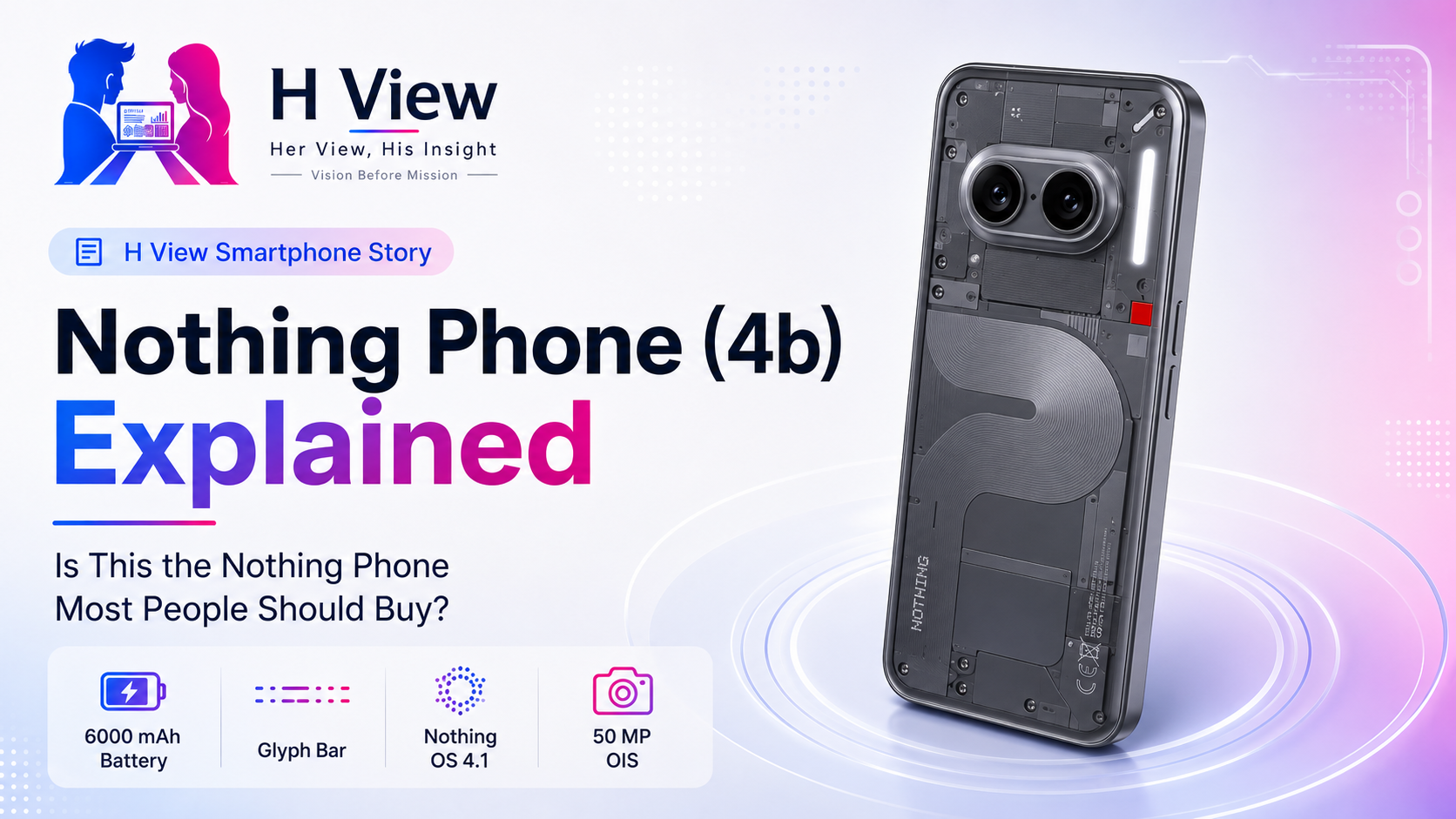
It offers the familiar Nothing design language, a refined Glyph Bar, Nothing OS 4.1, Essential AI tools and an unusually large battery for the Indian market. At the same time, it uses a mid-range Snapdragon processor and a simpler camera system than the Phone (4a).
This makes the Phone (4b) interesting—but also slightly difficult to place.
Is it the affordable Nothing phone that most buyers have been waiting for, or does its ₹29,999 effective launch price bring it too close to more powerful alternatives?
H View has not personally tested the Phone (4b). This article is a researched launch analysis based on Nothing’s current official specifications, pricing and software information.
Nothing has not presented the “b” series merely as a renamed CMF phone.
Phone (4b) remains part of the main Nothing family. It carries the company’s transparent-inspired visual identity, Glyph experience, Nothing OS features and Essential AI tools.
Its position appears to be below the Phone (4a), with greater emphasis on:
Phone (4b) launched globally in July 2026. In India, Nothing announced an effective starting price of ₹29,999 for 8 GB RAM and 128 GB storage, including a bank discount and exchange offer. The official maximum retail price is ₹34,999. An 8 GB + 256 GB version carries an effective price of ₹33,699 and an MRP of ₹38,999.
That distinction matters. Buyers should not treat ₹29,999 as the permanent standard price unless the required offer conditions remain available.
Budget-oriented devices often lose the visual identity of their more expensive siblings. Phone (4b) avoids that problem.
Nothing says its design combines the unibody construction and clear camera enclosure associated with Phone (4a) Pro with the Glyph Bar introduced through Phone (4a).
The result appears cleaner than the large lighting systems used on some earlier Nothing phones.
The device is offered in:
The RCB edition uses a red finish, special branding and collector-oriented packaging created in collaboration with Royal Challengers Bengaluru.
Nothing also gives the phone an IP64 rating. That provides resistance against dust and water splashes, but it should not be confused with full waterproofing or dependable underwater use.
The company claims the unibody construction improves bending resistance by 20% compared with Phone (3a) Lite.
Phone (4b) uses a redesigned Glyph Bar rather than the larger light patterns found on phones such as Phone (1) and Phone (2).
The bar contains 45 individually controlled mini-LEDs and is rated for brightness of up to 3,500 nits. Nothing lists supported uses such as:
This design may be less dramatic than the original Glyph Interface, but it could be easier to understand.
A smaller visual indicator works best when it communicates simple information quickly. The Glyph Bar should therefore be judged by how often it saves users from unlocking the phone—not by how impressive it looks in promotional photographs.
Phone (4b) is powered by the Snapdragon 6 Gen 4, built using a 4 nm manufacturing process.
Nothing pairs it with a 4,400 mm² vapour chamber to control heat during sustained activity. The company says the phone supports up to 90 frames per second in games such as BGMI and Call of Duty Mobile, with selected lighter titles supporting 120 frames per second.
This should be suitable for:
However, the Snapdragon 6 Gen 4 is not the strongest processor available around ₹30,000.
Performance-focused buyers may find competitors with Snapdragon 7-series or similarly positioned MediaTek processors. Members of Nothing’s own community have also questioned whether the processor and display bezels justify the pricing. Those responses are user opinions rather than formal benchmarks, but they highlight the pressure Phone (4b) faces in India’s competitive mid-range market.
The Phone (4b) should therefore be purchased for its complete software, battery and design package—not because it leads its price category in raw processing power.
Battery life may be the strongest reason to consider Phone (4b).
While the global model uses a 5,200 mAh battery, the Indian version receives a significantly larger 6,000 mAh battery. Nothing describes it as the company’s longest-lasting phone and claims up to two days of use under its testing conditions.
The phone supports 33 W wired charging. Nothing says it can reach 50% in under 30 minutes and complete a full charge in slightly over an hour.
The capacity is impressive, though charging speed is comparatively modest.
Buyers should expect actual battery life to vary based on:
For students, travellers and everyday users who value endurance more than top-tier gaming performance, the battery may outweigh several of the phone’s compromises.
Phone (4b) uses a 6.77-inch Super AMOLED display with:
These specifications suggest a screen suited to scrolling, streaming and gaming.
Nothing also includes dual stereo speakers and claims a 20% stronger stereo effect than Phone (4a). The software provides 160 volume levels for more precise adjustment.
Display quality cannot be judged from specifications alone. Colour accuracy, low-brightness behaviour, viewing angles and outdoor consistency require hands-on testing.
Phone (4b) uses a 50 MP main camera with optical image stabilisation. It supports 4K video recording at 30 frames per second.
The remaining camera hardware includes:
Nothing’s TrueLens Engine 4 provides computational processing, while Ultra XDR combines multiple RAW frames to improve highlights, shadows and colour. The phone also supports dual-video capture using front and rear cameras simultaneously.
The main limitation is the absence of a dedicated telephoto or periscope camera.
Phone (4a), by comparison, is positioned around a three-camera system with a 50 MP OIS periscope camera and zoom capabilities reaching up to 70x.
That makes the Phone (4a) more appropriate for buyers who care about:
Phone (4b) should provide a capable main camera, but it is not Nothing’s camera-focused option.
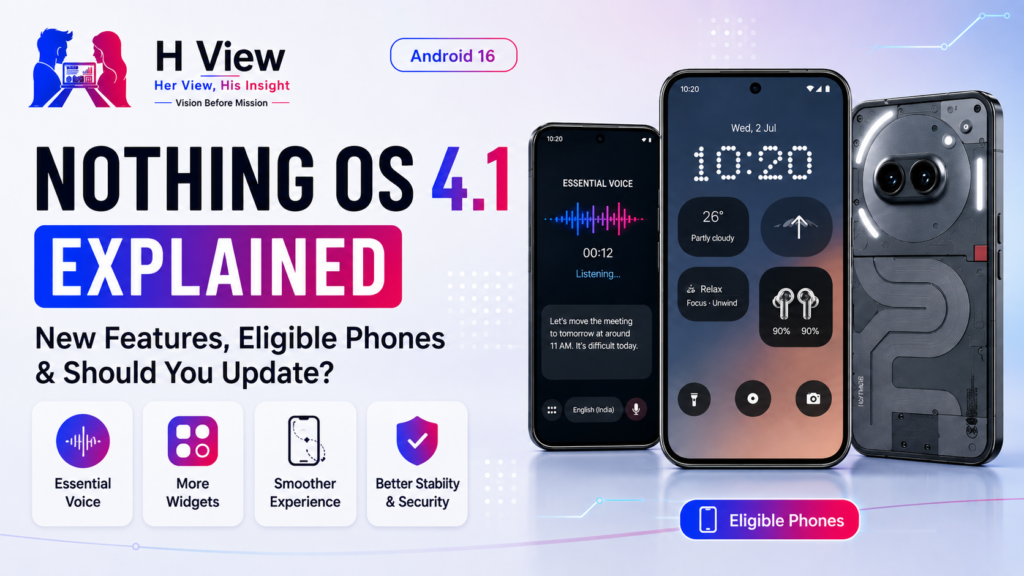
Phone (4b) launches with Nothing OS 4.1 based on Android 16.
Nothing promises:
This is a meaningful support commitment for a mid-range device, although the quality and punctuality of those updates will matter as much as the stated duration.
The software includes:
A physical Essential Key provides quick access to Nothing’s capture and AI tools.
This may be Phone (4b)’s strongest advantage over similarly priced phones with faster processors but more cluttered software. Buyers who enjoy Nothing OS can receive almost the same software direction offered on the brand’s more expensive models.
The Phone (4a) is the better choice for users who prioritise:
Phone (4b) is better suited to users prioritising:
The Phone (4a) is marketed around its three-camera system and 70x zoom, while Phone (4b) focuses on battery, a 50 MP main camera and software.
The choice should therefore depend on battery versus camera flexibility—not merely which model is newer.
CMF Phone 2 Pro offers a 5,000 mAh battery, 8 GB RAM and a four-camera system, including greater camera flexibility at a typically lower price.
CMF may offer better value for buyers who want:
Phone (4b) offers:
CMF remains the rational value choice, while Phone (4b) offers a more complete Nothing-branded experience.
Phone (4b) may be suitable for:
It may not suit:
The 8 GB + 128 GB model launched at an effective price of ₹29,999 with eligible offers. Its MRP is ₹34,999. The 8 GB + 256 GB model has an effective price of ₹33,699 and an MRP of ₹38,999.
The Indian version has a 6,000 mAh battery, while the global model uses a 5,200 mAh battery.
No. It has a 50 MP OIS main camera, an ultra-wide camera and a 16 MP front camera. Buyers wanting periscope zoom should consider Phone (4a).
It uses the Snapdragon 6 Gen 4, built on a 4 nm process.
Nothing promises three years of Android updates and six years of security patches.
Phone (4b) offers a larger Indian battery, Glyph Bar and longer stated support. CMF Phone 2 Pro may provide better affordability and camera flexibility. The better choice depends on priorities.
Harika is the co-founder of H View and covers AI, technology, gadgets, digital tools, online platforms, and modern internet trends. Her articles focus on simplifying complex topics with practical explanations, balanced opinions, and reader-first insights.
Share your real experience and help other readers decide better.
No community views yet. Be the first to share yours.
Nothing OS has become one of the strongest reasons to consider a Nothing phone. The…
Harika August 10, 2026 
Typing is not always the fastest way to express an idea. A message that takes…
Harika August 9, 2026 
A Nothing phone should comfortably support communication, social media, photography, navigation and entertainment throughout the…
Harika August 4, 2026 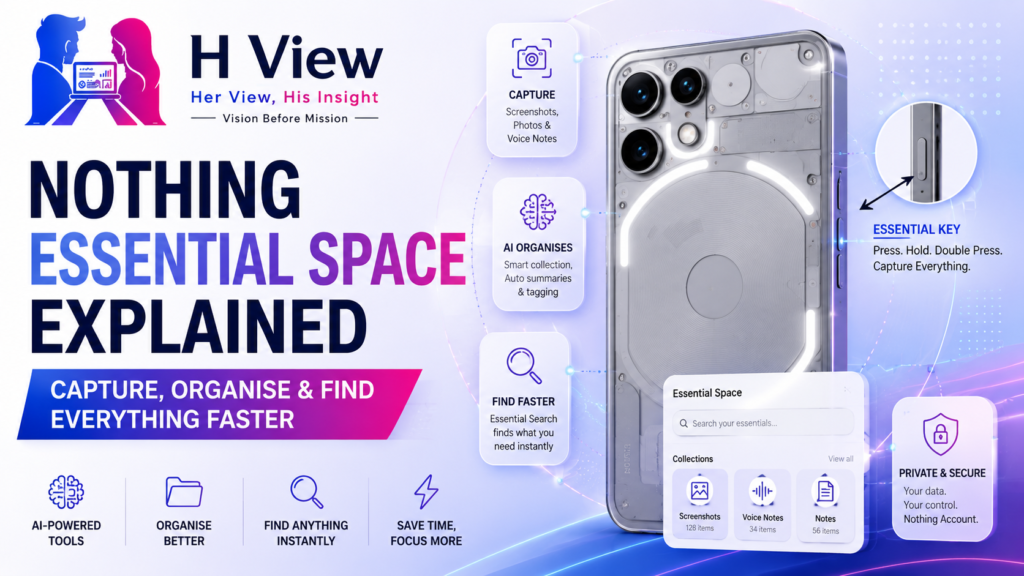
Screenshots, voice notes, saved links, photographs and reminders accumulate quickly on a smartphone. We capture…
Harika August 3, 2026