

Best Digital Marketing Tools in 2026: What Marketers Actually Need and What They Can Skip
Open LinkedIn for a few minutes and you will probably come across a colourful graphic…
 Harika October 6, 2026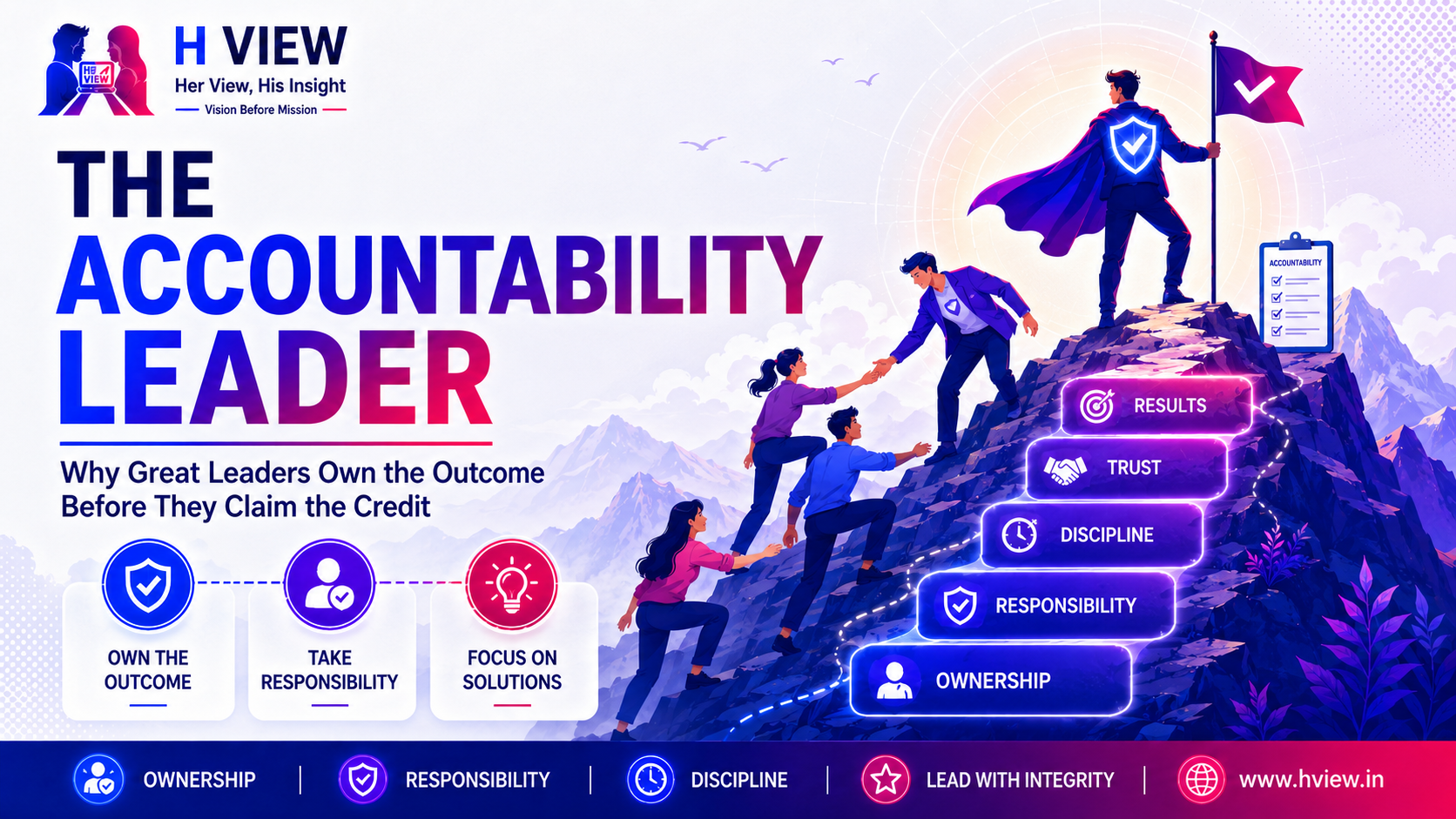
 By PraveenUpdated July 9, 20269 min read53 views
“Leadership begins where excuses end.”
📖 Part of the H View Leadership Journey
Series Intro: Leadership Lessons from Our Heroes | The Challenger Leader | The Servant Leader
Success is easy to celebrate. Anyone can take credit when the results are good. The true character of a leader is revealed during failure.
When a project misses its deadline. When a team loses an important match. When a business struggles. When a difficult decision backfires. Some leaders immediately look for reasons. Some look for people to blame.
Others quietly ask one question:
“What could I have done better?”
That simple question separates managers from leaders. The world doesn’t expect leaders to be perfect. It expects them to be accountable. Because accountability creates something far more valuable than success.
It creates trust.
In the previous article, we learned that great leaders serve others. But service without accountability has little meaning. If a leader is willing to help people but unwilling to accept responsibility for outcomes, trust eventually disappears.
That is why the third step in the H View Leadership Journey is becoming an Accountability Leader.
An Accountability Leader believes that leadership is not about having authority. It is about accepting responsibility.
These leaders don’t ask,
“Whose fault is this?”
They ask,
“What is my responsibility in fixing this?”
They understand that they cannot control every circumstance. But they can always control their response.
Accountability is not about carrying blame. It is about owning the outcome. Whether the result is success or failure. Whether people are watching or not.
At its core, accountability is built on one simple principle.
Great leaders own the outcome before they claim the credit.
Every successful organization is built on trust. Trust between leaders and employees, trust between teammates, trust between governments and citizens, trust between businesses and customers.
That trust is created when leaders consistently take ownership.
Without accountability:
With accountability:
People don’t follow leaders because they never make mistakes. They follow leaders because they know those leaders will never run away from responsibility.
Accountability begins with ownership. Instead of pointing fingers, accountable leaders first examine their own actions.
They understand that owning the problem is the first step toward solving it.
Doing the right thing is easy when everyone agrees. Integrity is doing the right thing when it is unpopular, uncomfortable, or personally costly.
Trust grows when actions consistently match words.
Promises don’t build credibility. Consistency does.
Accountability Leaders follow through on commitments, even when motivation fades.
Discipline transforms intentions into results.
Mistakes happen. Accountability Leaders acknowledge them openly. Rather than protecting their image, they focus on protecting trust.
Transparency creates psychological safety within teams.
Leaders cannot demand standards they are unwilling to demonstrate. People imitate behavior more than instructions.
Accountability Leaders become the benchmark they expect others to follow.
Leadership accountability appears differently across cinema, sports, business, and public life.
Yet every example teaches the same timeless truth.
Leadership is not measured by the power you possess.
It is measured by the responsibility you willingly accept.
When Bharat (in the movie Bharat Ane Nenu) unexpectedly becomes the Chief Minister, he quickly realizes that leadership is not about occupying the highest office. It is about honoring the responsibility that comes with it.
One of the most memorable moments in the film is when he reminds every public servant that a government job is not a privilege, it is a responsibility toward the people.
More importantly, he applies the same standards to himself. He doesn’t ask others to be accountable while avoiding accountability himself. He leads from the front. He takes ownership of difficult decisions. He demonstrates that institutions change only when leaders are willing to change first.
Leadership Lesson
Leadership is not about having authority.
It is about taking responsibility for how that authority is used.
Mahavir Singh Phogat (in Dangal) dreams of bringing international recognition to Indian wrestling. When he realizes he cannot fulfill that dream himself, he takes responsibility for preparing his daughters to achieve what he could not.
His coaching is demanding. His standards are uncompromising. At times, his methods are questioned.
But one thing is never in doubt.
He owns the responsibility for preparing his daughters to succeed on the world’s biggest stage. He doesn’t leave excellence to chance. He builds it through discipline, consistency, and accountability.
Leadership Lesson
Great leaders don’t lower standards to avoid discomfort.
They raise people to meet those standards.
Captain Miller (in Saving Private Ryan) leads a small group of soldiers on an extraordinarily dangerous mission during World War II.
Every decision he makes carries consequences. Lives depend upon his judgment. Despite uncertainty, he never hides behind excuses. He accepts responsibility for impossible decisions. He bears the emotional burden. And he remains committed to the mission, even when the personal cost becomes overwhelming.
Leadership isn’t always about making popular decisions.
Sometimes it is about making necessary ones.
Leadership Lesson
Accountability means standing by your responsibility, especially when the decisions are difficult.
Few athletes have experienced expectations as immense as Lionel Messi. After conquering club football with Barcelona, one question continued to follow him:
“Can he lead Argentina to international glory?”
The answer didn’t come immediately.
Argentina lost the 2014 FIFA World Cup Final.
Then two consecutive Copa América Finals.
The criticism was relentless. The pressure was enormous. Following the 2016 Copa América defeat, Messi even announced his retirement from international football. Many believed the story had ended.
Messi thought differently. He returned. Not because success was guaranteed. But because he believed his responsibility to his teammates and his country wasn’t over. He continued to lead through humility, hard work, and consistency.
His perseverance was rewarded with the 2021 Copa América, followed by the 2022 FIFA World Cup, fulfilling a dream that had eluded Argentina for decades.
Messi’s story teaches us that accountability isn’t about never failing. It is about refusing to abandon your responsibilities because you failed.
Leadership Lesson
Great leaders don’t let failure define them.
They take responsibility, return stronger, and finish what they started.
Few leaders demonstrate accountability more profoundly than Lee Kuan Yew. When Singapore became independent in 1965, it faced enormous uncertainty.
It had limited natural resources, high unemployment, housing shortages, and no guarantee of long-term survival.
Instead of blaming history or circumstances, Lee Kuan Yew focused on building strong institutions, disciplined governance, and a culture of accountability.
He believed governments should be judged by results, not promises. Over the following decades, Singapore transformed into one of the world’s cleanest, safest, and most prosperous nations.
That transformation wasn’t built on excuses. It was built on responsibility.
Leadership Lesson
Great nations, like great organizations, are built when leaders consistently own the outcome.
Notice something interesting about these five leaders.
One is a Chief Minister.
One is a wrestling coach.
One is a military captain.
One is a football legend.
One transformed an entire nation.
Different professions.
Different challenges.
One common leadership principle.
| Perspective | What They Teach Us |
| 🎬 Bharat Ram | Leadership begins with taking responsibility before demanding it from others. |
| 🎥 Mahavir Singh Phogat | Great leaders hold themselves and others to high standards. |
| 🎞️ Captain Miller | Accountability means making difficult decisions and standing by them. |
| ⚽ Lionel Messi | True leaders take responsibility for setbacks, return stronger, and lead by example. |
| 🌍 Lee Kuan Yew | Lasting institutions are built when leaders own outcomes instead of making excuses. |
This is the essence of the H View Leadership Prism.
Leadership begins where excuses end.
Accountability Leaders thrive wherever execution, trust, and responsibility matter.
They excel as:
Whenever people need someone they can depend on, Accountability Leaders step forward.
| Strengths | Watch Outs |
| Builds trust through reliability | May become overly self-critical |
| Leads by example | Can struggle to delegate |
| Creates disciplined teams | May expect everyone to match their standards |
| Earns long-term credibility | Can become frustrated with complacency |
| Solves problems instead of assigning blame | May carry too much responsibility alone |
True accountability also means trusting others with responsibility—not carrying every burden yourself.
Take a moment to reflect.
☐ Do I own my mistakes without making excuses?
☐ Do people trust me to deliver on my commitments?
☐ Do I admit mistakes quickly and honestly?
☐ Do I expect from others only what I expect from myself?
☐ Do I focus more on solutions than blame?
4–5 Yes: Accountability is one of your strongest leadership muscles.
2–3 Yes: You’re building a strong foundation. Keep strengthening it through consistent actions.
0–1 Yes: Start with one habit: own your next mistake before explaining it.
Small acts of ownership build extraordinary leaders.
People don’t expect leaders to be perfect.
They expect them to be honest.
Trust grows when leaders admit mistakes, learn from them, and move forward together.
Success earns admiration.
Accountability earns trust.
And trust is what gives leadership its lasting influence.
The Challenger Leader teaches us to believe in ourselves.
The Servant Leader teaches us to help others grow.
The Accountability Leader teaches us that leadership ultimately means owning the consequences of our decisions.
Because leadership is not defined by the authority we hold.
It is defined by the responsibility we willingly accept.
This week, strengthen your accountability muscle.
☐ Admit one mistake without defending yourself.
☐ Complete one commitment before the promised deadline.
☐ Replace one excuse with one solution.
☐ Ask someone you trust for honest feedback.
☐ End each day by writing one lesson you learned.
Leadership grows when ownership becomes a habit.
Think about a leader you deeply respect.
Was it their intelligence that earned your trust?
Or was it the way they accepted responsibility when things didn’t go according to plan?
Share your thoughts in the comments.
Your story may inspire someone else to lead with greater accountability.
Previous Article
← The Servant Leader: Why Great Leaders Put People Before Position
Next Article
→ The Change Agent Leader: Why Great Leaders Challenge the Status Quo
Praveen is an H View contributor covering general reviews, leadership, sports, and practical opinion-based topics. His writing focuses on balanced analysis, clear explanations, and reader-friendly insights that help people understand products, ideas, trends, and real-world decisions with more clarity.
Share your real experience and help other readers decide better.
No community views yet. Be the first to share yours.

Open LinkedIn for a few minutes and you will probably come across a colourful graphic…
Harika October 6, 2026 
When an employee resigns, many organisations move quickly into replacement mode. The manager informs HR,…
Harika October 6, 2026 
For many corporate employees, the workday begins long before they actually start working. They wake…
Harika October 5, 2026 
Many projects begin with an assumption that sounds reasonable on paper: the client will explain…
Harika October 1, 2026