

Best Digital Marketing Tools in 2026: What Marketers Actually Need and What They Can Skip
Open LinkedIn for a few minutes and you will probably come across a colourful graphic…
 Harika October 6, 2026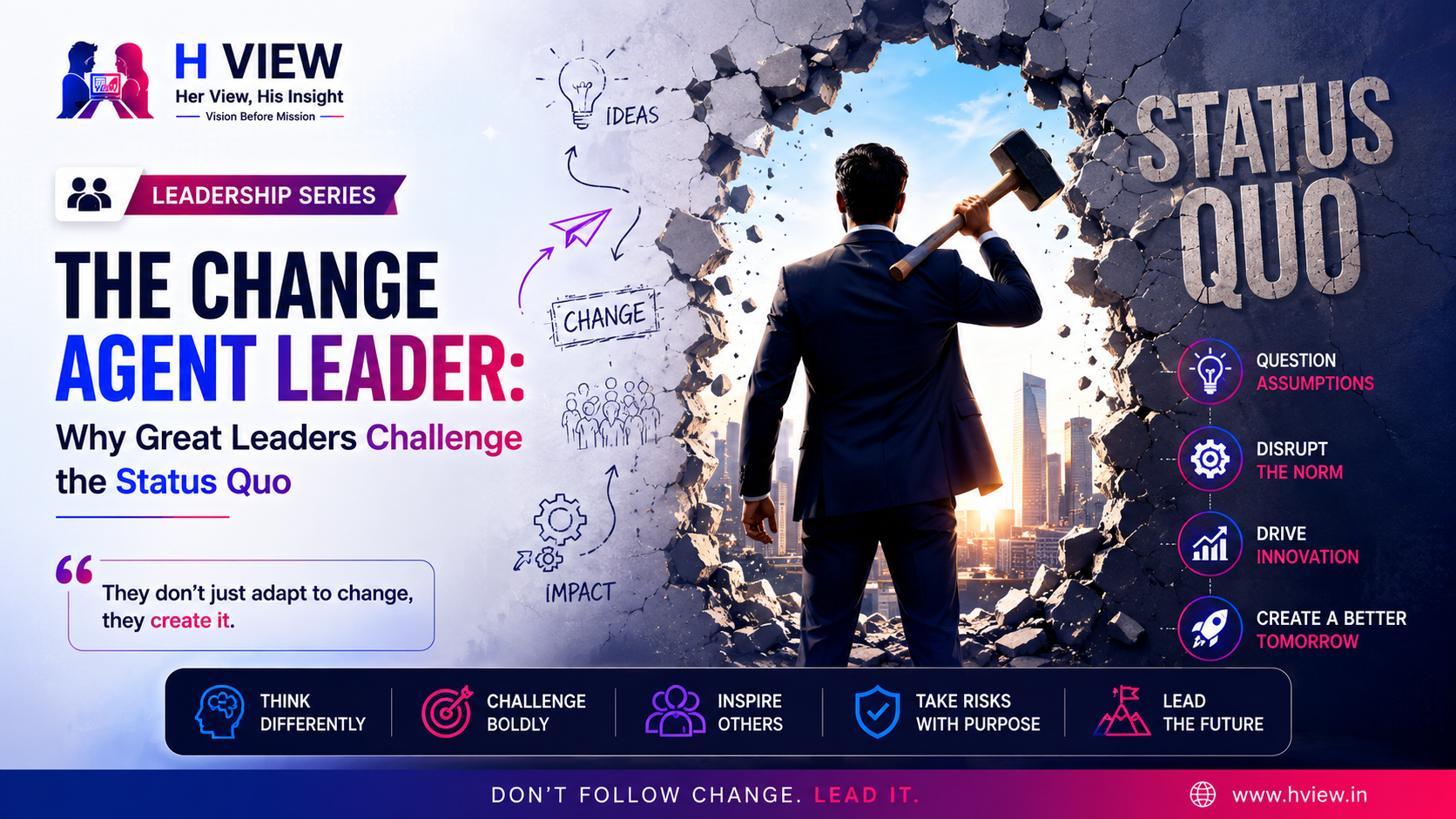
 By PraveenUpdated July 9, 20267 min read45 views
“Every breakthrough begins with one person asking, ‘Why not?'”
📖 Part of the H View Leadership Journey
Series Intro: Leadership Lessons from Our Heroes | The Challenger Leader | The Servant Leader | The Accountability Leader
Imagine walking into an organization where everyone says,
“This is how we’ve always done it.”
The meetings are the same. The processes are the same. The products are the same. The thinking is the same. Everything works. But nothing improves.
Now imagine someone asking a different question.
“Why?”
Or even better…
“Why not?”
That single question has changed industries, created revolutions, built companies, transformed nations.
Every major innovation in history began with someone who refused to accept that the current way was the only way.
That is the essence of the Change Agent Leader.
A Change Agent Leader refuses to accept the status quo simply because it exists.
They are naturally curious. They challenge assumptions. They question traditions. Most importantly, they inspire others to believe that improvement is always possible.
Change Agents aren’t rebels. They don’t create change for the sake of disruption. They create change because they see a better future. At their core, they believe one simple truth.
Progress belongs to those who dare to challenge “the way things have always been.”
History rewards people who improve the world. Every industry eventually reaches a point where existing systems stop delivering better results.
That’s when Change Agents emerge.
They don’t ask,
“How do we protect the past?”
They ask,
“How do we build the future?”
Without Change Agents:
With Change Agents:
Change always begins with a question. Curious leaders constantly ask:
“What can be better?”
Change Agents don’t simply see problems.
They see possibilities others haven’t imagined.
Questioning established systems isn’t easy. It attracts criticism.
Yet Change Agents continue because improvement matters more than approval.
They convert ideas into practical solutions.
Innovation is not creativity alone. It is creativity that creates value.
Great ideas change nothing unless people adopt them.
Change Agents inspire others to believe in a better future.
Every great transformation begins with one person refusing to accept the ordinary.
Let’s see how this archetype appears across different worlds.
Movie: Cameraman Gangatho Rambabu
Rambabu (in Cameraman Gangatho Rambabu) begins as an ordinary mechanic. But after entering journalism, he realizes that the media can be more than a business. It can become an instrument for social change.
Rather than chasing sensational stories, Rambabu uses journalism to expose corruption, challenge abuse of power, and question systems that have failed ordinary people.
He refuses to remain a silent observer. Instead, he becomes a catalyst for change.
He understands that leaders don’t merely adapt to broken systems. They improve them.
Leadership Lesson
Change begins when ordinary people decide they will no longer accept ordinary systems.
Harpreet (in Rocket Singh: Salesman of the Year) works inside a company where politics, shortcuts, and unethical behavior have become normal.
Instead of leaving, he quietly creates a different way of doing business. He builds a culture based on honesty, customer trust, and employee respect. Eventually, his new approach outperforms the very system that dismissed him.
Harpreet proves that real innovation is often cultural before it becomes technological.
Leadership Lesson
The greatest innovations often begin by changing values before changing products.
Tony Stark (a.k.a Iron Man) constantly reinvents himself. After witnessing the consequences of his own weapons, he transforms Stark Industries from a weapons manufacturer into a technology company focused on protecting humanity.
Throughout the Marvel Cinematic Universe, Stark repeatedly pushes technological boundaries. He doesn’t wait for the future. He builds it.
His willingness to question his own assumptions makes him one of cinema’s greatest Change Agents.
Leadership Lesson
Innovation begins the moment we are willing to challenge our own beliefs.
Few athletes have transformed an entire sport the way Tiger Woods transformed golf. Before Tiger, golf was often viewed as a niche sport with limited global appeal.
Tiger changed everything. He introduced unprecedented athleticism, fitness, mental preparation, and competitiveness to professional golf.
His dominance attracted millions of new fans, inspired a new generation of golfers, and reshaped the economics of the sport.
Courses became more demanding. Players became fitter. Sponsors invested more. Television audiences grew dramatically.
Tiger didn’t just win tournaments.
He changed what excellence looked like.
Leadership Lesson
The greatest Change Agents don’t simply succeed within the system.
They raise the standard for everyone who follows.
Few leaders embody transformational change better than Steve Jobs.
He didn’t invent the personal computer, the smartphone, digital music, Or animated films. But he reimagined each of them.
Jobs believed innovation was about making complex technology beautifully simple.
From the Macintosh to the iPhone, from iTunes to the App Store, his vision repeatedly transformed industries and changed the way billions of people live and work.
Steve Jobs reminds us that innovation isn’t about inventing something completely new. Sometimes it’s about seeing familiar problems differently.
Leadership Lesson
Change Agents don’t predict the future.
They create it.
Notice something interesting about these five stories.
One is a journalist.
One is a salesman.
One is an inventor.
One is a golfer.
One is a technology visionary.
Different professions.
Different challenges.
One common leadership principle.
| Perspective | What They Teach Us |
| 🎬 Rambabu | Question systems that no longer serve people. |
| 🎥 Harpreet Singh Bedi | Change culture before changing business. |
| 🎞️ Tony Stark | Reinvent yourself before reinventing the world. |
| ⛳ Tiger Woods | Raise the standard so everyone else must improve. |
| 🌍 Steve Jobs | Create the future instead of waiting for it. |
This is the essence of the H View Leadership Prism.
Progress belongs to those who refuse to accept that “good enough” is enough.
Change Agents naturally thrive in environments that demand innovation and transformation.
They excel as:
Wherever the future needs to be built, Change Agents lead the way.
| Strengths | Watch Outs |
| Visionary thinking | May underestimate resistance to change |
| Innovation | Can become impatient with slow progress |
| Problem-solving | May overlook operational details |
| Inspires transformation | Risk of changing too much, too quickly |
| Challenges assumptions | Can unintentionally alienate traditional thinkers |
Great Change Agents know that transformation succeeds only when people are brought along on the journey.
Ask yourself honestly.
☐ Do I regularly question existing processes?
☐ Do I enjoy solving problems others ignore?
☐ Am I comfortable challenging accepted norms respectfully?
☐ Do I encourage experimentation within my team?
☐ Can I inspire others to embrace change?
4–5 Yes
You naturally think like a Change Agent.
2–3 Yes
You have the curiosity—continue building influence and execution.
0–1 Yes
Start by asking one simple question each day:
“Is there a better way?”
Change doesn’t always begin with grand revolutions.
Sometimes it begins with one person refusing to accept mediocrity.
The easiest thing in life is to maintain the status quo.
The hardest—and often the most rewarding—is to improve it.
That is what separates Change Agents from everyone else.
The Challenger Leader teaches us to believe in ourselves.
The Servant Leader teaches us to grow others.
The Accountability Leader teaches us to own our decisions.
The Change Agent Leader teaches us that leadership is not just about succeeding within the system.
Sometimes, it is about having the courage to improve the system itself.
☐ Identify one outdated process at work.
☐ Ask “Why do we do it this way?”
☐ Suggest one practical improvement.
☐ Learn one idea from another industry.
☐ Encourage someone else’s innovative idea.
Innovation begins with curiosity.
Transformation begins with action.
Think about someone who changed the way people think, work, or live.
It could be an entrepreneur.
A teacher.
A scientist.
A colleague.
Or even a family member.
Who inspired you to think differently?
Share your story in the comments.
Previous Article
← The Accountability Leader: Why Great Leaders Own the Outcome Before They Claim the Credit
Next Article
→ The Courageous Leader: Why Character Matters Most When the Stakes Are Highest
Praveen is an H View contributor covering general reviews, leadership, sports, and practical opinion-based topics. His writing focuses on balanced analysis, clear explanations, and reader-friendly insights that help people understand products, ideas, trends, and real-world decisions with more clarity.
Share your real experience and help other readers decide better.
No community views yet. Be the first to share yours.

Open LinkedIn for a few minutes and you will probably come across a colourful graphic…
Harika October 6, 2026 
When an employee resigns, many organisations move quickly into replacement mode. The manager informs HR,…
Harika October 6, 2026 
For many corporate employees, the workday begins long before they actually start working. They wake…
Harika October 5, 2026 
Many projects begin with an assumption that sounds reasonable on paper: the client will explain…
Harika October 1, 2026