

Best Digital Marketing Tools in 2026: What Marketers Actually Need and What They Can Skip
Open LinkedIn for a few minutes and you will probably come across a colourful graphic…
 Harika October 6, 2026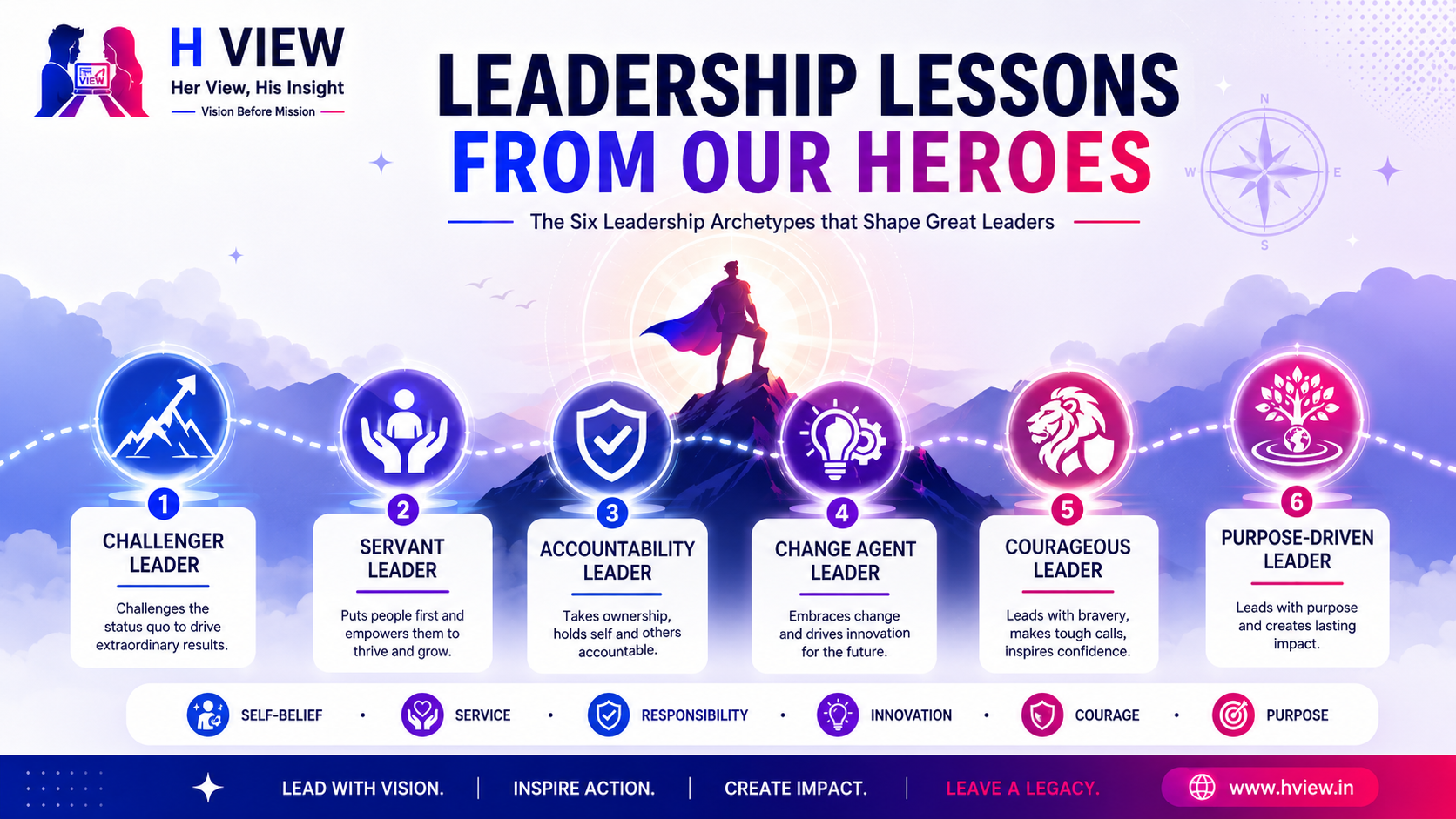
 By PraveenUpdated July 9, 20267 min read63 views
“Before You Can Lead Others, You Must First Understand the Kind of Leader You Want to Become.”
Leadership is everywhere.
It shapes businesses.
It transforms nations.
It builds winning sports teams.
It holds families together.
And sometimes, it changes the course of history.
Yet despite thousands of books, countless seminars, and endless discussions on leadership, one question continues to intrigue us:
Some believe leadership is about vision.
Others believe it is about execution.
Some emphasize communication.
Others value courage, influence, or decision-making.
The truth is, leadership is never just one quality.
It is a collection of values, behaviors, habits, and choices that develop over time.
But here’s an interesting thought.
Most of us didn’t learn our earliest leadership lessons from management books.
We learned them from stories.
We admired movie characters who refused to give up.
We celebrated athletes who performed under impossible pressure.
We respected business leaders who built organizations that changed millions of lives.
Without realizing it, we were learning leadership.
Not through theories.
But through people.
And that is the inspiration behind this series.
Most leadership articles explain concepts.
Stories demonstrate behavior.
You may forget a leadership principle you read in a textbook.
But you rarely forget a character who lived that principle.
You may not remember the definition of courage.
But you remember someone who stood up for what was right despite overwhelming odds.
You may not remember a chapter on resilience.
But you remember the underdog who refused to quit.
Stories stay with us because they help us experience leadership rather than simply understand it.
That is why, throughout this series, we will explore leadership through iconic Telugu movie characters while drawing parallels with memorable characters from Hindi and Hollywood cinema, legendary sportspersons, and globally respected business leaders.
Not because they are perfect.
But because their journeys reveal timeless leadership lessons that remain relevant in our personal and professional lives.
Over the years, I realized something interesting.
Great leaders may look very different on the surface, but many of them follow a remarkably similar journey.
It often begins with believing in themselves.
Then learning to serve others.
Taking responsibility.
Driving change.
Standing for what is right.
And finally, dedicating their success to a purpose greater than themselves.
That journey forms the foundation of this series.
I call it The Six Leadership Archetypes.
These are not personality labels.
They are not management theories.
They are different ways of thinking, behaving, and responding to life’s challenges.
More importantly, they represent six leadership muscles that all of us can develop.
So what are these six leadership archetypes?
Think of them not as six different kinds of leaders, but as six leadership muscles. Every one of us possesses them to some extent. The difference between good leaders and great leaders is that great leaders consciously strengthen each of these muscles over time.
Let us begin that journey.
Core Question: Can I rise above my circumstances?
Every leadership journey begins with self-belief.
Challenger Leaders refuse to let their current situation define their future.
They create opportunities instead of waiting for them.
Leadership Icon: Dhirubhai Ambani
Starting from modest beginnings, Dhirubhai Ambani built one of India’s largest business empires. More than his business success, it was his refusal to let circumstances define his future that makes him the perfect embodiment of the Challenger Leader.
Core Question: How can I help others succeed?
Leadership stops being about personal success and starts becoming about people.
Servant Leaders earn influence by helping others grow.
Leadership Icon: N. R. Narayana Murthy
As the founder of Infosys, Narayana Murthy built one of India’s most respected organizations by placing ethics, transparency, and people at the center of leadership. His leadership reminds us that great organizations are built by helping people succeed.
Core Question: Am I willing to own the outcome?
These leaders accept responsibility before they seek recognition.
They focus on solutions rather than excuses.
Leadership Icon: Lee Kuan Yew
When Singapore gained independence, it had limited natural resources and an uncertain future. Through disciplined governance, accountability, and long-term thinking, Lee Kuan Yew transformed it into one of the world’s most successful nations. His legacy demonstrates the power of taking ownership instead of making excuses.
Core Question: Can this be done better?
Change Agent Leaders challenge assumptions, improve systems, and inspire innovation.
They are never satisfied with “this is how it has always been.”
Leadership Icon: Steve Jobs
Steve Jobs challenged conventional thinking and repeatedly transformed industries through innovation. He proved that true leaders do not simply adapt to change, they create it.
Core Question: Will I do what is right even when it is difficult?
Courageous Leaders choose principles over comfort.
They understand that leadership is tested most during adversity.
H View Leadership Icon: Nelson Mandela
Nelson Mandela spent 27 years in prison for his beliefs. Yet when he emerged, he chose reconciliation over revenge. His life demonstrates that true courage is not only standing firm but also choosing forgiveness when it is hardest.
Core Question: How can I create an impact beyond myself?
The highest form of leadership is contribution.
Purpose-Driven Leaders use their success to improve the lives of others.
Leadership Icon: Verghese Kurien
Known as the architect of India’s White Revolution, Verghese Kurien transformed the lives of millions of farmers. His leadership was driven not by personal achievement but by a purpose that continues to benefit generations.
Absolutely.
In fact, the greatest leaders rarely fit neatly into a single archetype.
A Challenger Leader may eventually become a Servant Leader.
A Servant Leader may evolve into a Purpose-Driven Leader.
Leadership is not static.
As our responsibilities grow, our leadership must grow with them.
These archetypes are not boxes.
They are lenses through which we can better understand ourselves and the leaders we admire.
| Leadership Archetype | Core Question | Leadership Focus |
| Challenger Leader | Can I rise above my circumstances? | Self-belief |
| Servant Leader | How can I help others succeed? | People |
| Accountability Leader | Am I willing to own the outcome? | Responsibility |
| Change Agent Leader | Can this be done better? | Innovation |
| Courageous Leader | Will I do what is right? | Values |
| Purpose-Driven Leader | How can I create lasting impact? | Legacy |
One of the unique aspects of this series is that every leadership archetype will be explored through five different lenses.
Each lens represents a different world, but the leadership lessons remain surprisingly similar.
| Lens | What You’ll Learn |
|---|---|
| 🎬 Telugu Hero | Leadership lessons from iconic Telugu movie characters. |
| 🎥 Hindi Hero | Perspectives from memorable Hindi cinema. |
| 🎞️ Hollywood Hero | Universal leadership lessons from global storytelling. |
| 🏏 Sports Hero | How champions lead under pressure and inspire teams. |
| 🌍 H View Leadership Icon | Real-life leaders whose actions shaped businesses, nations, and society. |
Because leadership is universal.
Whether it appears on a movie screen, a cricket field, a corporate boardroom, or the world stage, the principles remain remarkably similar.
Over the next six articles, we’ll explore each leadership archetype through these five H View Leadership Lenses. We’ll discover how the same leadership principles appear across cinema, sports, and real life, helping us connect timeless lessons with everyday situations.
For every archetype, we’ll discuss:
Because leadership is not reserved for CEOs, politicians, or entrepreneurs.
Every one of us leads—in our families, workplaces, friendships, communities, and decisions.
Leadership is often mistaken for authority.
But authority can be given.
Leadership cannot.
Leadership is earned through the way we treat people, respond to challenges, and make decisions when no one is watching.
Great leaders rarely excel because of one extraordinary quality.
They grow because they develop different leadership muscles over time.
Understanding these archetypes is the first step toward becoming a more complete leader.
Leadership is not a destination.
It is a lifelong journey.
A journey that begins with believing in yourself.
Grows through serving others.
Strengthens through accountability.
Evolves by driving change.
Is tested through courage.
And finds its highest purpose in creating an impact that outlives you.
That is the journey we will explore together.
One story at a time.
One leader at a time.
One leadership lesson at a time.
Because becoming a better leader does not happen in a single moment.
It happens through a lifetime of learning.
Every one of us has looked up to someone at some point in life.
A movie character who inspired us.
A sportsperson who refused to give up.
A business leader who built something extraordinary.
Or perhaps someone much closer to home.
Who do you think best represents each of these leadership archetypes?
Share your thoughts in the comments.
Some of your suggestions may even become part of this H View journey. If you had to choose one movie character who perfectly represents each of these leadership archetypes, who would it be?
Praveen is an H View contributor covering general reviews, leadership, sports, and practical opinion-based topics. His writing focuses on balanced analysis, clear explanations, and reader-friendly insights that help people understand products, ideas, trends, and real-world decisions with more clarity.
Share your real experience and help other readers decide better.
No community views yet. Be the first to share yours.

Open LinkedIn for a few minutes and you will probably come across a colourful graphic…
Harika October 6, 2026 
When an employee resigns, many organisations move quickly into replacement mode. The manager informs HR,…
Harika October 6, 2026 
For many corporate employees, the workday begins long before they actually start working. They wake…
Harika October 5, 2026 
Many projects begin with an assumption that sounds reasonable on paper: the client will explain…
Harika October 1, 2026