

Best Digital Marketing Tools in 2026: What Marketers Actually Need and What They Can Skip
Open LinkedIn for a few minutes and you will probably come across a colourful graphic…
 Harika October 6, 2026
  By HarikaUpdated September 20, 202610 min read45 views
Artificial intelligence becomes more useful when we give it more context.
A short question may produce a general answer. But when we upload a resume, medical report, photograph, contract, spreadsheet, voice recording, or complete conversation, AI can respond in a far more personalised way.
That personalisation feels convenient.
A user can ask AI to interpret a health report, improve a private email, review a salary slip, analyse business documents, edit a family photograph, summarise office meetings, or provide advice based on months of previous conversations.
But every personalised response begins with a small exchange:
We receive convenience, and the AI system receives information about us.
The more we share, the more useful the tool may become. At the same time, the privacy consequences can become harder to understand.
What happens to an uploaded document after the answer is generated? Can conversations be used to improve AI models? Are deleted chats immediately erased? What happens when an AI assistant connects to email, photos, calendars, cloud storage, or third-party services?
The biggest AI privacy risk may not be a dramatic data breach.
It may be the habit of sharing deeply personal information without pausing to ask where it is going.
AI conversations feel different from traditional web searches.
Most people would not type their complete medical history, family conflict, financial problems, confidential office plans, or emotional struggles into a normal search box.
But conversational AI feels more private and personal.
The system responds directly, remembers context within the conversation, and uses calm, helpful language. It may feel less like posting information online and more like speaking privately with an assistant.
This encourages people to share:
The intention is usually harmless. People want a better answer.
But the sensitivity of the information does not disappear simply because it was uploaded for assistance.
From one perspective, context is essential.
An AI tool cannot meaningfully review a resume without seeing the resume. It cannot summarise a contract without accessing the document. It cannot improve an email without reading the message.
Similarly, photo-editing tools need access to images, voice assistants require audio, and connected AI services may need permission to access calendars, emails, or files.
Personalisation can make AI genuinely helpful.
A user may receive:
Some AI platforms also provide settings that allow users to control history, activity, model improvement, connected applications, and deletion.
For example, ChatGPT provides Data Controls that allow personal-workspace users to turn off the use of new conversations for model improvement. Google provides a Gemini Apps Privacy Hub and activity-management controls, while Anthropic explains when consumer conversations may be used for model improvement and how users can manage those choices. These policies differ across providers and can change, making it important to check the settings of the specific service being used.
When users understand these controls and share information carefully, personalisation can be valuable without requiring complete surrender of privacy.
The danger is assuming that a conversation is private simply because it feels private.
An AI service is still an online platform operating through servers, accounts, applications, storage systems, and company policies.
Depending on the service and settings, submitted information may be:
The exact treatment varies between consumer accounts, business products, enterprise plans, application programming interfaces, and temporary-chat features.
This is why there is no single answer to the question, “Does AI save my data?”
The correct answer depends on the platform, account type, privacy settings, feature used, and current policy.
NIST identifies privacy as a major part of AI risk management and notes that AI can create additional risks, including the possibility of inferring or revealing information about individuals from available data.
Many users assume that pressing “Delete” instantly removes every copy of a conversation from every system.
That may not always be how deletion works.
Online services may retain deleted information temporarily for security, abuse prevention, legal compliance, backup management, or technical processing. Data used for model improvement may also be governed by separate retention rules.
The practical lesson is simple:
Deletion is useful, but it should not be treated as permission to upload anything.
Privacy must begin before the information is shared.
Users should review the platform’s current deletion and retention policy rather than assuming that disappearing from the visible chat history means immediate removal from all underlying systems.
One of the most important distinctions is between personal AI accounts and company-approved business tools.
An employee may use a free consumer chatbot to:
The employee may only be trying to work faster. But the action could violate organisational privacy, security, contractual, or compliance rules.
Business and enterprise AI products may offer stronger administrative controls, contractual protections, access management, or different data-use policies. However, employees should never assume that every workplace-approved tool has the same protections.
Before uploading company information, users should check:
A convenient shortcut can become a serious workplace risk when confidential information is involved.
Modern AI assistants are becoming more useful because they can connect with other services.
With permission, an assistant may access email, calendars, photographs, files, maps, contacts, or third-party applications to complete a request. Google, for example, explains that Gemini can work with connected applications and use information from those services to respond to users. Third-party services may process data according to their own privacy policies.
This creates a broader privacy question.
The user may believe they are sharing one request with one AI assistant, while several systems may be involved in fulfilling it.
Connected access is not automatically unsafe. But permissions should be reviewed carefully.
Users should ask:
Convenience grows with connection, but so does the potential exposure.
A photograph may reveal:
A voice recording can reveal identity, emotion, accent, age range, environment, and sometimes sensitive conversations happening nearby.
People frequently upload photos for enhancement, background removal, style transformation, identification, or analysis. They may submit voice recordings for transcription, translation, cloning, or meeting summaries.
Before uploading media, users should check whether unnecessary faces, documents, addresses, screens, or background details can be removed.
The safest file is not merely the one with hidden text. It is the one containing only the information required for the task.
Some documents deserve stronger protection because the consequences of exposure are greater.
A medical report may include the patient’s name, age, identification number, hospital, diagnosis, test results, and contact information.
A bank statement may reveal account numbers, transaction history, salary, location patterns, and personal spending.
A legal document may contain addresses, signatures, disputes, confidential terms, and information about other people.
Before uploading such files:
Even when an AI system has strong security practices, sharing less information remains one of the best privacy protections.
Parents may upload a child’s photograph, school report, health information, learning assessment, or personal behaviour details to receive advice.
This information belongs partly to someone who may not be able to understand or consent to the privacy decision.
Children’s information can remain sensitive for many years.
Parents should avoid sharing full names, school details, faces, medical identifiers, addresses, and documents unless there is a clear reason and an appropriately protected service.
The FTC has continued examining the data-handling and safety practices of consumer-facing AI chatbots, including concerns relating to children and teenagers.
Avoid entering:
AI tools do not need to be completely avoided. The information should be minimised.
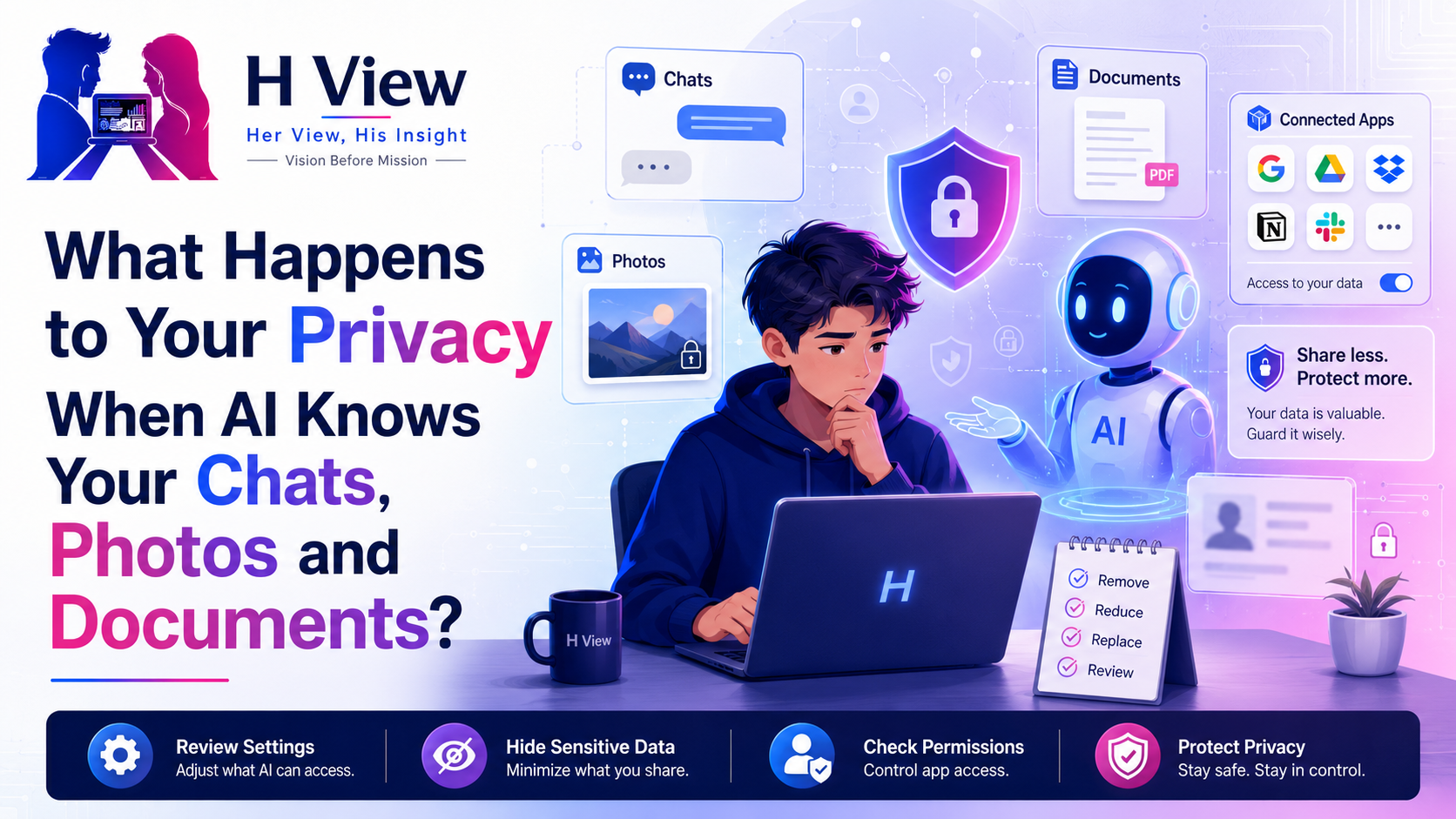
Use the Remove, Reduce, Replace and Review method.
Delete names, addresses, numbers, signatures, faces, passwords, and unrelated pages.
Share only the paragraph, page, image area, or data range needed for the task.
Use labels such as “Employee A,” “Client B,” or “Hospital X” instead of real identities.
Check the platform’s privacy settings, retention policy, connected applications, and model-improvement controls before submitting sensitive content.
This method cannot eliminate every risk, but it greatly reduces unnecessary exposure.
Her View: AI becomes genuinely useful when it understands the user’s documents, preferences, communication style, files, and personal context. Privacy controls and responsible business products can make this personalisation safer.
His Insight: The more information an AI knows, the greater the consequences of poor settings, excessive access, accidental disclosure, policy changes, or account compromise. A helpful response is not proof that the information was safe to share.
Both views are valid.
Personalisation and privacy are not complete opposites. But they must be balanced consciously.
The safest way to use AI is not to assume that every tool is dangerous.
It is also not to assume that every conversation is private.
AI can review documents, improve communication, support accessibility, organise information, and save hours of work. These benefits are real.
But convenience should not remove caution.
Before uploading anything, ask:
Does the AI need this complete file?
Can I remove identifying details?
Would sharing this violate someone else’s privacy?
Do I understand the platform’s settings and policy?
Would I be comfortable if this information were exposed?
The best privacy setting is not only a switch inside an application.
It is the decision to share only what is genuinely necessary.
AI chats are not automatically private in the same way as a confidential conversation with a doctor or lawyer. Data handling depends on the service, account type, settings, and current privacy policy.
Some consumer AI services may use conversations for model improvement depending on the platform and user settings. Many services provide controls or opt-out options, while business products may follow different policies.
IIt is safer to remove names, patient numbers, addresses, and other identifiers first. AI may help explain terminology, but important medical decisions should still involve qualified professionals.
Remove names, addresses, phone numbers, account details, identification numbers, signatures, faces, passwords, and information unrelated to the question.
Deletion policies differ by provider. A deleted chat may disappear from the user interface before all retained copies are removed from underlying systems.
Business or enterprise accounts may offer additional controls and different data-use terms. Employees should still follow company policy and confirm what information is approved for upload.
Normally, connected access requires permission. However, users should review active connections and understand what information each connected application can provide.
Share the minimum amount of information necessary. Remove identifying details, review privacy controls, and avoid uploading anything that could cause serious harm if exposed.
Harika is the co-founder of H View and covers AI, technology, gadgets, digital tools, online platforms, and modern internet trends. Her articles focus on simplifying complex topics with practical explanations, balanced opinions, and reader-first insights.
Share your real experience and help other readers decide better.
No community views yet. Be the first to share yours.
Open LinkedIn for a few minutes and you will probably come across a colourful graphic…
Harika October 6, 2026 
When an employee resigns, many organisations move quickly into replacement mode. The manager informs HR,…
Harika October 6, 2026 
For many corporate employees, the workday begins long before they actually start working. They wake…
Harika October 5, 2026 
Many projects begin with an assumption that sounds reasonable on paper: the client will explain…
Harika October 1, 2026